


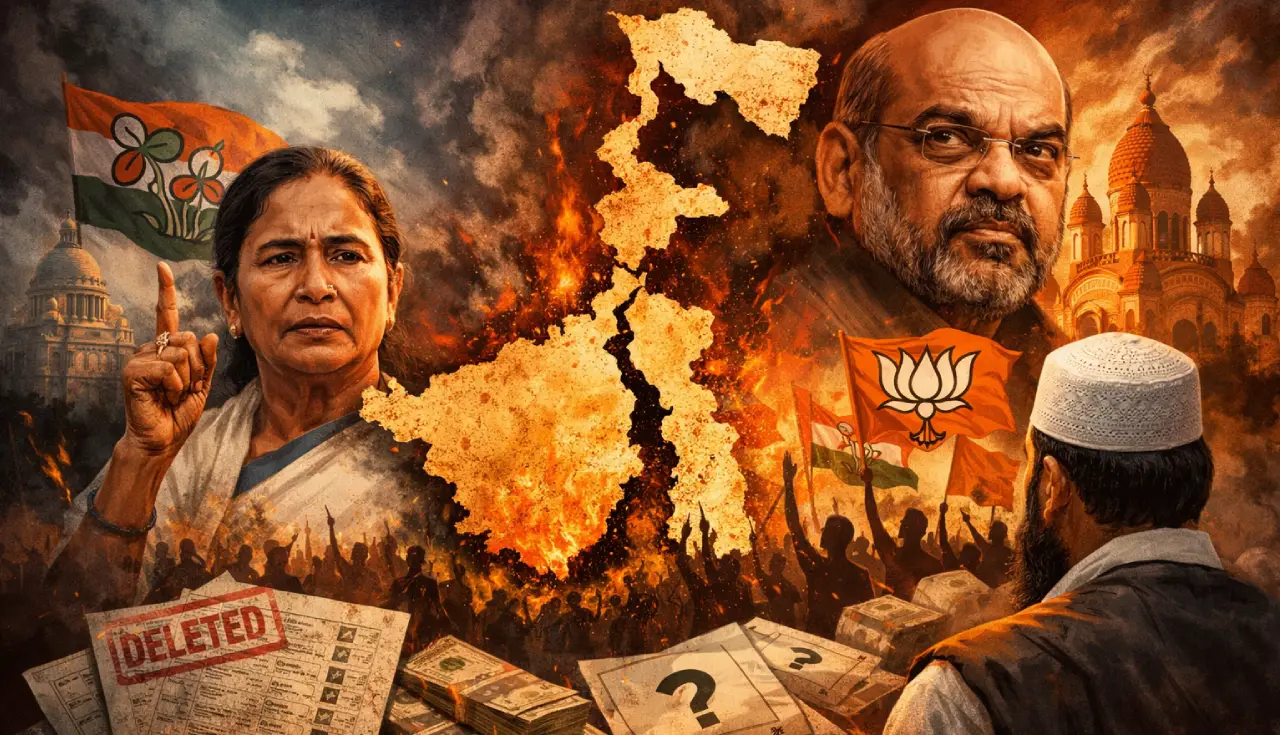
West Bengal is moving toward an election that will not merely decide a government; it will determine the direction of the state’s political character for the next decade. Beneath the visible noise of rallies, slogans, and campaign strategies, the real contest is unfolding quietly in demographics, electoral arithmetic, and strategic negotiations that rarely reach the public domain. After fifteen years of uninterrupted rule by Mamata Banerjee and the Trinamool Congress, the question before Bengal is no longer whether anti-incumbency exists—it inevitably does after such a long tenure—but whether that dissatisfaction has matured into a political wave capable of dismantling one of India’s most resilient regional political structures. Bengal has historically defied simplistic electoral predictions. It has shifted from Congress dominance to three decades of Left rule and then dramatically to the Trinamool Congress. Each transition appeared impossible until it suddenly became inevitable. The present moment carries the same sense of uncertainty.
During recent interactions across districts and political circles in the state, a noticeable undercurrent is emerging. There are quiet attempts by multiple actors to rearrange political equations in ways that could weaken the Trinamool Congress from within. The BJP, still hungry to conquer the last major bastion in eastern India, understands that defeating Mamata Banerjee requires more than slogans and polarization. The party must crack the demographic fortress that has protected the TMC for over a decade. That fortress is the Muslim vote, which constitutes roughly twenty-seven percent of the state’s population but becomes decisive in dozens of constituencies where the community forms the dominant electoral bloc. In districts such as Murshidabad, Malda, Uttar Dinajpur, Birbhum and South 24 Parganas, Muslim voters range from thirty-five to more than sixty percent of the electorate. These districts together account for eighty-five assembly seats that function as the political backbone of the Trinamool Congress.
The scale of that dominance became visible in the 2021 Assembly election when the TMC captured seventy-five of those eighty-five seats, effectively sealing Mamata Banerjee’s return to power despite the BJP’s aggressive campaign. Yet the assumption that Muslim voters operate as a uniform political bloc has always been an oversimplification. Like any large social group, they are divided by class interests, regional identities, sectarian differences and local leadership networks. Prior to 2019, Muslim voting behavior in Bengal was fragmented between the Congress, the Left Front and regional players. The consolidation behind the TMC occurred largely as a defensive reaction to the rise of the BJP’s Hindutva politics. But political consolidation driven by fear rarely remains permanent. Over time, new leaders emerge who attempt to renegotiate their community’s political leverage.
One such figure attracting attention in Bengal’s political circles is Bharatpur MLA Humayun Kabir. Kabir has increasingly positioned himself as a vocal Muslim political voice, raising community concerns while simultaneously exploring political options that extend beyond the Trinamool Congress framework. According to political sources in the state, Kabir has attempted to establish back-channel communication with BJP leadership in Delhi, seeking substantial political and financial commitments in exchange for potential external support that could weaken Mamata Banerjee’s hold on power. In one such attempt, he reportedly held discussions with senior BJP leader and Union Minister Bhupender Yadav, who has been among the most aggressive critics of the TMC government ahead of the West Bengal polls, describing the state government’s budget as little more than a farewell document for a declining regime. However, the conversation appears to have ended without any concrete outcome, leaving Kabir searching for a direct line to the BJP’s national leadership. Whether such negotiations eventually produce tangible alliances remains uncertain, but their mere existence reveals a deeper political reality: Bengal’s minority politics is no longer entirely predictable.
At the same time, the BJP is attempting to consolidate a counterbalancing force through Hindu political mobilization. In many districts, particularly among younger voters, the narrative that Mamata Banerjee’s administration practices minority appeasement has gained traction. Political messaging framed around Hindutva has successfully reshaped perceptions among sections of the Hindu electorate who increasingly see the state government as hostile to their interests. This ideological shift is not uniform across Bengal, which historically possessed a culture of political pluralism rather than religious polarization. Yet the BJP has clearly succeeded in altering the emotional vocabulary of political debate, especially among younger Hindu voters who now view the election as a struggle to reclaim political space.
Despite these efforts, electoral arithmetic continues to favor the Trinamool Congress in key regions. Data from the most recent Lok Sabha segments within forty-one high-minority constituencies reveals that the TMC still commands a significant average vote share of roughly forty-five percent. The Congress-Left alliance captures a large portion of the anti-TMC vote in these areas, leaving the BJP with barely twenty-one percent support—far below its statewide average. This fragmentation of the opposition remains Mamata Banerjee’s strongest structural advantage. As long as anti-TMC votes remain divided between multiple parties, the ruling party can continue to survive even with declining popularity.
Yet a new and far more unpredictable factor has entered the political equation: the Special Intensive Revision of West Bengal’s electoral rolls. The scale of this exercise is unprecedented in the state’s electoral history. Before the revision began, West Bengal had approximately 7.66 crore registered voters. After the draft electoral rolls were published in December 2025, the number fell sharply to 7.08 crore. Following the final publication of the rolls in February 2026, the electorate shrank further to around 7.04 crore. In total, nearly 1.21 crore electors—almost one out of every six voters in the state—have been classified either as “deleted” or “under adjudication.” Among them, more than 61 lakh voters have been removed entirely from the rolls, while another 60 lakh remain under administrative scrutiny, their eligibility unresolved.
The political implications of these numbers are staggering. In 140 assembly constituencies, the number of deleted voters alone exceeds the winning margins recorded in the 2024 Lok Sabha election. Across 234 of the state’s 294 constituencies, the volume of affected electors is larger than the previous winning margins. In many minority-dominated constituencies, the number of voters currently under adjudication exceeds fifty-five thousand per seat. In seventeen constituencies, this pending voter pool is greater than the margin by which the previous election was decided. Seats such as Asansol Uttar, Durgapur Purba, Barrackpore and Bally illustrate how fragile electoral outcomes could become if even a fraction of these unresolved voters are added or removed from the final rolls. The phenomenon raises a deeper question about whether administrative processes rather than voter sentiment may ultimately shape the contours of Bengal’s next government.
Against this backdrop, Mamata Banerjee faces perhaps the most complicated political challenge of her career. Fifteen years in power inevitably produce fatigue among sections of the electorate. Allegations of corruption, internal factionalism and governance lapses have weakened the aura of invincibility that once surrounded the Trinamool Congress. Yet Mamata Banerjee remains one of India’s most instinctively political leaders. She has repeatedly demonstrated an ability to convert adversity into mass sympathy and to transform political attacks into narratives of regional pride. For the BJP, Bengal remains the unfinished chapter in its national expansion. Despite significant growth in vote share since 2019, the party has not yet cracked the final electoral equation necessary to dethrone the TMC. The Congress and the Left Front, though diminished from their historic dominance, still retain enough localized support to disrupt the BJP’s rise in many minority-heavy constituencies.
What is unfolding in Bengal is therefore not a straightforward contest between two parties but a layered political struggle shaped by religion, governance, administrative intervention and demographic arithmetic. Voters themselves appear caught between competing impulses: the desire for stable governance and the emotional pull of religious and identity-based politics. For the Trinamool Congress, survival will depend on its ability to retain minority consolidation while preventing large-scale Hindu polarization. For the BJP, victory requires simultaneously eroding the TMC’s minority base and unifying Hindu voters behind a single political banner—an extraordinarily difficult task in a state where political loyalties are deeply entrenched.
The coming election will reveal whether Mamata Banerjee’s political fortress is merely weathered or genuinely vulnerable. Bengal has a long tradition of producing dramatic electoral shifts when public mood quietly transforms beneath the surface. Whether such a transformation is underway now remains the central mystery of this election. One thing, however, is certain: the outcome will not only determine the future of the Trinamool Congress but will also define whether West Bengal remains the last major regional bastion resisting the BJP’s national political expansion or becomes the next chapter in its march across India.
