


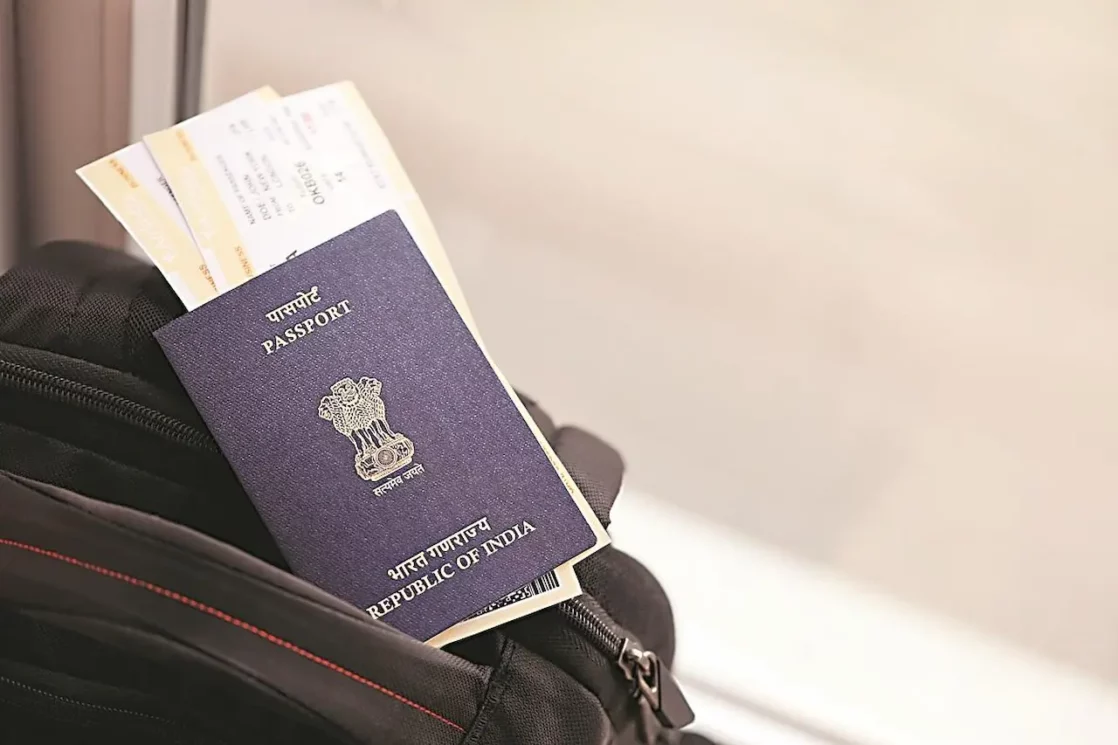
The Centre on Thursday clarified that an Indian passport has never been considered conclusive proof of citizenship under law, asserting that no new policy or decision has been introduced by the Narendra Modi government regarding the status of the document.
The clarification came after remarks by a senior Ministry of External Affairs (MEA) official during Passport Seva Divas events reignited debate over what legally constitutes proof of Indian citizenship.
Government sources said the MEA had merely reiterated a long-standing legal position that a passport is primarily a travel document and not a citizenship certificate.
“It was not decided yesterday that a passport is not proof of citizenship. Nor was it decided in the last 12 years. A passport has never been treated as conclusive proof of citizenship,” a government source said.
The clarification sparked political reactions because Indian passports prominently mention the holder’s nationality as Indian and are widely regarded by citizens as among the most authoritative government-issued identity documents.
However, the government drew a distinction between nationality recorded for travel purposes and legal proof of citizenship under Indian law.
Officials cited provisions of the Passports Act, 1967, noting that Section 20 empowers the Central Government to issue a passport or travel document to a person who is not an Indian citizen if deemed necessary in the public interest. According to officials, this provision itself demonstrates that possession of a passport cannot be treated as the sole or definitive test of citizenship.
Government sources also referred to judicial precedents, including a 2013 Bombay High Court ruling, which held that a passport alone does not conclusively establish Indian citizenship in every legal context.
The issue has gained significance amid ongoing debates surrounding electoral roll verification and citizenship documentation. Recently, while hearing matters related to the Election Commission’s Special Intensive Revision (SIR) of electoral rolls, the Supreme Court observed that Aadhaar can serve as proof of identity but not as proof of citizenship.
The court’s observations on Aadhaar, coupled with the MEA’s clarification on passports, have revived a broader public debate over what documents citizens can rely upon to establish citizenship if questioned by authorities.
Government sources maintained that citizenship is determined under the Citizenship Act, 1955, and the rules framed thereunder, rather than through possession of any single document issued for another purpose.
The Citizenship Act provides multiple pathways to citizenship, including birth, descent, registration, naturalisation and incorporation of territory, with eligibility depending on factors such as date of birth, parental citizenship, residence and other legal criteria.
Officials recalled that during discussions surrounding the Citizenship Amendment Act (CAA) and the proposed National Register of Citizens (NRC) in 2019, the government had indicated that citizenship could be established through documents relating to date and place of birth, while also stating that a final list of acceptable documents had not been formally prescribed.
While the Centre has stressed that no new rules have been introduced and that passport regulations remain unchanged, opposition parties argue that repeated statements questioning the evidentiary value of commonly used documents such as Aadhaar, voter identity cards and passports are creating uncertainty among citizens.
For now, an Indian passport continues to remain a key travel and identity document. However, the latest clarification has once again highlighted the distinction between public perception of citizenship documents and the legal framework governing citizenship in India.
