


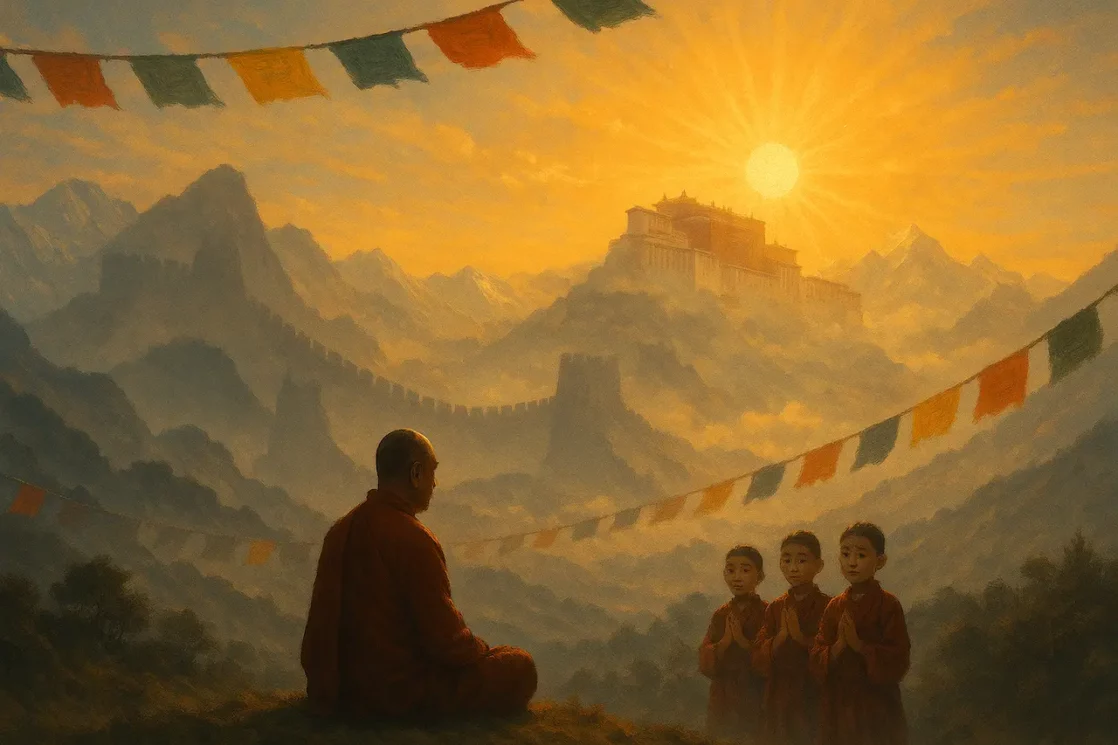
In a monumental and unprecedented declaration, the 14th Dalai Lama, Tenzin Gyatso, has confirmed that the centuries-old institution of the Dalai Lama will continue after his death — an assurance that not only brings hope to millions of Tibetan Buddhists but also directly challenges the Chinese government’s ongoing attempts to dominate and redefine Tibetan spiritual traditions. As he approaches his 90th birthday in July 2025, the Dalai Lama has made it unequivocally clear: his successor will be born outside China and the process of identifying the next Dalai Lama will strictly follow Tibetan Buddhist traditions, not Communist Party mandates.
This announcement has far-reaching geopolitical implications. For years, China has insisted that any reincarnation of the Dalai Lama must be approved by Beijing, a claim widely condemned by Tibetans and human rights advocates as blatant religious interference. The Dalai Lama’s move is seen as a strategic spiritual act to ensure that the Chinese state cannot fill a leadership vacuum with a state-approved figurehead. By declaring his intention in advance and affirming the legitimacy of traditional Tibetan methods of identifying his reincarnation, he is securing his legacy and resisting China’s attempts to erase Tibetan identity.
Born in 1935 in a remote village in what is now Qinghai province, China, Lhamo Thondup was recognized at age two as the reincarnation of the 13th Dalai Lama. Trained in Buddhist philosophy and leadership, he assumed political authority at just 15 when Chinese troops invaded Tibet in 1950. After a failed uprising in 1959, he fled to India, where Prime Minister Jawaharlal Nehru granted him asylum. He settled in McLeod Ganj, Dharamshala, where he built a government-in-exile and kept Tibetan identity alive through education, culture, and spiritual leadership.
Despite the exile, the Dalai Lama has maintained global prominence as a symbol of peace and nonviolence. He was awarded the Nobel Peace Prize in 1989 and has long advocated for a “Middle Way” approach — seeking autonomy for Tibet within China rather than full independence. His political evolution, from a ruler in exile to a moral and spiritual global leader, has been profound. He relinquished political duties to an elected parliament of Tibetan exiles in 2001, focusing solely on his spiritual mission.
The Potala Palace in Lhasa once served as the winter residence of successive Dalai Lamas. Now, the seat of Tibetan Buddhism sits in Dharamshala, where the Dalai Lama continues to teach and guide. His successor, he insists, could be a woman, could be born in India or Mongolia, and must be found by spiritual means — not political interference. In recent years, he has spoken out repeatedly against Beijing’s attempt to politicize the reincarnation process and warned the international community that any Chinese-appointed Dalai Lama should be considered illegitimate.
He has not been without controversy. In 2023, a video showing the Dalai Lama interacting playfully yet inappropriately with a child sparked backlash and forced a public apology. He explained his actions as part of his often teasing, lighthearted manner — but the moment served as a reminder of the complexities of leading as a spiritual figure in a media-saturated world.
Still, his influence remains immense. From advocating for the rights of refugees to speaking on global harmony, from criticizing both Chinese oppression and Western hypocrisy, to calling India a model of religious coexistence, the Dalai Lama continues to shape public consciousness. He has affirmed that Tibetans seek harmony, not separation, but also warned that the failure of the Middle Way approach could eventually push Tibetans toward demands for complete independence under international law.
With his 90th birthday drawing near, the 14th Dalai Lama has chosen to reaffirm faith in his people and their ancient traditions. By preemptively declaring a plan for his succession, he is denying Beijing the opportunity to manipulate Tibetan Buddhism and hijack its future. More than a spiritual statement, this is a political masterstroke — a final act of defiance from a man who has spent his life peacefully resisting one of the most powerful regimes on Earth.
As the world watches, the question now is not whether the institution of the Dalai Lama will continue — but where, how, and with what consequences. In that answer lies the future of a people, a religion, and a legacy that refuses to fade into silence.
