


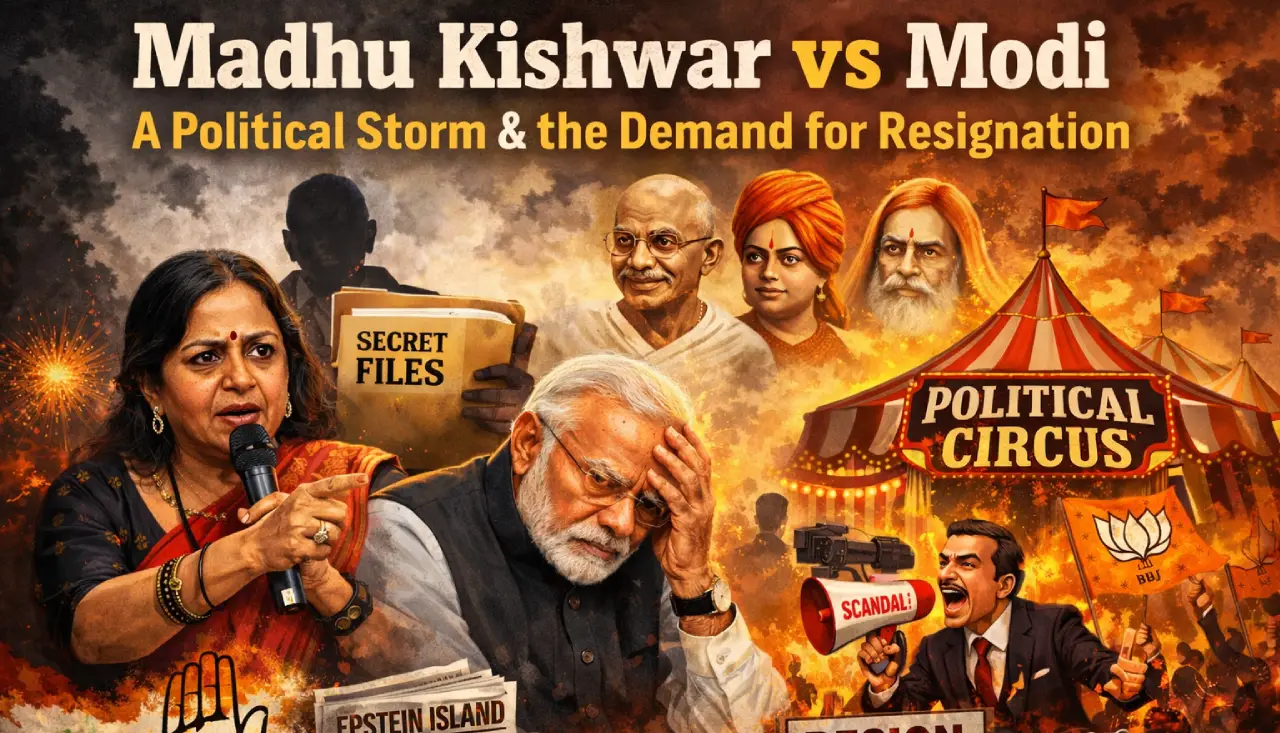
Let’s get one thing straight—politics is not a poetry contest where the loudest voice wins. It’s a battlefield of narratives, and right now, what we’re witnessing is less of a debate and more of a full-blown circus.
To understand the current controversy, you first need to know who Madhu Kishwar is. She is not a random commentator or a fringe voice. Kishwar has long been part of India’s intellectual ecosystem—an academic, a public thinker, and someone who once positioned herself close to nationalist discourse. In fact, she was among those who openly supported Narendra Modi during his rise, especially around 2014. That’s precisely why her recent statements are drawing attention—because criticism from within always carries more weight than attacks from outside.
Now, what exactly is happening? Kishwar has suggested that Modi may have been pressured or influenced through sensitive files, allegedly shown by a senior bureaucrat from the previous regime. Whether this claim is true or speculative, it has ignited a storm. But here’s where the real game begins.
The Indian National Congress, which has struggled to directly counter Modi politically, has found unexpected comfort in this situation. Ironically, even if the allegations trace back to individuals or systems from their own time in power, the mere possibility that it dents Modi’s image is enough reason for celebration. That’s modern politics in a nutshell—if mud is flying, it doesn’t matter who threw it, as long as it sticks to the opponent.
But let’s not get carried away by noise. The claim about “blackmail” through files is serious. It leads us to only two logical possibilities. Either it is true—in which case it reflects a deeply troubling institutional failure where even the highest office can be compromised—or it is unverified narrative-building, a political strike designed to weaken perception without concrete proof. There is no comfortable middle ground here.
This naturally raises the question—should Modi resign “with dignity”? That sounds noble, but politics doesn’t run on poetic morality. Resignation is not a gesture of sensitivity; it is a consequence of proven accountability. If there is credible evidence that a sitting Prime Minister has been compromised, then stepping down becomes necessary to protect institutional integrity. But if accusations are floating without substantiation, then resignation becomes surrender—and in politics, surrender is not admired, it is exploited.
This is exactly where the Bharatiya Janata Party must step up. Silence, in such moments, is not strategic—it is dangerous. If Modi is innocent, the party must respond with clarity, not ambiguity. Facts must be placed on the table. Allegations must be challenged directly. And if necessary, legal recourse should be taken against those spreading unverified claims. Because in today’s environment, silence is quickly interpreted as weakness, if not admission.
What makes this entire episode even more disturbing is the descent into personal territory. When political discourse shifts from policies to private lives, from governance to gossip, it signals intellectual bankruptcy. The moment conversations begin revolving around bedrooms instead of boardrooms, you know the debate has collapsed.
There is also a strange tendency to drag historical and spiritual figures into contemporary politics. Names like Mahatma Gandhi, Swami Vivekananda, and Adi Shankaracharya are invoked as benchmarks. This is not just misplaced—it is fundamentally flawed. These figures belong to a different plane of thought and legacy. Trying to measure modern politicians against them is like comparing a candle to the sun. It neither elevates the politician nor does justice to the legacy of those icons.
The same applies to the debate around personal life—whether a leader is married, unmarried, or follows any particular lifestyle. History is full of great figures across the spectrum—kings with multiple wives, ascetics who renounced everything, and leaders who lived ordinary family lives. None of that defines their capability to lead. Governance is judged by decisions, outcomes, and accountability—not by personal choices that have no bearing on public duty.
And then comes the larger distraction—the obsession with global scandals like the Epstein case being loosely dragged into Indian political conversations. If crimes of that magnitude exist anywhere, they are not political talking points—they are matters of justice that demand serious, impartial investigation. But what we often see instead is selective outrage, where one side weaponizes it against the other, and the truth gets buried under layers of agenda.
At its core, this entire episode is not about Madhu Kishwar, nor is it about Subramanian Swamy or any individual critic. It is about how narratives are manufactured, amplified, and consumed. One narrative tries to project Modi as strong and uncompromising. The other attempts to paint him as pressured or compromised. And in the end, the version that the public believes becomes the dominant reality—regardless of the actual truth.
That is the real battlefield today—not policy, not ideology, but perception.
The harsh truth is this: if every day brings a new allegation, a new controversy, a new spectacle, then democracy risks turning into a 24/7 drama show. Serious issues get sidelined, and the public is left reacting to noise instead of engaging with substance.
If there are genuine allegations, they must be investigated thoroughly and transparently. If someone is guilty, they must face consequences—no matter how powerful they are. But if claims are being thrown around without evidence, then they deserve to be called out for what they are—reckless attempts to destabilize through insinuation.
Because when everything becomes a scandal, nothing remains serious.
And that is how a democracy slowly turns into a circus—loud, chaotic, and dangerously distracting.
