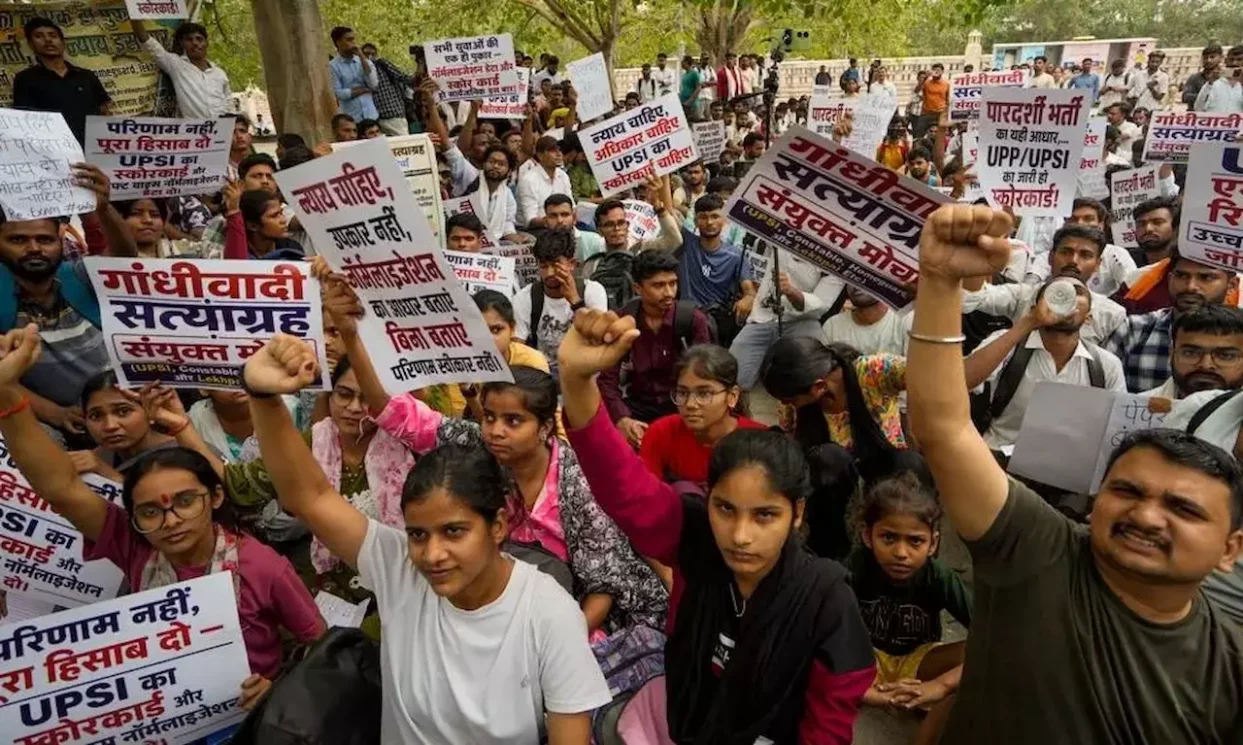
Students, Job Aspirants Rally in Lucknow Over Exam Irregularities; CJP Demands Dharmendra Pradhan's Resignation 2
Students and government job aspirants gathered in Lucknow on Friday to participate in a protest led by Cockroach Janta Party (CJP) founder Abhijeet Dipke, demanding accountability over alleged examination irregularities and calling for the resignation of Union Education Minister Dharmendra Pradhan.
The demonstration, held at Eco Garden, drew candidates preparing for various competitive examinations, including teaching, medical, revenue, administrative and other government recruitment tests.
The protest forms part of a nationwide campaign launched by the CJP, which has previously organised demonstrations in Delhi and Pune over issues related to examination management and recruitment processes.
Speaking earlier about the campaign, Dipke said the movement aims to raise concerns regarding alleged examination-related controversies through peaceful and democratic means.
“We have held peaceful protests in Delhi and Pune. We are not doing anything wrong. We only want to put forward our views in a democracy,” he had said.
According to police officials, permission for the protest was granted after a formal application was submitted on Thursday evening.
Additional Commissioner of Police (Law and Order) Babloo Kumar clarified that the application was filed by an individual and not by any organisation.
“The application was submitted by a teacher, Vivek Kumar, late Thursday evening. After completing the required procedure, permission was granted,” Kumar told PTI.
He also dismissed reports suggesting that the police had denied permission for the protest, stating that no prior application regarding the event had been received before Thursday evening.
Police said the permission for the gathering was valid from 10 am to 4 pm and that around 1,000 participants were expected to attend the programme.
The protest remained focused on issues concerning examination conduct, recruitment delays and alleged irregularities affecting students and job aspirants across the country.
As part of its ongoing campaign, the CJP has announced plans to organise similar demonstrations in Amritsar and Bengaluru before culminating in a larger protest at Delhi’s Jantar Mantar on June 20.
The movement has gained attention on social media, with participants urging authorities to address concerns related to examination transparency, recruitment processes and accountability in the education sector.
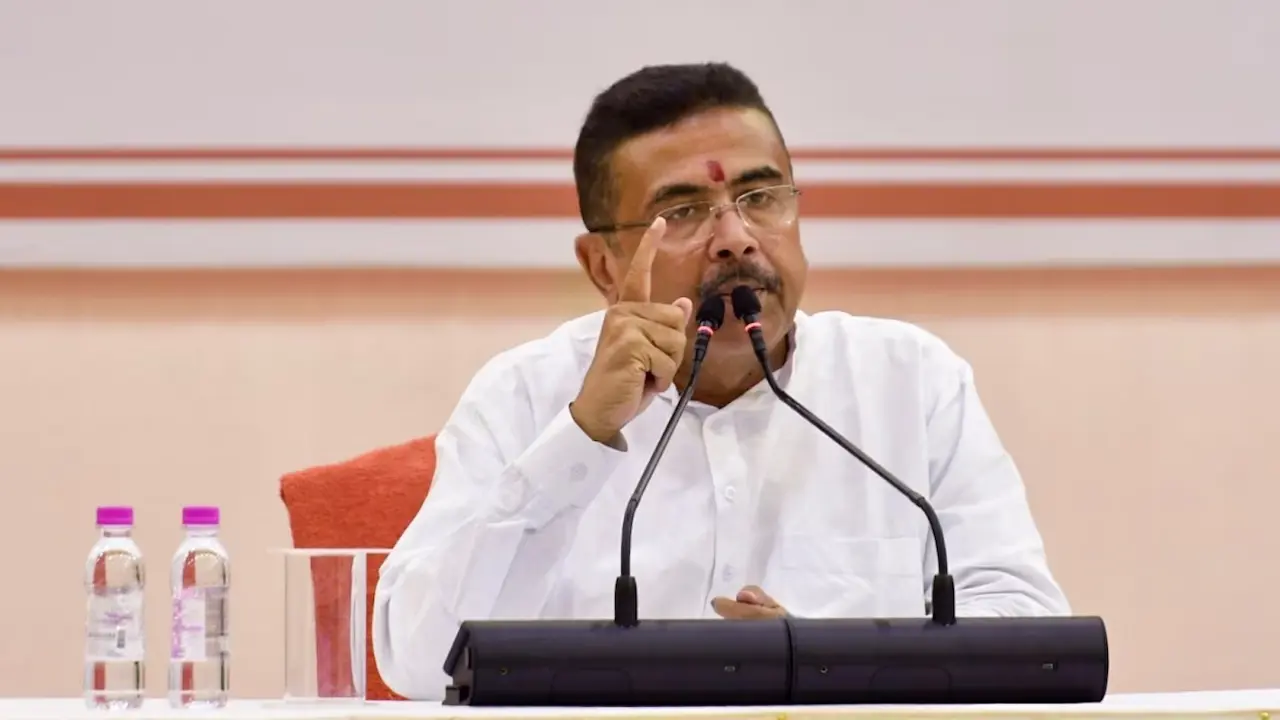
BJP Will Bring Tata Group Back to Bengal, Says Suvendu Adhikari; Targets TMC and Left Over Industry Policies 4
West Bengal Chief Minister Suvendu Adhikari on Friday said a BJP government would bring the Tata Group back to the state and revive Bengal’s industrial growth, while accusing the previous Left Front and Trinamool Congress (TMC) governments of failing to create a sustainable industrial environment.
Addressing a press conference, Adhikari said his government would pursue industrialisation through a balanced approach that protects farmers’ rights while attracting investments and generating employment opportunities.
“We will bring back the Tatas in Bengal,” Adhikari asserted, referring to the Tata Motors Nano project that was shifted from Singur in Hooghly district to Gujarat in 2008 following prolonged protests over land acquisition.
The chief minister criticised both the Left Front and the TMC over their handling of industrial development, alleging that one relied on forcible land acquisition while the other failed to translate promises into actual investments.
“We don’t want to indulge in lies and organise photo sessions like the previous government did to attract industries,” he said.
On the issue of land acquisition, Adhikari said the state government was working on a comprehensive policy framework but made it clear that industrial growth would not come at the expense of farmers and local communities.
“The government is working on its land acquisition policy. We are against forcible land acquisition, like what happened in Singur and Nandigram during the erstwhile Left Front regime. At the same time, we are also against the TMC’s policy of doing nothing while only holding photo sessions and spreading lies about bringing industries,” he said.
Adhikari said the BJP government was committed to ensuring industrial development through consensus and public participation, avoiding controversies that had marred previous attempts to attract large-scale investments.
The Singur and Nandigram movements remain landmark events in West Bengal’s political history. The protests against land acquisition for industrial projects played a crucial role in strengthening Mamata Banerjee’s political campaign and eventually helped the Trinamool Congress end the Left Front’s 34-year rule in 2011.
The chief minister maintained that Bengal has the potential to emerge as a major industrial destination once again and said his government would focus on creating a business-friendly environment while safeguarding the interests of farmers and local residents.
Adhikari’s remarks come amid renewed political debate over industrialisation, investment inflows and employment generation in West Bengal, with the BJP seeking to position itself as a pro-development alternative focused on economic growth and job creation.
India Summons US Envoy After American Strikes on 3 Ships With Indian Crew; Three Seafarers Killed 6
India on Thursday strongly protested to the United States after three merchant vessels carrying Indian crew members came under attack by American military forces off the coast of Oman within four days, resulting in the deaths of three Indian seafarers.
The Ministry of External Affairs (MEA) confirmed that it had summoned US Charge d’Affaires Jason Meeks and conveyed India’s deep concern over the incidents, marking the first public acknowledgement of US military action targeting ships carrying Indian crew.
According to official information, a Palau-flagged oil tanker, MT Marivex, carrying 24 Indian seafarers, was disabled by US forces on June 8. All crew members aboard the vessel were rescued safely.
A second Palau-flagged tanker, MT Settebello, was struck by US forces on June 10, resulting in the deaths of three Indian sailors among the 24 crew members on board.
Following the latest attack, India lodged a formal diplomatic protest with Washington.
“We attach high importance to the welfare and well-being of our seafaring community. When this particular attack on the ship MT Settebello occurred, we lodged a strong protest with the American side,” MEA spokesperson Randhir Jaiswal said during an inter-ministerial media briefing.
“We summoned the US Charge d’Affaires and conveyed our deepest concern over the ongoing incidents. We also registered our strong protest,” he added.
Jaiswal stressed that such attacks must cease immediately and reiterated India’s position that dialogue and diplomacy remain the only viable path to resolving regional tensions.
“We further conveyed that dialogue and diplomacy are the way forward for the peaceful resolution of the conflict and that there should be unimpeded access through the Strait of Hormuz in accordance with international law,” he said.
The MEA also emphasised that the safety and welfare of Indian nationals remained a top priority for the government.
Jaiswal clarified that while the vessels involved were not Indian-owned, they carried significant numbers of Indian crew members. Two of the ships were registered in Palau, while the third vessel was flagged in Guinea-Bissau.
He stated that the attacks were carried out by US Navy forces operating in the region.
US Central Command (CENTCOM) has confirmed strikes on MT Settebello and MT Marivex but has not yet commented on reports regarding a third vessel, Jalveer.
Providing an update on evacuation efforts, Mukesh Mangal, Additional Secretary in the Ministry of Ports, Shipping and Waterways, said that all surviving crew members from MT Settebello had been safely evacuated.
The rescued personnel include 21 Indians, two Pakistanis, one Russian and one Ukrainian national.
Mangal also announced that the Seamen Welfare Fund Society has been directed to provide financial assistance of ₹10 lakh each to the families of the three deceased Indian sailors.
He further revealed that more than 18,000 Indian seafarers are currently deployed across the Gulf region, including 562 crew members aboard 13 Indian-flagged vessels. Of these, 329 are located west of the Strait of Hormuz, while 233 are operating in the Gulf of Oman.
The government is closely monitoring the situation amid escalating tensions in the region, particularly around key maritime routes critical to global trade and energy supplies.
Jaiswal noted that two of the vessels involved were reportedly under sanctions administered by the US Treasury Department’s Office of Foreign Assets Control (OFAC), while another had been categorised as non-compliant.
The incidents have heightened concerns over the safety of commercial shipping and the thousands of Indian seafarers operating in one of the world’s most strategically sensitive maritime regions.
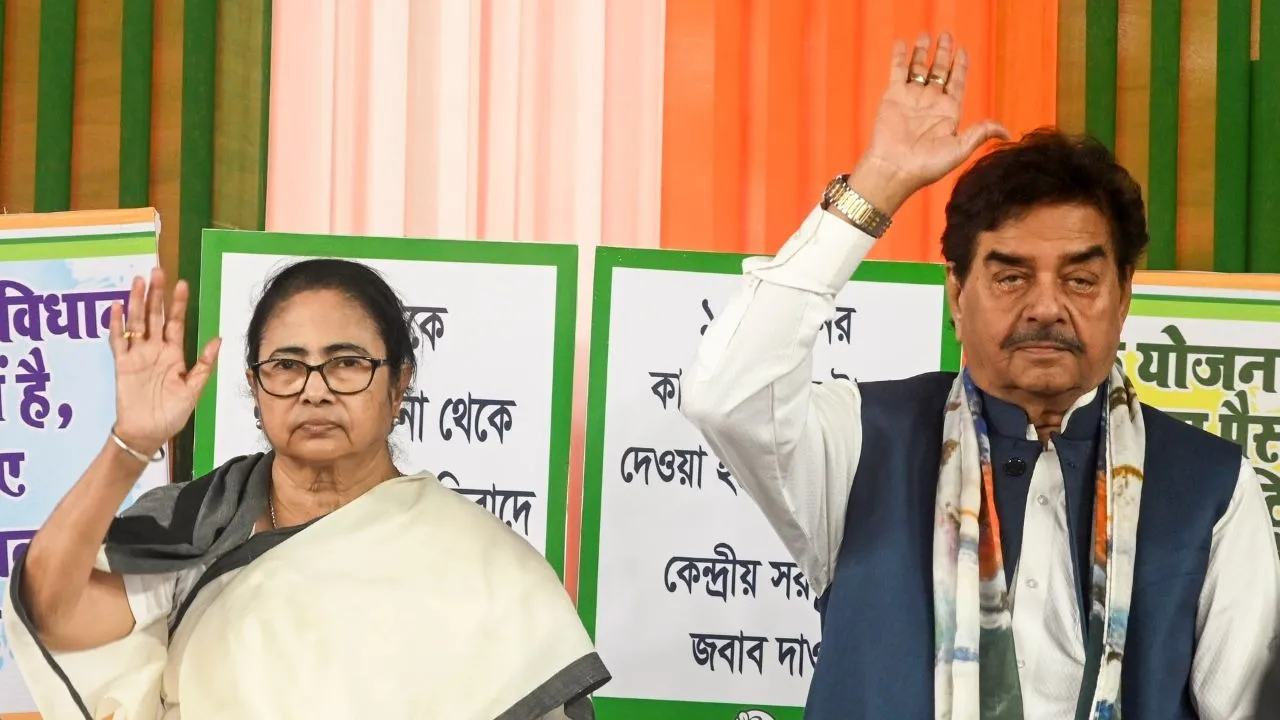
Amid growing political turmoil within the Trinamool Congress (TMC), actor-turned-politician and Asansol MP Shatrughan Sinha on Thursday firmly dismissed speculation about joining the rebel camp, asserting that he would stand by party supremo Mamata Banerjee during difficult times.
In an exclusive interview with PTI, Sinha said he remains committed to the TMC and its leader, recalling how Banerjee supported him when he faced one of the most challenging phases of his political career.
“I am issuing a three-line whip to myself — I was with the TMC and Mamata ji, I am with the TMC and Mamata ji, and I will stay with the TMC and Mamata ji. I have no intention of going anywhere,” Sinha said.
His remarks come at a time when the TMC is grappling with an unprecedented internal rebellion following its defeat in the West Bengal Assembly elections. Sinha’s name had recently figured in a purported list of rebel MPs circulating on social media, triggering speculation about his political future.
The rumours gained further traction after the former Union minister posted a message on X congratulating Prime Minister Narendra Modi on completing 12 years in office.
“In true sportsman spirit, wishing our friend and guide of society and nation, Prime Minister Narendra Modi, best wishes on completing 12 years in office. Wish you a long, healthy and prosperous life ahead. Jai Hind!” Sinha wrote.
Clarifying his position, Sinha said maintaining cordial relations across party lines should not be misconstrued as a political shift.
“I have friends in every political party, but that does not mean I will leave Mamata Banerjee. Some people are speaking the truth, while others are spreading rumours. Some have claimed that I have joined the rebel group, which is completely incorrect,” he said.
The veteran politician recalled that Banerjee stood by him after his defeat in the 2019 Lok Sabha elections from Patna Sahib, a gesture he said he would never forget.
“Very few people supported me when I lost, or rather was made to lose, the election. Mamata Banerjee was one of them. I cannot desert her in her difficult times,” he said.
Sinha, who joined the TMC after stints with both the BJP and Congress, credited Banerjee, the party and the people of Asansol for his electoral success.
“I won on the symbol of ‘jora phul’ (the TMC symbol), so it is my duty to stand by the party. My principle is very clear — when Mamata ji stood by me in difficult times, it is now my responsibility to stand by her,” he said.
While acknowledging that he had received invitations to join the rebel camp, Sinha said he had declined them.
“I am grateful to those who invited me, and I have no complaints against anyone. But my principled stand is to remain with Mamata Banerjee. As of now, I will not change my path,” he added.
Describing Banerjee as a “street fighter,” Sinha noted that despite the party’s electoral setback, she still commands significant public support in West Bengal.
The TMC has been facing a severe crisis since its Assembly election defeat. More than two-thirds of its MLAs — 58 out of 80 legislators — have reportedly broken away from the official legislature party and secured recognition as the principal opposition bloc in the West Bengal Assembly under expelled legislator Ritabrata Banerjee.
The rebellion has also spread to Parliament, with dissident MPs led by Kakoli Ghosh Dastidar claiming the support of more than 20 Lok Sabha members. Amid these developments, Sinha’s public endorsement of Banerjee offers a boost to the embattled TMC leadership as it attempts to contain the growing revolt within its ranks.
Ex-Assembly Official Defends Meenakshi Natarajan, Says No FIR or Chargesheet Existed to Disclose in Affidavit 10
A former senior Madhya Pradesh Assembly official has come out in support of Congress leader Meenakshi Natarajan, claiming that her Rajya Sabha nomination was wrongly rejected as there was no FIR, chargesheet or criminal case requiring disclosure in her election affidavit.
Speaking to PTI Videos on Thursday, former Madhya Pradesh Assembly Principal Secretary Bhagwandev Israni said Natarajan had not concealed any information that warranted cancellation of her candidature and alleged that she was not given a fair opportunity to clarify the issue.
The controversy erupted after Natarajan’s nomination for the June 18 Rajya Sabha elections in Madhya Pradesh was rejected during scrutiny on Tuesday. The Returning Officer, Arvind Sharma, held that her affidavit was incomplete because it did not mention a court complaint allegedly filed against her in Telangana.
The objection was raised by BJP candidate Mahesh Kewat, who alleged that Natarajan had failed to disclose details of the Telangana case in Form 26 submitted with her nomination papers.
However, Israni maintained that the legal requirement for disclosure did not apply in Natarajan’s case.
“I don’t think any information had been concealed,” he said.
Referring to Section 33A of the Representation of the People Act, 1951, Israni explained that candidates are required to disclose pending criminal cases only when charges have been formally framed by a competent court for offences punishable with imprisonment of two years or more.
“But this is not the case in this matter. No criminal case has been filed yet, nor has an FIR been registered, and a chargesheet has also not been filed. Therefore, there was no need to provide any information,” he claimed.
Drawing a comparison with a similar case in Jharkhand, Israni said authorities there had allowed the candidate to submit a second affidavit and granted additional time to rectify the issue.
“In this case, that opportunity was not given to Natarajan,” he said.
The former official also urged the Election Commission to intervene, arguing that courts generally refrain from interfering once the electoral process is underway.
“I think the Election Commission should intervene. Courts usually do not interfere after the election process begins,” he said.
Israni noted that Congress leaders had already approached the Election Commission but no decision had been taken so far.
Reflecting on his four-decade-long administrative career, he said he had overseen numerous elections without rejecting a single nomination.
“Our notebook also says — give a chance and ignore minor mistakes. But she was not given a chance,” he remarked.
Meanwhile, all three BJP candidates — Tarun Chugh, Rajneesh Agrawal and Mahesh Kewat — were declared elected unopposed to the Rajya Sabha on Thursday following the rejection of Natarajan’s nomination.
The legal battle is set to continue, with a partial working day bench of the Supreme Court on Thursday questioning the maintainability of Natarajan’s petition during the ongoing electoral process. The matter is expected to come up for further hearing on Friday.
The dispute has intensified political tensions in Madhya Pradesh, with the Congress alleging that the rejection of its candidate’s nomination undermined democratic principles and denied the party a fair contest for the third Rajya Sabha seat.
The Trinamool Congress (TMC) suffered another major setback on Thursday after Rajya Sabha MP Prakash Chik Baraik resigned from the Upper House, becoming the third party parliamentarian to step down within a week amid an escalating political crisis.
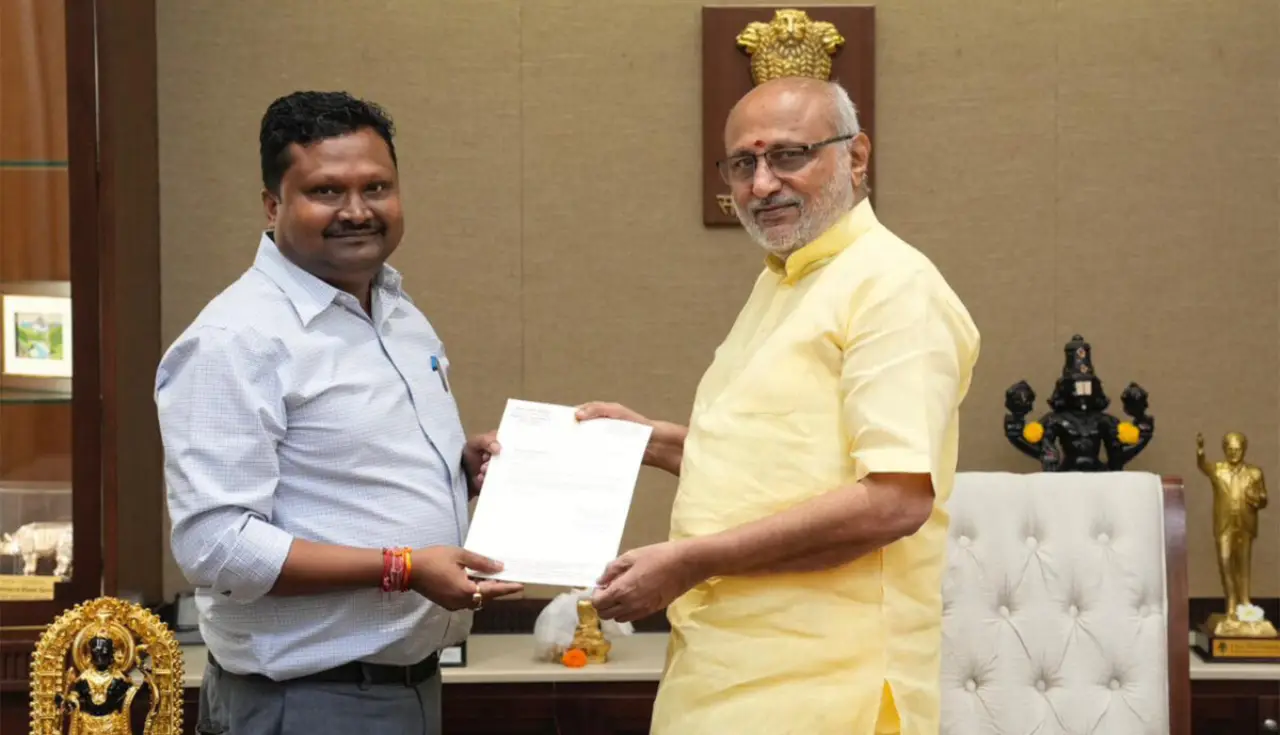
According to sources, Baraik met Rajya Sabha Chairman C.P. Radhakrishnan and submitted his resignation, further intensifying the turmoil within the Mamata Banerjee-led party.
In his resignation letter, Baraik stated, “I do hereby resign from the membership of Rajya Sabha, which may please be accepted with immediate effect.”
He also expressed gratitude to the Rajya Sabha Chairman, Deputy Chairman and officials of the Rajya Sabha Secretariat for their support and cooperation during his tenure in Parliament.
A prominent tribal leader from West Bengal, Baraik served as a member of the Parliamentary Standing Committee on Consumer Affairs, Food and Public Distribution, as well as the Consultative Committee on Tribal Affairs.
His resignation follows a series of high-profile exits from the TMC. Earlier this week, Rajya Sabha MP Sukhendu Sekhar Ray resigned from both Parliament and the party, citing differences with the leadership. On Wednesday, Rajya Sabha MP Sushmita Dev also stepped down from the Upper House and subsequently resigned from the party.
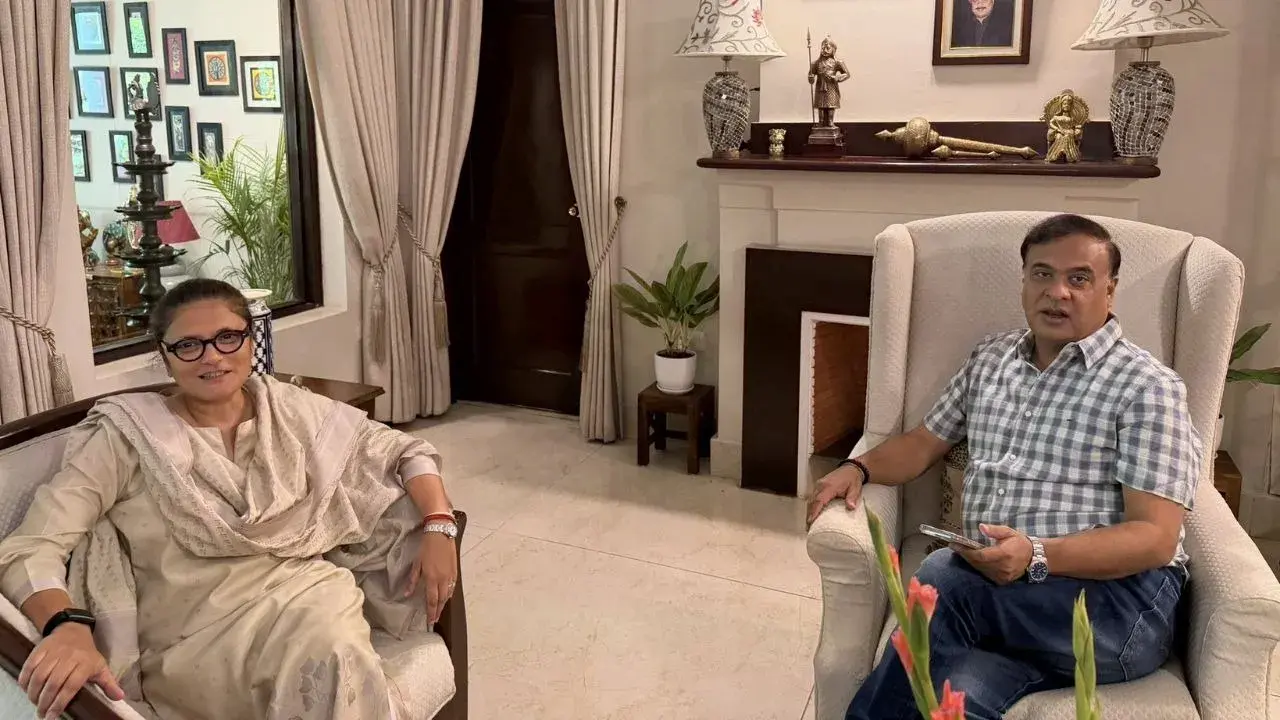
Dev’s meeting with Assam Chief Minister Himanta Biswa Sarma in New Delhi after her resignation fuelled speculation about a possible shift in her political allegiance.
With Baraik’s departure, the TMC has now lost three Rajya Sabha members in a matter of days, dealing a fresh blow to the party at a time when it is battling its most serious internal crisis in recent years.
The turmoil began after the party’s defeat in the West Bengal Assembly elections and has since snowballed into a large-scale rebellion affecting both the organisation and its legislative wings.
Last week, more than two-thirds of the TMC’s MLAs — 58 out of 80 legislators — broke away from the official legislature party and secured recognition as the principal opposition bloc in the West Bengal Assembly under the leadership of expelled MLA Ritabrata Banerjee. The rebel camp has since claimed that its numbers have grown further.
The unrest has also spread to Parliament. Dissident MPs led by Kakoli Ghosh Dastidar have claimed the support of more than 20 Lok Sabha members. On Wednesday, Jadavpur MP Saayoni Ghosh and Kolkata Dakshin MP Mala Roy reportedly joined the rebel faction, adding to the pressure on the party leadership.
As resignations continue and rebel factions gain momentum, the Trinamool Congress faces mounting challenges to its unity, organisational structure and political influence, raising fresh questions about the party’s future trajectory both in West Bengal and at the national level.
Another Blow to TMC as Rajya Sabha MP Sushmita Dev Resigns Amid Growing Party Turmoil 14
The Trinamool Congress (TMC) suffered another setback on Wednesday after Rajya Sabha MP Sushmita Dev resigned from the Upper House, becoming the second party parliamentarian to step down within a week amid an escalating political crisis in the party.
Dev, a former Congress leader who joined the TMC in 2021, submitted her resignation to Rajya Sabha Chairman C.P. Radhakrishnan. Her exit comes shortly after senior TMC leader Sukhendu Sekhar Ray resigned from both the Rajya Sabha and the party.
In her resignation letter, Dev expressed gratitude to the Rajya Sabha leadership and secretariat for their support during her tenure.
“I do hereby resign from the membership of Rajya Sabha, which may please be accepted with immediate effect,” she wrote.
“I convey my sincere gratitude to Your Excellency, the Hon’ble Deputy Chairman and all functionaries of the Rajya Sabha Secretariat for extending all help and cooperation during my tenure as a member of the Rajya Sabha,” the letter added.
While Dev has not publicly stated the reasons behind her resignation, political circles are abuzz with speculation that she may soon leave the Trinamool Congress and join the Bharatiya Janata Party (BJP). Sources indicated that she recently met Assam Chief Minister Himanta Biswa Sarma, further fuelling rumours of a political shift.
Her resignation comes at a turbulent time for the Mamata Banerjee-led party, which has been grappling with an internal rebellion following its defeat in the West Bengal Assembly elections.
The crisis has deepened in recent days, with several TMC MPs reportedly deciding to form a separate group and extend support to the BJP-led National Democratic Alliance (NDA) at the Centre. Simultaneously, a majority of the party’s 80 MLAs in the West Bengal Assembly are reported to have aligned with a separate faction led by Ritabrata Banerjee, who has emerged as the Leader of the Opposition.
Dev’s departure is likely to intensify concerns within the TMC leadership over further defections and the growing challenge to the party’s organisational unity, both in Parliament and in West Bengal.
With two Rajya Sabha resignations in quick succession and continuing signs of unrest within the party ranks, the political future of the TMC appears to be entering a crucial and uncertain phase.
Gutkha Smugglers Attempt to Run Over Woman FDA Officer During Raid in Waluj, Escape With Contraband-Laden Truck 16
In a brazen attack on government officials, suspected gutkha smugglers allegedly attempted to run over a woman Food and Drug Administration (FDA) officer with an SUV and escaped with a truck loaded with banned gutkha and pan masala during a late-night enforcement operation near Waluj in Chhatrapati Sambhajinagar district.
The incident occurred in the early hours of Tuesday at Rahimpur village, where an FDA team had launched a crackdown following a tip-off about the transportation of prohibited tobacco products.
The team, led by Assistant Commissioner Vivek Patil and comprising Food Safety Officers Farid Siddiqui and Pragya Surse, along with Sample Assistant Amol Kamble, intercepted a suspicious truck bearing registration number MH-16-CD-8296. During the inspection, officials reportedly discovered 25 to 30 sacks containing banned gutkha and pan masala products.
According to officials, the team had sought police protection from the Waluj Police Station. However, before police personnel could reach the spot, a black Scorpio SUV without a registration number allegedly arrived at the location.
The occupants of the SUV reportedly surrounded the FDA officials, verbally abused them and attempted to disrupt the seizure operation. The situation soon escalated, with the accused allegedly issuing threats and creating an atmosphere of fear and intimidation.
As per the complaint, the suspects allegedly shouted threats, including calls to shoot the officials. The accused then allegedly drove the SUV towards the FDA team in an attempt to run them over.
Sensing imminent danger, three officials reportedly took shelter behind a nearby temple, while Food Safety Officer Pragya Surse ran across the road to save herself. Officials said the timely reaction of the team prevented a potentially fatal incident.
Amid the chaos, one of the accused allegedly drove away the truck carrying the banned products, while the remaining suspects fled from the scene.
Based on Surse’s complaint, Waluj police have registered a case under various provisions related to attempt to murder, obstructing a public servant from discharging official duties, criminal intimidation and removal of seized contraband.
Police Sub-Inspector Ajay Shitole is leading the investigation.
According to police sources, suspects identified as Saddam and Prabhakar Solunke are known for their alleged involvement in gutkha smuggling activities across the Marathwada region. In an earlier Crime Branch operation, gutkha worth nearly ₹60 lakh was reportedly seized from Solunke’s residence, leading to his arrest and the confiscation of multiple luxury vehicles.
The incident has raised serious concerns within the administration over the growing boldness of organised gutkha smuggling networks and the risks faced by enforcement officers while carrying out anti-contraband operations.
BJP Alleges Congress Infighting Behind Natarajan Nomination Rejection in MP Rajya Sabha Polls 18
Senior BJP leader Kailash Vijayvargiya on Tuesday dismissed the Congress’ allegations of a “murder of democracy” over the rejection of Meenakshi Natarajan’s nomination for the third Rajya Sabha seat from Madhya Pradesh, claiming that Congress leaders from Telangana had supplied the documents that led to the controversy.
The Rajya Sabha election in Madhya Pradesh witnessed a dramatic turn after Natarajan’s nomination was rejected on charges of concealing information in her affidavit. The election for three Rajya Sabha seats is scheduled to be held on June 18.
According to Returning Officer Arvind Sharma’s order, scrutiny of the nomination papers revealed that Natarajan had failed to disclose a court complaint in Telangana in Form 26 submitted along with her nomination, rendering the affidavit incomplete.
The objection was raised by BJP candidate Mahesh Kewat, who alleged that Natarajan had omitted details of a case registered against her in Telangana. Following the rejection of her nomination, Vijayvargiya suggested that the information did not originate from the BJP.
“As for the documents we received, who gave them to us? One can understand the condition of the Congress. We were receiving documents related to Telangana, a state where Congress is in power. We had no information ourselves; it must have come from Congress members,” Vijayvargiya told reporters.
Taking a swipe at the Congress over reports that it plans to move its Madhya Pradesh MLAs to Karnataka to prevent cross-voting, the BJP leader said such measures would not affect the outcome.
“Whether they take MLAs to Bengaluru or even to London, we would have won the election anyway because the people of the country have faith in Prime Minister Narendra Modi,” he remarked.
The Congress has strongly opposed the Returning Officer’s decision, describing it as not merely “vote theft” but “seat theft” and a “murder of democracy.” The party has announced its intention to challenge the rejection in court.
Senior Congress leader and Rajya Sabha MP Vivek Tankha suggested that the matter should be taken directly to the Supreme Court. Meanwhile, the party staged protests outside the Election Commission office in Bhopal and at the Election Commission headquarters in New Delhi.
Madhya Pradesh Congress president Jitu Patwari announced that party MLAs and leaders would observe a hunger strike across the state on Wednesday in protest against the decision.
Natarajan alleged that despite lacking the numerical strength to secure a third seat, the BJP fielded a third candidate in a bid to undermine democratic processes and constitutional values.
Of the three Rajya Sabha seats falling vacant in Madhya Pradesh, the BJP was comfortably placed to win two, while the Congress held a numerical advantage for the third seat. The BJP has fielded Tarun Chugh, Rajneesh Agarwal and Mahesh Kewat as its candidates.
In the 230-member Madhya Pradesh Assembly, the effective strength currently stands at 229, requiring a candidate to secure 58 first-preference votes to win a Rajya Sabha seat.
Sandhya Purecha: The Cultural Visionary Bringing India’s Timeless Heritage to the Global Stage 20
In the vast and vibrant landscape of Indian classical arts, few names command as much respect, admiration, and authority as Sandhya Purecha. A distinguished Bharatanatyam exponent, acclaimed author, scholar, choreographer, and cultural administrator, Sandhya Purecha has devoted her life to preserving, promoting, and reimagining India’s rich artistic traditions for contemporary audiences. Her remarkable journey stands as a testament to the enduring power of classical arts and their ability to connect generations, cultures, and civilizations.
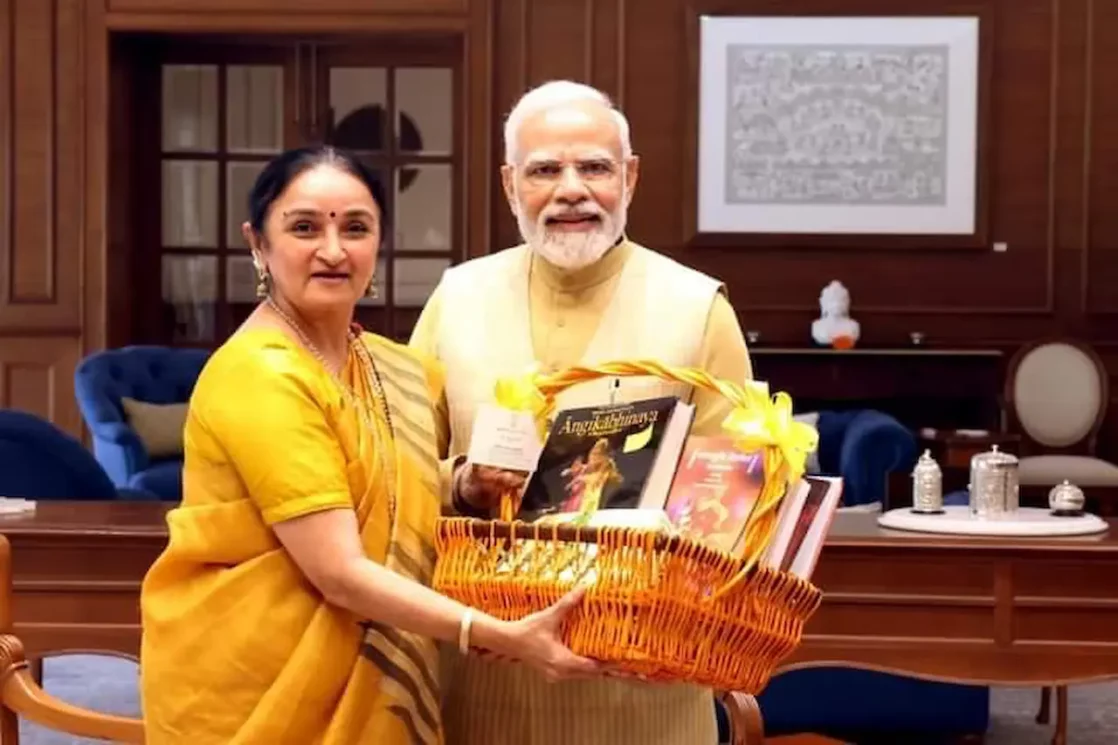
For decades, Purecha has been one of the foremost torchbearers of Bharatanatyam, combining rigorous scholarship with artistic excellence. She holds the rare distinction of being the first artist to present on stage the complete Abhinaya Darpana, the seminal dance treatise authored by Nandikeshwara. Guided by the visionary choreography of her revered guru, Parvati Kumar, she transformed this ancient theoretical text into a living artistic experience, demonstrating an extraordinary ability to bridge classical knowledge and performance.
Her scholarly contributions have been equally significant. Through extensive research on Karanas, the ancient dance movements described in the Natya Shastra, she published her landmark work on Kalasa Karana in 2010, enriching the academic discourse surrounding India’s classical dance traditions and contributing to the preservation of invaluable cultural knowledge.
Recognition for her lifelong dedication arrived in the form of the prestigious Sangeet Natak Akademi Award, bestowed upon her in 2017 for her outstanding contribution to the performing arts. Yet, beyond accolades, it is her role as a cultural institution-builder that has elevated her influence to national prominence.
As Chairperson of the Sangeet Natak Akademi, India’s apex body for the performing arts, and Chairperson of the W20 Engagement Group during India’s G20 Presidency in 2023, Purecha has played a pivotal role in shaping the country’s cultural narrative on both national and international platforms. Her stewardship has demonstrated how India’s artistic heritage can serve as a powerful instrument of cultural diplomacy in the twenty-first century.
Her contributions extend further through her role as a Trustee of the Indira Gandhi National Centre for the Arts, where she continues to support initiatives aimed at preserving India’s artistic and intellectual traditions. Since 1994, she has also been actively involved in government teacher-training programmes through Natyashala, introducing educators to the profound aesthetic principles of Rasa Theory, one of India’s greatest contributions to world aesthetics. Her expertise was further recognized through her appointment to the prestigious Padma Awards Committee in 2023.
In recent years, Sandhya Purecha has emerged as one of India’s most influential cultural curators, conceptualizing and directing some of the country’s most significant national events. She curated the grand opening ceremony of Bharat Mandapam, presenting a spectacular artistic narrative that celebrated India’s civilizational journey, cultural diversity, and creative genius. The production showcased the country’s artistic traditions on an unprecedented scale, leaving a lasting impression on audiences from around the world.
Her visionary approach was equally evident in the inaugural cultural presentation at Yashobhoomi, where she conceptualized a unique production centered on Bhagavan Dhanvantari, highlighting India’s ancient healthcare traditions and knowledge systems. The performance beautifully illustrated how traditional wisdom continues to remain relevant in modern times.
Perhaps one of her most internationally acclaimed achievements came during the G20 Summit, where she curated and directed a historic ensemble featuring 150 rare Indian musical instruments. Presented before world leaders and global delegates, the performance served as a magnificent showcase of India’s intangible cultural heritage. Alongside the celebrated Gandharva Ayodhya presentation, it projected India’s artistic richness onto the global stage with remarkable elegance and sophistication.
Her commitment to presenting India’s civilizational legacy continued through initiatives such as Bharat Smriti Bodh for AI Summit delegates, introducing international participants to India’s ancient knowledge traditions and cultural memory. She has consistently demonstrated an extraordinary ability to translate complex philosophical and historical themes into compelling artistic experiences.
Sandhya Purecha has also championed narratives that celebrate courage, resilience, and empowerment. Her thematic production on Women Warriors for the Ministry of Women and Child Development paid tribute to the extraordinary contributions of women throughout Indian history. Similarly, her specially curated Shaurya and Shakti presentation for Veer Bal Diwas commemorated the bravery and sacrifice of India’s young heroes, blending artistic excellence with powerful national storytelling.
Her cultural leadership was further showcased during the opening celebrations of the Shri Ram Janmabhoomi, where she designed and directed a unique musical ensemble that brought together diverse artistic traditions in a spiritually uplifting presentation. The programme resonated deeply with audiences and reflected her ability to weave devotion, culture, and artistic expression into a unified experience.
Among her most ambitious undertakings was Utkarsh, a monumental folk festival that brought together more than 1,500 folk and tribal artists from across India in the presence of the President of India. The festival celebrated the living traditions of rural and indigenous communities, reaffirming the importance of preserving cultural diversity in an increasingly globalized world.
From welcoming delegates of the World Heritage Committee through specially designed musical ensembles to conceptualizing innovative cultural programmes for the WAVES Summit in Mumbai, Sandhya Purecha has consistently demonstrated exceptional artistic vision, organizational leadership, and cultural insight. Her work transcends performance; it serves as a bridge connecting India’s ancient wisdom with contemporary global audiences.
Today, Sandhya Purecha stands not merely as a celebrated Bharatanatyam exponent, but as one of the foremost architects of India’s cultural renaissance. Through scholarship, performance, administration, and visionary curation, she has elevated Indian arts to new heights, ensuring that the country’s timeless traditions continue to inspire, educate, and captivate audiences across the world. Her legacy is one of preservation and innovation, rooted in tradition yet boldly looking toward the future—a rare combination that has made her one of the most influential cultural ambassadors of modern India.