


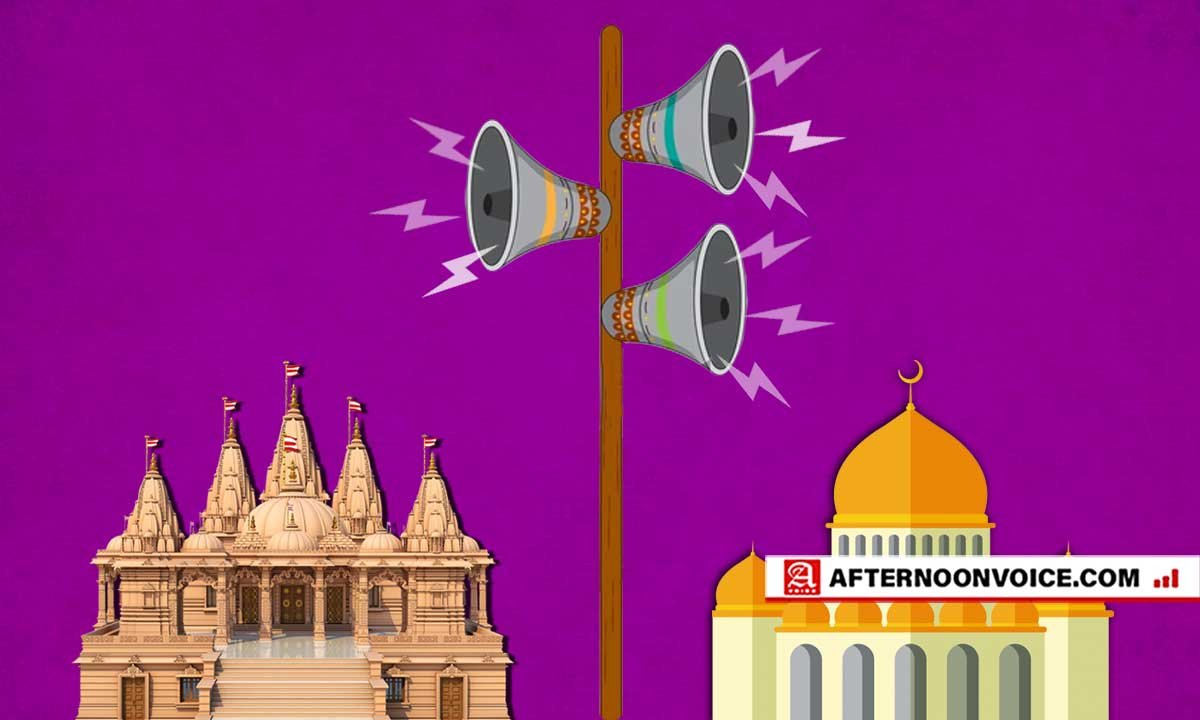
Raj Thackeray recently became BJP’s voice and tried creating unrest in the loudspeaker’s name. Looking at this chaos, I reminded myself of a Bhonga Marathi-language drama film. The film revolves around a middle-class Muslim family where a nine-month-old baby is suffering from a chronic disease named Cerebral hypoxia. This disease causes the amount of oxygen in the blood drops and it affects the brain. A family leaves their home because of financial difficulties. The new house stands back from a mosque. The movie then recounts the story of the child’s father, uncle, and other villagers. ‘Bhonga’ movie is based on a true story.
The film is not against the Muslim or Hindu religion. This is the story of a film producer’s friend, who stays in Malegoan. He was suffering from the same medical issues when he was born. There were over 20 mosques near his house and how the sound of Azaan from a neighbouring mosque troubled him. Well, the movie was very special about noise pollution in all religious places. But the tamasha in Maharashtra in the name of loudspeaker has gone worst.
The politics over loudspeakers at religious places, and main mosques, took a dangerous turn. Around 22,000 loudspeakers were removed in Uttar Pradesh and Madhya Pradesh. A mob of Shiv Sena workers gathered at Khar, outside the Mumbai residence of Amravati MP Navneet Rana and her MLA husband Ravi Rana, trying to break the barricades and enter their house. It gathered numerous Shiv Sainiks outside Matoshree, the residence of Maharashtra Chief Minister Uddhav Thackeray in suburban Bandra, sloganeering against the Rana family.
Claiming 90% success, Raj vows to drag the ‘anti-loudspeakers’ campaign. SC decision is the same for all. Now our temples also have to withstand it. It’s a black day for us Hindus that people couldn’t hear Aartis because of BJP’s politics in cahoots with Raj Thackeray. Over the last four decades, the Shiv Sena and the BJP have repeatedly resorted to ‘temple and mosque’ politics to buttress their Hindutva commitment, both as allies and adversaries. This is around the same time that the Shiv Sena embraced the larger Hindutva agenda, leaving behind its identity of just being an outfit for the sons of the soil.
They conceived the Shiv Sena as a nativist movement in June 1966, but, by the 1980s, Bal Thackeray realised that the party needed more ideological ammunition in order to expand beyond Mumbai. Therefore, the Sena officially adopted Hindutva as an agenda at the party’s second adhiveshan (session) held at Mahad in the Konkan region in 1985. Bal Thackeray then employed his aptitudes to highlight the Shiv Sena’s newfound Hindutva agenda with his speeches and columns.Political observers believe the 1980s Vile Parle bypoll was the electoral battle that led Hindutva into the mainstream of Maharashtra politics.
Bal Thackeray and his Shiv Sena organised such ‘Maha Aartis’ on an especially grand scale around the time of the 1992-93 riots. In its report on the 1992-93 riots, the Srikrishna Commission identified ‘Maha Aartis’ as among the factors that provoked violence in Mumbai. While many Shiv Sena leaders take pride in objecting to namaz being offered on public roads, some cite that it was the Sena-led govt (1995-1999) that increased Mumbai’s Floor Space Index (FSI) — a ratio that defines the extent of construction allowed on a given plot. The 1990s decade was also when Bal Thackeray questioned the use of loudspeakers in mosques for the first time. Claiming “90 per cent success” on the first day of the anti-loudspeakers drive, Maharashtra Navnirman Sena president Raj Thackeray vowed to continue the campaign on a long-term basis till the issue was resolved completely. A majority of the mosques in Mumbai and other parts of Maharashtra reportedly did not use the loudspeakers for the morning ‘azan’ call to the faithful, the MNS chief told media persons at his home. In Mumbai, there are 1,140 mosques, 135 sounded the ‘azan’ call on loudspeakers before 5 a.m., flouting the Supreme Court directives.
The Aurangabad police on Tuesday registered a case against MNS chief Raj Thackeray, days after he called for “silencing” loudspeakers atop mosques from May 4, an official said. Earlier in the day, Maharashtra director general of police Rajnish Seth said the Aurangabad police commissioner will take legal action against Thackeray over his speech against loudspeakers in mosques. The city Chowk police registered a case against Thackeray under sections 153 (wantonly giving provocation with intent to cause riot), 116 (abetment of an offence punishable with imprisonment-if offence be not committed) and 117 (abetting commission of the offence by the public or by more than 10 persons) of the Indian Penal Code and provisions of the Maharashtra Police Act.
Leaders of the ruling Maha Vikas Aghadi (MVA) on Wednesday met in the presence of Nationalist Congress Party supremo Shard Pawar, amidst the ongoing loudspeaker row in Maharashtra, in which a case has been registered against MNS chief Raj Thackeray. The meeting began earlier today at the Sahyadri State Guest House in Mumbai. Ajit Pawar, Jayant Patil, Lazdada Bhuse (Dadaji Dagadu Bhuse), and Balasaheb Thorat were among those who attended the meeting. Let us hope that the government will come out with better options.
