


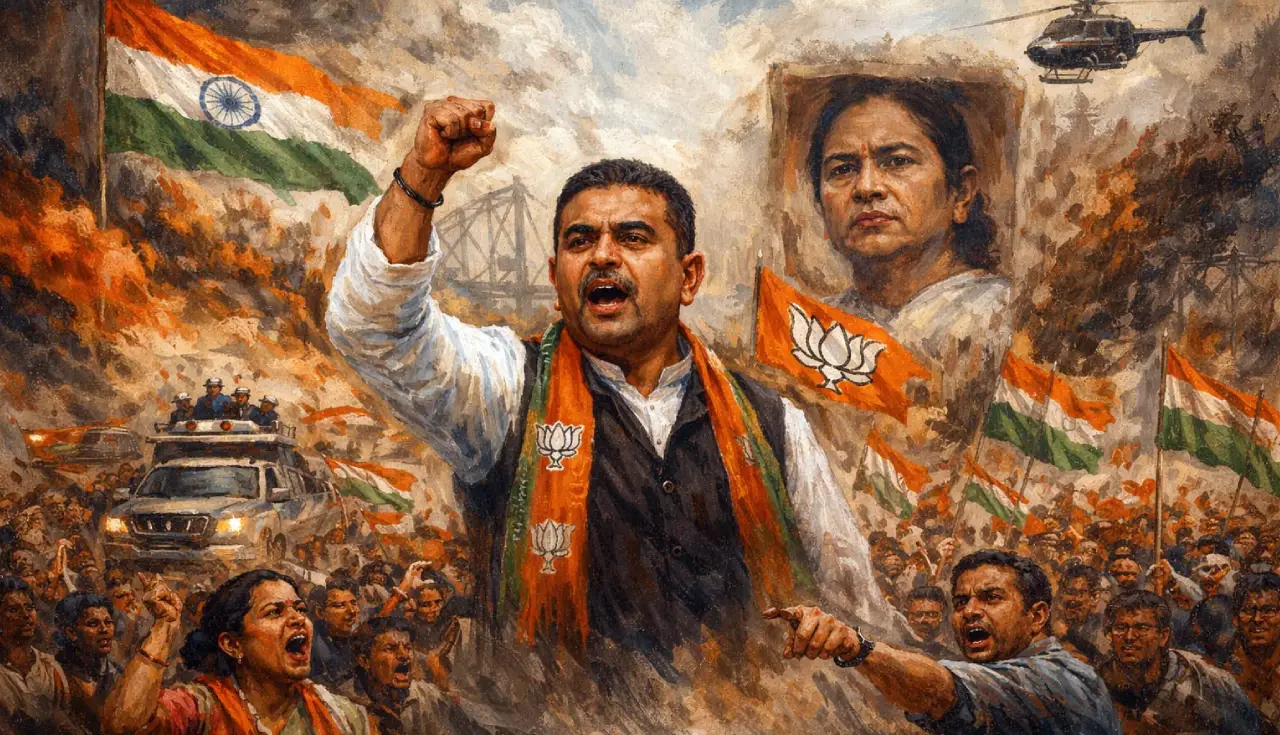
I went to Kolkata to meet writers and journalists. Politics, as always in Bengal, found its way into every conversation. When I asked a simple but decisive question—who is the BJP’s real bet against Mamata Banerjee in the coming battle?—there was no hesitation, no diplomatic evasion, no chorus of multiple names.
There was one name. Spoken with conviction. Suvendu Adhikari.
West Bengal does not fall for ornamental leadership. It never has. This is a state that has lived through ideological wars, street struggles, cadre politics, and mass mobilizations. Bengal rewards leaders who sweat on the ground, not those who glide from convoy to podium and vanish. And in today’s BJP ecosystem in Bengal, Suvendu stands apart precisely because he operates like a field commander, not a weekend campaigner.
What struck me most was what local journalists told me—he is accessible. One call away. And if he cannot reach personally, his team responds. Follow-ups happen. Complaints are addressed. In a political culture where post-election amnesia is almost standard practice, that alone is disruptive.
But accessibility is only one dimension. There is a deeper factor—memory and connection. It is said that Suvendu knows large numbers of people in his constituency by name. Not as voter data, not as booth-level figures, but as individuals. This sounds old-fashioned. Good. Bengal still respects that old-fashioned model. Leaders here were once known to attend family ceremonies, funerals, and community gatherings without cameras. Suvendu has revived that style of politics in a party often perceived as distant in the state.
Let’s be blunt. The BJP in West Bengal struggled for years because it lacked rooted faces. Many leaders relied on motorcades, layered security, and stage-managed optics. They delivered thunderous speeches, promised structural overhauls, and disappeared until the next rally. Expensive lifestyles and perceived detachment cost the party emotional credibility. Voters want to feel ownership over a leader. They must see him as one of us.
When Suvendu left the Trinamool Congress and joined the BJP, he brought more than political weight. He brought networks, booth-level relationships, and a culture of relentless mobilisation. His political résumé is substantial—former Transport and Irrigation Minister, former Lok Sabha MP from Tamluk, now Leader of the Opposition in the West Bengal Assembly since May 2021. Experience is not his liability; it is his arsenal.
Yes, he came from outside the traditional BJP-RSS fold. And yes, that has caused discomfort among certain long-standing state leaders. Internal friction exists. There are veterans who question his ideological lineage. There are factions wary of his rapid rise. But politics is not a nostalgia club—it is a performance arena. Parties that prioritize ego hierarchies over winning strategies do so at their peril.
If the BJP in West Bengal is serious about defeating Mamata Banerjee, it needs clarity, not confusion. Discipline, not rivalry. A single power centre, not competing egos.
So what must BJP do?
First, project a clear Chief Ministerial face. Bengal’s voter psychology revolves around strong personalities. Mamata Banerjee’s dominance is built on a narrative of singular authority. To defeat that structure, BJP cannot rely solely on national leadership imagery. It must present a credible, assertive, locally embedded alternative. Suvendu fits that profile more convincingly than any other current state leader.
Second, rebuild grassroots machinery with zero tolerance for factional sabotage. Electoral battles in Bengal are booth-driven, hyper-local, and emotionally charged. Cadre strength must be energised and unified under one strategic command. The party must decide—does it want internal comfort or electoral victory? It cannot have both.
Third, sharpen narrative clarity. The BJP needs a balanced, strategic mix of governance critique and aspirational messaging. Attack corruption relentlessly. Highlight administrative lapses. But also present a bold development blueprint tailored specifically for Bengal—not recycled national templates.
Fourth, invest in community outreach beyond rhetoric. Bengal’s social fabric is complex—culturally proud, politically alert, economically varied. Building trust requires presence in villages, small towns, minority-dominated belts, industrial pockets, and intellectual spaces alike. Suvendu’s method of physical engagement should be institutionalized across the party’s structure.
Fifth, stabilise leadership lines. If Suvendu is to be the spearhead, he must be given operational autonomy in state strategy. Half-empowered leaders become scapegoats. Fully backed leaders become force multipliers.
Can Suvendu Adhikari emerge as the future Chief Ministerial face for BJP in West Bengal?
The possibility is real. But it demands courage—from the party as much as from him.
He has demonstrated stamina, combative clarity, and organisational experience. As Leader of the Opposition, he has taken an aggressive stance inside the Assembly. On the streets, he remains visible and vocal. His electoral victory against Mamata Banerjee in Nandigram remains symbolically potent within BJP circles. That battle turned him from defector to frontline challenger overnight.
Leadership in Bengal is not granted through designation—it is earned in public confrontation. Suvendu has repeatedly shown he is willing to confront, not negotiate his relevance.
However, being a Chief Ministerial candidate requires expanding perception beyond stronghold zones. He must consolidate broader statewide appeal—urban middle class, youth voters, and undecided segments. He must be seen not only as a fighter but also as an administrator-in-waiting. The transition from opposition warrior to governance architect is delicate.
Yet among the current lineup, he appears best positioned for that leap.
The BJP today stands at a decisive juncture in West Bengal. It can either remain an ambitious challenger fragmented by internal calculations, or it can evolve into a cohesive alternative anchored by a grounded, assertive leader. If it chooses the latter path, it must invest its full faith in leaders who command organic loyalty.
Bengal has never feared strong personalities. It respects them—if they remain accessible, if they remain visible, if they remain accountable.
Suvendu Adhikari’s political currency is hard-earned mass contact. It was not manufactured in television studios. It was built in streets, blocks, and booths. If the BJP harnesses that energy rather than dilute it through internal anxieties, the 2026 Assembly election could shift from speculation to serious contest.
Defeating Mamata Banerjee will not be easy. She remains a formidable, battle-tested leader with deep cadre roots. Underestimating her would be fatal.
But Bengal’s political landscape is not static. It changes when momentum meets organization.
Suvendu has momentum.
Now the BJP must decide whether it has the organisational maturity—and the strategic courage—to transform that momentum into a full-fledged power bid.
If it does, Bengal may witness a new political chapter. If it hesitates, history will repeat itself.
In this state, opportunity waits for no one.
