


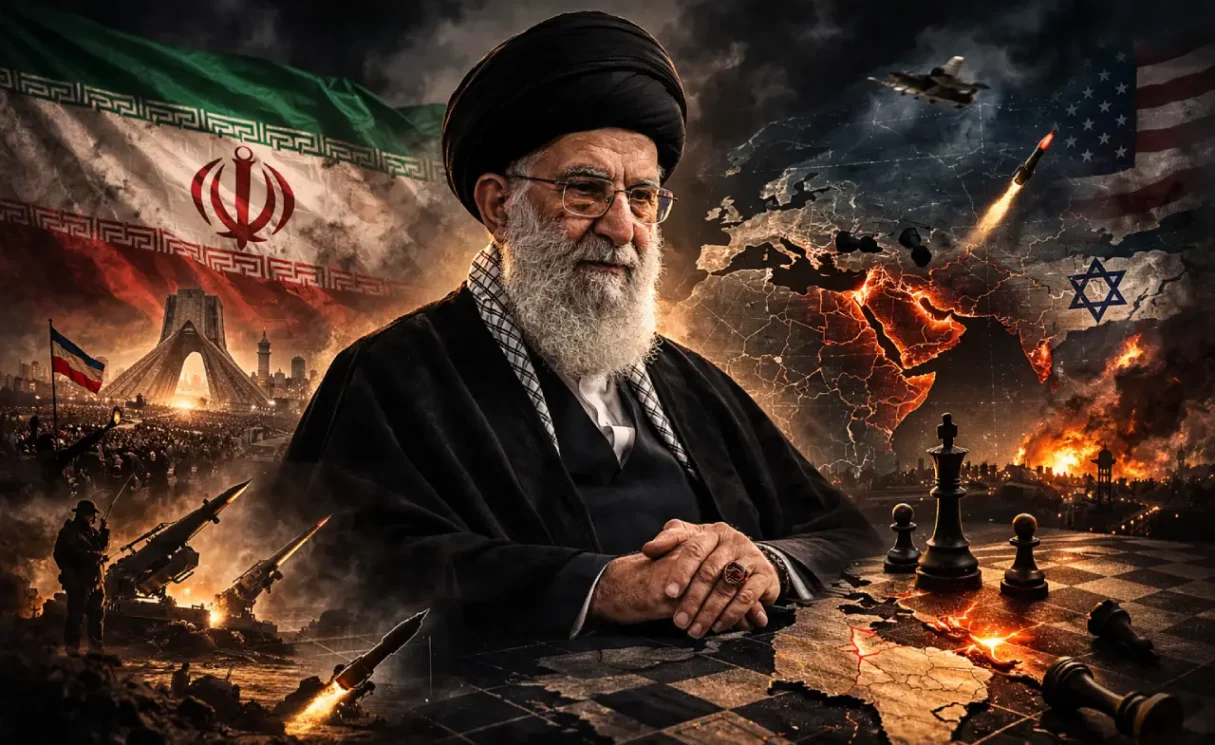
Leaders come and go. Systems endure. But once in a generation, a figure emerges who fuses himself with the machinery of the state so completely that separating the two becomes nearly impossible. Ayatollah Sayyed Ali Khamenei is one such figure. For more than three decades, he has not merely led the Islamic Republic of Iran — he has defined its structure, calibrated its ideology, and engineered its global posture.
To understand why his eventual death will reshape geopolitical equations from Washington to Riyadh, from Tel Aviv to Moscow, one must first understand how a mid-ranking cleric, not even a Grand Ayatollah at the time of his elevation, became one of the most powerful men in the Middle East.
Ali Khamenei was born in 1939 in Mashhad, into a clerical family with modest means. His early formation came through hawza education — first in Mashhad, later in Qom, where he came under the influence of Ruhollah Khomeini. It was here that he absorbed the revolutionary synthesis of Shi’a theology and political activism that would later define the Islamic Republic. Under Mohammad Reza Pahlavi, the Shah of Iran, Khamenei became involved in oppositional networks. Arrested multiple times and eventually exiled, he built credibility within revolutionary circles not as a theoretician, but as a disciplined cadre operator.
During the 1978–79 Iranian Revolution, Khamenei was not its face — Khomeini was. But he was embedded in its organizational arteries. After the monarchy fell, he entered the power structure quickly. He served in the Revolutionary Council, held military liaison roles during the Iran–Iraq War, and survived an assassination attempt in 1981 that permanently damaged his right arm. That attack added to his revolutionary legitimacy; survival became part of his personal mythology.
His presidency from 1981 to 1989 occurred during wartime. The Iran–Iraq War hardened the regime and militarized governance. It was during this period that Khamenei developed deep, durable ties with the Islamic Revolutionary Guard Corps (IRGC). Those relationships would later become decisive.
The real turning point came in 1989 with the death of Ayatollah Khomeini. Khamenei was not a Grand Ayatollah. He lacked the highest clerical standing. His elevation to Supreme Leader required both constitutional adjustments and political choreography inside the Assembly of Experts. It was a calculated compromise candidate outcome: acceptable to clerical leadership, aligned with the security elite, and close to then-President Akbar Hashemi Rafsanjani.
From that moment onward, Khamenei transformed the office of Supreme Leader from a symbolic pinnacle into the central command node of Iran’s hybrid theocratic-republican system.
He did this in three ways.
First, institutional consolidation. Under Khamenei, power migrated steadily toward the Supreme Leader’s office. Oversight of the judiciary, armed forces, state broadcasting, key economic foundations, and strategic decision-making channels tightened around the leadership core. Parallel institutions — especially the IRGC — expanded both politically and economically.
Second, militarized statecraft. The IRGC evolved from a revolutionary guard into a regional power instrument. Through the Quds Force, Iran supported non-state actors across Lebanon, Iraq, Syria, Yemen, and Gaza. This “Axis of Resistance” doctrine enabled Iran to project power asymmetrically, offsetting conventional military disadvantages. Rather than confronting adversaries head-on, Iran operated through layered deterrence — missile capabilities, proxy networks, ideological alliances.
Third, ideological calibration. Khamenei was often labeled a “hardliner,” but his governance was pragmatic when required. When sanctions threatened regime stability, he permitted nuclear negotiations that led to the 2015 Joint Comprehensive Plan of Action (JCPOA). When protests challenged legitimacy — in 1999, 2009, 2017–18, 2019–20, and during the Mahsa Amini unrest — the system responded with force, but also recalibrated tactically. His doctrine combined ideological rigidity with tactical flexibility.
Internationally, Khamenei positioned Iran as a resistant pole against US influence, Israeli regional dominance, and Saudi strategic competition. Under his leadership, Iran cultivated ties with Russia and China, leveraged energy geopolitics, and inserted itself decisively into the Syrian civil war to prevent the fall of Bashar al-Assad — a move that reshaped the Middle East’s balance of power.
Critics argue his tenure entrenched repression, suppressed dissent, and curtailed civil liberties. Supporters claim he defended sovereignty, resisted foreign domination, and preserved ideological continuity after revolutionary turbulence. Both assessments coexist because Khamenei’s leadership was neither simplistic nor one-dimensional. It was structural.
And this is precisely why his eventual death will not be an ordinary leadership transition.
Iran’s system is theoretically designed to survive its leader. The Assembly of Experts is tasked with selecting a successor. Potential candidates include senior clerics and figures with close ties to the IRGC establishment. But the succession will test the cohesion of three power blocs: the clerical establishment, the IRGC-security apparatus, and the technocratic political class.
If succession proceeds smoothly, Iran may continue on its current trajectory — hardened anti-Western posture, regional proxy deterrence, calibrated nuclear advancement.
But if fissures appear, the regional consequences could be enormous.
A more IRGC-dominant leadership could accelerate militarization and reduce clerical balancing influence. A comparatively pragmatic successor might reopen negotiated channels with the West, especially if sanctions pressures intensify domestic economic strain. A contested succession could trigger internal instability, emboldening opposition movements while simultaneously provoking hard security crackdowns.
Global politics would shift accordingly.
Israel’s security calculus would adjust immediately. US regional posture — naval deployments, Gulf alliances — would tighten during uncertainty. Saudi Arabia and the UAE would recalibrate risk tolerance. Russia and China would move swiftly to secure influence in the transition vacuum.
Energy markets would react. Oil price volatility would likely spike if political instability threatens production or transport lanes. The Strait of Hormuz would regain headlines overnight.
Khamenei’s central achievement was system durability. He ensured that the Islamic Republic did not fragment under sanctions, war pressure, or domestic protest waves. But durability does not eliminate fragility — it merely compresses it.
What makes his eventual death geopolitically consequential is not sentiment, nor symbolism, but structure. For over three decades, he has been the ultimate arbitrator among Iran’s factions. Remove the arbiter, and suppressed rivalries may surface.
History shows that revolutionary systems are most vulnerable during generational transitions. The first generation carries legitimacy derived from struggle. The second often governs through institutional inertia. The third must either reform or rigidify.
Iran stands on that threshold.
Ayatollah Ali Khamenei’s rise was not inevitable. It was engineered through ideological alignment, political maneuvering, and security partnerships. His longevity was not accidental. It was sustained by calculated balancing between repression and pragmatism, theology and realpolitik.
His eventual departure will test whether Iran is leader-centric or system-centric.
And the world will be watching — because whenever the strategic center of one of the Middle East’s most consequential states shifts, the balance of global power shifts with it.
