


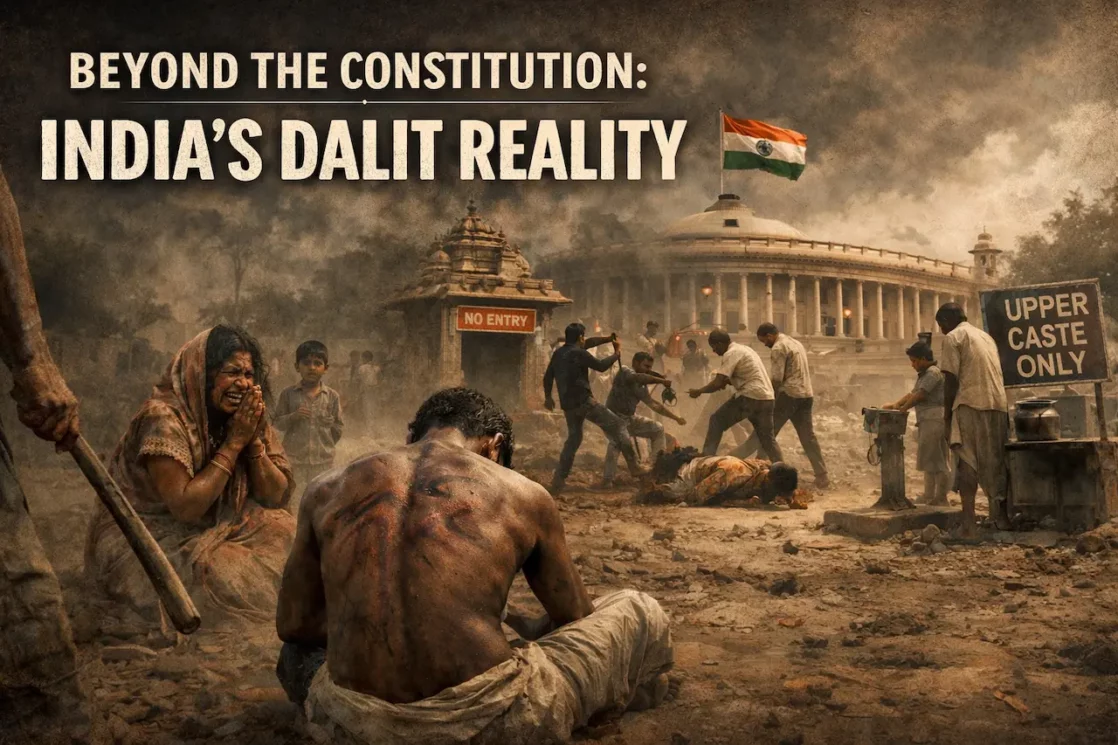
India often takes pride in calling itself the world’s largest democracy, a nation that constitutionally guarantees equality and dignity to every citizen. Yet beneath the confident rhetoric of progress lies a disturbing reality that many prefer not to confront openly. The oppression of Dalits, historically categorized as Scheduled Castes, continues to haunt the social fabric of the country even after decades of independence, constitutional protections, and social reform movements. It is one of those uncomfortable truths that survives quietly in the shadows of India’s rapid economic growth and technological advancement. While urban India celebrates start-ups, space missions, and global influence, millions of Dalits still struggle against a deeply embedded system of social hierarchy that has shaped Indian society for centuries.
The brutality of caste discrimination is not merely a relic of history; it remains a living social reality. Every year thousands of cases of violence against Dalits are registered across India. These incidents include physical assaults, murders, sexual violence, social boycotts, humiliation, and denial of access to basic resources such as water sources, temples, or community spaces. Behind every statistic lies a painful human story. In several rural areas Dalits have been attacked for riding a horse during their wedding procession, for sitting on chairs in the presence of dominant castes, or for attempting to assert equal rights that the Constitution supposedly guarantees. Such incidents expose the harsh contradiction between legal equality and social reality. Laws exist, but social attitudes remain deeply resistant to change.
The root of the problem lies in the historical structure of caste itself. Unlike many other forms of social discrimination around the world, caste in India is not merely a matter of prejudice between individuals. It is a rigid hereditary system that historically assigned people a fixed social status at birth. Over centuries this hierarchy became intertwined with religion, occupation, land ownership, and social prestige. Even after modern laws abolished untouchability, the cultural memory of caste hierarchy remained deeply embedded in everyday life. It shapes marriage alliances, social networks, economic opportunities, and political mobilization. Many Indians may publicly claim that caste no longer matters, yet one simple question often reveals the truth: before marriage alliances, business partnerships, or even friendships deepen, people quietly ask about caste background. The system may have softened in its outward appearance, but it still influences the invisible architecture of social relations.
Removing caste discrimination is extraordinarily difficult because it is sustained not only by prejudice but also by power. Historically dominant castes-controlled land, education, and social institutions. These advantages accumulated over generations and translated into economic and cultural capital. Dalits, on the other hand, were historically denied access to these resources and were forced into degrading occupations that society considered impure. Even today the economic gap created by centuries of exclusion continues to affect opportunities. While reservation policies in education and government jobs have enabled the rise of a Dalit middle class, a large proportion of Dalits still live in conditions marked by poverty, limited educational access, and social vulnerability.
Affirmative action policies were designed to correct this historical injustice, yet they have also created intense political debate. Many people from historically dominant castes believe that reservation policies unfairly disadvantage them. This resentment sometimes fuels social tensions, especially in regions where competition for jobs and educational opportunities is fierce. Dalit activists, however, argue that reservations are not a privilege but a minimal corrective mechanism for centuries of structural inequality. The clash between these viewpoints reveals how deeply caste still shapes India’s political and social landscape.
The role of the Brahmin community in the contemporary caste debate is often discussed in emotional and polarized ways. Historically Brahmins occupied the highest rung in the traditional social order and enjoyed cultural authority through their role as scholars, priests, and interpreters of sacred knowledge. This historical association with privilege has made Brahmins symbolic targets in modern caste discourse. At the same time, the reality of contemporary India is more complex. Not every Brahmin family enjoys wealth or power, and many struggle economically like any other social group. However, historical advantages such as access to education and intellectual networks did provide many upper-caste groups with a head start in modern professions such as academia, administration, and media. This historical advantage continues to influence perceptions of inequality even today.
One of the most troubling aspects of the Dalit question is the relative silence or inconsistency of mainstream media. Caste atrocities often receive limited national attention unless they become politically explosive. Several observers have pointed out that leadership positions in major news organizations are still dominated by individuals from upper-caste backgrounds, while marginalized communities remain underrepresented in editorial decision-making. When the voices shaping national narratives do not come from diverse social backgrounds, certain issues inevitably receive less attention. The result is a media environment where caste discrimination appears sporadically in headlines but rarely becomes a sustained national conversation.
Political parties have also contributed to the persistence of caste divisions. While leaders publicly condemn discrimination and promise social justice, electoral politics frequently relies on caste arithmetic. Communities are mobilized as vote banks, alliances are built around caste equations, and political rhetoric often reinforces social identities rather than transcending them. Caste thus becomes both a problem and a political tool. Leaders who claim to fight caste discrimination often depend on caste loyalties to secure power. This contradiction ensures that the system remains politically useful even as it is publicly criticized.
The most brutal truth is that social hierarchies rarely disappear simply because laws prohibit them. The Indian Constitution abolished untouchability and declared equality as a fundamental right, yet laws cannot instantly erase centuries of cultural conditioning. Real change requires transformation in social attitudes, economic structures, and personal relationships. It requires people to question inherited prejudices, challenge discriminatory practices within their own communities, and build institutions that genuinely promote equal opportunity.
India stands at a crossroads where its aspirations as a global power collide with unresolved social realities at home. The nation has achieved remarkable progress in science, technology, and economic development, yet the persistence of caste discrimination exposes a deeper moral challenge. A society that tolerates humiliation and violence against any community cannot truly claim to be modern or just. The plight of Dalits is therefore not merely a problem affecting one section of society; it is a mirror reflecting the unfinished work of India’s democratic promise.
Whether discrimination will ever completely disappear remains uncertain. Social systems that have survived for thousands of years rarely vanish within a few generations. Yet acknowledging the truth is the first step toward change. Ignoring the problem, romanticizing the past, or silencing uncomfortable discussions only prolongs injustice. India’s future credibility as a democratic civilization will depend on whether it confronts the legacy of caste with honesty and courage rather than denial.
