


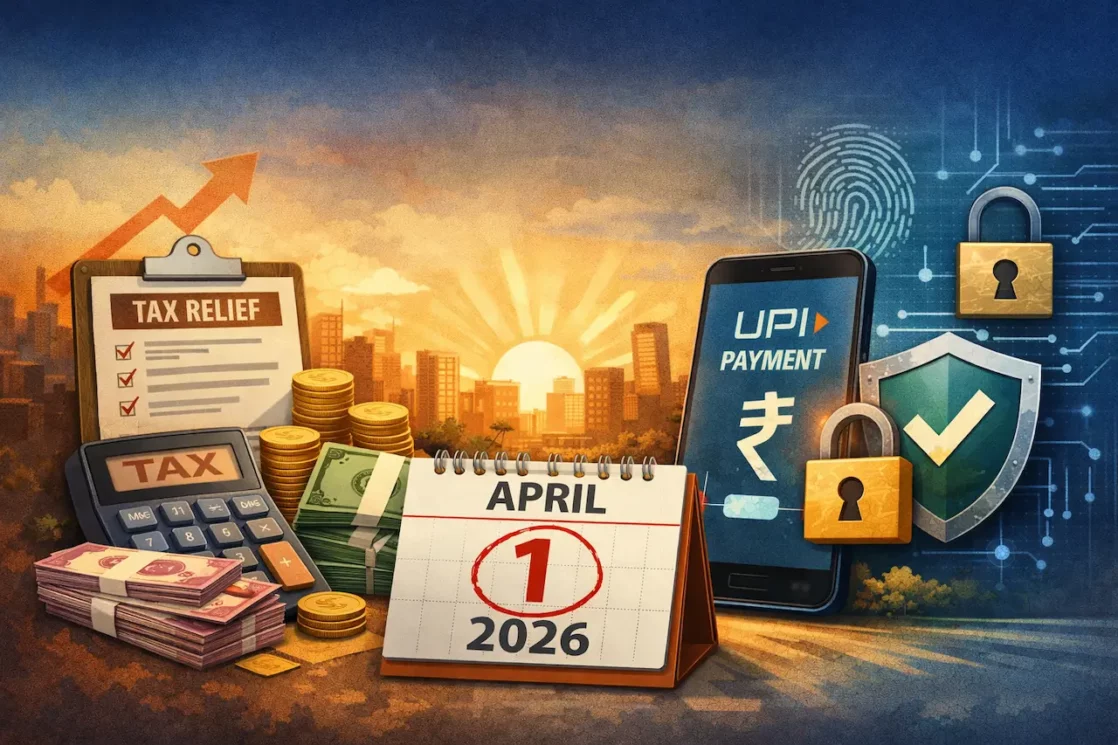
As India enters the new financial year on April 1, 2026, a wide range of regulatory changes have come into effect, impacting everything from taxation and digital payments to travel, fuel, and savings.
One of the biggest changes is the implementation of a revised income tax framework, under which individuals earning up to ₹12 lakh annually will not have to pay tax. With a rebate of up to ₹60,000 under Section 87A and a standard deduction of ₹75,000 for salaried individuals, effective tax-free income can go up to ₹12.75 lakh under the new regime.
The income tax filing calendar has also been adjusted. While salaried taxpayers must continue to file returns by July 31, the deadline for non-audit cases, including professionals and self-employed individuals, has been extended to August 31.
Digital payments are becoming more secure, with the Reserve Bank of India mandating two-factor authentication for UPI transactions. This means users may now need biometric verification, such as fingerprint or facial recognition, in addition to their PIN.
Banking costs are also seeing a slight increase. After exhausting the monthly limit of five free ATM withdrawals, customers may be charged ₹23 per transaction, along with applicable taxes, by several banks.
On the environmental front, oil companies are now required to supply E20 petrol—a blend containing 20 per cent ethanol—across the country. At the same time, new BS-VII emission norms are being introduced, bringing stricter monitoring of vehicle emissions, including brake dust and tyre microplastics.
Travel expenses and policies have also been revised. FASTag annual passes for non-commercial vehicles have increased by ₹75 to ₹3,075. Indian Railways has tightened its refund rules, offering no refund for tickets cancelled within eight hours of departure, compared to the earlier four-hour window.
Workplace regulations are undergoing significant changes under new labour codes. Employers must now ensure that at least 50 per cent of an employee’s salary is basic pay, which will likely reduce take-home pay but increase provident fund contributions for long-term savings. The minimum working days required to qualify for leave have been reduced from 240 to 180, and the tax-free limit for meal allowances has been raised to ₹200 per meal.
In a major boost to financial accessibility, the Employees’ Provident Fund Organisation (EPFO) has enabled PF withdrawals through ATMs and UPI, simplifying access to savings. Withdrawals have been categorised into essential needs, housing, and special circumstances.
However, certain administrative processes have become stricter. Applying for a PAN card will now require additional documentation beyond Aadhaar, such as a birth certificate, driving licence, or passport.
These changes mark a significant shift towards a more transparent, secure, and environmentally conscious system. While some adjustments—such as slightly lower take-home salaries or higher travel costs—may be felt in the short term, the reforms aim to deliver long-term benefits through improved financial security, cleaner energy usage, and easier access to savings.
