


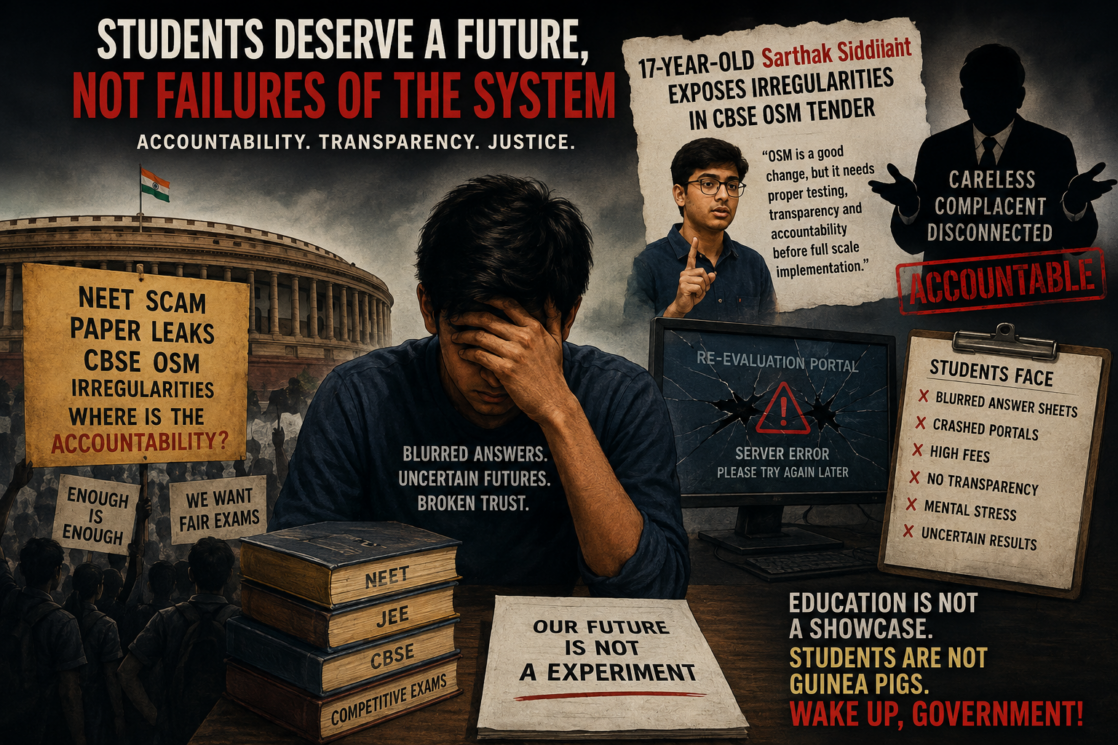
The unfolding controversy surrounding the CBSE’s On-Screen Marking (OSM) system should serve as a wake-up call for the Government of India. Instead, what we are witnessing is a familiar pattern of bureaucratic complacency, administrative opacity, and a shocking disregard for the concerns of millions of students whose futures depend upon the integrity of public examinations.
The fact that a 17-year-old student researcher, Sarthak Siddhant from Jharkhand, was compelled to investigate hundreds of tender documents and expose alleged irregularities in one of India’s most important educational institutions is both inspiring and deeply embarrassing. It raises a fundamental question: Where were the regulators, auditors, policymakers, and education administrators whose job it was to ensure transparency and accountability in the first place?
For years, the BJP-led government has repeatedly promised educational reforms, digital transformation, and world-class infrastructure. Yet the reality experienced by students tells a very different story. Whether it was the NEET examination controversies, repeated paper leak allegations across various recruitment examinations, technical failures in online systems, or now the chaos surrounding CBSE’s OSM implementation, the pattern remains disturbingly consistent. Ambitious announcements are made, technology is introduced, and reforms are celebrated before adequate testing, infrastructure, and safeguards are put in place.
The OSM controversy is not merely about software. It is about governance. Students reported blurred answer sheets, discrepancies in evaluation, crashed portals, inaccessible re-evaluation systems, and unexplained marks. Instead of anticipating these challenges through pilot testing and rigorous quality assurance, authorities appear to have pushed ahead with implementation at a national scale. When concerns emerged, students and parents were left struggling for answers while systems repeatedly failed them.
Even more troubling are the allegations raised regarding the tendering process itself. If eligibility conditions were indeed modified across multiple rounds in a manner that favoured a particular vendor, as alleged by Siddhant, then the issue extends far beyond examination management. It enters the realm of procurement transparency and public accountability. Such allegations deserve an independent and exhaustive investigation. The public has every right to know whether established procurement norms were followed and whether the interests of students were adequately protected.
What makes this episode particularly alarming is that it reflects a larger culture of administrative arrogance that has increasingly become visible in educational governance. Constructive criticism is often dismissed. Students who raise concerns are frequently ridiculed, ignored, or branded as troublemakers. In several recent cases, students were subjected to online abuse before institutions eventually acknowledged errors. A democracy cannot function when questioning authority becomes more difficult than exposing institutional failures.
The government must understand that education is not a public relations exercise. Students are not statistics to be displayed in annual reports, nor are examination systems laboratories for untested experiments. Every technical failure, every evaluation error, and every administrative lapse carries consequences that can alter academic careers, university admissions, scholarships, and professional opportunities.
The BJP government must therefore abandon its self-congratulatory approach and confront the growing crisis in educational administration with honesty and humility. India’s students deserve more than slogans about becoming a global knowledge superpower. They deserve reliable examination systems, transparent procurement processes, robust digital infrastructure, and institutions willing to admit mistakes when they occur.
The Parliamentary Standing Committee’s examination of this matter is a welcome step. However, the country must now await the findings of the investigative process. If the allegations are substantiated, accountability cannot stop at junior officials or technical vendors. Responsibility must extend to those who approved, supervised, and defended the system.
The larger lesson is impossible to ignore. When a teenager uncovers issues that entire institutions failed to detect—or chose not to address—it is not merely a story of youthful brilliance. It is an indictment of a system that has become too comfortable with mediocrity, too resistant to scrutiny, and too disconnected from the students it is meant to serve.
India’s young people deserve better. The question is whether those in power are finally prepared to listen.
