


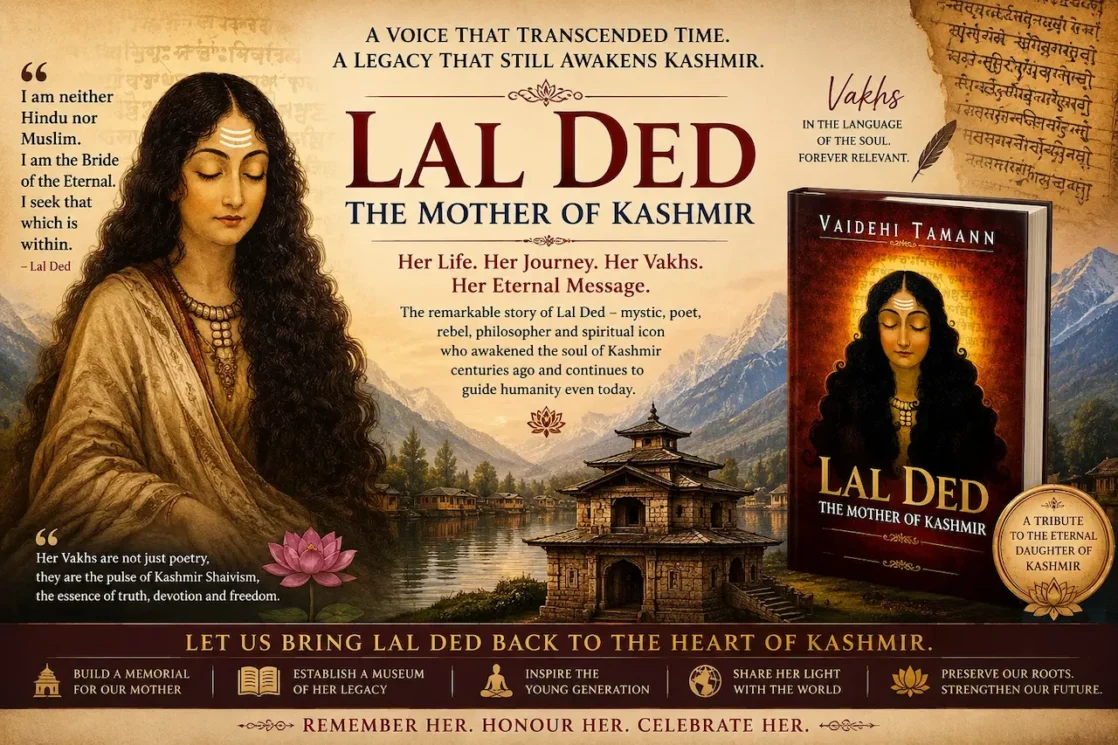
I arrived in Kashmir not merely as a journalist or an author, but as a seeker. While writing my recently published book, Lal Ded – Mother of Kashmir, I spent months walking through the Valley, travelling from one district to another, speaking to scholars, saints, historians, artists, villagers and ordinary Kashmiris. I visited ancient temples, forgotten shrines, abandoned archaeological sites and libraries filled with fading manuscripts. I listened to countless interpretations of Lal Ded’s Vakhs, yet one question refused to leave me: Where is Lal Ded herself?
Not in books. Not in research papers. Not in academic seminars.
Where is the living presence of the woman who shaped Kashmir’s soul?
The answer was both heartbreaking and disturbing. Kashmir remembers Lal Ded in words but has forgotten her in spirit. She survives in scattered verses, university dissertations and occasional textbook chapters, yet the woman who gave Kashmir its philosophical language has virtually disappeared from the public landscape. There is no grand memorial worthy of her stature, no museum narrating her extraordinary life, no cultural centre dedicated to her teachings, no statue that greets visitors entering the Valley, no pilgrimage circuit celebrating her journey, no interpretation centre where a young student or a curious tourist can understand why she transformed the spiritual history of Kashmir forever. The Valley proudly showcases its breathtaking mountains, shimmering lakes and magnificent gardens, yet the greatest landscape Kashmir has ever produced—the landscape of consciousness created by Lal Ded—remains invisible.
This absence is not merely an administrative oversight; it is a civilizational failure.
Every great civilization preserves those individuals who shaped its moral imagination. Italy celebrates Dante. Greece honours Socrates. China reveres Confucius. Maharashtra breathes through Sant Dnyaneshwar, Tukaram and Muktabai. Tamil Nadu carries Andal in its collective memory. Yet Kashmir, the land that produced one of the world’s greatest women mystics, has allowed her to slowly fade into the margins of public consciousness. Can a civilization truly call itself progressive if it forgets the very people who gave it its identity?
Development is often measured through highways, tunnels, airports, bridges and investment figures. These achievements are important and necessary. Kashmir deserves world-class infrastructure and economic prosperity. Its youth deserve opportunities, employment and a future free from violence. But development without memory is dangerously incomplete. Roads connect destinations, but culture connects generations. Concrete strengthens cities, but heritage strengthens civilizations. A society that invests only in physical infrastructure while neglecting its spiritual inheritance gradually begins to lose its identity. Its foundations become fragile, not because its economy is weak, but because its soul is neglected.
Lal Ded is not simply a historical figure confined to the fourteenth century. She is Kashmir’s moral compass. She belongs neither to one religion nor one community. She belongs to the conscience of Kashmir itself. Long before concepts such as interfaith dialogue, women’s empowerment or spiritual equality entered academic discourse, Lal Ded lived them. She walked fearlessly across a divided society, challenging ritualism, hypocrisy, superstition and empty orthodoxy. She questioned power without hatred and sought truth without fear. She rejected social pretence and taught that the divine could never be imprisoned within walls of caste, sect or external appearances. Her Vakhs continue to illuminate the timeless truth that self-realisation begins only when ego dissolves.
Perhaps this is precisely why Lal Ded remains relevant today.
We inhabit an age overflowing with information but starving for wisdom. We are digitally connected yet emotionally isolated. We celebrate material success while battling unprecedented anxiety, loneliness and spiritual emptiness. Young people scroll endlessly through social media searching for identity while knowing increasingly little about the civilization that shaped them. In such an age, Lal Ded speaks with astonishing freshness. She reminds us that peace cannot be downloaded, purchased or legislated. It must be discovered within. She teaches simplicity in an age of excess, authenticity in an era of performance, inner strength in a culture obsessed with external validation. Her philosophy is not medieval; it is profoundly modern because truth never becomes obsolete.
For Kashmir’s younger generation, Lal Ded should not remain merely another examination topic to be memorised and forgotten. She deserves to become an experience. Children should grow up visiting a Lal Ded Museum where her life is recreated through immersive storytelling. Universities should establish dedicated centres for Lal Ded Studies bringing together philosophy, literature, psychology, history and spirituality. Her Vakhs should be translated into every major Indian and international language without losing their poetic essence. Artists should paint her, filmmakers should interpret her, musicians should sing her verses, theatre groups should stage her journey and schools should organise annual Lal Ded festivals celebrating the values she lived for. Visitors from across the world should leave Kashmir carrying not only photographs of Dal Lake but also an understanding of the extraordinary woman who transformed the Valley’s spiritual consciousness.
Imagine if Kashmir had a magnificent Lal Ded Memorial overlooking the Valley, where pilgrims, scholars and tourists could gather irrespective of religion. Imagine a research institute preserving every manuscript related to her life. Imagine digital archives, international conferences, meditation centres inspired by her teachings, heritage walks tracing her footsteps and museums that narrate the story of Kashmir through her eyes. Such institutions would not merely honour one woman; they would restore confidence in Kashmir’s own civilizational identity. They would remind the world that long before Kashmir became associated with conflict, it was celebrated as one of humanity’s greatest centres of philosophy, aesthetics and spiritual inquiry.
The tragedy is not that scholars have ignored Lal Ded. On the contrary, several dedicated researchers have spent decades studying her Vakhs, preserving manuscripts and interpreting her philosophy. Many distinguished authors have written valuable books. Universities continue to undertake important research. Textbooks briefly introduce students to her legacy. Yet scholarship alone cannot preserve a civilization. A culture survives only when knowledge leaves the classroom and enters public life. Lal Ded deserves to be visible in Kashmir’s streets, institutions, museums, public art and collective imagination. She should not exist only in footnotes and doctoral theses.
As I travelled through Kashmir during my research, I met elderly people who still spoke her Vakhs with devotion. They carried her words in memory as though they had inherited them from generations before. But I also met countless young Kashmiris who had heard her name without truly knowing who she was. Some recognised a verse or two, while others associated her vaguely with spirituality. That disconnect should concern every Kashmiri. Civilizations are not lost overnight. They disappear gradually, one forgotten memory at a time.
Kashmir stands today at an important crossroads. The Valley is changing rapidly. Tourism is growing, infrastructure is expanding and new opportunities are emerging. This transformation must continue. But alongside every road built, let there also be a monument that preserves memory. Alongside every new institution, let there be one dedicated to culture. Alongside economic development, let there be a renaissance of Kashmir’s intellectual and spiritual heritage. Progress that abandons its roots ultimately becomes directionless. The tallest tree survives only because its roots remain deep beneath the soil.
Lal Ded is not merely the Mother of Kashmir because she was born here. She is its mother because she gave Kashmir a language through which to understand itself. She transformed philosophy into poetry, spirituality into lived experience and humanity into a shared identity that transcended boundaries. Her voice continues to whisper across the Valley’s rivers, mountains and chinars, waiting patiently for a generation willing to listen once again.
My journey through Kashmir while writing Lal Ded – Mother of Kashmir convinced me of one undeniable truth: Kashmir does not need to rediscover Lal Ded because she was never truly lost. It needs to rediscover itself through her. The greatest tribute to Lal Ded will not be another seminar, another research paper or another commemorative lecture. It will be the day when every child in Kashmir grows up knowing why she mattered, every visitor leaves the Valley carrying her message, and every Kashmiri feels pride in preserving the legacy of the woman who remains the eternal conscience of this ancient land.
A civilization that forgets its saints gradually forgets its soul. Kashmir cannot afford that loss. If it truly wishes to build a prosperous future, it must first reclaim the mother who gave it its spiritual identity. The time has come to bring Lal Ded home—not to history, where she already belongs, but to the living heart of Kashmir, where she has always deserved to be.
