


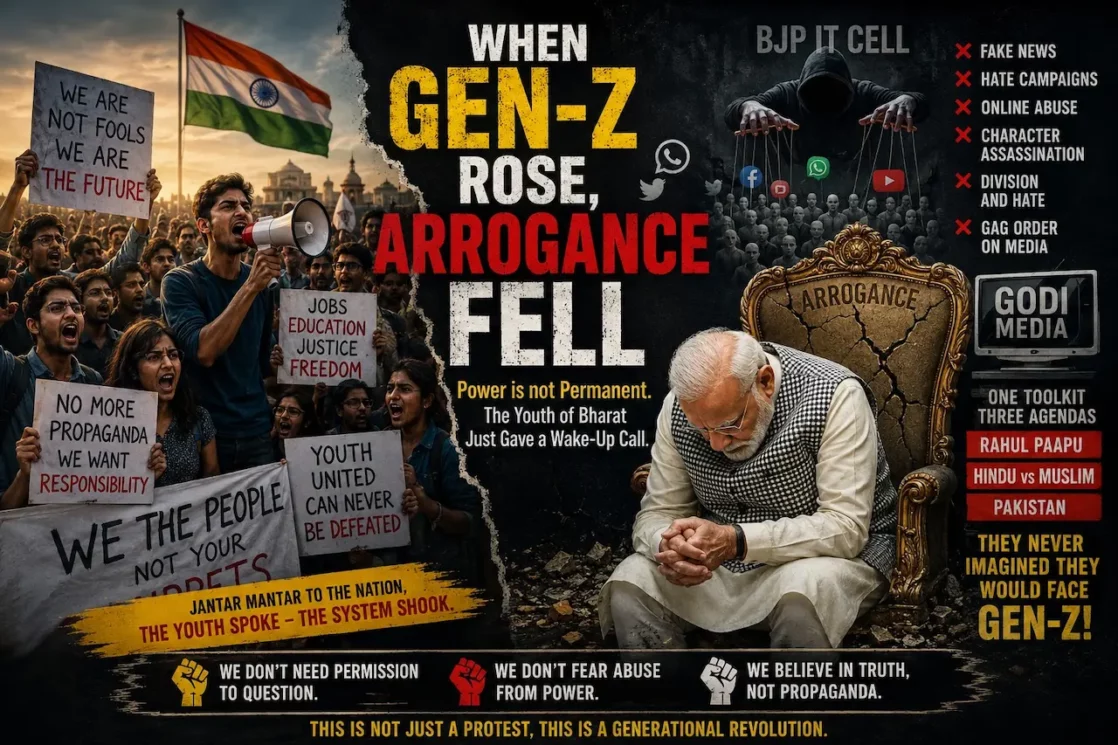
Power has one recurring weakness throughout history—it often mistakes electoral victory for permanent public consent. Governments may command institutions, dominate headlines, and shape political narratives, but they cannot indefinitely control the thoughts of an entire generation. Whenever young citizens begin questioning authority on their own terms, politics enters unfamiliar territory.
The recent wave of student-led protests demonstrated precisely this phenomenon. Regardless of one’s political affiliation, one message emerged unmistakably: India’s youth are unwilling to be passive spectators. They are connected, technologically fluent, emotionally expressive, and largely immune to the traditional methods of political messaging that influenced previous generations.
For over a decade, Indian politics has increasingly shifted from public meetings to digital battlefields. Social media became more than a communication platform—it became an instrument of political warfare. Every trending hashtag, viral video, clipped speech, edited photograph, and coordinated online campaign contributed to shaping public perception. Supporters viewed this as effective political communication. Critics argued that it frequently descended into misinformation, personal attacks, online harassment, and manufactured outrage.
Many political commentators have alleged that highly coordinated digital ecosystems have been used to amplify favourable narratives while aggressively targeting journalists, activists, opposition leaders, and dissenting voices. These allegations have been widely debated in public discourse, although the extent and organisation of such campaigns remains contested. Critics argue that branding opponents as “anti-national” or reducing every disagreement to patriotism versus betrayal narrows democratic debate and discourages genuine discussion.
Equally debated has been the role of sections of television media. Media scholars and opposition parties have often criticised parts of mainstream television for giving disproportionate space to emotionally charged narratives centred on personalities, religion, nationalism, and Pakistan, while devoting comparatively less sustained attention to governance failures, inflation, unemployment, education, healthcare, or administrative accountability. Supporters of the government reject this characterisation and argue that media outlets exercise independent editorial judgment.
Whether one accepts these criticisms or not, an important political reality has become difficult to ignore: digital narrative management has limits. It works most effectively when citizens remain passive consumers of information. It becomes significantly less effective when millions of young people begin creating their own narratives instead.
That is precisely what made recent student mobilisations politically significant.
Unlike traditional opposition movements organised by established political parties, these demonstrations were driven largely by young citizens speaking in their own language, using their own humour, memes, videos, music, and online communities. There was no single command centre, no universally recognised leadership, and no conventional hierarchy. This decentralised nature made the movement far harder to counter through familiar political strategies.
Generation Z does not consume information the way earlier generations did. They compare multiple sources, circulate recordings instantly, remix political speeches into memes, and challenge official narratives within minutes. Attempts to dominate information flows through conventional messaging face a very different communications environment than existed even ten years ago.
Another important feature of these protests was psychological rather than organisational. Students generally possess a different risk calculation from established politicians or professionals. Many are not yet embedded in corporate careers, government employment, or business networks. Consequently, traditional forms of political pressure often have less influence over them. That does not place them above the law, nor does it justify abusive conduct, but it changes the dynamics of political mobilisation.
This is where established political communication strategies encountered an unfamiliar challenge. Systems designed primarily to confront rival political parties suddenly found themselves responding to a generation that neither followed conventional political etiquette nor accepted inherited partisan narratives. The conversation was no longer confined to television studios or party press conferences; it unfolded simultaneously across thousands of phones and social media accounts.
Political communication also carries an important lesson about credibility. Public trust is difficult to build and easy to exhaust. Communication scholars have long observed that when audiences are repeatedly exposed to exaggerated warnings that fail to match subsequent evidence, the persuasive power of future warnings declines. In politics, this means that constant rhetorical escalation can eventually produce diminishing returns. Citizens begin distinguishing between genuine crises and routine political messaging.
India’s democracy has repeatedly shown that no political party, however dominant, enjoys permanent ownership over public opinion. Every generation reassesses those in power according to its own priorities. Today’s young voters are concerned not only with identity and ideology but also with employment opportunities, education, technological growth, cost of living, institutional accountability, transparency, and personal freedoms. Any political formation that underestimates these concerns risks losing the confidence of emerging voters.
The deeper democratic lesson extends beyond one government or one opposition. Democracies remain healthy only when criticism is answered with arguments rather than intimidation, facts rather than rumours, and accountability rather than personality cults. Governments gain legitimacy not by silencing uncomfortable questions but by responding to them openly.
History consistently reminds us that power changes hands, political narratives evolve, and every ruling establishment eventually encounters a generation it cannot easily predict. Youth movements have often served as reminders that democratic authority ultimately rests not in propaganda, publicity, or perception management, but in the continuing consent of informed citizens.
Whether one supported or opposed these student protests, they underscored a timeless truth: no government, no political party, no media ecosystem, and no digital campaign is larger than the democratic right of citizens to question those who govern them. Power may appear formidable, but in a constitutional democracy it is never permanent. Every generation rewrites the political conversation, and every government is ultimately accountable to the people it serves.
