India Launches Its Heaviest Communication Satellite GSAT-7R, A 'Shiny Example of Aatmanirbhar Bharat': ISRO Chief 2
The Indian Space Research Organisation (ISRO) on Sunday successfully launched the Indian Navy’s GSAT-7R (CMS-03), India’s heaviest communication satellite, marking a major milestone in the nation’s space and defence capabilities. The launch took place from the second launch pad of the Satish Dhawan Space Centre in Sriharikota, Andhra Pradesh, at 5:26 PM. The satellite was placed precisely into its intended orbit by the LVM3-M5 (Baahubali) rocket.
Weighing 4,410 kg, the multi-band communication satellite is designed to provide services across India and the adjoining oceanic region. It is expected to operate for at least 15 years. The indigenously developed satellite will significantly boost the Indian Navy’s space-based communication and maritime domain awareness capabilities, featuring advanced technologies tailored to operational needs.
Commending the successful mission, ISRO Chairman V. Narayanan hailed the CMS-03 as “another shiny example of Aatmanirbhar Bharat,” crediting the achievement to the relentless efforts of ISRO teams across multiple centres despite challenging weather conditions. “The CMS-03 satellite is a multi-band communication satellite with coverage over a wide oceanic region, including the Indian landmass. It incorporates a host of new technologies and is designed to provide services for at least 15 years. The entire ISRO team deserves high praise for executing this complex mission flawlessly,” he said.
Narayanan revealed that ISRO had conducted a crucial in-flight experiment involving the indigenously developed C-25 cryogenic stage, successfully igniting the thrust chamber after satellite deployment. This achievement, he said, would pave the way for future mission flexibility, allowing multiple satellite placements in varied orbits.
Highlighting the performance of the LVM3-M5 rocket, Narayanan said the vehicle had lifted 4,410 kg to an elliptical orbit—its highest payload ever—exceeding its standard 4,000 kg capacity to Geosynchronous Transfer Orbit (GTO). “All eight launches of the LVM3 have been successful, making it a 100% reliable vehicle. The same launcher is earmarked for our upcoming Gaganyatri-2 mission,” he added.
The CMS-03 satellite marks a significant leap in India’s drive to modernize naval communications through indigenous innovation. With expanded coverage over the Indian Ocean Region, it will strengthen the Navy’s network-centric operations, improve real-time coordination, and enhance India’s strategic space capabilities.
ISRO’s accomplishment reinforces India’s growing self-reliance in space technology and underscores its steady march toward becoming a global leader in space exploration under the vision of Aatmanirbhar Bharat.
Jain Monk Launches Hunger Strike Over Dadar Kabutarkhana Closure in Mumbai 4
Jain monk Nileshchandra Vijay on Monday began a protest at Mumbai’s Azad Maidan, opposing the Brihanmumbai Municipal Corporation’s (BMC) decision to shut down the Dadar Kabutarkhana — a site where the Jain community has traditionally fed pigeons for decades.
Before starting his indefinite fast near the BMC headquarters, the monk told reporters that his demand was simple — the restoration of the historic Kabutarkhana, which holds deep religious and cultural significance for the community.
The protest comes in response to the civic body’s recent move to allow controlled pigeon feeding only at four alternate locations — Worli Reservoir, Lokhandwala Back Road mangroves in Andheri West, the Airoli-Mulund check post area, and Gorai ground in Borivali West. The BMC has clarified that feeding will be allowed only between 7 am and 9 am, with non-governmental organisations managing the sites. It also termed the arrangement temporary until the expert committee’s recommendations and court orders are received.
Criticising the decision, Vijay said the alternate sites were too far from Dadar. “The sites are 4 to 9 kilometres away. Will pigeons fly that far? The administration should have chosen a site within two kilometres of the existing Kabutarkhana,” he argued.
Drawing parallels with other public movements, he said, “If Manoj Jarange can protest for his community, why can’t I protest for the welfare of animals? If I’m asked to leave Azad Maidan, I’ll continue my fast at Dadar Kabutarkhana itself.”
The monk demanded that the BMC permit feeding at Dadar for two hours each in the morning and evening, similar to the alternate sites. He also said the Jain community was ready to raise funds to purchase land if the civic body allotted a new location.
“The Kabutarkhana is over a hundred years old — it’s the pigeons’ home, and we have a moral duty to protect it,” he said, adding that since the closure, the pigeon population had declined drastically. “More than one lakh pigeons have died since the feeding stopped. Community volunteers now treat around 50 to 60 injured or sick pigeons daily.”
Vijay emphasised that his agitation would remain peaceful. “We are protesting for the pigeons — they are messengers of peace,” he said.
Earlier, the Jain community had staged demonstrations across Mumbai after the BMC closed pigeon-feeding enclosures following a Bombay High Court order. While many residents supported the move citing health concerns from pigeon droppings, Jain groups expressed deep anguish over what they described as an assault on religious tradition.
Tensions first escalated in August when community members tore down tarpaulin covers installed by the civic body at Dadar Kabutarkhana. The BMC, however, refused to reverse its decision. Jain monks even organised a prayer meeting for pigeons that reportedly died after the closure, urging the government to reopen the site.
Meanwhile, local groups like Aamhi Girgaonkar have backed the ban, holding placards that read “Kabutar Go Back to Marwad Rajasthan,” arguing that human health must take precedence over religious custom.
Thick Haze Engulfs Delhi as Air Quality Dips to 'Very Poor' with AQI at 316 6
A thick grey haze enveloped Delhi on Monday morning as the city’s air quality remained in the ‘very poor’ category, showing persistent pollution levels across the capital.
According to the Central Pollution Control Board (CPCB), Delhi recorded an overall Air Quality Index (AQI) of 316. Data from the CPCB’s Sameer app revealed that 28 monitoring stations across the city reported ‘very poor’ air quality with readings exceeding 300.
As per the AQI scale, a reading between 0 and 50 is considered ‘good’, 51 to 100 ‘satisfactory’, 101 to 200 ‘moderate’, 201 to 300 ‘poor’, 301 to 400 ‘very poor’, and 401 to 500 ‘severe’.
The India Meteorological Department (IMD) reported Delhi’s minimum temperature at 17.9 degrees Celsius — nearly two degrees above the seasonal average — with humidity levels recorded at 64 per cent at 8:30 am. The maximum temperature is expected to hover around 30 degrees Celsius with misty conditions likely to persist throughout the day, the IMD added.
19 Killed, 4 Injured as Gravel-Laden Lorry Crashes Into Bus in Telangana's Ranga Reddy District 8
At least 19 people were killed and four others injured when a gravel-laden tipper lorry collided head-on with a Telangana State Road Transport Corporation (RTC) bus in Ranga Reddy district on Monday morning, police said.
The accident occurred near Chevella when the tipper lorry rammed into the RTC bus travelling from Tandur to Hyderabad, causing the gravel load to spill onto the vehicle. Among the deceased were 10 women, and the bus driver was also killed in the crash, a police official confirmed.
Authorities said the total number of passengers on board was not immediately known, as the injured survivors were in shock and unable to provide details. Rescue teams used earthmovers to clear the debris and pull out trapped passengers from the mangled bus.
Chief Minister A Revanth Reddy expressed deep sorrow over the tragic incident and directed Chief Secretary K Ramakrishna Rao and DGP Shivadhar Reddy to carry out relief operations on a war footing. He also instructed ministers to reach the site and oversee the rescue efforts, while ordering that the injured be shifted to Hyderabad for advanced medical treatment.
PM Modi Unveils Rs 1 Lakh Crore RDI Fund to Boost Private R&D and Inspire Young Innovators 10
Prime Minister Narendra Modi on Monday launched the ₹1 lakh crore Research, Development and Innovation (RDI) Fund to encourage private sector investment in research and development. The announcement was made at the inaugural Emerging Science Technology and Innovation Conclave (ESTIC), a platform that brings together policymakers, innovators, and global experts to advance the government’s vision of Viksit Bharat 2047.
During the event, Modi also unveiled a coffee table book showcasing India’s scientific achievements and a vision document outlining the country’s roadmap for science and technology.
The Department of Science and Technology (DST) will serve as the nodal ministry for the RDI Fund, which will operate through a two-tiered structure. At the first level, a Special Purpose Fund (SPF) will be set up within the Anusandhan National Research Foundation (ANRF), serving as the custodian of the ₹1 lakh crore corpus.
Instead of directly investing in industries or startups, the Fund will route capital through second-level fund managers, including Alternative Investment Funds (AIFs), Development Finance Institutions (DFIs), and Non-Banking Finance Companies (NBFCs).
These fund managers will recommend projects for support through expert investment committees drawn from financial, business, and technical domains, functioning independently from the government.
The initiative aims to create a robust ecosystem for private R&D in India while inspiring young innovators to contribute to the nation’s technological growth.
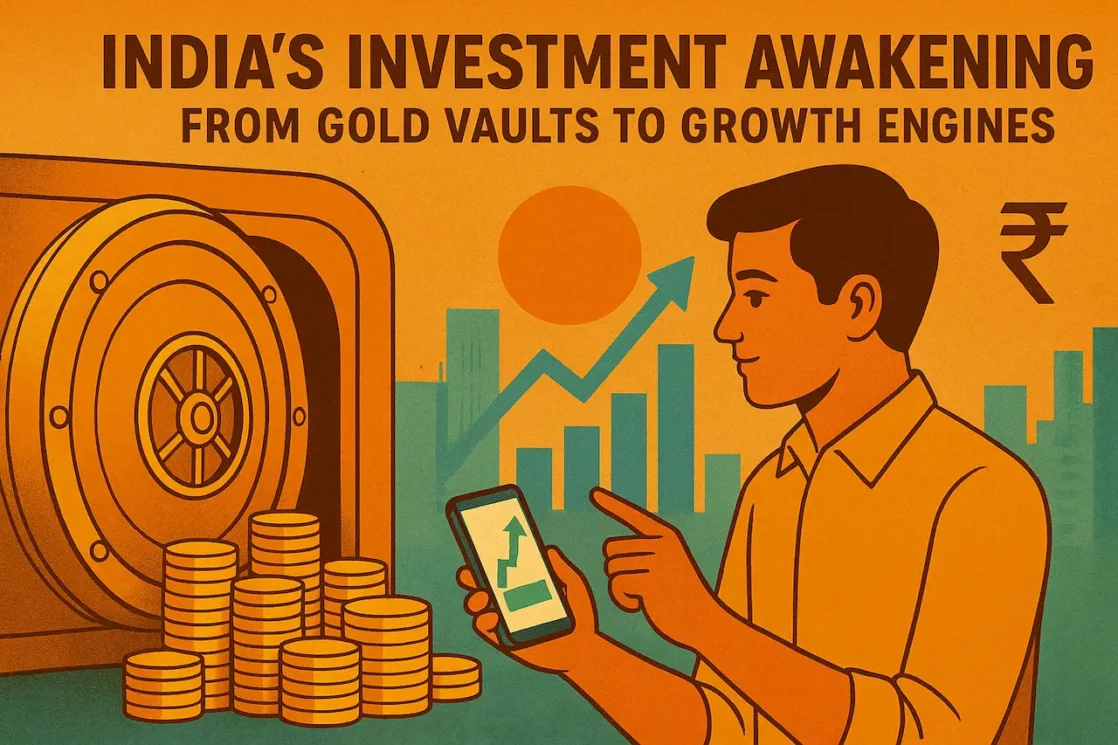
India's Investment Awakening: From Gold Vaults to Growth Engines 12
Investment in India’s financial markets is no longer the privilege of a few savvy urban players; it’s becoming a quiet revolution. Yet, beneath the enthusiasm and new demat account numbers lies a sobering truth—India is still vastly under-invested in its own growth story. Barely ten percent of Indian households participate in the securities market, and even that figure is misleading because many accounts are either inactive or represent multiple holdings by the same individuals. For a country of over 140 crore people with one of the world’s highest savings rates, this under-penetration of financial investment reveals both an enormous opportunity and a long-standing cultural hesitation. Historically, Indians have preferred safety over strategy. Gold, real estate, and fixed deposits have symbolized stability, while equities were viewed as risky or speculative. That mindset is slowly changing, driven by technology, regulation, and generational shift. The advent of digital platforms, zero-brokerage models, and simplified KYC procedures has stripped away many barriers that once kept retail investors at bay. A person in a tier-3 town can now open a demat account and start an SIP in minutes using a mobile app. This democratization of access has created a surge of new investors, particularly among the youth, who see financial markets not as gambling dens but as legitimate tools for wealth creation and economic participation.
Still, the journey from access to active, informed participation is a long one. Numbers alone don’t tell the full story. India’s 12 crore registered investor accounts sound impressive, but account activity and portfolio size show that a large percentage of investors barely scratch the surface of opportunity. Many enter markets during rallies and disappear at the first sign of correction. This herd behavior—rooted in poor financial literacy and an ingrained fear of loss—keeps the broader market fragile and underdeveloped. The challenge isn’t to bring people in; it’s to keep them in, with discipline and understanding. That’s where financial education becomes not just a moral goal but an economic necessity. Without basic awareness of diversification, asset allocation, compounding, and taxation, participation risks becoming speculation. In a society still dominated by informal savings, teaching disciplined investing is the only way to convert a culture of storing into a culture of growing.
The importance of investing in financial markets for India cannot be overstated. When households channel their savings into equities and mutual funds, they fuel the real economy. Companies gain access to domestic capital instead of relying solely on foreign institutional investors. The ownership of national growth becomes broad-based, allowing ordinary citizens to benefit from corporate profits, innovation, and infrastructure expansion. A deep and retail-driven market also cushions the economy from external shocks. It ensures that capital formation is anchored in domestic confidence rather than foreign sentiment. The more Indians invest in their own markets, the more resilient India becomes against global volatility. This isn’t just about numbers; it’s about sovereignty—economic self-reliance through participatory capitalism.
However, the structural roadblocks are real. The average Indian household still equates financial safety with guaranteed returns, ignoring inflation’s silent theft of value. Even educated professionals often lack the patience for long-term compounding. They chase short-term tips, rely on hearsay, or fall prey to social media gurus promising instant riches. This behavioral immaturity costs dearly. For India to truly mature as an investing nation, it needs not only infrastructure and regulation but also psychological reform. People must understand that market volatility is not loss—it’s the price of future growth. Volatility filters out the impatient and rewards those who trust the power of time and compounding. As Warren Buffett famously said, the stock market is a mechanism for transferring money from the impatient to the patient; India’s problem is that too few have yet joined the patient side.
Fortunately, there are clear tailwinds. Mutual funds have become household words, SIP culture is strengthening, and financial influencers—despite their excesses—have sparked curiosity among the young. Fintech innovation has flattened barriers of geography and class. Women investors are rising rapidly, reflecting broader social participation. Regulatory vigilance from SEBI, tighter norms on advisory ethics, and better product transparency are building confidence. The government’s push for financial inclusion—through Jan Dhan, UPI, and digital literacy drives—has created the rails on which this investment revolution can run. The transformation of Indian savings into formal investment will be one of the most consequential socio-economic shifts of this century. It will determine whether India’s much-discussed demographic dividend translates into sustainable household prosperity.
Yet optimism must stay tethered to realism. The average Indian investor’s portfolio is still narrow, often limited to a few mutual funds or small-cap stocks. Long-term pension and insurance-linked investments remain underpenetrated. Corporate bond markets are shallow, and the appetite for diversified financial instruments is thin. For every new investor who studies before investing, there are ten who trade on impulse. That imbalance between participation and preparation is India’s next frontier. Bridging it requires a national mission—financial literacy taught as life skill, not luxury. Schools and universities should treat investing the way they teach civics: as an essential part of responsible adulthood. Only then can the Indian saver evolve into the Indian shareholder.
In the bigger picture, investing in financial markets is not merely about personal wealth—it’s about national development. When citizens invest in companies, they’re indirectly funding factories, jobs, and innovation. They’re converting individual savings into collective productivity. A farmer in Gujarat, a teacher in Odisha, and an engineer in Bengaluru—all owning units of Indian companies—represent a more inclusive version of capitalism than any slogan about equality ever could. This is how a nation truly grows together: not just through redistribution of wealth, but through co-creation of it. The moral dimension of investing lies here—participation transforms economic spectators into economic citizens.
India’s growth story is now global conversation, but to sustain that narrative domestically, Indians themselves must invest in it—literally. Our ancestors trusted gold and land because they lived in times of uncertainty; our generation must trust enterprise, innovation, and markets because we live in a time of opportunity. The world’s fifth-largest economy cannot remain a country where less than ten percent of households participate in its capital markets. It’s time for financial investment to be seen not as speculation but as a patriotic duty—a vote of confidence in India’s future. Every SIP, every share, every systematic contribution is not just a transaction; it’s a declaration: “I believe in India’s growth.” That belief, multiplied across millions of disciplined investors, is what will make India not just a fast-growing economy but a financially empowered civilization.
Sanjay Raut Reveals Serious Health Issues, Advised to Avoid Public Gatherings 14
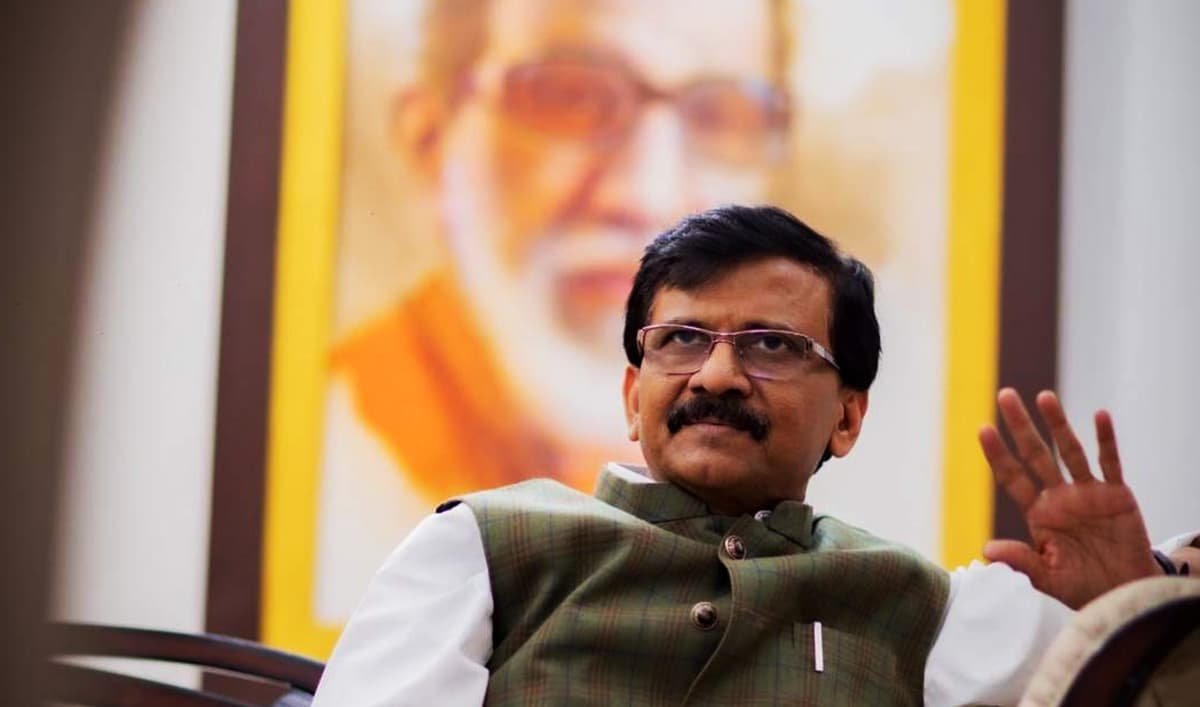
Shiv Sena (UBT) leader and Rajya Sabha MP Sanjay Raut on Friday revealed that he is suffering from serious health issues and is currently undergoing treatment. In a heartfelt post on X, Raut said he has been advised by doctors not to step out or mingle with people for the time being.
“You have all loved and trusted me. But I have developed serious health issues and am undergoing treatment. I will come out of this. As per medical advice, I have been asked not to step out or mingle in public,” Raut wrote, without sharing further details about his condition.
The senior leader expressed optimism that he would regain good health by next year.
A prominent Opposition voice and a fierce critic of the BJP, Raut is known for his sharp commentary and daily interactions with the media. He was also expected to join the Opposition parties’ protest against the Election Commission on November 1, but his health condition may now prevent his participation.
RBI Wraps Up Rs 32,000 Crore Bond Auction; Green Bond Draws Highest Underwriting Commission 16
The Reserve Bank of India (RBI) on Friday announced the completion of its ₹32,000 crore bond auction, revealing the highest underwriting commission in the Sovereign Green Bond (SGrB) 2054 issue. The auction, held on October 31, was part of the central bank’s Additional Competitive Underwriting (ACU) for select government securities.
According to the RBI, the 5.91% Government Security (GS) 2028, with a notified amount of ₹9,000 crore, had a Minimum Underwriting Commitment (MUC) of ₹4,515 crore and an ACU amount of ₹4,485 crore. The total amount underwritten stood at ₹9,000 crore, with a cut-off commission rate of 0.15 paise per ₹100.
For the 6.98% Government of India Sovereign Green Bond (SGrB) 2054, the notified amount was ₹5,000 crore, with an MUC of ₹2,520 crore and an ACU accepted amount of ₹2,480 crore. The total underwritten amount reached ₹5,000 crore, with the highest underwriting commission rate of 1.50 paise per ₹100.
The 6.28% GS 2032, with a notified amount of ₹11,000 crore, recorded an MUC of ₹5,502 crore and an ACU of ₹5,498 crore. The total underwritten amount was ₹11,000 crore, with the underwriting commission fixed at 0.30 paise per ₹100.
Meanwhile, the 7.24% GS 2055 issue, worth ₹7,000 crore, saw an MUC of ₹3,507 crore and an ACU of ₹3,493 crore. The total underwritten amount stood at ₹7,000 crore, with a commission rate of 0.67 paise per ₹100.
With this, the RBI concluded the auction of government securities worth ₹32,000 crore, showcasing strong market participation and growing interest in long-term green bond instruments.
Beyond Alliances and Egos: Fadnavis's Quiet Game to Reclaim Maharashtra 18
Maharashtra’s politics is once again entering a decisive and intriguing phase. The rallies planned by Uddhav Thackeray’s Shiv Sena and Raj Thackeray’s Maharashtra Navnirman Sena are not just shows of strength — they mark an attempt to recapture the emotional and linguistic core of the Marathi voter. Behind this visible mobilisation, however, lies a quieter but far more complex political design being shaped by Devendra Fadnavis, the real strategist behind the BJP’s enduring influence in the state.
Fadnavis has, over the years, mastered the art of weakening regional parties not by frontal confrontation but through calculated fragmentation. He first worked to break the strongholds of the Congress and NCP, then turned towards the Shiv Sena when it began drifting away from the BJP’s fold. What appeared to be a setback after the 2019 election — when Uddhav Thackeray chose to ally with the Congress and NCP — was, in fact, the beginning of a new game. Fadnavis used the moment to split the Sena, elevate Eknath Shinde, and reclaim power for the BJP through an alliance that appeared secondary but was deeply tactical. It allowed the BJP to maintain its dominance while letting the Sena fight its own identity battle.
Now, that same strategy seems to be entering its next phase. With Shinde having served his political purpose, the BJP’s focus appears to be on shrinking his influence and isolating him from both ends — emotionally from the Marathi base that sees him as a betrayer, and politically from the BJP’s core that views him as a temporary ally. Several of Shinde’s key associates, once aggressive and vocal, have quietly lost ground or public relevance. The initial enthusiasm of the breakaway faction has faded, replaced by an unease that Fadnavis seems to have calculated perfectly.
In contrast, Uddhav Thackeray, despite his diminished numbers, retains emotional legitimacy among a section of traditional Shiv Sainiks and the urban Marathi electorate. This makes a potential future understanding between BJP and Uddhav Sena not just possible but strategically advantageous. For the BJP, this would mean a return to the traditional alliance that once anchored its rise in Maharashtra — but this time, on its own terms. The Thackeray faction, exhausted by isolation, may be more amenable to negotiation, and Fadnavis, with his ability to combine tactical patience with political timing, would be the natural architect of such a reunion.
At the same time, Fadnavis has maintained a deliberate silence over Uddhav’s recent outreach and the growing restlessness within Shinde’s camp. It is the silence of a chess player who knows the next few moves are his to make. His strength lies not just in electoral management but in controlling the psychological tempo of Maharashtra’s politics. While others react, he plans. While others campaign, he reconfigures alliances. His ability to dismantle power structures without overt conflict has made him the state’s most formidable political operator in decades.
If this trajectory continues, Eknath Shinde’s faction is likely to fade into political irrelevance — too estranged from the Thackeray legacy to reclaim its roots and too dependent on the BJP to claim independent identity. The Marathi vote that once split between pride and protest may again consolidate, and the BJP, under Fadnavis, would emerge as the stabilising force capable of bridging both ends.
India, US Seal Historic 10-Year Defence Pact in Malaysia to Boost Strategic Ties 20
India and the United States on Friday signed a landmark 10-year Defence Framework Agreement in Kuala Lumpur, strengthening their strategic partnership and reaffirming their commitment to regional security. The agreement was exchanged between Defence Minister Rajnath Singh and US Secretary of War Pete Hegseth, outlining a long-term roadmap for the US–India Major Defence Partnership.
The new framework marks a major milestone in bilateral relations, providing policy direction across the entire spectrum of defence cooperation, including technology sharing, coordination, and strategic planning.
Calling the pact “historic,” Hegseth said it reflects unprecedented defence collaboration between the two democracies. “This advances our defence partnership — a cornerstone for regional stability and deterrence. We’re enhancing coordination, information sharing, and technology cooperation. Our defence ties have never been stronger,” he wrote on X.
Rajnath Singh echoed this sentiment, describing his meeting with Hegseth as “fruitful” and the agreement as a “new era” in the India–US relationship. “The framework will provide policy direction to the entire spectrum of the India–US defence relationship. It signals our growing strategic convergence and will herald a new decade of partnership,” Singh said in a post on X.
The meeting took place on the sidelines of the ASEAN–India Defence Ministers’ Informal Meeting in Kuala Lumpur, ahead of the ASEAN Defence Ministers’ Meeting Plus (ADMM-Plus) scheduled for November 1. The forum will focus on regional cooperation and security in the Indo-Pacific region.
Ahead of his visit, Singh had said that India’s engagements with ASEAN member states aim to deepen defence and security cooperation under the ‘Act East Policy’.
The agreement cements the momentum in India–US defence relations, highlighting shared goals of maintaining a free, open, and rules-based Indo-Pacific.