


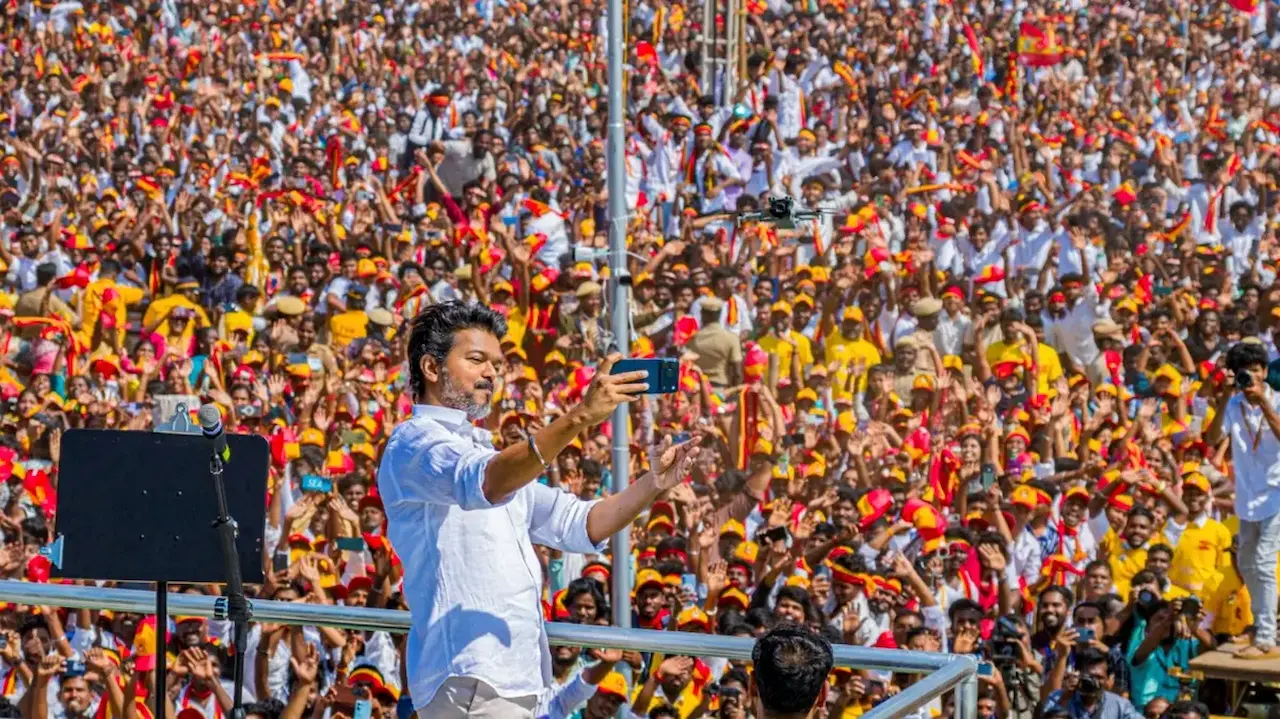
Actor-turned-politician Vijay has pulled off a stunning electoral debut, with his party Tamilaga Vettri Kazhagam (TVK) emerging as a front-runner to form the government in Tamil Nadu, drawing comparisons to rare political “startups” that achieved instant success.
TVK’s rapid rise places it alongside a select group of parties such as the Aam Aadmi Party (AAP), Asom Gana Parishad (AGP), and Telugu Desam Party (TDP), all of which formed governments soon after their electoral debut. While AAP formed a government in Delhi in 2013 with outside support, AGP came to power in Assam in 1985, and TDP swept Andhra Pradesh in 1983 under the leadership of N. T. Rama Rao.
According to early Election Commission trends, TVK was leading in over 100 seats in the 234-member Assembly, well within striking distance of the majority mark of 118. In contrast, the Dravida Munnetra Kazhagam (DMK) and All India Anna Dravida Munnetra Kazhagam (AIADMK)—the two dominant Dravidian parties—were trailing significantly, marking a potential political upheaval in the state.
TVK’s meteoric rise stands out in a political landscape where many new parties fail to sustain momentum. Recent examples include Jan Suraaj Party, which generated significant buzz but failed to win seats, and Makkal Needhi Maiam, which did not make an electoral breakthrough in 2021.
Across India, several smaller parties continue to operate with limited regional influence, including outfits like the Hindustani Awam Morcha and Rashtriya Lok Morcha in Bihar, or Apna Dal (Sonelal) and Suheldev Bharatiya Samaj Party in Uttar Pradesh. However, few have managed to translate initial hype into decisive electoral victories.
Historically, successful parties have either emerged from strong ideological movements, mass agitations or charismatic leadership. The Indian National Congress traces its roots to the freedom movement, while the Bharatiya Janata Party rose through ideological mobilisation. Regional powerhouses such as the Trinamool Congress and Biju Janata Dal grew from established political figures breaking away from parent parties.
In this context, TVK’s performance stands out as a rare phenomenon—a political “startup” turning into a “unicorn” almost instantly. If current trends hold, it could not only end decades of DMK-AIADMK dominance but also inspire a new wave of political entrants looking to replicate its success.
