


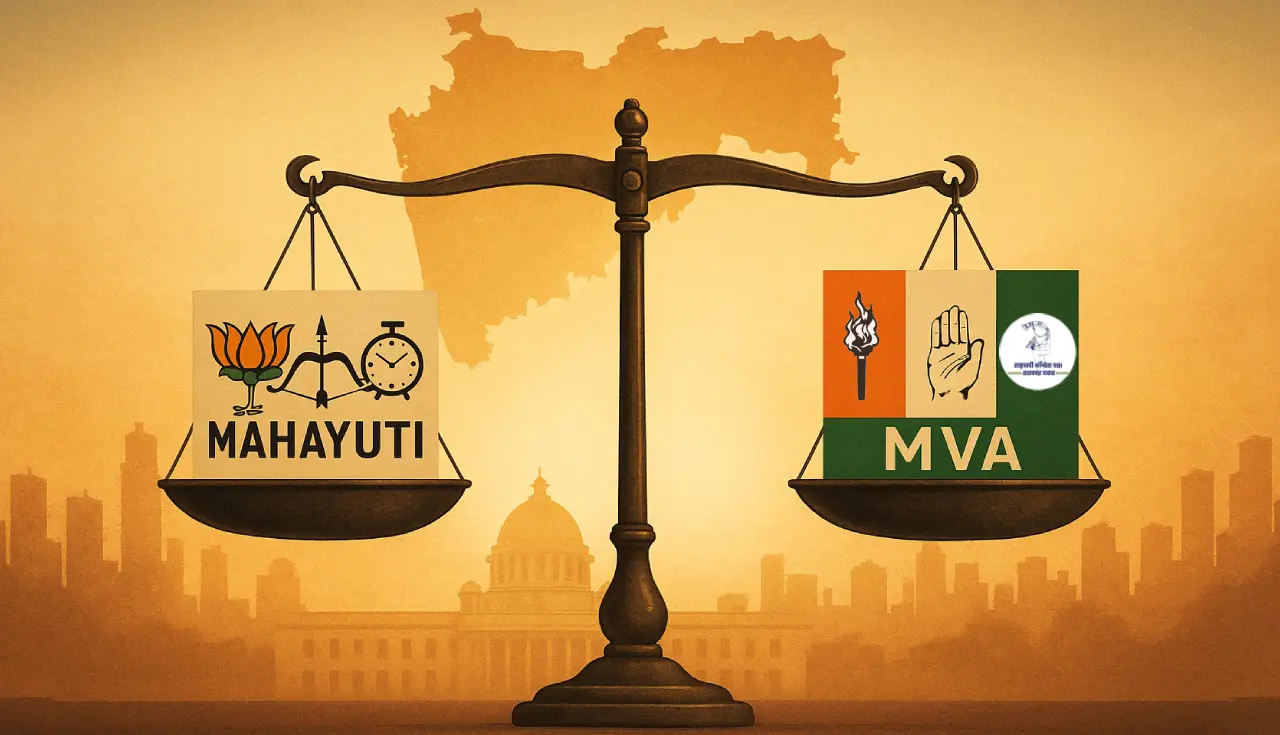
The upcoming local bodies elections in Maharashtra are no ordinary contests. They are the first major litmus test for the Mahayuti alliance — a coalition that came together out of strategy and necessity — and a proving ground for the Bharatiya Janata Party (BJP) as it prepares the battlefield for its ambitious “Shatpratishat BJP” (100% BJP) strategy aimed at the 2029 Assembly elections.
Behind the local battles for municipal corporations, zilla parishads, and panchayat samitis lies a much larger political war — one that will determine who controls Maharashtra’s political narrative for the next decade. For the BJP, these polls are not merely administrative contests; they are about deepening its grassroots presence, asserting its organizational supremacy, and reclaiming dominance in regions where local equations once tilted in favor of regional parties like Shiv Sena and the NCP.
The BJP’s approach to these elections is a calculated mix of ambition and caution. Unlike earlier years, when alliances dictated the structure of local campaigns, this time the party is putting its organizational growth above coalition comfort. By adopting a need-based alliance model, the BJP has sent a clear signal to its partners — particularly Eknath Shinde’s Shiv Sena and Ajit Pawar’s NCP — that coalition politics will no longer come at the cost of the BJP’s expansion.
Chief Minister Devendra Fadnavis, who remains the party’s chief strategist and the central pillar of Mahayuti’s stability, has made the approach explicit: “The BJP will contest as Mahayuti wherever possible, but where alliances are not feasible, we will go solo.” The statement may sound diplomatic, but it carries an unmistakable undertone — BJP will no longer play second fiddle in regions where it has grown strong.
The political message is straightforward: BJP wants to consolidate its own cadre, energize its booth-level workers, and prepare for long-term dominance rather than short-term alliance arithmetic.
Nowhere is this power balancing act more visible than in Mumbai and Thane — the twin nerve centers of Maharashtra politics. Mumbai, with its 227-seat Brihanmumbai Municipal Corporation (BMC), is the crown jewel. For decades, the Shiv Sena ruled it as its emotional and political fortress. But for BJP, dislodging the Sena (Uddhav Balasaheb Thackeray faction) from BMC is not just a political mission — it’s a symbolic conquest that would reassert its supremacy in Maharashtra’s urban heartland.
The challenge, however, lies in coalition management. While the BJP is ready for an alliance with Shiv Sena and NCP in Mumbai, it has deliberately left the Thane decision open-ended. Thane, after all, is the bastion of Deputy Chief Minister Eknath Shinde — his prestige seat and the epicenter of his faction’s strength. The local BJP unit in Thane has already sounded the war bugle with its aggressive slogan, “Ab ki board 70 paar,” setting a target of 70-plus seats out of 131 and hinting that it wants to capture the mayor’s post.
This bold positioning has not gone unnoticed. For Shinde, the Thane municipal election is non-negotiable. For BJP, it’s a test of how far it can push its organizational muscle without fracturing the alliance.
As insiders reveal, the Mumbai-Thane decisions are deeply interlinked — a delicate political barter that will likely be finalized by the BJP’s central leadership after consultations with all Mahayuti partners. “If BJP concedes Thane, Sena may ease up in Mumbai,” one senior minister admitted privately. “But both sides want to show strength, not dependence.”
This tug-of-war underscores the uneasy truce within Mahayuti — where each partner wants expansion but none can afford an open rift before 2029.
While Mahayuti grapples with internal coordination, the opposition — under the Maha Vikas Aghadi (MVA) banner — is attempting a grand counter-consolidation. The potential coming together of Uddhav Thackeray’s Shiv Sena (UBT), Raj Thackeray’s MNS, Sharad Pawar’s NCP (SP), and the Congress could dramatically alter the equation, especially in Mumbai.
The Uddhav–Raj Thackeray handshake, if it materializes into an electoral alliance, will be politically explosive. The combined Marathi vote bank, estimated at 30–35%, alongside the Muslim electorate, could form a formidable bloc. Both brothers share not only the Thackeray surname but also emotional resonance with Marathi pride — a sentiment deeply rooted in Mumbai’s political psyche.
For the MVA, this alignment is less about ideology and more about survival. The opposition senses that Mahayuti’s growing strength under the BJP’s umbrella can only be countered through an emotional Marathi consolidation — something only the Thackerays can engineer.
In Mumbai, where local issues often merge with cultural identity, the Shiv Sena (UBT) is expected to play the “betrayal” card — portraying Eknath Shinde as the turncoat and BJP as the usurper. With Congress and NCP (SP) focusing on minority and slum votes, the MVA could potentially make the contest in Mumbai intensely bipolar.
If that happens, BJP will have to depend heavily on Shinde’s Sena and Ajit Pawar’s NCP machinery to mobilize votes. A split within Mahayuti or even a hint of discord could hand the advantage to the opposition.
What makes these local elections especially complex is that the Mahayuti is not a natural coalition but a strategic compulsion. BJP, Shinde Sena, and Ajit Pawar’s NCP all have distinct voter bases, cadres, and ambitions. Each wants to use the local body polls to grow its own footprint.
BJP’s insistence on a flexible, district-wise approach reflects this reality. “One formula for all local bodies is not practical,” admitted a senior BJP functionary. “Every district has different political dynamics.”
In Western Maharashtra, especially Pune and Pimpri-Chinchwad — where the NCP (Ajit Pawar faction) has strong roots — BJP might avoid pre-poll alliances to test its independent strength. In Vidarbha and North Maharashtra, BJP is dominant and will contest solo to reinforce its control. Meanwhile, in Marathwada — battered by floods and agrarian distress — BJP will have to work doubly hard to retain voter confidence.
This decentralized, adaptive approach shows the party’s maturity. It’s no longer content with symbolic alliances; it wants measurable growth on the ground.
For the BJP, these elections are not about immediate power — they are about building the foundation for 2029. The local bodies serve as the first rung of the political ladder, nurturing future legislators, consolidating the cadre, and shaping narratives at the booth level. Winning these bodies means controlling local governance, welfare schemes, and influence networks — all of which translate into electoral capital later.
If BJP manages to perform well, it will not only strengthen its Mahayuti partners’ dependence on it but also cement its image as the pivot of Maharashtra politics. A strong showing will energize the cadre, demoralize the opposition, and establish the groundwork for Fadnavis’s long-term vision — a Maharashtra where BJP doesn’t just lead the coalition but becomes synonymous with governance itself.
However, the opposition sees an opening. The MVA, though ideologically incoherent, is trying to rebuild its credibility through emotional and cultural narratives. Uddhav Thackeray has recast himself as the custodian of “real Hindutva,” contrasting his father Balasaheb’s legacy with what he calls BJP’s “political appropriation.”
Raj Thackeray’s MNS, once sidelined, is finding renewed relevance as a Marathi voice — now willing to align if it means survival. Sharad Pawar’s NCP (SP) remains the intellectual and emotional glue of the opposition, while Congress is content playing a supplementary role by focusing on minorities and urban poor.
If they manage to project unity and avoid vote-splitting, the opposition could make the battle in urban centers fiercely competitive. But that’s a big if. Past experience shows that personal egos and turf wars often derail opposition cohesion at the local level.
At the macro level, these elections will reveal whether Maharashtra’s politics has decisively shifted from personality-driven regionalism to organizational nationalism. For decades, the state was ruled by strong regional satraps — from Balasaheb Thackeray to Sharad Pawar. Today, that dominance is challenged by a BJP that operates with national coordination, deep pockets, and a disciplined cadre.
Mahayuti represents the transitional phase — a bridge between regional charisma and national organization. Whether this alliance survives long enough to deliver electoral dividends depends on how skillfully Fadnavis and the BJP leadership manage the egos and ambitions of their partners.
If trends and ground reports are any indication, BJP and its allies are positioned advantageously in most regions — particularly in Vidarbha, North Maharashtra, and parts of Western Maharashtra. However, Mumbai and Thane will remain tough, emotional battlegrounds where local sentiments could outweigh macro narratives.
A strong BJP showing will reaffirm the Mahayuti’s stability and demoralize the opposition. A fractured verdict, however, will embolden Uddhav Thackeray and give MVA a psychological edge before the 2029 run-up.
The outcome, therefore, will not just determine who controls municipal boards — it will decide which ideological current dominates Maharashtra’s future: the disciplined nationalism of BJP or the emotional regionalism of the Thackerays.
In essence, Maharashtra’s local body elections are no longer local. They are a referendum on leadership, alliance stability, and political foresight. For BJP, this is the dress rehearsal for 2029 — an exercise in asserting command while managing coexistence. For the opposition, it’s perhaps the last window to prove relevance before being completely overshadowed by the saffron surge.
The stakes couldn’t be higher. The battles may unfold in municipal wards, but the war is for Maharashtra’s soul — and whoever wins here, writes the script for the decade to come.
