


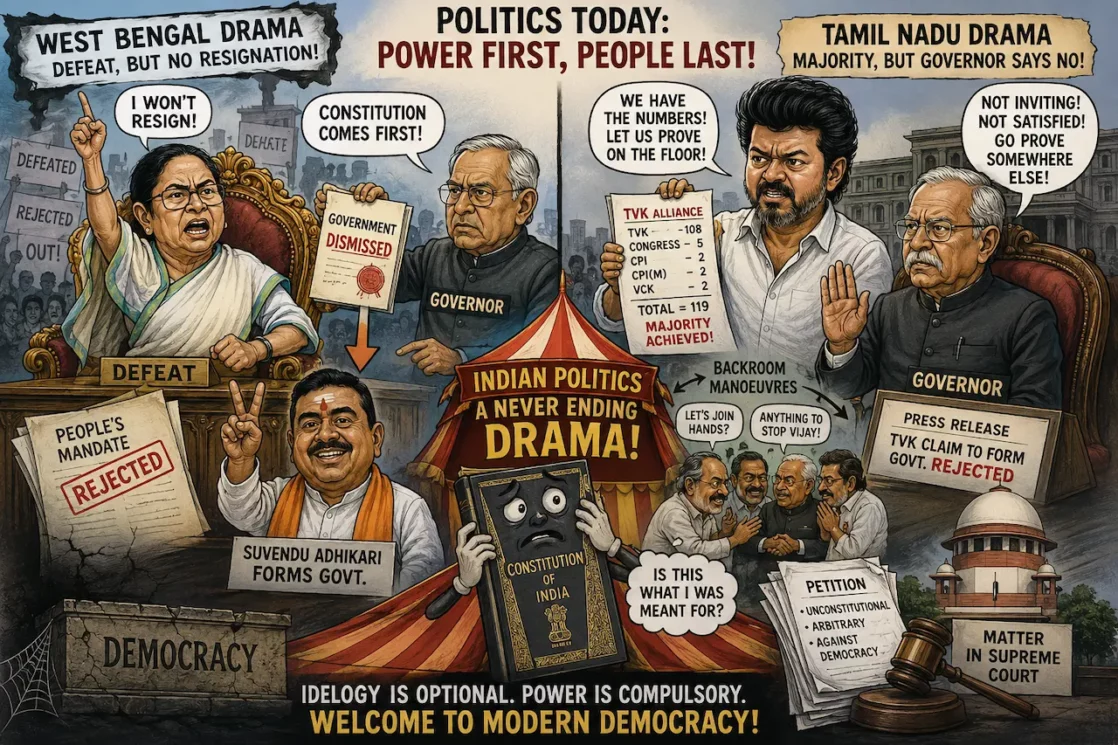
Indian politics was once ideological. Leaders fought elections on vision, sacrifice, and conviction. Today, politics resembles a never-ending reality show where morality changes every hour, enemies become allies overnight, defeated leaders refuse to leave, governors become political referees, and constitutional institutions are dragged into public street fights.
The political developments unfolding in West Bengal and Tamil Nadu in May 2026 have exposed the most hilarious — and dangerous — side of modern Indian democracy. What we are witnessing is not merely political competition. It is the transformation of governance into high-voltage entertainment where power matters more than mandate, optics matter more than ethics, and constitutional morality is interpreted according to political convenience.
The irony is breathtaking.
In West Bengal, after facing a humiliating electoral defeat, Mamata Banerjee reportedly refused to resign gracefully. The same leader who once projected herself as the undisputed “Didi” of Bengal suddenly appeared unwilling to accept the people’s verdict. Eventually, the Governor had to step in, dismiss the government, and pave the way for Suvendu Adhikari to form the government.
Just pause and absorb the absurdity.
For decades, Indian political leaders lectured citizens about democratic values. They spoke endlessly about respecting institutions and the people’s mandate. But when defeat arrived at their own doorstep, democracy suddenly became negotiable.
This is the new political culture of India — leaders who celebrate democracy only when they win.
The Bengal episode demonstrated something deeper than political stubbornness. It exposed the psychological transformation of modern politicians. Earlier generations of leaders treated power as temporary responsibility. Today’s politicians treat power as personal property. Losing office feels less like electoral defeat and more like an eviction notice from a kingdom.
And Bengal was only the beginning.
Tamil Nadu has now produced an even grander political drama — a blockbuster film script that would embarrass even the most exaggerated cinema plotlines.
Actor-turned-politician C. Joseph Vijay stormed into Tamil Nadu politics with remarkable momentum. His party, Tamilaga Vettri Kazhagam (TVK), emerged as the single-largest party with 108 seats in the 234-member Assembly — just 10 short of the majority mark.
Under established parliamentary convention, the leader of the single-largest party is generally invited to form the government and prove majority on the floor of the House. That is how parliamentary democracy works. Or at least, that is how it used to work.
But modern politics no longer trusts conventions. It trusts calculations, manipulation, and delay tactics.
What followed in Tamil Nadu looked less like constitutional governance and more like a political chess tournament played behind closed doors.
Even before the ink on election results had dried, intense backroom manoeuvring reportedly began. Senior AIADMK leaders allegedly explored splitting their own legislative party to support Vijay while attempting to bypass anti-defection laws. Simultaneously, another faction reportedly opened discussions with the DMK — their traditional rival — simply to prevent Vijay from becoming Chief Minister.
Imagine the level of political irony here.
Parties that spent decades calling each other corrupt, anti-Tamil, anti-people, and dangerous suddenly discovered “common democratic values” the moment a new political force threatened their survival.
This is precisely why citizens increasingly distrust politicians. Ideology today lasts only until the counting of votes is complete.
The Tamil Nadu developments have exposed a brutal reality — many political parties are no longer fighting for principles. They are fighting for political survival. And when survival becomes the priority, ideology becomes disposable.
The Governor’s role has added another dramatic layer to the unfolding crisis.
Despite TVK emerging as the single-largest party and later crossing the majority mark with support from Congress, CPI, CPI(M), and VCK, the Governor reportedly hesitated to invite Vijay to form the government. That hesitation triggered outrage, legal challenges, and accusations of constitutional impropriety.
Now the matter has reached the Supreme Court.
The petition filed against the Governor raises fundamental constitutional questions. Can a Governor deny the single-largest party an opportunity to prove majority on the floor of the Assembly? Can Raj Bhavan become an active political gatekeeper instead of a constitutional office?
These are not minor procedural questions anymore. They strike at the heart of parliamentary democracy.
Ironically, every political party changes its position on the Governor’s powers depending on whether it is in power or opposition.
When Governors help them, parties praise constitutional wisdom.
When Governors obstruct them, they scream about democracy being murdered.
This selective morality has become the trademark of modern Indian politics.
The Tamil Nadu crisis also reveals another major transformation in Indian politics — the rise of personality-driven political movements.
Earlier, political parties were built around ideological schools of thought. Today, politics revolves around charisma, celebrity culture, social media popularity, and emotional branding. Vijay’s rise is a perfect example of this shift. He did not emerge through decades of grassroots organizational struggle. He emerged through mass emotional connect, cinematic popularity, and public frustration with traditional parties.
And perhaps that is exactly why established political forces appear nervous.
The old political order understands something very clearly: celebrity-politicians with mass appeal can destroy decades of carefully constructed caste equations, alliance structures, and traditional vote banks.
That is why resistance becomes fierce.
But the larger issue goes beyond Vijay, Mamata Banerjee, or Suvendu Adhikari.
The real issue is this: modern politics has normalized instability.
Political defections are normal.
Midnight negotiations are normal.
Governors being accused of bias is normal.
Courtroom battles over government formation are normal.
Parties joining hands with sworn enemies is normal.
Defeated leaders refusing to step aside is normal.
Everything that once would have shocked the nation now barely surprises anyone.
That is perhaps the most dangerous development of all.
Citizens are slowly becoming emotionally numb to constitutional manipulation.
India’s democracy was designed with certain assumptions — dignity in defeat, restraint in power, respect for conventions, and institutional neutrality. But modern politics increasingly treats conventions as obstacles rather than guiding principles.
And social media has further accelerated this decay.
Today, politics is no longer about governance. It is about perception warfare.
Every event becomes content.
Every constitutional crisis becomes propaganda.
Every political negotiation becomes hashtag warfare.
Supporters no longer defend principles. They defend personalities.
One side calls every opponent anti-national.
The other side calls every institution fascist.
Nuance has disappeared.
The tragedy is that serious governance issues — unemployment, agriculture, inflation, infrastructure, education, healthcare — are increasingly overshadowed by political theatrics.
Television debates scream about government formation arithmetic while ordinary citizens struggle with daily survival.
Meanwhile, political leaders behave like corporate competitors fighting hostile takeovers.
What India is witnessing today is the corporatization of democracy.
Power is treated like acquisition.
MLAs are treated like assets.
Alliances are treated like mergers.
And ideology is treated like advertising material.
Yet amid this chaos, there is one silver lining.
The Indian voter is becoming unpredictable.
Regional giants are falling.
New forces are emerging.
Political arrogance is being challenged.
The message from voters is becoming increasingly clear: no leader is invincible anymore.
Not Mamata Banerjee.
Not Stalin.
Not the Congress.
Not even national parties.
That unpredictability is perhaps democracy’s last surviving strength.
The Bengal and Tamil Nadu dramas should serve as warning signs for the entire political class. Citizens are watching carefully. They may tolerate political drama for a while, but eventually they punish arrogance, manipulation, and betrayal.
History repeatedly teaches one lesson — leaders who stop respecting public sentiment eventually lose public trust.
Modern politicians would do well to remember that democracy is not merely about capturing power. It is about accepting defeat with dignity too.
Unfortunately, in today’s political climate, dignity appears to be the first casualty after election results are declared.
