


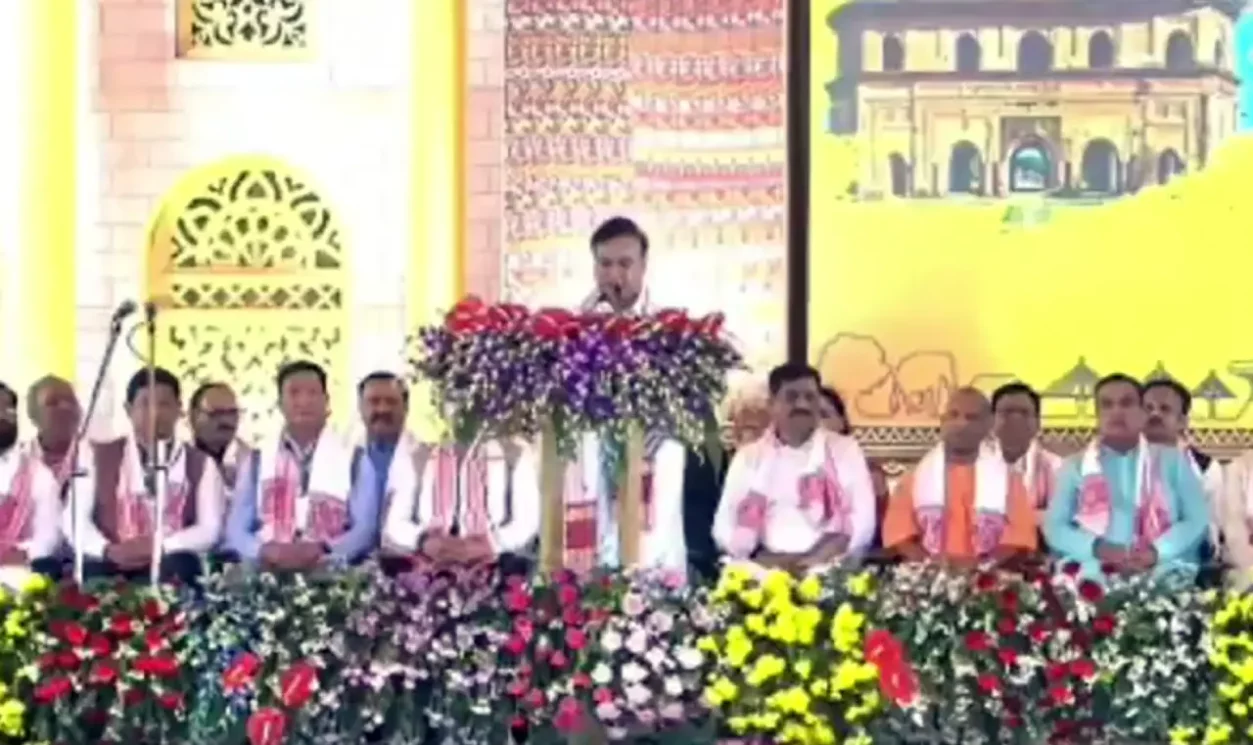
The swearing-in of Himanta Biswa Sarma as Assam chief minister for a second consecutive term marks not only continuity in leadership but also the BJP’s deepening political influence across the northeast.
Widely credited with expanding the BJP’s footprint in the region, Sarma played a central role in the party’s emphatic victory in Assam, where the BJP secured 82 seats in the 126-member Assembly despite sustained attacks from the Congress and controversies surrounding his tenure.
The 57-year-old leader vowed to accelerate Assam’s development journey, declaring that his first term was “just a trailer” and that “the movie will unfold in the second term”.
During his first tenure, Sarma focused heavily on infrastructure, welfare schemes and policies aimed at safeguarding the land rights of indigenous communities. However, his government also drew criticism over controversial measures targeting Bengali-speaking Muslims of Bangladeshi origin.
Eviction drives on alleged encroached land, action against child marriage, moves against polygamy, enforcement of the Cattle Protection Act and the closure of government-run madrasas triggered sharp criticism from opposition parties, which accused his administration of increasing social polarisation.
Despite repeated allegations of corruption and attacks over the business dealings of his wife by Congress leaders, Sarma remained politically resilient and continued to emerge as the BJP’s most influential face in the northeast.
A major controversy erupted after Congress leader Pawan Khera made allegations involving Sarma’s wife, triggering a bitter political exchange that even found mention in a Supreme Court order granting relief to Khera.
Political observers describe Sarma as one of the BJP’s most effective strategists in the northeast. As convenor of the North East Democratic Alliance (NEDA), he played a key role in bringing all eight northeastern states under the NDA’s influence either through BJP governments or alliance partners.
Sarma’s political journey began during the Assam Agitation of the 1980s, when he worked with leaders of the All Assam Students’ Union (AASU). After entering mainstream politics, he rose rapidly within the Congress under the mentorship of former chief ministers Hiteswar Saikia and Tarun Gogoi.
He became a minister in the Gogoi government in 2001 and earned a reputation for administrative efficiency and political management. However, differences with the Congress leadership, particularly with Gogoi’s son Gaurav Gogoi, led to his exit from the party in 2015.
The BJP quickly absorbed Sarma into its ranks and leveraged his influence to strengthen its position in Assam and across the northeast. Alongside Sarbananda Sonowal, he helped the BJP form its first government in Assam in 2016 before taking over as chief minister in 2021.
Born in Jorhat to noted Assamese poet and novelist Kailash Nath Sarma and literary activist Mrinalini Devi, Sarma holds a master’s degree and PhD in political science. He also earned an LL.B degree and practised law at the Gauhati High Court before entering electoral politics.
With a second consecutive term now secured, Sarma’s growing stature within the BJP appears set to shape not only Assam’s politics but also the party’s future strategy in the northeast.
