


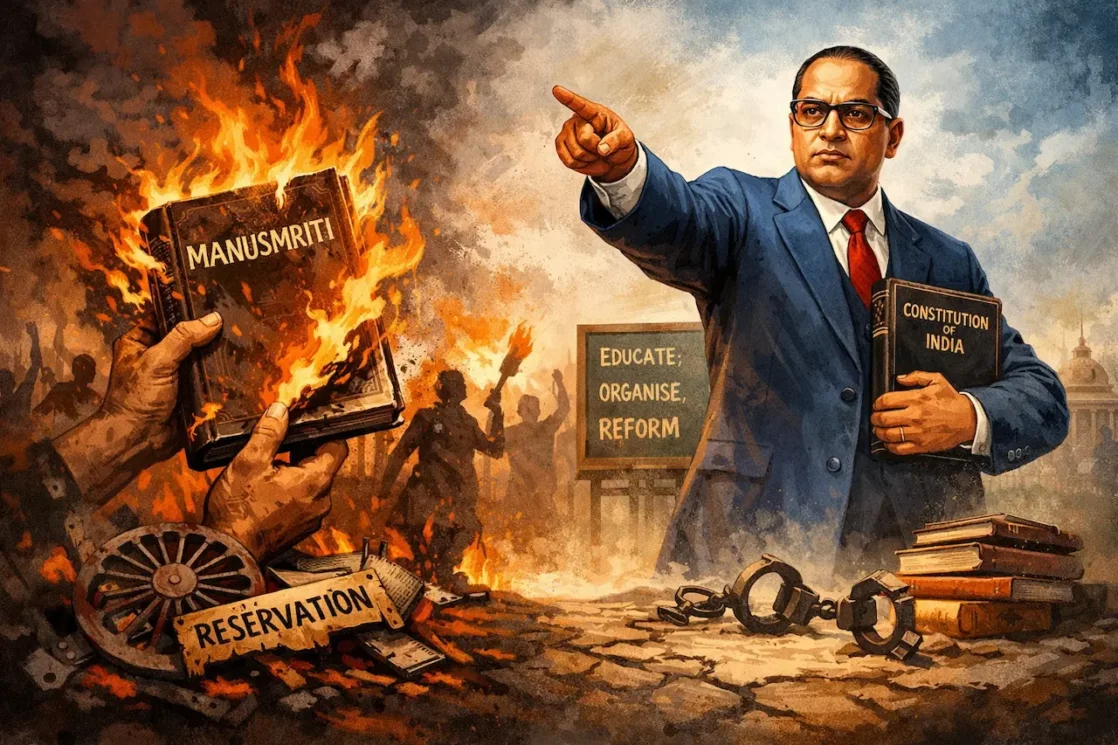
What happened recently in Madhya Pradesh, where members of the Bhim Army publicly burned the Manusmriti, is not just a political act. It is a scream—raw, angry, wounded. And it deserves to be listened to with understanding. But understanding pain does not mean endorsing every expression of it. Some acts don’t heal wounds; they deepen them.
There is a deep sadness in book-burning. Not because books are sacred objects, but because burning a book is the moment when dialogue dies and theatre begins. Fire makes noise, smoke gets attention, but neither produces wisdom. Burning Manusmriti may give a few minutes of emotional release, a sense of symbolic revenge against centuries of humiliation—but after the ash settles, nothing real changes. The caste structure does not collapse, discrimination does not vanish, dignity does not magically arrive. Only anger gets recycled.
The Manusmriti controversy is not new. It did not begin yesterday, nor did it start with today’s politics. Even before independence, Manusmriti had become a symbol—less a text and more a metaphor. A metaphor for oppression, hierarchy, and social cruelty inflicted in the name of religion. For many Dalits, Manusmriti is not a philosophical document; it is remembered as a social weapon used against their ancestors. That memory is real. That pain is real. Pretending otherwise is dishonest.
But history also demands honesty in the other direction.
Manusmriti is not a single unified, state-sponsored law book that ruled India the way modern constitutions do. It is one among many Smritis, written, interpolated, edited, misused, and reinterpreted over centuries. Different versions exist. Different regions followed different customs. Even within Hindu traditions, Manusmriti was never universally applied. Kings ruled by rajdharma, village customs mattered more than texts, and lived practice often contradicted written codes.
More importantly, post-independence India consciously rejected Manusmriti as a governing authority. Modern India does not run on Manusmriti. It runs on the Constitution drafted under the leadership of B. R. Ambedkar—a Constitution that guarantees equality, dignity, liberty, and justice. Hindus, conservatives included, accepted that Constitution. They did not revolt demanding Manusmriti be reinstated. That fact matters.
This is where the pain sharpens into concern.
Dr. Ambedkar criticised Manusmriti fiercely—and rightly so. He symbolically burned it in 1927 to awaken a sleeping society, not to permanently replace social reform with ritual outrage. Ambedkar’s legacy was not book-burning as an end, but social transformation as a goal. He believed in annihilating caste—not by permanent confrontation theatre, but by legal safeguards, education, economic empowerment, and rational thought.
Reducing Ambedkar’s vision to repetitive acts of symbolic fire is, frankly, a betrayal of his intellect.
Burning Manusmriti today does not make one an intellectual. If intellect could be acquired by lighting a matchstick, universities would be redundant. And if symbolic rebellion alone could uplift communities, reservations would have ended long ago. The uncomfortable question must be asked: are such acts about justice—or about preserving permanent victimhood politics, where anger is more useful than empowerment?
This is not said lightly. It is said with pain.
Because communities do not progress by fighting symbols endlessly. They progress by building institutions, focusing on education, health, employment, social discipline, and ethical reform. Ask honestly: how much time is spent on addiction reform, school dropout prevention, skill development, women’s safety, mental health, entrepreneurship? Burning a book does none of this work. It only gives the illusion of resistance.
There is another hard truth. Manusmriti is not merely a book that can be destroyed and erased. It has seeped into social habits—good and bad—over centuries. Some parts promote order, duty, self-control, ethical conduct: “do not lie,” “avoid intoxication,” “seek knowledge,” “respect teachers,” “practice restraint.” Other parts reflect the worst of historical patriarchy and hierarchy. Civilisations mature by discrimination—by accepting what elevates human life and rejecting what degrades it. Hindu society, slowly and imperfectly, has been doing exactly that.
No Hindu today defends untouchability openly. No law allows it. Social crimes still exist—yes—but they exist not because Manusmriti survives, but because moral reform lags behind legal reform. Burning a text does nothing to reform daily behaviour. Changing social norms does.
Manusmriti today functions less as a ruling book and more as a social memory—contested, criticised, partially inherited. Burning it does not erase caste any more than burning a history book erases history. Caste is a lived social structure. It will fall only when communities invest in self-correction, internal reform, mutual respect, and collective upliftment.
Here is the most painful irony: acts like these give ammunition to those who genuinely oppose reform. They convert a moral struggle into a spectacle. They replace conversation with confrontation. They turn social justice into a predictable annual ritual, safely ignored by those in power because it changes nothing on the ground.
And let us say this clearly and without cruelty: publicly burning a book, in a democracy, is not courage. It is an act born from helplessness. True courage is harder—it requires patience, sustained engagement, institution-building, and the willingness to evolve even when evolution is uncomfortable.
Dr. Ambedkar urged people to educate, agitate, organise. Not just agitate.
India has changed. The era has changed. Mentalities must change too. Communities that want prosperity, progress, and perfection must shift focus from symbolic enemies to structural solutions. Social traditions do not disappear by fire; they disappear by reform. Discrimination does not die by slogans; it dies by sustained ethical and economic transformation.
Burning Manusmriti neither humiliates Hinduism nor emancipates Dalits. It only freezes both in a permanent war of symbols, where real issues remain untouched.
If Ambedkar were alive today, he would not ask for more ashes. He would ask harder questions: What have you built? What have you reformed? How many minds have you sharpened instead of inflamed?
Pain deserves respect. Anger deserves empathy. But the future demands wisdom.
And wisdom, unlike books, cannot be burned into existence.
