


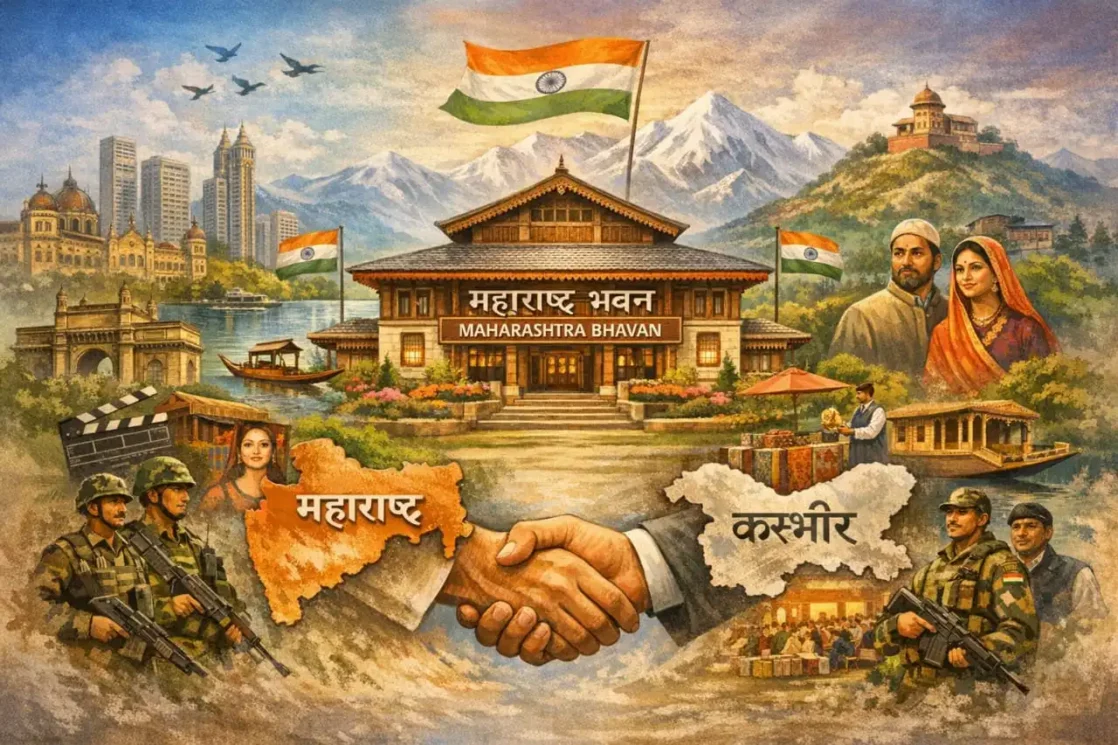
In the noise of daily politics, it is easy to miss the quiet moments when history shifts its tone. Maharashtra Deputy Chief Minister Eknath Shinde’s announcement of building a Maharashtra Bhavan in Kashmir is one such moment. On the surface, it may appear to be a routine administrative decision—a state guest house, an official facility, another government project. But in truth, it carries within it something far deeper: a recognition of an emotional, cultural, and human bond that already exists between Maharashtra and Kashmir, waiting only to be acknowledged and strengthened.
Kashmir has never been a distant land for Maharashtra. Nor has Maharashtra been a stranger to Kashmir’s pain, resilience, and beauty. The two are bound not just by geography within the Indian Union, but by shared lives, shared sacrifices, and shared cultural journeys that few people stop to reflect upon.
Mumbai, the heart of Maharashtra, became a refuge for thousands of Kashmiri Pandits when terror uprooted them from their ancestral homes in the Valley. They arrived carrying grief, trauma and uncertainty—but they also carried education, creativity, and an unbreakable commitment to rebuilding their lives with dignity. Over time, they did more than just settle in Mumbai; they became an inseparable part of the city’s intellectual, artistic, and cultural bloodstream.
Some of the most respected writers, filmmakers, journalists, actors, lyricists, and thinkers in Bollywood and Indian media come from Kashmiri Pandit families. They helped shape modern Hindi cinema, television, literature, and public discourse. Their stories, their aesthetics, and their cultural depth blended naturally into Mumbai’s cosmopolitan identity. In return, Mumbai gave them space, opportunity, and the freedom to become who they truly were. The city absorbed Kashmir into its soul.
This cultural and human integration happened organically, without government programs or political slogans. It happened because both societies recognized something familiar in each other—a love for language, art, resilience, and dignity.
At the same time, thousands of Maharashtrians have served Kashmir in silence and sacrifice. Maharashtra-cadre IAS and IPS officers, army officers, soldiers, CRPF personnel, doctors, engineers, teachers, and administrators have spent years working in Jammu & Kashmir. They have governed towns, protected civilians, treated patients, built infrastructure, and defended borders. Many have lived far from their families in difficult conditions. Some never returned.
For these men and women, Kashmir was not a posting—it was a responsibility, a moral duty, and often a deeply emotional experience. They came to know the Valley not through television debates, but through human faces: shopkeepers, students, children, colleagues, and neighbors. When they returned to Maharashtra, they brought back stories not of abstractions but of people—of warmth, struggle, hope, and resilience.
This is the invisible human corridor between Maharashtra and Kashmir that already exists.
The announcement of Maharashtra Bhavan in Kashmir gives institutional recognition to this corridor.
A Bhavan is not just a building. In Indian political culture, it is a home. A place where people from a state feel protected, welcomed, and rooted. By placing such a home in Kashmir, Maharashtra is telling every Maharashtrian serving or travelling there: You belong here too.
It also tells every Kashmiri: Maharashtra is not a distant power. It is a partner, a friend, a fellow traveler in the Indian journey.
The Bhavan will provide practical support—accommodation for officials, space for delegations, and facilities for tourists, journalists, scholars, and families of personnel posted there. But its real value lies beyond logistics. It will be a living space of dialogue, exchange, and mutual presence.
One can imagine literary evenings where Kashmiri poets read alongside Marathi writers. Cultural festivals where Lavani meets Sufiana Kalam. Film screenings, art exhibitions, academic discussions, and youth exchanges. These are not luxuries—they are the soft tissue that binds nations and regions together.
In a place that has suffered from alienation, suspicion, and violence, such spaces quietly heal what politics often wounds.
What gives this initiative even greater depth is the personal clarity behind it.
My own interaction with Chief Minister Eknath Shinde on this development was nothing short of mesmerizing. It was not a routine political conversation. What stood out was his remarkably clear vision: he does not see Maharashtra Bhavan merely as an administrative asset but as a cultural and emotional bridge.
He spoke with sincerity about preserving Kashmiriyat in the hearts of Maharashtrians who serve and reside in Kashmir—and about ensuring that Kashmir continues to feel emotionally connected to Maharashtra. For him, the officers, soldiers, doctors, and teachers posted there are not just employees of the state; they are carriers of mutual trust. They absorb the valley’s spirit and carry it back to Maharashtra. They take Maharashtra’s pluralism and warmth into Kashmir.
This two-way flow, he believes, is how harmony is built—not through declarations, but through lived human experience.
He was clear that the Bhavan must not become a closed bureaucratic enclave. It must be open, welcoming, alive—a place where Kashmiris feel just as comfortable walking in as Maharashtrians. A place that reflects hospitality, not hierarchy.
That clarity of purpose is rare in public life. It transforms what could have been a symbolic gesture into a meaningful institution.
From a broader national perspective, this initiative also quietly changes the narrative around Kashmir. For decades, Kashmir has been spoken about only in terms of security, conflict, and control. What Maharashtra Bhavan represents is something different: everyday civic normalcy.
It says that Kashmir is not a periphery that needs to be managed but a part of India’s shared civic space where every state can plant roots. Just as Delhi has its Bhavans across the country, Maharashtra is now placing its presence in the Valley—not to dominate, but to belong.
For Kashmir, this brings something valuable: consistent engagement from one of India’s most powerful economic and cultural states. Tourism from Maharashtra is already a major contributor to Kashmir’s economy. With a state-level institutional base, this flow will grow more organised, safer and more confident. Business delegations, cultural groups, film units and investors will have a trusted base, encouraging deeper engagement.
For young Kashmiris, this opens new windows — to Maharashtra’s universities, industries, media and creative world. For Maharashtrian youth, it opens a more nuanced, human understanding of Kashmir beyond headlines.
In a fractured world, such bridges matter.
Eknath Shinde’s Maharashtra Bhavan is therefore not just a structure of stone and steel. It is an architecture of trust. It acknowledges the pain of Kashmiri Pandits who found a second home in Maharashtra. It honors the sacrifice of Maharashtrians who have served Kashmir. It creates a space where culture, memory, administration, and belonging can coexist.
In a time when integration is often shouted from podiums, this is integration quietly built—brick by brick, relationship by relationship.
And sometimes, it is these quiet acts that shape the future far more powerfully than any speech ever could.
