Delhi Govt May Take Over Janakpuri School After Toddler Sexual Assault Case 2
The Delhi government may take over the management of a private school in west Delhi’s Janakpuri after the institution failed to respond to a show-cause notice issued over the alleged sexual assault of a three-year-old girl on its premises, officials said on Monday.
The Directorate of Education (DoE) had issued the notice on May 8, citing serious lapses in child safety, supervision and compliance with statutory norms. The department warned that failure to submit a satisfactory reply within three days could lead to withdrawal of the school’s recognition and a possible takeover of its management under provisions of the Delhi School Education Act and Rules (DSEAR).
Officials said the school authorities have not yet submitted their response, and disciplinary action is now being considered against the institution for alleged deficiencies in child protection measures.
According to police, the child’s mother filed a complaint at Janakpuri police station on May 1, alleging that her daughter was sexually assaulted during school hours on April 30, just a day after she was admitted to the school.
Police said the girl complained of pain after returning home and later informed her mother that she had been taken to an isolated area inside the school where a staff member allegedly assaulted her.
A 57-year-old caretaker employed at the school was arrested in connection with the case. Police said the child identified the accused, who was later produced before a court and sent to judicial custody. However, he was granted bail by a Dwarka court on May 7 despite strong objections from the prosecution.
The DoE, in its preliminary inquiry, reportedly found several violations by the school administration. The department alleged that the institution failed to maintain adequate surveillance systems, including the absence of CCTV cameras in sensitive areas of the campus.
The notice also flagged lapses in the implementation of child protection safeguards and preventive mechanisms within the school premises.
Additionally, the department alleged that nursery and pre-primary classes were being operated from a separate private premises located nearly one kilometre away from the recognised main campus without prior approval from authorities.
According to the notice, shifting students to an unapproved location raised serious concerns regarding student safety, statutory compliance and possible violation of land allotment conditions.
The DoE had directed the school management to submit details related to CCTV footage, staff deployment, child safety policies, suspension procedures against the accused, building and fire safety certificates, and permissions for operating classes from the separate premises by May 11.
The notice warned that failure to provide a satisfactory response could result in withdrawal of recognition, takeover of management and a recommendation to the Delhi Development Authority for cancellation of land allotment or lease.
Police have registered a case under Section 64(1) of the Bharatiya Nyaya Sanhita related to rape of minors and Section 6 of the Protection of Children from Sexual Offences (POCSO) Act concerning aggravated penetrative sexual assault.
Investigators said CCTV footage from the school premises is also being examined as part of the probe.
Shares of major jewellery companies witnessed sharp declines on Monday after Prime Minister Narendra Modi urged citizens to postpone gold purchases and avoid non-essential foreign travel for one year to help conserve foreign exchange amid the ongoing West Asia crisis.
The appeal triggered heavy selling across jewellery and bullion-related stocks, with investors fearing a potential slowdown in discretionary spending and gold demand.
Sky Gold And Diamonds Ltd plunged 12.24 per cent, while Senco Gold Ltd dropped 11 per cent on the BSE. Kalyan Jewellers fell 9.99 per cent, Thangamayil Jewellery declined 9.79 per cent and Titan Company slipped 8 per cent. Shares of Tribhovandas Bhimji Zaveri Ltd and PC Jeweller Ltd also dropped 6.83 per cent and 5.67 per cent, respectively.
The broader market also came under pressure, with the BSE Sensex falling 1,082.40 points to 76,243.56 in morning trade, while the Nifty 50 declined 309.45 points to 23,865.10.
Addressing a BJP rally in Hyderabad on Sunday, Modi appealed to citizens to use fuel judiciously and reduce foreign exchange outflows amid the escalating geopolitical tensions in West Asia.
The prime minister suggested measures such as reducing petrol and diesel consumption, using metro rail services, opting for carpooling, increasing the use of electric vehicles, relying more on railways for parcel movement and adopting work-from-home practices wherever possible.
He also stressed the need to postpone gold purchases and non-essential foreign travel for a year to reduce pressure on India’s import bill and conserve foreign exchange reserves.
V K Vijayakumar said the appeal was part of a broader crisis-management strategy to tackle the current account deficit caused by soaring crude oil prices.
“This austerity call may have a mildly negative impact on economic growth in FY27. Sectors linked to petroleum, fertilisers, gold, air travel and hospitality are likely to face sentiment-driven pressure,” he said.
Jateen Trivedi said the appeal should be viewed in the context of India’s macroeconomic stability and import management.
“India is one of the world’s largest gold importers, and high gold imports during periods of elevated crude prices and geopolitical uncertainty increase pressure on the trade deficit and the rupee,” he said.
He added that while gold remains deeply embedded in India’s cultural and investment landscape, the prime minister’s remarks could temporarily affect discretionary jewellery purchases and weigh on sentiment in the bullion sector.
AIADMK Faces Internal Turmoil After Poll Defeat as Rift Deepens Over Support to TVK 5
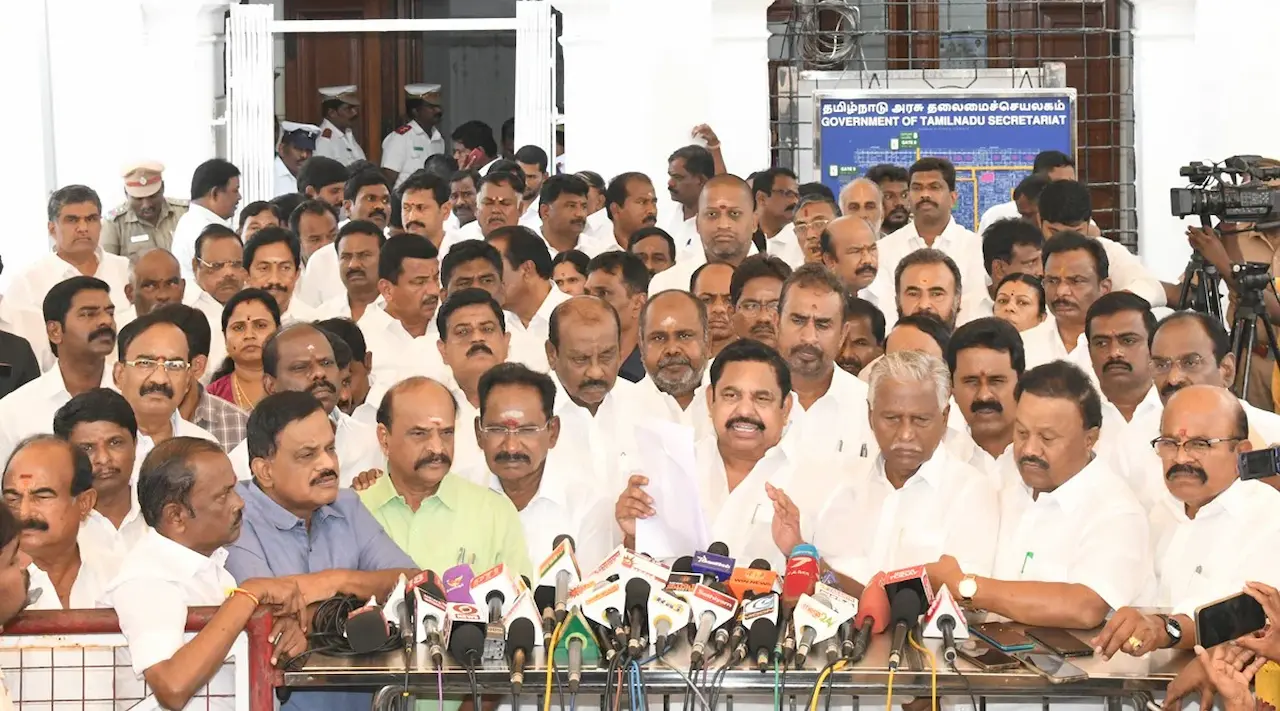
The All India Anna Dravida Munnetra Kazhagam appears to be facing an internal crisis following its poor performance in the Tamil Nadu Assembly elections, with divisions emerging over whether to support the ruling Tamilaga Vettri Kazhagam government led by C Joseph Vijay.
The AIADMK contested 167 of the 234 assembly constituencies but managed to win only 47 seats, triggering unrest within the party ranks.
In the aftermath of the electoral setback, a series of meetings chaired by party general secretary Edappadi K Palaniswami were held to assess the situation and discuss the party’s future course.
According to party sources, one faction strongly opposed extending support to the Vijay-led TVK government, while another section favoured offering outside support to ensure political relevance.
The poll debacle has also intensified dissatisfaction with Palaniswami’s leadership, with some MLAs reportedly demanding that he step down as party chief.
Several senior AIADMK leaders and former ministers, including C Ve Shanmugam and S P Velumani, along with MLAs aligned with them, stayed away from meetings convened by Palaniswami.
Party insiders indicated that Shanmugam, Velumani and their supporters are inclined towards backing the TVK government.
Former AIADMK leader K C Palanisamy claimed there was a clear split within the party and said many legislators were seeking a leadership change.
“If Palaniswami continues as leader, there is a possibility that some MLAs may extend support to the TVK,” he said, adding that Palaniswami should voluntarily step down to help reunite the party ahead of future elections.
Political analyst Sathyalaya Ramakrishnan said the disagreements within the AIADMK should be resolved through dialogue and unity.
“I feel the party still appears united since all AIADMK MLAs were seated together in the Assembly. Senior leaders must ensure that no split takes place within the party,” he said.
The developments come amid growing political realignments in Tamil Nadu following the rise of TVK and its strong electoral debut.
Mumbai Local Trains Get AI-Like 'Electronic Co-Pilot' System to Boost Safety and Reduce Errors 7
Central Railway has upgraded the Signal Location Announcement System (SILAS) across all Mumbai suburban local trains to assist motormen in safer and error-free train operations, officials said on Monday.
The GPS-based SILAS functions as an “electronic co-pilot” by announcing the number and position of upcoming railway signals, including whether they are located on the left, extreme left, right or extreme right side.
More than 2,300 local train services operate daily on Central Railway’s suburban network under an automatic signalling system. Since most signals are placed just 400 to 500 metres apart, motormen often work under intense operational pressure.
Central Railway Chief Public Relations Officer Swapnil Nila said Mumbai suburban motormen perform a “single-man job” under extremely demanding conditions.
“SILAS is being upgraded to act as an electronic co-pilot, reducing stress and enhancing safety by ensuring no signal is missed,” he said, adding that the move is a major step towards achieving the railway’s “Zero SPAD” goal, referring to “signal passed at danger” incidents.
According to railway officials, the upgraded SILAS provides audio alerts 350 metres and 250 metres before approaching a signal. In the case of a yellow signal, the system repeatedly warns motormen with the message: “Be careful, next signal is Red,” until a green or double-yellow signal appears.
The technology includes pre-loaded GPS coordinates, signal locations and route-specific audio recordings. Before beginning a trip, the train manager selects the relevant route, including up or down local and through lines.
Officials said SILAS is also being enhanced to announce upcoming stations 500 metres and 250 metres before arrival to improve operational efficiency and passenger convenience.
The upgraded system will additionally help analyse motormen’s driving patterns by monitoring train speeds at critical points such as yellow signals, platform entries, permanent speed restrictions and neutral sections.
Railway authorities said the technology also enables real-time train tracking and speed monitoring of EMU local trains, improving overall operational control on Mumbai’s busy suburban network.
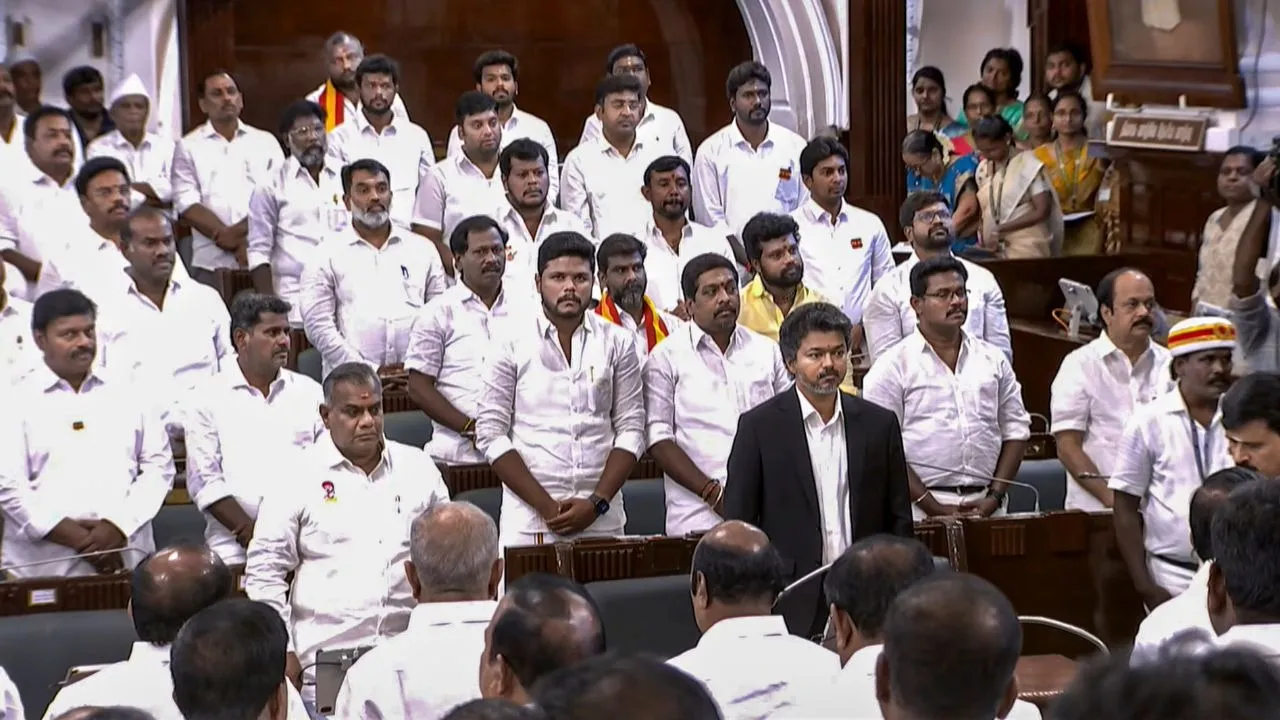
CM Vijay Takes Oath as MLA in Tamil Nadu Assembly Along With Ministers and Newly Elected Members 9
C Joseph Vijay on Monday took oath as a member of the Tamil Nadu Legislative Assembly along with nine ministers, former chief ministers and newly elected MLAs during the inaugural proceedings of the newly constituted House, officials said.
Pro-Tem Speaker M V Karuppaiah administered the oath of office to the members.
The Assembly proceedings commenced at 9.30 am with a brief introductory address by the Pro-Tem Speaker. Chief Minister Vijay was the first member to take oath as an MLA.
Nine ministers, including N Anand and Aadhav Arjuna, also took oath as legislators during the session.
Later, DMK legislature party leader and former Deputy Chief Minister Udhayanidhi Stalin, former chief minister and AIADMK leader Edappadi K Palaniswami, and former chief minister O Panneerselvam took oath as MLAs.
Several senior AIADMK leaders, including Agri Krishnamurthy and K P Anbalagan, were also among those sworn in during the proceedings.
The oath-taking ceremony marked the formal beginning of the new Assembly term following the recently concluded Tamil Nadu Assembly elections.
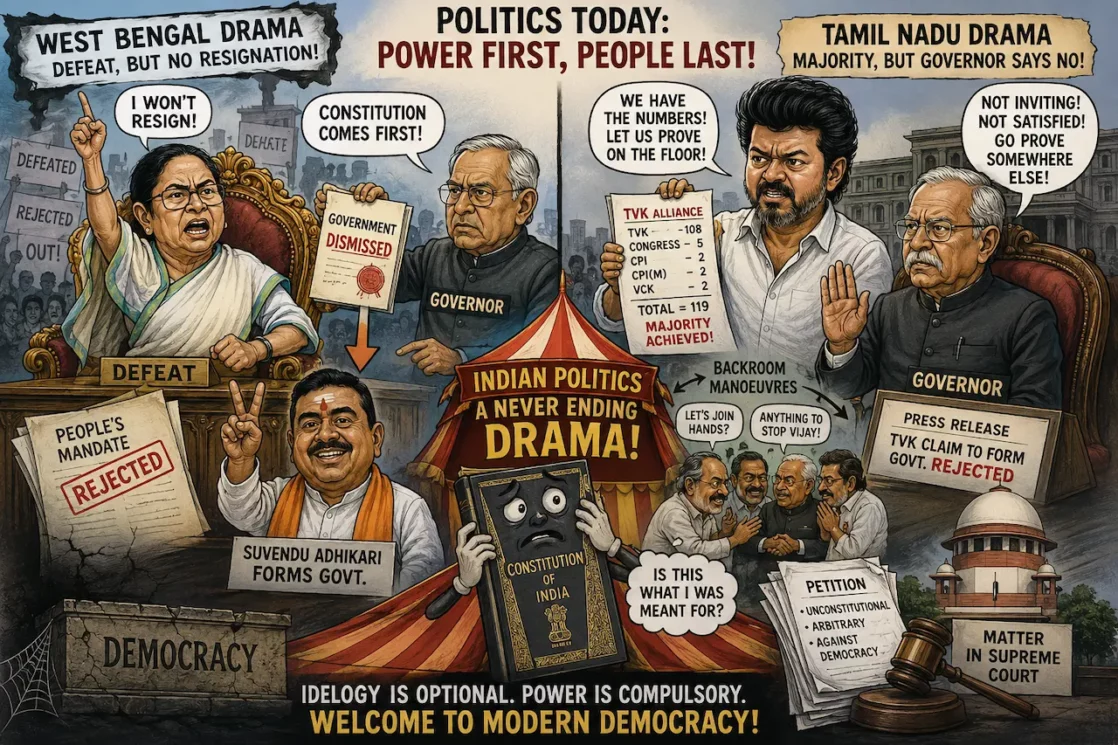
Indian politics was once ideological. Leaders fought elections on vision, sacrifice, and conviction. Today, politics resembles a never-ending reality show where morality changes every hour, enemies become allies overnight, defeated leaders refuse to leave, governors become political referees, and constitutional institutions are dragged into public street fights.
The political developments unfolding in West Bengal and Tamil Nadu in May 2026 have exposed the most hilarious — and dangerous — side of modern Indian democracy. What we are witnessing is not merely political competition. It is the transformation of governance into high-voltage entertainment where power matters more than mandate, optics matter more than ethics, and constitutional morality is interpreted according to political convenience.
The irony is breathtaking.
In West Bengal, after facing a humiliating electoral defeat, Mamata Banerjee reportedly refused to resign gracefully. The same leader who once projected herself as the undisputed “Didi” of Bengal suddenly appeared unwilling to accept the people’s verdict. Eventually, the Governor had to step in, dismiss the government, and pave the way for Suvendu Adhikari to form the government.
Just pause and absorb the absurdity.
For decades, Indian political leaders lectured citizens about democratic values. They spoke endlessly about respecting institutions and the people’s mandate. But when defeat arrived at their own doorstep, democracy suddenly became negotiable.
This is the new political culture of India — leaders who celebrate democracy only when they win.
The Bengal episode demonstrated something deeper than political stubbornness. It exposed the psychological transformation of modern politicians. Earlier generations of leaders treated power as temporary responsibility. Today’s politicians treat power as personal property. Losing office feels less like electoral defeat and more like an eviction notice from a kingdom.
And Bengal was only the beginning.
Tamil Nadu has now produced an even grander political drama — a blockbuster film script that would embarrass even the most exaggerated cinema plotlines.
Actor-turned-politician C. Joseph Vijay stormed into Tamil Nadu politics with remarkable momentum. His party, Tamilaga Vettri Kazhagam (TVK), emerged as the single-largest party with 108 seats in the 234-member Assembly — just 10 short of the majority mark.
Under established parliamentary convention, the leader of the single-largest party is generally invited to form the government and prove majority on the floor of the House. That is how parliamentary democracy works. Or at least, that is how it used to work.
But modern politics no longer trusts conventions. It trusts calculations, manipulation, and delay tactics.
What followed in Tamil Nadu looked less like constitutional governance and more like a political chess tournament played behind closed doors.
Even before the ink on election results had dried, intense backroom manoeuvring reportedly began. Senior AIADMK leaders allegedly explored splitting their own legislative party to support Vijay while attempting to bypass anti-defection laws. Simultaneously, another faction reportedly opened discussions with the DMK — their traditional rival — simply to prevent Vijay from becoming Chief Minister.
Imagine the level of political irony here.
Parties that spent decades calling each other corrupt, anti-Tamil, anti-people, and dangerous suddenly discovered “common democratic values” the moment a new political force threatened their survival.
This is precisely why citizens increasingly distrust politicians. Ideology today lasts only until the counting of votes is complete.
The Tamil Nadu developments have exposed a brutal reality — many political parties are no longer fighting for principles. They are fighting for political survival. And when survival becomes the priority, ideology becomes disposable.
The Governor’s role has added another dramatic layer to the unfolding crisis.
Despite TVK emerging as the single-largest party and later crossing the majority mark with support from Congress, CPI, CPI(M), and VCK, the Governor reportedly hesitated to invite Vijay to form the government. That hesitation triggered outrage, legal challenges, and accusations of constitutional impropriety.
Now the matter has reached the Supreme Court.
The petition filed against the Governor raises fundamental constitutional questions. Can a Governor deny the single-largest party an opportunity to prove majority on the floor of the Assembly? Can Raj Bhavan become an active political gatekeeper instead of a constitutional office?
These are not minor procedural questions anymore. They strike at the heart of parliamentary democracy.
Ironically, every political party changes its position on the Governor’s powers depending on whether it is in power or opposition.
When Governors help them, parties praise constitutional wisdom.
When Governors obstruct them, they scream about democracy being murdered.
This selective morality has become the trademark of modern Indian politics.
The Tamil Nadu crisis also reveals another major transformation in Indian politics — the rise of personality-driven political movements.
Earlier, political parties were built around ideological schools of thought. Today, politics revolves around charisma, celebrity culture, social media popularity, and emotional branding. Vijay’s rise is a perfect example of this shift. He did not emerge through decades of grassroots organizational struggle. He emerged through mass emotional connect, cinematic popularity, and public frustration with traditional parties.
And perhaps that is exactly why established political forces appear nervous.
The old political order understands something very clearly: celebrity-politicians with mass appeal can destroy decades of carefully constructed caste equations, alliance structures, and traditional vote banks.
That is why resistance becomes fierce.
But the larger issue goes beyond Vijay, Mamata Banerjee, or Suvendu Adhikari.
The real issue is this: modern politics has normalized instability.
Political defections are normal.
Midnight negotiations are normal.
Governors being accused of bias is normal.
Courtroom battles over government formation are normal.
Parties joining hands with sworn enemies is normal.
Defeated leaders refusing to step aside is normal.
Everything that once would have shocked the nation now barely surprises anyone.
That is perhaps the most dangerous development of all.
Citizens are slowly becoming emotionally numb to constitutional manipulation.
India’s democracy was designed with certain assumptions — dignity in defeat, restraint in power, respect for conventions, and institutional neutrality. But modern politics increasingly treats conventions as obstacles rather than guiding principles.
And social media has further accelerated this decay.
Today, politics is no longer about governance. It is about perception warfare.
Every event becomes content.
Every constitutional crisis becomes propaganda.
Every political negotiation becomes hashtag warfare.
Supporters no longer defend principles. They defend personalities.
One side calls every opponent anti-national.
The other side calls every institution fascist.
Nuance has disappeared.
The tragedy is that serious governance issues — unemployment, agriculture, inflation, infrastructure, education, healthcare — are increasingly overshadowed by political theatrics.
Television debates scream about government formation arithmetic while ordinary citizens struggle with daily survival.
Meanwhile, political leaders behave like corporate competitors fighting hostile takeovers.
What India is witnessing today is the corporatization of democracy.
Power is treated like acquisition.
MLAs are treated like assets.
Alliances are treated like mergers.
And ideology is treated like advertising material.
Yet amid this chaos, there is one silver lining.
The Indian voter is becoming unpredictable.
Regional giants are falling.
New forces are emerging.
Political arrogance is being challenged.
The message from voters is becoming increasingly clear: no leader is invincible anymore.
Not Mamata Banerjee.
Not Stalin.
Not the Congress.
Not even national parties.
That unpredictability is perhaps democracy’s last surviving strength.
The Bengal and Tamil Nadu dramas should serve as warning signs for the entire political class. Citizens are watching carefully. They may tolerate political drama for a while, but eventually they punish arrogance, manipulation, and betrayal.
History repeatedly teaches one lesson — leaders who stop respecting public sentiment eventually lose public trust.
Modern politicians would do well to remember that democracy is not merely about capturing power. It is about accepting defeat with dignity too.
Unfortunately, in today’s political climate, dignity appears to be the first casualty after election results are declared.
Suvendu Adhikari Sworn In as Bengal's First BJP Chief Minister in Historic Political Shift 13
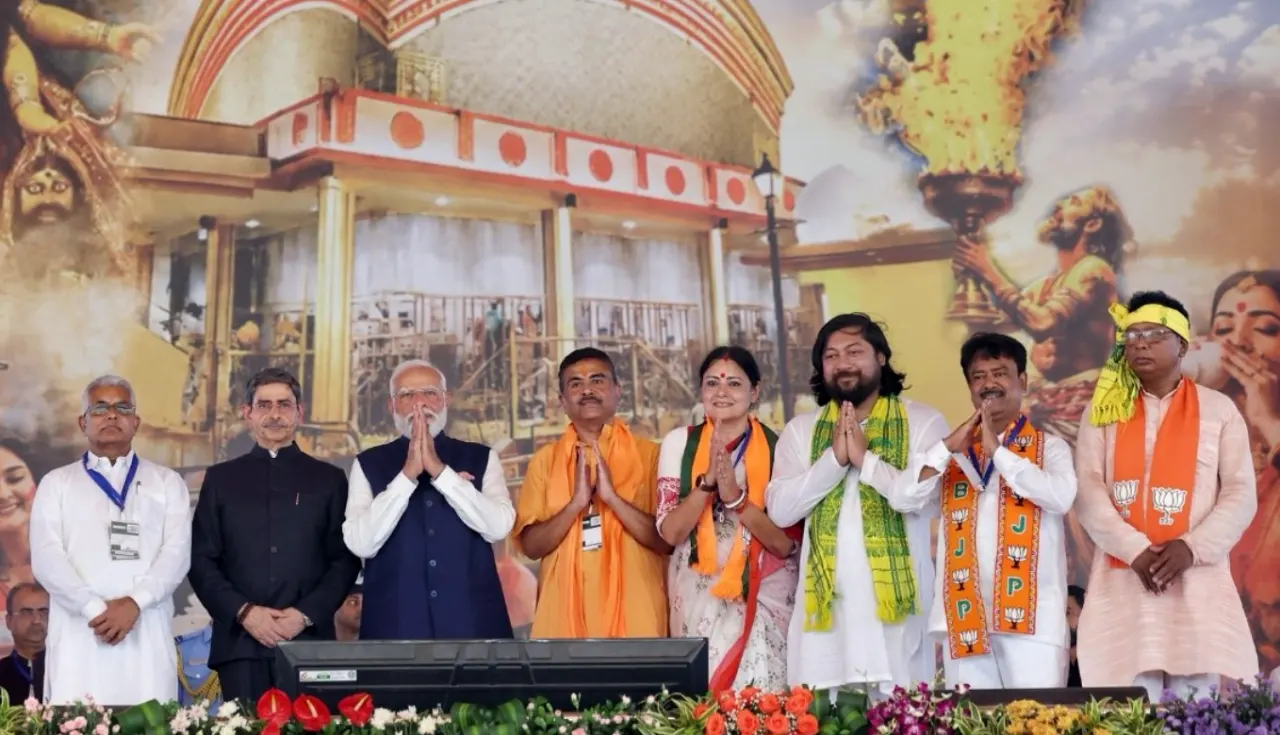
Suvendu Adhikari on Saturday took oath as the first BJP chief minister of West Bengal, marking a major political turning point in the state after decades of resistance to saffron politics.
R N Ravi administered the oath of office and secrecy to Adhikari at a grand ceremony attended by Prime Minister Narendra Modi, Union ministers, chief ministers of NDA-ruled states and senior BJP leaders.
Soon after Adhikari’s swearing-in, senior BJP leader Dilip Ghosh took oath as a minister in the new cabinet. BJP MLAs Agnimitra Paul, Ashok Kirtania, Nisith Pramanik and Kshudiram Tudu were also sworn in as ministers.
The swearing-in ceremony was held at Brigade Parade Ground, a venue historically associated with massive Left rallies and later a significant political battleground for the Trinamool Congress.
Thousands of BJP supporters gathered at the venue, waving saffron flags and chanting “Jai Shri Ram” slogans as Adhikari, regarded as one of the key architects behind the BJP’s rise in Bengal, took oath amid tight security arrangements.
The BJP secured 207 seats in the 294-member assembly in the recently concluded elections, ending the 15-year rule of the All India Trinamool Congress and marking the party’s biggest political breakthrough in eastern India.
The ceremony was attended by senior BJP leaders, MPs, industrialists and film personalities, with the party projecting the event as the beginning of a “Sonar Bangla” under a “double-engine” government.
Adhikari, who defeated TMC supremo Mamata Banerjee in the Bhabanipur assembly constituency while also retaining his Nandigram seat, was unanimously elected leader of the BJP legislature party on Friday in the presence of Union Home Minister Amit Shah.
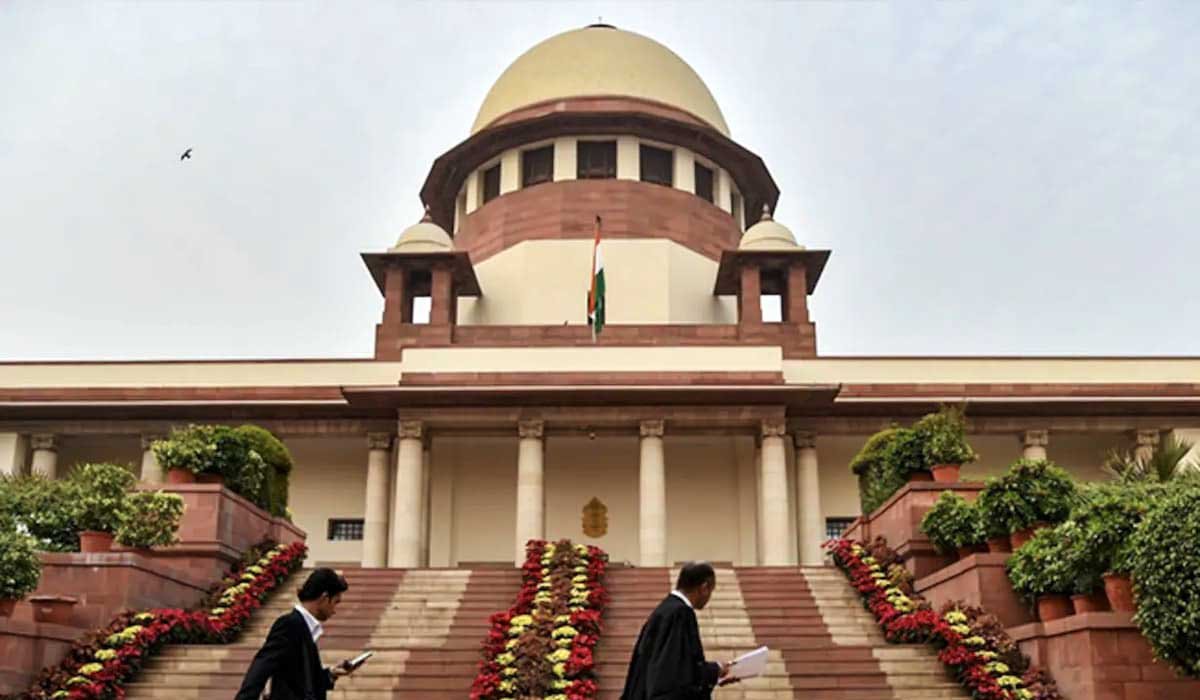
The Supreme Court of India on Friday observed that the alleged large-scale banking fraud involving the Anil Dhirubhai Ambani Group (ADAG) and its firms requires a “thorough investigation” after the CBI informed the court that the estimated loss in seven cases under probe stood at around Rs 27,337 crore.
A bench comprising Chief Justice Surya Kant and Justice Joymalya Bagchi was hearing a public interest litigation filed by former bureaucrat E A S Sarma, who sought a court-monitored probe into alleged loan frauds exceeding Rs 40,000 crore involving ADAG firms led by industrialist Anil Ambani.
The CBI informed the apex court that nine FIRs had been registered in connection with the matter. Of these, charge sheets have already been filed in two cases, while investigations are ongoing in the remaining seven.
Senior advocate Prashant Bhushan, appearing for the petitioner, questioned why Anil Ambani had not been arrested despite probe agencies allegedly identifying him as the “kingpin” of the scam. He described it as “puzzling” that both the CBI and the Enforcement Directorate had referred to the matter as a Rs 27,000-crore scam but had not taken custodial action against Ambani.
The bench, however, observed that the Supreme Court has consistently maintained restraint in directing arrests and said the decision on custodial interrogation must remain with the investigating agencies. The court cautioned against sensationalising the investigation and stressed that the focus should remain on collecting relevant evidence and ensuring a fair probe.
“We do not want prejudice to either side, but the matter requires a thorough investigation and it should be completed in a timely manner so that there is public confidence,” the bench remarked.
Senior advocate Kapil Sibal, appearing for Ambani, argued that his client was fully cooperating with the investigation and questioned how the petitioner had accessed a charge sheet before the concerned court had even taken cognisance of it. “Maybe I was cheated,” Sibal submitted on behalf of Ambani.
Solicitor General Tushar Mehta, representing the investigating agencies, informed the court that two FIRs had been registered against Reliance Telecom Ltd based on complaints filed by the State Bank of India. He added that multiple teams of investigating officers had been formed for a speedy probe, searches had been conducted at 14 locations and around 3,960 documents had been collected.
Mehta also informed the court that 31 lookout circulars had been issued and two persons had been arrested so far in connection with the ongoing investigations. The agencies also shared tentative timelines for filing charge sheets in the remaining cases.
The apex court noted that it had earlier intervened to activate the probe agencies and said it may step in further if it finds shortcomings in the investigation. The matter has now been posted for further hearing in July.
Earlier, the court had expressed displeasure over the “reluctance” shown by the CBI and ED in probing the alleged fraud and directed both agencies to carry out a “fair, dispassionate, transparent and time-bound” investigation.
The ED has alleged defaults of Rs 7,500 crore in Reliance Home Finance and Rs 8,200 crore in Reliance Commercial Finance, citing large-scale diversion of public funds. The agency is also probing allegations involving forged bank guarantees submitted by Reliance Power to the Solar Energy Corporation of India, allegedly causing losses exceeding Rs 105 crore.
Delhi HC Defers Hearing on CBI Plea Against Kejriwal, Sisodia Discharge to May 11 17
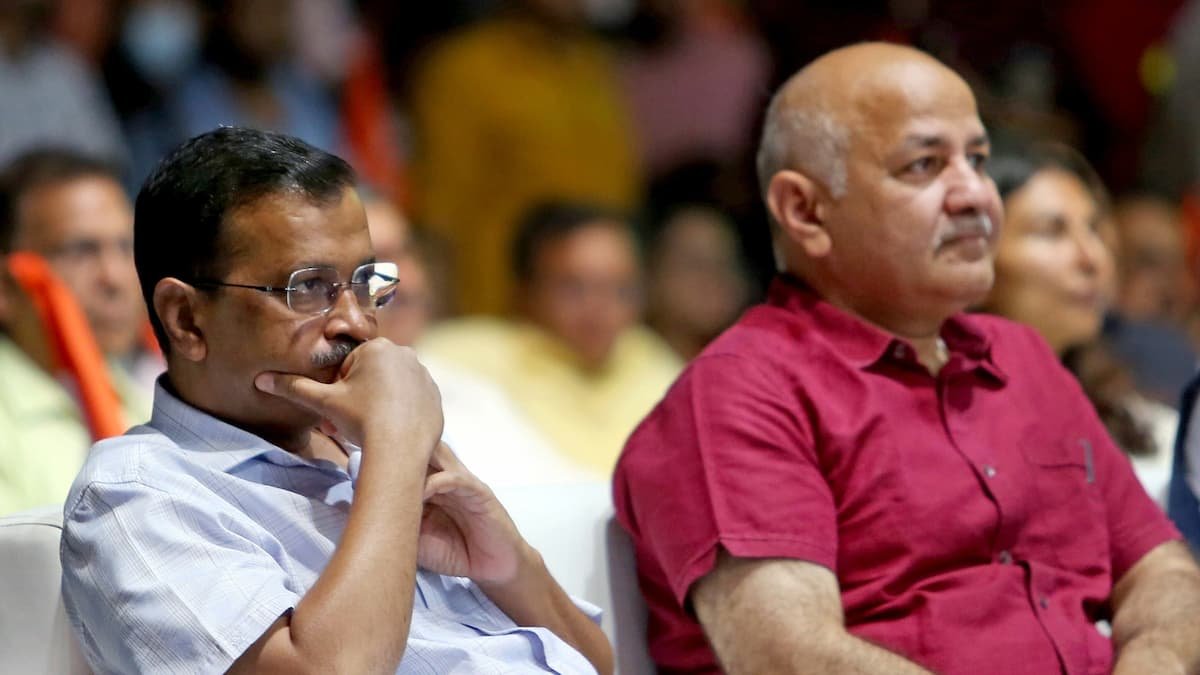
The Delhi High Court on Friday deferred the hearing on the CBI’s petition challenging the discharge of AAP leaders Arvind Kejriwal, Manish Sisodia and others in the Delhi excise policy case till May 11.
Justice Swarana Kanta Sharma said the court was awaiting consent from certain senior lawyers who may be appointed to represent Kejriwal, Sisodia and AAP MLA Durgesh Pathak, who are currently unrepresented in the matter.
“I will appoint on Monday. Arguments will begin on Tuesday,” Justice Sharma observed during the hearing.
The former Delhi chief minister and other AAP leaders have boycotted proceedings before Justice Sharma after the judge declined to recuse herself from the case despite applications alleging conflict of interest and apprehension of bias.
Earlier this week, the court had indicated that proceedings would continue once legal representation was arranged for the unrepresented parties.
During Friday’s hearing, the court also noted that discharged accused Vijay Nair and Arvind Kumar Singh had filed applications challenging the maintainability of the CBI’s petition.
Solicitor General Tushar Mehta, appearing for the CBI, informed the court that replies to the applications had already been filed and that the agency would address the issue during arguments.
On February 27, a trial court discharged Kejriwal, Sisodia and 21 others in the liquor policy case, observing that the prosecution case failed to withstand judicial scrutiny and stood “discredited in its entirety”.
After Justice Sharma rejected their recusal pleas on April 20, Kejriwal, Sisodia and Pathak wrote to the judge stating that they would neither appear personally nor through lawyers and would instead follow “Mahatma Gandhi’s path of Satyagraha”.
On April 5, the high court had closed the AAP leaders’ right to file replies after no one appeared on their behalf, while also indicating that senior advocates could be appointed as amici curiae to represent them.
Earlier, on March 9, the court had stayed the trial court’s recommendation for departmental action against the CBI investigating officer in the excise policy case.
While issuing notices to the 23 accused on the CBI’s plea against their discharge, Justice Sharma had remarked that certain findings of the trial court appeared prima facie erroneous and warranted examination.
The recusal applications alleged a possible conflict of interest on the ground that the judge’s children are empanelled as central government lawyers and receive assignments through the Solicitor General, who represents the CBI in the case.
Rejecting the plea on April 20, Justice Sharma held that judges cannot recuse themselves merely to satisfy “unfounded apprehensions of bias” raised by litigants.
Bombay HC Directs Maharashtra Govt to Form Expert Panel for Slum Act Audit 19
The Bombay High Court on Friday directed the Maharashtra government to constitute an expert committee within four weeks to conduct a performance audit of the Maharashtra Slum Areas (Improvement, Clearance and Redevelopment) Act.
A bench comprising Justices G S Kulkarni and Advait Sethna observed that the Act needs to be made more efficient to help achieve the “distant dream” of a slum-free Mumbai and other major cities in the state.
The court passed the order while hearing a suo motu petition initiated following directions from the Supreme Court of India to review the functioning and implementation of the legislation.
While pronouncing its verdict, the high court said several critical issues concerning the implementation of the Act require serious consideration by the authorities responsible for enforcing it.
The bench observed that ideal town-planning principles appear to have taken a backseat, particularly on public lands, and stressed the need for urgent reforms.
The court directed that the expert panel should comprise adequate members capable of conducting a comprehensive performance audit to make the Act more effective and help the government move towards the objective of slum-free urban centres.
Highlighting the current urban situation, the court remarked that the persistence of large slum pockets reflects the “abysmal progress” of town planning standards expected from an international city like Mumbai.
“Any town planning which does not sail with the times is questionable,” the bench observed.
The high court further noted that despite multiple efforts over the years, authorities have failed to eradicate slums in Mumbai and called for a more scientific, area-wise and systematic approach to redevelopment and urban planning.
Describing the task as “herculean”, the court said it was not impossible if the authorities demonstrated determination, strong political will and a genuine commitment to public welfare as Mumbai continues to evolve in the 21st century.