Star Javelin Thrower Neeraj Chopra Conferred Rank of Lieutenant Colonel 2
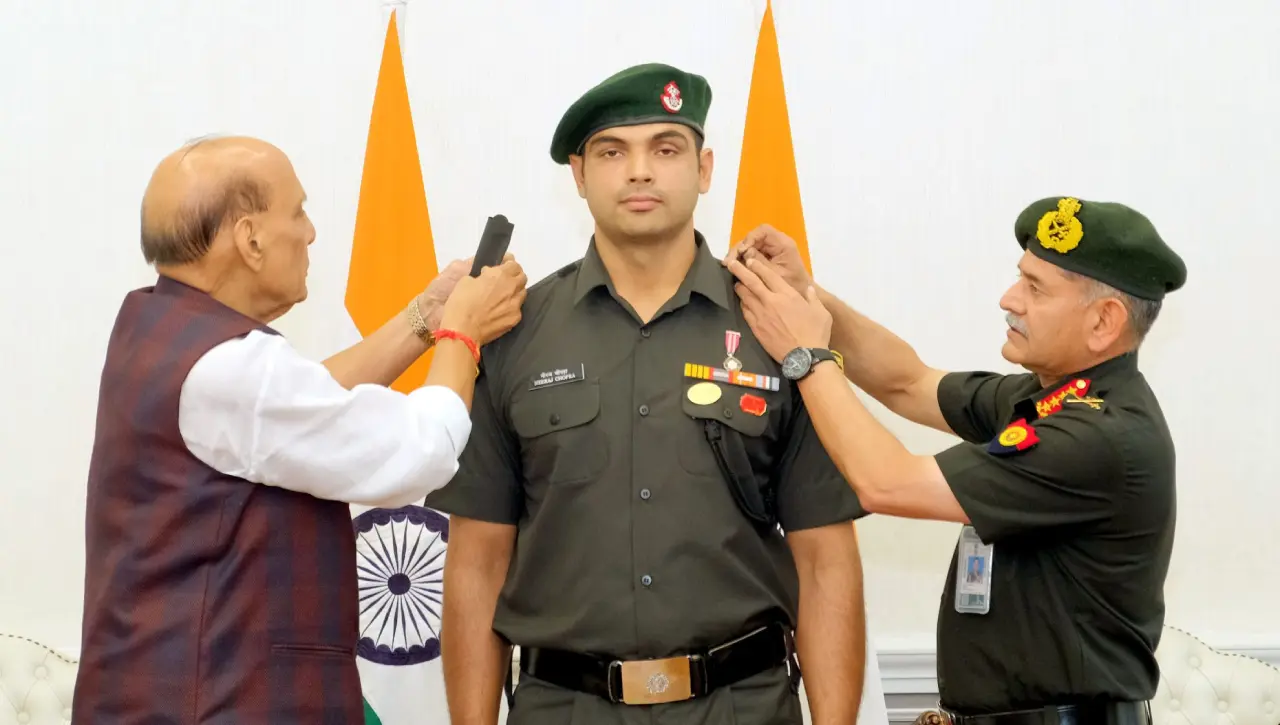
Olympic gold medallist javelin thrower Neeraj Chopra was on Wednesday conferred with the rank of Lieutenant Colonel.
Defence Minister Rajnath Singh formally conferred the insignia of Honorary Lieutenant Colonel in the Territorial Army on the star javelin thrower during a ceremony in New Delhi.
Speaking to Neeraj Chopra and his family, Singh described him as an “epitome of perseverance, patriotism and the Indian spirit of striving for excellence.” He said, “Lt Col (Hony) Neeraj Chopra embodies the highest ideals of discipline, dedication and national pride, serving as an inspiration to generations within the sporting fraternity and the Armed Forces alike.” Chief of the Army Staff General Upendra Dwivedi and other senior officials from the Indian Army and Territorial Army attended the ceremony.
Born on December 24, 1997, in Khandra village, Panipat district, Haryana, Neeraj Chopra joined the Indian Army in 2016 and has served with The Rajputana Rifles. He made history at the Tokyo Olympics in 2020 by becoming the first Indian to win an Olympic gold medal in track and field. He followed this with a silver medal at the Paris Olympics in 2024 and a gold at the World Athletics Championships in 2023.
Neeraj has also won multiple gold medals at the Asian Games, Commonwealth Games, and Diamond League events. His personal best throw of 90.23 metres in 2025 remains a landmark in Indian athletics.
In recognition of his achievements and contribution to the nation, Neeraj was granted an honorary commission in the Territorial Army by President Droupadi Murmu on April 16, 2025. He has also been honoured with the Padma Shri, Major Dhyan Chand Khel Ratna Award, Arjuna Award, Param Vishisht Seva Medal, and Vishisht Seva Medal.
Prashant Kishor Accuses BJP of Forcing Jan Suraaj Candidates to Withdraw, Urges EC to Intervene 4
Poll strategist-turned-politician Prashant Kishor on Tuesday accused the Bharatiya Janata Party (BJP) of coercing three Jan Suraaj Party candidates to withdraw their nominations from the Bihar elections. He urged the Election Commission to take immediate action, calling the incident a direct assault on democracy.
Speaking at a press conference, Kishor claimed that the ruling NDA was so afraid of losing the polls that it had resorted to pressuring opposition candidates to step aside. “Democracy is being murdered. There has been no such precedent in the country,” he said.
Kishor alleged that candidates fielded by Jan Suraaj in the Danapur, Brahampur, and Gopalganj constituencies were forced to withdraw under pressure from BJP leaders. He compared the situation to the “Surat model,” where a BJP candidate was elected unopposed after other contenders were allegedly coerced to back out.
“The BJP should remember that voters have already punished such undemocratic tactics,” Kishor remarked, pointing out that despite claims of winning 400-plus seats, the BJP managed only 240 in last year’s Lok Sabha elections.
Jan Suraaj had announced candidates for all 243 constituencies in Bihar. With three withdrawals, the party will now contest 240 seats as the deadline for filing nominations has expired.
Borivali Railway Police Nab 28-Year-Old for Molesting Woman at Station 6
The Borivali Railway Police have arrested a 28-year-old man for allegedly molesting a woman at Borivali railway station in the early hours of October 19. The court has remanded the accused to judicial custody, officials said.
According to police, the woman was at the station to board a train to Nagpur, where her mother had passed away. She was seated on a bench at platform number three around 1.30 am when the accused, reportedly intoxicated, approached and touched her inappropriately.
The woman immediately sought help from the railway police, who acted swiftly and registered a case under Section 74 of the Bharatiya Nyaya Sanhita (BNS), which pertains to assault or use of criminal force with intent to outrage a woman’s modesty.
The accused, who works as a video editor with a Mumbai-based production house, was arrested and later sent to Thane jail. His identity has not been disclosed by the authorities.
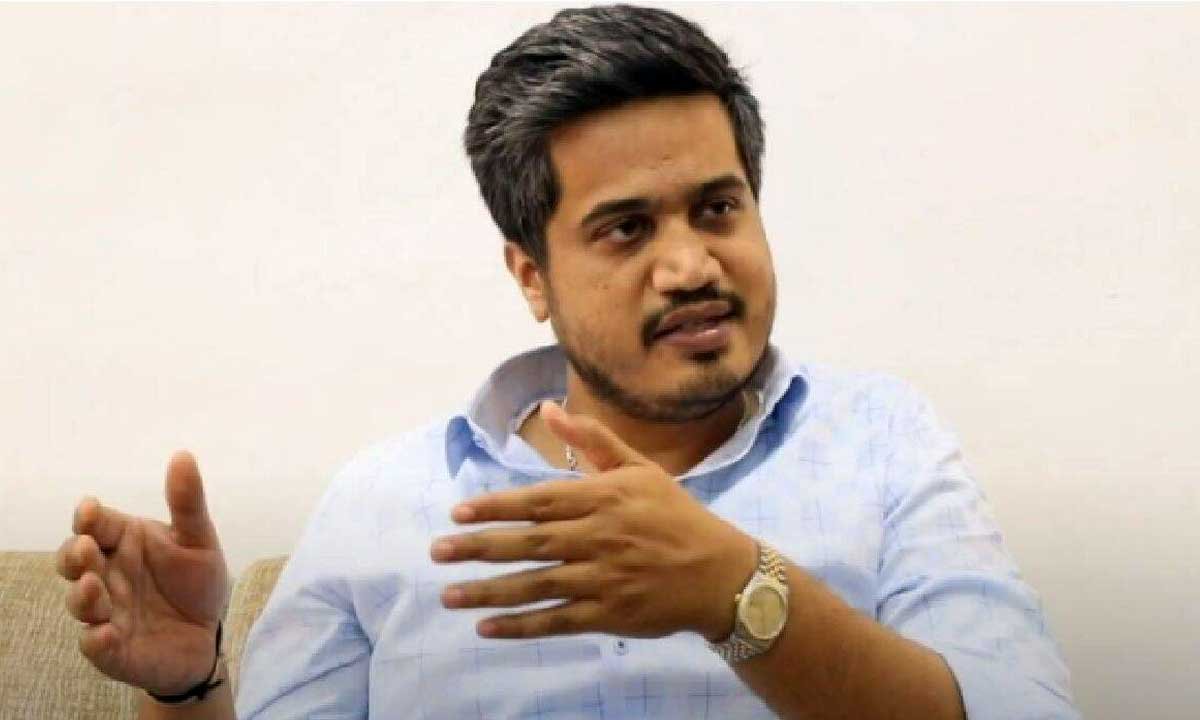
Rohit Pawar Demands Pune College Principal's Removal from State Panel over Caste Bias Allegations 8
NCP (Sharad Pawar faction) general secretary Rohit Pawar has called for the removal of Pune’s Modern College principal Nivedita Ekbote from the state’s youth and sports policy committee, after a former Dalit student accused her of caste-based discrimination.
The student, a former BBA graduate of the college, alleged that his job verification documents were deliberately withheld due to his caste background, which affected his employment with a UK-based company. However, the college administration denied the claims, stating that the required documents had been sent to his employer and that the student had not lost his job.
Labeling the allegations as “baseless,” the institution maintained that it followed due process in handling the verification.
Despite the clarification, Rohit Pawar criticized the college, accusing it of promoting “Manuvadi” ideology and questioned the inclusion of such individuals in a committee responsible for shaping the state’s youth and sports policy.
“If people with casteist mindsets are part of the committee drafting Maharashtra’s youth policy, what future can our youth expect?” Pawar wrote on social media. He added that the panel should include progressive members who “help students secure jobs abroad, not those who cause them to lose opportunities due to caste prejudice.”
Pawar has demanded that the state government immediately remove controversial members from the committee and restructure it to ensure inclusivity and fairness.
Midnight Blaze at Vashi's Raheja Residency Claims Four Lives, Injures Ten 10
A tragic fire at Raheja Residency in Navi Mumbai’s Vashi area claimed the lives of four people, including a six-year-old girl, and left ten others injured early Tuesday morning, officials said.
According to police, the blaze broke out around 12:30 am in a flat on the 10th floor of the MGM Complex, Sector 14, and quickly spread to the 11th and 12th floors. Two women, one man, and a young girl succumbed to the fire, while several residents sustained injuries due to smoke inhalation and burns.
The injured were immediately rushed to two hospitals in Vashi for treatment. Fire officials said they received the call shortly after the fire started and rushed to the scene with eight fire tenders and around 40 personnel. After intense firefighting operations, the blaze was brought under control by 4 am.
Authorities said the cause of the fire is yet to be determined. A detailed investigation is underway to ascertain whether an electrical short circuit or other negligence triggered the incident.
Residents were evacuated as a precautionary measure, and teams are now assessing the structural safety of the affected building.
The tragic incident has once again raised questions about fire safety compliance in Mumbai’s high-rise apartments, as residents mourn the loss of lives and await clarity on the cause of the disaster.
Post-Diwali Smog Chokes Delhi as Air Quality Dips to 'Very Poor' Levels 12
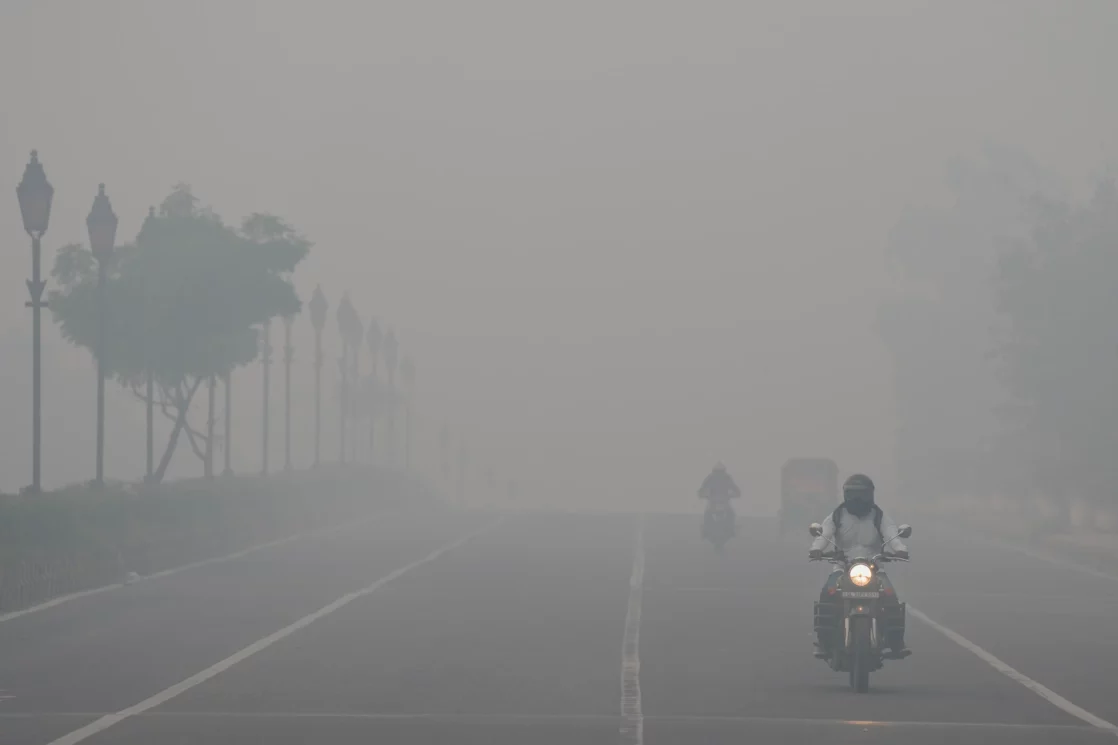
Delhi woke up on Tuesday to a thick blanket of grey smog, reduced visibility, and hazardous air as post-Diwali pollution sent the city’s Air Quality Index (AQI) spiraling into the ‘very poor’ zone. Many residents flouted the Supreme Court’s two-hour limit on firecrackers, celebrating late into the night.
According to data from the Central Pollution Control Board (CPCB), Delhi recorded an AQI of 352 at 8 am, up from 346 at 5 am and 351 at 7 am, indicating a sustained rise in pollution levels. The 24-hour average AQI on Monday was reported at 345, placing it firmly in the ‘very poor’ category.
An AQI between 301 and 400 falls under the ‘very poor’ range, meaning prolonged exposure may cause respiratory discomfort. On Monday, 36 out of Delhi’s 38 monitoring stations registered readings in the ‘red zone,’ showing that pollution was widespread across the capital.
The CPCB’s SAMEER app, which tracks real-time AQI data, remained unresponsive on Tuesday morning, leaving citizens relying on scattered updates from local stations.
While the Supreme Court had permitted the use of green firecrackers in Delhi-NCR only between 8 pm and 10 pm on Diwali night, widespread violations were reported as loud bursts and fireworks continued well past midnight.
At midnight, the AQI stood at 349, and at 1 am it was 348, reflecting that pollution levels had already surged during the peak of celebrations. Environmental experts warned that stagnant winds and low temperatures could trap pollutants near the ground for the next few days, worsening the smog.
Forecasts suggest the capital’s air quality may slip into the ‘severe’ category on Tuesday and Wednesday as pollution from firecrackers combines with emissions from vehicles, industries, and ongoing stubble burning in neighboring states.
With Delhi once again gasping for breath, environmentalists are urging authorities to step up enforcement and citizens to exercise restraint during future festivities.
Bihar 2025: A Mandate of Maturity and the Reinvention of Political Power 14
The 2025 Bihar election was not an event — it was an awakening. It proved once again that India’s most politically aware electorate has matured beyond rhetoric, slogans, and dynasty-driven narratives. The slogan “Vote Chor, Gaadi Chhod,” which was aggressively marketed by sections of the opposition, failed to resonate beyond a few social media corners. Bihar’s voters no longer invest emotions in catchy lines; they measure leadership by delivery. Their reality is defined by employment, flood management, infrastructure, and safety — not by verbal theatrics or family legacies. Beneath the surface noise, the people of Bihar made one of the most decisive, quietly intelligent electoral choices in recent history, reinforcing the Bharatiya Janata Party’s (BJP) position as the state’s most powerful and organized political machine.
What unfolded in Bihar was not just an election; it was a case study in political discipline versus disorder. While the Congress and the Rashtriya Janata Dal (RJD) scrambled to find relevance, the BJP had already completed its groundwork months in advance. Its network — stretching from booth-level committees to the remotest panchayat — functioned like a living organism, not a campaign office. The Sangh Parivar’s social capital, accumulated over decades, played a silent but decisive role in translating trust into votes. Every small trader, fisherman, weaver, and women’s self-help group had been approached by BJP cadres well before polling dates were announced. This wasn’t outreach; it was relationship management.
The contrast with the opposition could not have been starker. The Congress, stuck in its outdated template of grand roadshows and photo opportunities, failed to recognize that visibility without credibility achieves nothing. Its state units remain demoralized, unrecognized, and directionless. The Gandhis continued to perform to television cameras, but their disconnect from their own cadres has reached a breaking point. On the other hand, the BJP’s leadership ecosystem — from Amit Shah to Dharmendra Pradhan, C.R. Patil, Keshav Prasad Maurya, and Vinod Tawde — demonstrated that power doesn’t just flow from the top; it circulates through structure. Every worker, however small, felt valued. Amit Shah’s meetings with local workers weren’t symbolic; they were strategic morale sessions that instilled belongingness and accountability. When workers feel seen, they perform not for reward, but for pride.
Meanwhile, Prashant Kishor’s much-discussed entry into Bihar politics ended as a self-inflicted political embarrassment. His Lok Niti initiative, initially framed as a revolutionary civic movement, degenerated into an exercise in personal branding. Kishor failed to grasp that in Bihar’s soil, politics is built through sweat, not surveys. His speeches sounded more like lectures than leadership. For a man once celebrated as the backroom brain behind historic victories, the fall from strategist to sideshow was swift and public. His political capital, once respected by both camps, has now evaporated entirely.
The RJD, still orbiting the ghost of Lalu Prasad Yadav, continued to rely on caste-based arithmetic and nostalgia, failing to notice that Bihar’s political psychology has evolved. Viral videos of RJD workers threatening voters circulated widely on social media, devastating the party’s credibility and exposing its internal lawlessness. Worse still, Tejashwi Yadav’s absence from his flood-hit constituency during critical weeks spoke volumes. The people noticed. While they waited for leadership, it was the BJP’s local units and RSS volunteers who were seen distributing relief material and helping affected families. Tejashwi’s indifference cost him moral legitimacy. Bihar’s voters, far more politically literate than Delhi’s drawing-room analysts admit, saw through the facade of populism. They now recognize that charisma without compassion is worthless.
In contrast, Nitish Kumar retained his quiet but solid image of governance. Over the years, his emphasis on infrastructure, roads, electricity, and education has earned him administrative respect. Even his critics concede that Nitish’s government delivered visible transformation in a state once synonymous with backwardness. The JD(U)’s governance model complements BJP’s organizational might — a partnership that works not because it is convenient, but because it is coherent. Nitish brings technocratic balance; the BJP brings ideological energy. The people of Bihar understand that equilibrium well.
But the BJP’s strength in this election was not just organizational — it was emotional. The Modi factor continues to be the glue binding aspirational India, and Bihar is no exception. For a state long defined by migration and economic struggle, Modi’s persona as a self-made leader who rose from modest origins resonates deeply. His articulation of “Viksit Bharat” aligns perfectly with Bihar’s yearning for dignity-driven progress. The Prime Minister’s message that every small trader, fisherman, and farmer has a place in the national vision was not seen as rhetoric but as recognition. And in Bihar, recognition matters more than rhetoric.
At the operational level, the BJP ran a textbook-perfect campaign. Unlike opposition parties that treat workers as instruments, the BJP treats them as assets. The involvement of senior strategists like Dharmendra Pradhan and Vinod Tawde ensured precision in execution. But equally significant was the spontaneous participation of veteran party workers — those who volunteered, often unpaid, simply to ensure the victory of what they call “our ideology.” This ideological motivation is BJP’s deepest strength. Other parties rely on alliances of convenience; BJP relies on conviction. That distinction is why its machinery never collapses, even under pressure.
In sharp contrast, the opposition alliance appeared transactional. Congress leaders appeared on television more than on the ground. RJD leaders gave fiery speeches but failed to provide any constructive roadmap. Prashant Kishor oscillated between criticism and confusion. And through all this chaos, the BJP maintained silence — letting its karyakartas do the talking. The result was a campaign that looked less like politics and more like disciplined civic engagement.
There is also a sociological layer to BJP’s growing dominance in Bihar. The party’s systematic integration of women, youth, and small-scale entrepreneurs into its ecosystem has built a parallel social identity that transcends caste lines. Women voters, often the silent majority, turned out in large numbers — influenced by the BJP’s welfare measures, self-help group initiatives, and micro-financing outreach. The traditional caste arithmetic that once dictated Bihar’s politics is being replaced by issue-based alignment, a shift largely engineered by BJP’s long-term presence in local communities.
This election also exposed a pattern the media continues to ignore — the emergence of the silent voter. Bihar’s real electorate does not speak on television panels or Twitter spaces. It neither attends large rallies nor waves flags. It observes quietly, makes up its mind privately, and votes decisively. The so-called experts who relied on urban surveys and media bites misread Bihar entirely. The silent majority rejected chaos and chose continuity. It was less a vote for ideology and more a vote for reliability.
The decline of RJD and Congress, coupled with Prashant Kishor’s implosion, has left a political vacuum that only BJP appears equipped to fill. The opposition’s leadership crisis is structural: no clarity of message, no chain of command, and no sense of accountability. In contrast, BJP’s hierarchy functions with precision — clear goals, disciplined communication, and measurable outcomes. The difference between them can be summarized simply: BJP works 365 days a year; the opposition wakes up every five years.
Beyond the numbers, the message of Bihar 2025 is philosophical. Politics is no longer about noise, emotion, or dynasty. It’s about delivery, dignity, and depth. The BJP’s dominance is not the result of propaganda; it is the outcome of performance. Its ability to combine ideology with governance has set a new standard in Indian politics. From flood relief to booth management, from policy articulation to cultural grounding, the BJP has mastered the art of being both the government and the movement.
Bihar’s voter base has matured, its political aspirations have evolved, and its patience for opportunism has run out. The electorate no longer votes for caste; it votes for competence. It no longer votes for faces; it votes for faith. The 2025 mandate, therefore, is not just a victory for the BJP — it is a validation of structured politics over spontaneous chaos. It reflects a silent social revolution where people prefer institutions over individuals, systems over slogans, and work over words.
The opposition will continue to exist in fragments — RJD as a nostalgic family enterprise, Congress as a fatigued organization running on inertia, and Prashant Kishor as a forgotten footnote in political experimentation. But the BJP stands unchallenged because it has built what the others never could — an ecosystem of belief. It understands Bihar’s pulse not through poll data but through lived engagement. Its power lies not in marketing but in movement, not in promises but in participation.
Bihar 2025 is therefore more than an election result; it is a statement of evolution. The state that once symbolized chaos now represents clarity. The voter who was once reactive is now reflective. And the party that mastered that reflection — with discipline, ideology, and a human touch — is the BJP. In the end, Bihar did not vote for noise or nostalgia. It voted for trust. And in today’s India, trust has only one political address.
Trump Urges Ukraine and Russia to 'Stop the War Now,' Cools on Zelenskiy's Plea for Tomahawk Missiles 16
Ukrainian President Volodymyr Zelenskiy arrived at the White House on Friday seeking advanced U.S. weapons to bolster his country’s defense against Russia. Instead, he encountered an American president intent on halting the war rather than escalating it.
While U.S. President Donald Trump did not entirely dismiss the idea of providing Tomahawk missiles, he appeared reluctant as he looked ahead to a forthcoming meeting with Russian President Vladimir Putin in Hungary. After over two hours of talks, Trump urged both nations to end hostilities immediately — even if that meant Ukraine conceding territory.
“You stop at the battle line, and both sides should go home,” Trump told reporters en route to Florida. “Stop the killing — that should be it. I told that to President Zelenskiy. I told it to President Putin.”
Trump’s renewed outreach to Putin — a move that has previously unsettled Kyiv and European allies — cast a shadow over his otherwise cordial exchange with Zelenskiy. The two later met privately, discussing Trump’s recent phone call with Putin and the potential path toward negotiations.
“I think President Zelenskiy wants it done, and I think President Putin wants it done. Now all they have to do is get along a little bit,” Trump said, framing himself as a mediator. Zelenskiy, however, stressed that only one side truly seeks peace. “We want this. Putin doesn’t want it,” he said.
The Ukrainian leader candidly explained that Kyiv’s planned offensive required U.S.-supplied long-range weapons. “We don’t have Tomahawks, that’s why we need Tomahawks,” he said. Trump replied, “We’d much rather have them not need Tomahawks.” Later, he added, “We want to keep our own weapons — we don’t want to give away what we need to protect our country.”
Though Zelenskiy called the meeting “productive,” he acknowledged that Washington was wary of escalation. “I’m realistic,” he said, adding that he was counting on Trump to pressure Putin “to stop this war.”
Trump’s conciliatory tone followed a recent call with Putin, after which he agreed to meet the Russian leader again — possibly within weeks. The Kremlin, however, hinted the timing could shift. The August summit between the two had ended early without significant progress.
Trump’s remarks raised doubts about near-term U.S. military aid for Ukraine and reignited European concerns of a deal that could favor Moscow. Still, the European Union said it would welcome any genuine peace efforts.
Asked if he feared being manipulated by Putin, Trump quipped, “I’ve been played all my life by the best of them, and I came out really well — so it’s possible.”
Analysts said Zelenskiy likely left disappointed. Michael Carpenter, a senior fellow at the International Institute for Strategic Studies, said, “The underlying reality is that there is no inclination to impose costs on Russia.”
Despite tensions, Trump praised Zelenskiy’s appearance, joking that he looked “beautiful in his jacket” — a nod to past criticism over his attire during a previous White House visit.
Three and a half years after Russia’s full-scale invasion, the war remains intense. Russia claims to have seized 5,000 square kilometers of Ukrainian territory this year, while Kyiv insists Moscow’s broader offensive has failed. Both sides continue to target each other’s energy infrastructure, with Russian drones occasionally crossing into NATO airspace.
Experts believe Putin’s latest outreach aims to delay U.S. arms transfers, particularly the Tomahawk missiles that Kyiv views as a game-changer. Max Bergmann of the Center for Strategic and International Studies said Moscow’s diplomacy was “meant to make U.S. weapons support less likely.”
Mykola Bielieskov, an analyst at the Ukrainian NGO Come Back Alive, said Tomahawks could shift battlefield dynamics. “It’s not about one or two strikes,” he said. “It’s about constant pressure — disrupting Russia’s war machine.”
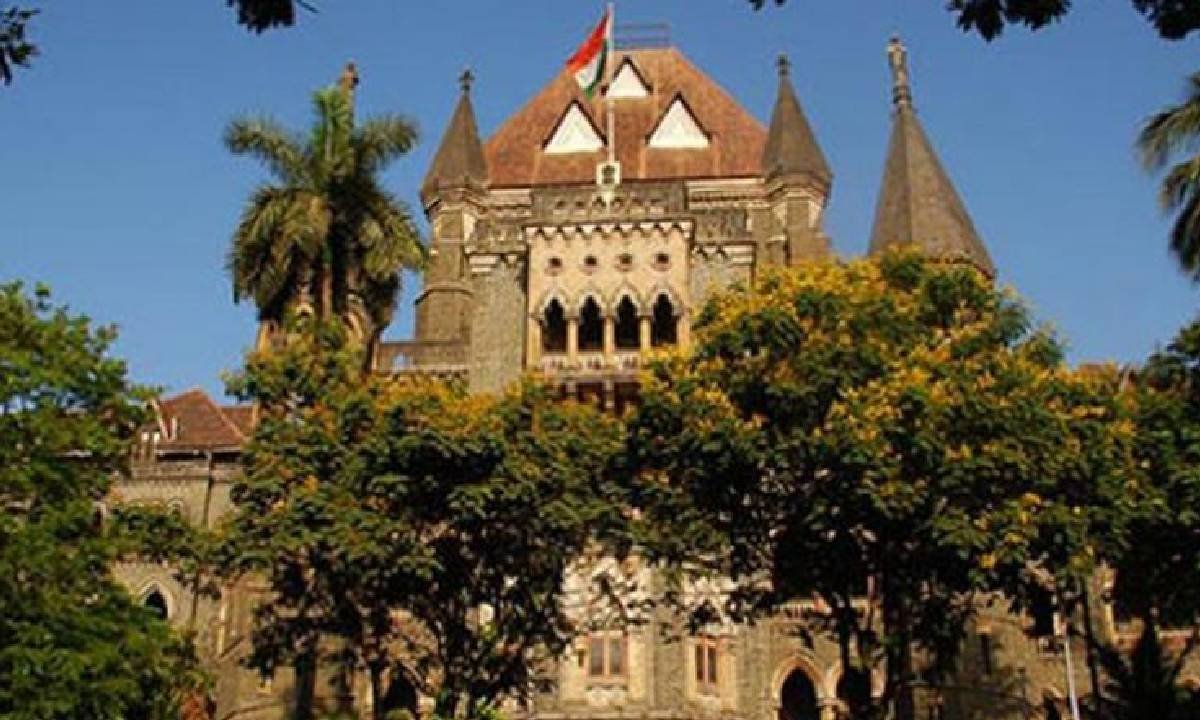
The Bombay High Court on Friday granted bail to suspended Thane Municipal Corporation (TMC) Deputy Commissioner Shankar Patole and his associates Omkar Ram Gaikar and Sushant Sanjay Surve in a ₹70-lakh bribery case investigated by the Maharashtra Anti-Corruption Bureau (ACB).
The case, registered at Naupada Police Station in Thane, pertains to offences under various sections of the Prevention of Corruption (PC) Act. According to the complaint, a builder developing a property with unauthorised structures had approached Patole, who allegedly demanded ₹20 lakh to initiate action against the violations. Though half the amount was transferred to Surve, Patole reportedly took no action beyond issuing two notices.
Later, Patole allegedly demanded another ₹50 lakh, prompting the builder to approach the ACB. A trap was laid, and investigators recorded a phone conversation in which Patole purportedly demanded the bribe. Gaikar was caught red-handed while allegedly collecting the cash on Patole’s behalf.
Advocates Aabad Ponda and Saurabh Butala, representing Patole, argued that none of the charges attracted punishment exceeding seven years and that the police should have first issued summons under Section 41A of the CrPC. They further contended that the accused’s continued detention would amount to “pre-trial punishment.”
Advocates Sudeep Pasbola and Waqar Pathan maintained that the money transferred to Surve’s account was legitimate consultancy fees, while Advocate Harshad Sathe, representing Gaikar, said his client was unaware that the bag he carried contained cash.
Justice N.J. Jamadar, while acknowledging that the evidence made out a prima facie case, noted that it was “essentially a trap case” with most material already collected by the ACB. Observing that Patole’s suspension reduced the risk of tampering with records, the court ruled that further detention was not necessary.
While granting bail, the court imposed stringent conditions after the prosecution expressed concern over alleged threats made to the complainant builder.
Nobel Laureate Physicist Chen Ning Yang Passes Away at 103 19
Renowned physicist and Nobel laureate Chen Ning Yang passed away in Beijing on October 18 at the age of 103, China’s state news agency Xinhua reported on Saturday. Yang, who made pioneering contributions to theoretical physics, died of illness.
Born in Hefei, Anhui province, in 1922, Yang later became a Chinese-American physicist celebrated for his work in statistical mechanics and symmetry principles in elementary particle physics. His groundbreaking research reshaped the understanding of physical laws governing the universe.
In 1957, Chen Ning Yang jointly received the Nobel Prize in Physics with Tsung-Dao Lee for their revolutionary theory challenging the long-held concept of parity conservation in weak nuclear interactions — a discovery that forever changed modern physics.