Home Blog Page 6

The Kerala Story 2: Stop Turning Kerala into a Political Scapegoat

kerala story 2, the kerala story 2, propaganda
The Kerala Story 2: Stop Turning Kerala into a Political Scapegoat 2

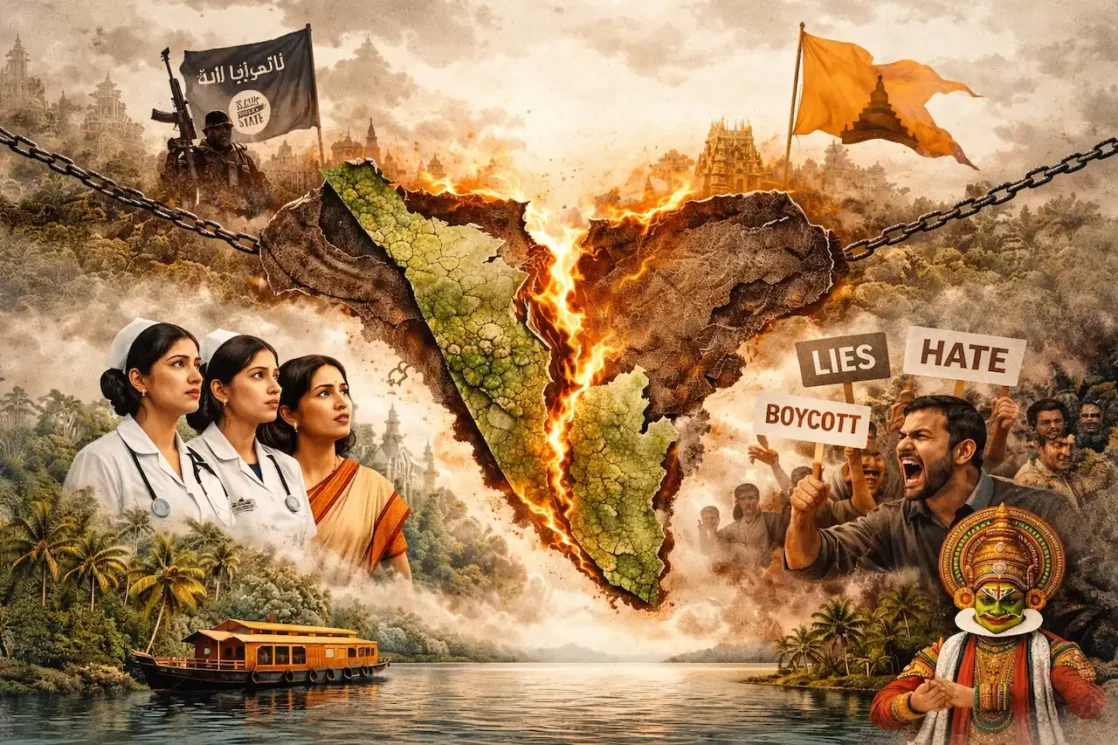
Kerala has long been called God’s Own Country, and not without reason. A narrow, fertile strip between the Arabian Sea and the Western Ghats, it is a land of temples and churches, mosques and monasteries, coconut groves and backwaters, literature and learning. Its nurses heal across continents, its teachers shape generations abroad, its migrant workers carry the state’s resilience into the Gulf and beyond. It is devout yet politically argumentative, traditional yet fiercely modern. And precisely because it defies neat categorisation, it has become a convenient target for neat political narratives.

In recent years, Kerala has repeatedly been framed as a hotbed of demographic conspiracy, radical recruitment and civilisational vulnerability. The 2023 Hindi-language film The Kerala Story, directed by Sudipto Sen and produced by Vipul Amrutlal Shah, claimed to be inspired by real events involving the alleged coercion of Hindu women into extremist networks. It was marketed with dramatic numbers suggesting mass conversion and recruitment. Eventually, the filmmakers had to include disclaimers acknowledging that the figures were inauthentic and that the story was fictionalised. Critics described it as propaganda; supporters called it a brave exposé. Either way, the film ignited a national controversy not merely about content but about intent.

The sequel has deepened the confrontation. Within hours of the trailer release of The Kerala Story 2: Goes Beyond, social media from Kerala erupted in sharp resistance. Memes, rebuttals and counter-campaigns flooded timelines. Now the Kerala High Court has issued notice to the producers, the Central Board of Film Certification and the Union Government over a petition questioning the film’s certification and even its title. The concern is straightforward: when narratives involving multiple states are branded exclusively as “The Kerala Story,” they attach allegations of terrorism, forced conversion and demographic conspiracy uniquely to Kerala’s identity. Titles are not neutral. They frame public imagination.

Strip away the cinematic intensity and a sober question emerges: is Kerala truly facing an organised existential threat, or is the state being drafted into a larger political strategy? Kerala is not without problems. No society is. There have been isolated cases of radicalisation; law enforcement has acted in such matters. There have been interfaith marriages that later turned controversial. There have been instances of ideological friction. But official investigations have repeatedly stated that there is no evidence of a coordinated mass campaign of forced conversion as portrayed in exaggerated narratives. The widely discussed Hadiya case, examined by investigative agencies and ultimately addressed by the Supreme Court, reaffirmed the constitutional right of an adult woman to choose her partner and her faith. That ruling was not merely about one individual; it was about autonomy in a republic governed by law.

To suggest that Kerala’s Hindu women are collectively naïve, easily manipulated or under siege is not only factually contestable but deeply patronising. Kerala’s women are among the most literate in India. Many serve as nurses and therapists across the globe, particularly in Muslim-majority nations. They navigate diverse cultural environments daily, often as primary earners in their households. They are not sheltered caricatures of innocence; they are professionals shaped by one of India’s most robust educational systems. Interfaith relationships, whether between Hindu women and Muslim men or vice versa, are complex social realities influenced by personal choice, changing aspirations and individual circumstances. They are not automatically evidence of conspiracy. Allegations of coercion, if proven, must be prosecuted with full force of law. But conflating isolated cases with an orchestrated demographic war corrodes rational debate.

Kerala’s social fabric is the product of centuries of plural contact. Arab traders reached the Malabar coast long before many parts of North India encountered Islamic rule. Jewish communities found refuge in Kochi. Syrian Christians trace ancient roots there. Temple culture flourished alongside mosque architecture. Onam is celebrated across communities. Communal harmony in Kerala has not been perfect, but it has been negotiated over time through reform movements, social renaissance leaders and political mobilisation that cut across caste and religion. Simplifying such a layered history into a binary of victim and aggressor is historically irresponsible.

The political context cannot be ignored. Kerala is not governed by the BJP; it is led by a Left coalition under Chief Minister Pinarayi Vijayan. In a highly polarised national environment, ideological difference often sharpens narrative battles. When a state does not align electorally with a dominant national party, its internal tensions can become amplified symbols. Problems that would be treated as local elsewhere become national flashpoints when attached to Kerala. Cinema, in such circumstances, morphs into a political instrument. That does not mean filmmakers lack the right to explore dark themes. It does mean that audiences are entitled to question whether storytelling is serving truth or serving strategy.

Cultural misunderstanding further complicates matters. Few issues reveal India’s diversity as starkly as the debate around cattle and beef. In much of North India, the cow holds sacred status shaped by centuries of agrarian dependence and religious symbolism. In Kerala, geography shaped a different economy. Large stretches were historically waterlogged paddy fields where water buffalo were better suited for cultivation than bullocks. The region never depended heavily on cattle rearing in the way the Gangetic plains did. The coconut tree, providing food, oil, fibre and fuel, became central to daily life. Over time, beef became part of Kerala’s culinary mainstream across religious lines. It is legal in the state, widely available and embedded in local cuisine. For many in Kerala, dietary practice is cultural rather than ideological. For many in the plains, reverence for the cow is civilisational. National maturity requires understanding both emotional landscapes without demonising either.

The surge in beef consumption in Kerala over the twentieth century was driven as much by economic shifts and cattle import patterns as by religious demography. The absence of sweeping cultural taboos allowed it to integrate into local diets. None of this makes Kerala anti-national. It makes Kerala different. Diversity has always meant difference, not uniformity. Demanding identical symbols of reverence from every region of India misunderstands how civilisations actually function.

What is troubling is not discussion of security. Vigilance against extremism is necessary everywhere. What is troubling is the leap from vigilance to sweeping indictment. When exaggerated figures are used to suggest thousands of women have been radicalised without substantiating evidence, public anxiety is manufactured faster than facts can respond. When one community is portrayed predominantly as predator and another exclusively as prey, social distrust deepens. That trajectory is dangerous in a country as plural as India.

Cinema has power. It shapes perception beyond box office numbers. A film that claims to reveal hidden truths bears a responsibility to anchor itself in verifiable data. If disclaimers are later required to clarify that figures are inaccurate and depictions fictionalised, credibility suffers. Propaganda is not defined solely by political alignment; it is defined by selective amplification designed to provoke. Audiences increasingly recognise the difference between art that interrogates reality and art that weaponises it.

The backlash from Kerala—court petitions, organised social media campaigns and pointed satire—reveals something important. The state is not silent. It pushes back. That pushback is not denial of problems; it is resistance to caricature. Kerala has confronted its own violent clashes between political cadres, its own episodes of communal tension, its own socioeconomic strains arising from migration and unemployment. These issues deserve granular reporting, not grand narrative inflation.

The heart of the matter is balance. If credible threats emerge, they must be confronted transparently and decisively. But if numbers are exaggerated, if incidents are generalised, if a state’s name becomes shorthand for terror in the national imagination without proportionate evidence, then the discourse shifts from security to stigmatisation. That shift harms not only Kerala’s image but India’s social cohesion.

India is not strengthened by setting one community against another. Nor is it strengthened by dismissing all concerns as hysteria. It is strengthened by clarity, by constitutional fidelity, by refusing to infantilise its women and demonise its minorities. Kerala embodies contradiction—deep religiosity coexisting with leftist politics, temple festivals flourishing alongside church feasts, beef on one table and strict vegetarianism on another. That coexistence is messy, imperfect and democratic.

The real story of Kerala is not mass conspiracy. It is negotiation. It is argument conducted within constitutional boundaries. It is young women boarding flights to Doha as nurses, remitting income back to families that light lamps at temples and celebrate festivals across faith lines. It is courts examining contested films. It is citizens responding with critique rather than violence.

If the nation seeks strength, it must resist the temptation of easy villains. Hard truths deserve evidence, not exaggeration. Kerala does not require myth-making to be understood. It requires honesty. And honesty, not propaganda, is what ultimately sustains both democracy and unity.

Rahul Gandhi Appears in Bhiwandi Court, Submits New Surety in RSS Defamation Case

rahul gandhi, bhiwandi court, defamation case, case, rss
Rahul Gandhi Appears in Bhiwandi Court, Submits New Surety in RSS Defamation Case 4

Congress leader Rahul Gandhi on Saturday appeared before a magistrate’s court in Bhiwandi, Maharashtra’s Thane district, to furnish a new surety in an ongoing defamation case filed against him by an RSS activist.

The court had directed Gandhi to present a fresh surety after former Union Home Minister Shivraj Patil, who had stood as his guarantor in the case, passed away in December last year. Gandhi submitted Maharashtra Pradesh Congress Committee chief Harshwardhan Sapkal as his new surety.

The magistrate had specifically instructed the Leader of Opposition in the Lok Sabha to remain present in person to complete the legal formalities related to the change of surety, his lawyer had earlier said.

The case stems from a complaint filed by Rashtriya Swayamsevak Sangh (RSS) activist Rajesh Kunte, who alleged that Gandhi, during a rally at Sonale village in the run-up to the 2014 Lok Sabha elections, stated that the RSS was behind the assassination of Mahatma Gandhi. Kunte claimed the remark was false and damaged the organisation’s reputation, and filed the complaint under Section 500 (defamation) of the Indian Penal Code.

The trial has progressed with Kunte’s cross-examination and re-examination already completed. The matter, which was initially scheduled for hearing on December 20, 2025, was adjourned to January 17 due to the requirement of a new surety. On January 17, the magistrate further deferred the hearing to February 21.

The Robotic Dog Scandal and India’s Moment of Embarrassment

The Robotic Dog Scandal, Robotic Dog, Galgotia, AI Summit, AI Impact Summit, Robotic dog Orion, Galgotias University
The Robotic Dog Scandal and India's Moment of Embarrassment 6

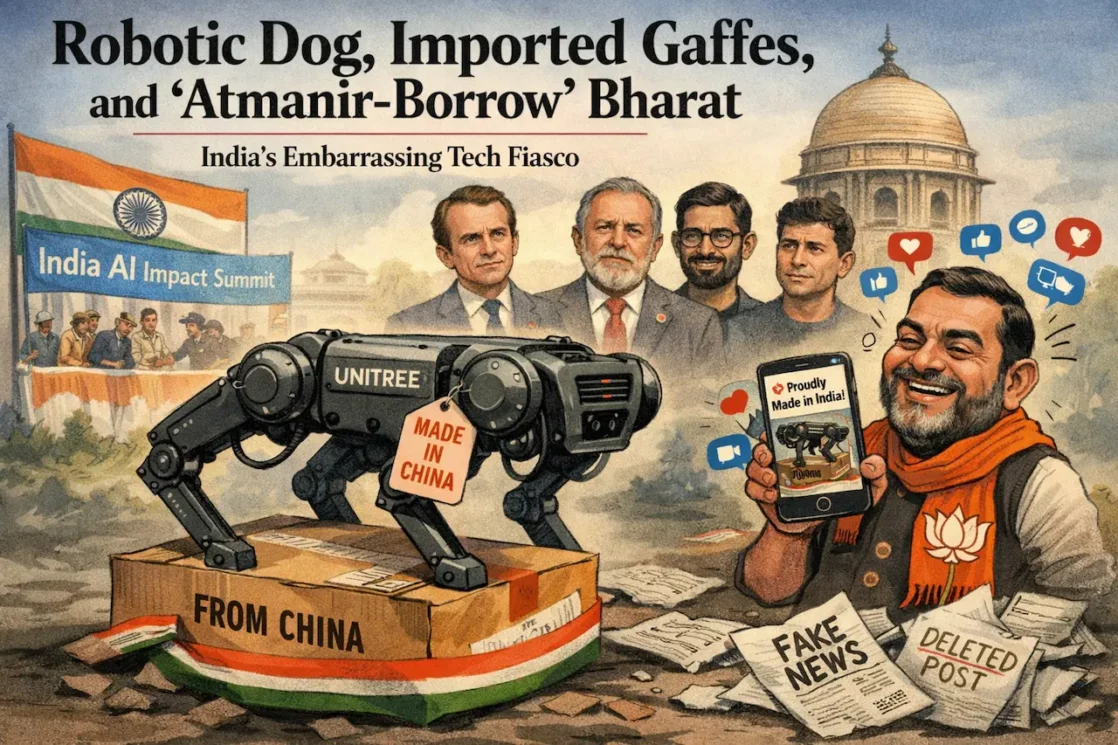
India hosted the India AI Impact Summit with all the pomp and ambition of a nation ready to proclaim itself a technological powerhouse. The stage was global, the audience formidable. Leaders like Emmanuel Macron and Luiz Inácio Lula da Silva were in attendance, global tech heavyweights such as Sundar Pichai, Sam Altman and Cristiano Amon were expected to participate, and Prime Minister Narendra Modi was set to address the gathering. This was supposed to be India’s moment — a confident announcement to the Global South that we are not just consuming artificial intelligence, we are building it. Instead, what stole the spotlight was not a breakthrough algorithm or a groundbreaking chip, but a robotic dog that could be ordered online.

The controversy exploded when videos from the summit circulated widely on social media. Representatives from Galgotias University showcased a sleek four-legged robot named “Orion,” describing it as a product of the university’s Centre of Excellence. The optics were powerful: a made-in-India quadruped symbolizing indigenous innovation. The applause, however, did not last long. Internet users quickly identified the machine as the Unitree Go2, a commercially available robotic dog manufactured by China-based Unitree Robotics. Available for purchase in India for roughly ₹2–3 lakh, and globally at modest price points, it is widely used in labs and classrooms around the world. There was nothing mysterious about it, and certainly nothing indigenous.

What followed was a textbook case of narrative outrunning facts. Critics accused the university of passing off imported technology as homegrown innovation. Under pressure, Galgotias University clarified on social media that the robot had indeed been procured from Unitree and was being used merely as a teaching aid. Yet the explanation came too late. Government sources indicated that the university was asked to vacate its exhibition space at Bharat Mandapam during the summit. Professor Neha Singh later stated she never explicitly claimed the robot was built from scratch but had only presented it as an exhibit. Still, the perception of misrepresentation had already hardened.

The embarrassment did not stop there. Reports soon highlighted another product displayed by the university — a drone soccer device allegedly developed on campus. Observers pointed out striking similarities between the showcased drone and commercially available models associated with South Korea’s Helsel, the pioneer of drone soccer technology since 2015. Once again, what was suggested to be domestic innovation appeared suspiciously like imported hardware. Two incidents in quick succession turned what should have been a triumphant AI gathering into an uncomfortable international talking point.

The real damage lies not in buying foreign technology. Universities across the world procure international tools for research. There is no shame in importing a robot for educational purposes. The humiliation arises when optics blur into exaggeration. At a summit attended by heads of state and CEOs evaluating India’s AI ecosystem, the line between showcasing research capability and implying product ownership must be crystal clear. Investors and global partners do not measure technological leadership by viral videos; they examine patents, supply chains, intellectual property, and research depth.

Equally troubling was the rush by several political figures and supporters to amplify the robotic dog as a symbol of India’s success without basic verification. Posts celebrating the “indigenous breakthrough” spread quickly. Images were circulated proudly. When online users exposed the truth, those celebratory posts quietly disappeared. Deleting a tweet may remove it from a timeline, but it does not erase the digital trail or the credibility lost in the process. In the age of screenshots, enthusiasm without due diligence is not harmless; it is reckless.

This episode has wider implications. The India AI Impact Summit was marketed as a flagship initiative projecting India as a serious AI leader for the Global South. When an internationally visible event becomes associated with questions of authenticity, it risks overshadowing the genuine achievements of Indian scientists and startups. The country has brilliant engineers building large language models, robotics solutions, semiconductor designs, and AI applications across sectors. Their painstaking work does not deserve to be diluted by careless showmanship.

There is also a question of institutional responsibility. How did a private university’s exhibit pass through vetting processes at such a high-profile international summit without clearer disclosures? Large-scale events require rigorous screening, not just elaborate staging. Transparency should not depend on social media detectives correcting public claims after the fact. The credibility of national platforms rests on strong institutional filters long before exhibition booths are opened.

The broader irony cuts deeper. The government has consistently championed the vision of “Atmanirbhar Bharat,” emphasizing self-reliance in manufacturing and technology. The aspiration is legitimate and necessary. But self-reliance cannot be retroactively stamped onto imported machines. It is built through sustained research investment, academic integrity, and honest representation of progress. Branding cannot substitute for building. A slogan becomes hollow the moment presentation outpaces substance.

International observers are not easily swayed by spectacle. When leaders like Macron or Lula attend an AI summit in New Delhi, and global executives such as Pichai or Altman share the stage, they are evaluating whether India offers credible partnerships, robust innovation ecosystems, and trustworthy institutions. An episode involving misrepresented hardware risks feeding skepticism that India is better at packaging than producing. Whether fair or not, perceptions matter on the global stage.

The government now faces a choice. It can treat this episode as a minor embarrassment and move on, or it can use it as a catalyst for stricter standards. Clear guidelines must define how institutions present imported technologies at official forums. Claims of indigenous development must be backed by documentation. Political endorsements should follow verification, not precede it. A developed nation does not rely on viral validation; it relies on verifiable achievement.

It is tempting in moments like this to demand punitive action out of anger — cancellation of accreditation, arrests, sweeping punishments. Yet durable solutions require systemic reform rather than symbolic fury. The objective should be to restore credibility and prevent recurrence, not merely to produce scapegoats. Transparency, accountability, and procedural rigor are stronger correctives than outrage alone.

India stands at an important technological crossroads. The ambition to become a developed nation by the coming decades is not fantasy; it is achievable. But development is not a marketing campaign. It is discipline sustained over years. When we celebrate prematurely, we invite scrutiny. When scrutiny reveals exaggeration, we invite ridicule. When ridicule becomes international, we undermine the very institutions tasked with carrying the national vision forward.

The robotic dog saga may fade from daily headlines, but its lesson should not. If we want the world to take India’s AI aspirations seriously, we must first take our own standards seriously. Celebrate what is real. Build what does not yet exist. And above all, remember that credibility, once dented on a global stage, costs far more to repair than any robotic dog ever will.

When Politics Sinks to the Gutter: Deflection, Distortion, and the Assault on India’s Democratic Memory

9b0bb577 dd53 4bc7 9e9d a45360cc18ef
When Politics Sinks to the Gutter: Deflection, Distortion, and the Assault on India’s Democratic Memory 8

The scenes that unfolded outside Parliament yesterday were not just another episode in India’s noisy political theatre. They were a revealing moment — one that exposed how fragile, reactionary and intellectually hollow public discourse can become when political desperation takes precedence over dignity.

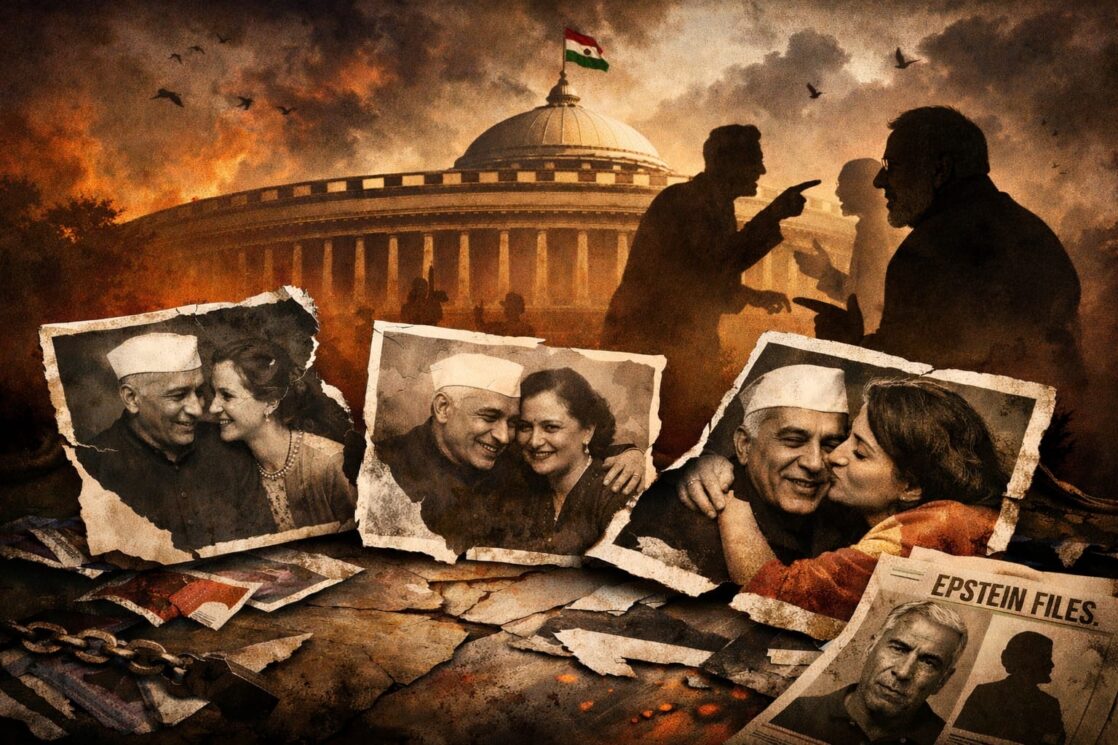
A senior leader of the Bharatiya Janata Party, while responding to allegations circulating about so-called “Epstein files” and an alleged connection being whispered around Prime Minister Narendra Modi, chose not to confront the matter with evidence, clarity, or reason. Instead, he stood before the media with a handful of photographs of India’s first Prime Minister, Jawaharlal Nehru. One photograph showed Nehru alongside Edwina Mountbatten. Another featured his sister, Vijaya Lakshmi Pandit. The third showed a tender family moment — his niece, Nayantara Sahgal, affectionately hugging and kissing her uncle on the cheek.

It was, by all reasonable standards, a loving family photograph. Anyone with basic emotional intelligence can recognise affection within a family without descending into cheap insinuations.

And yet, what appeared to be the subtext of this spectacle? A crude attempt to imply: “Even if Modi’s name appears in certain speculative files, Nehru was no saint either.” This is not argument. This is intellectual bankruptcy dressed up as outrage.

Let us examine the absurdity.

First, the relationship between Nehru and Vijaya Lakshmi Pandit was that of brother and sister. Pandit was a distinguished diplomat who later became President of the United Nations General Assembly. To weaponise photographs of siblings standing together is not political debate — it is moral decay.

Second, the photograph with Nayantara Sahgal depicted familial affection between an uncle and niece. Sahgal herself has written extensively about growing up in Anand Bhavan surrounded by intense political discussions and nationalist fervour. To twist such images into something unsavoury is not only shameful; it reflects a disturbing willingness to defile even family bonds for political convenience.

Third, and most sensationalised over decades — Nehru’s friendship with Edwina Mountbatten. Yes, the two shared a deep bond. It has been documented, analysed, romanticised, and scrutinised. But it has also been clarified by Edwina’s daughter in her memoir Daughter of Empire, where she emphasised the respect, emotional kinship and platonic nature of their relationship. Both Nehru and Edwina belonged to elite political circles. They interacted frequently in public, amidst officials and dignitaries. Their correspondence, when released, revealed warmth — not scandal.

History records human relationships in shades of complexity. It does not validate sensational gossip engineered decades later for political mud-slinging.

Now let us turn to the deeper issue — the practice of dragging freedom fighters into contemporary controversies. Nehru was not merely India’s first Prime Minister. He was a central architect of independent India. He spent nine long years in British prisons. He helped lay down the foundations of democratic institutions — from IITs and scientific research centres to a secular constitutional framework. He navigated a shattered nation through Partition’s horrors without social media, without propaganda machinery, and without an IT cell narrating his glory day and night.

Disagree with his policies. Critique his economic model. Debate his Kashmir approach. That is legitimate in a democracy. But equating affectionate family photographs with modern allegations tied to entirely unrelated global scandals crosses into intellectual delinquency.

As for the mention of “Epstein files” — allegations and insinuations are not convictions. The global controversy surrounding Jeffrey Epstein has engulfed politicians, businessmen, celebrities and royals worldwide, often on the basis of association rather than proof. Dragging such speculative matters into India’s internal politics without verified evidence is reckless. If credible facts exist, they should be investigated transparently. If not, weaponising whispers is nothing but character assassination.

Equally troubling is the use of allegedly AI-generated or digitally manipulated images in political attacks. In an age where artificial intelligence can fabricate convincing visuals, deploying altered historical imagery to score points is deeply unethical. Once truth becomes optional, democracy becomes ornamental.

The larger question is this: Is there even a valid comparison between Modi and Nehru?

Nehru governed a fragile newborn republic emerging from colonial ruin. Literacy was abysmal. Infrastructure was skeletal. Industrial capacity was marginal. He was building from ashes. Today’s India, for all its challenges, stands on the institutional scaffolding erected in those first years. To deny his role in shaping modern India is historical illiteracy.

Prime Minister Narendra Modi governs a rising economic power with digital governance, global connectivity, expansive media networks and unparalleled communication tools. His political era operates in a completely different landscape. He benefits from decades of institutional continuity.

Every leader must be judged within their context.

But what unfolded yesterday was not contextual criticism. It was deflection. Instead of directly addressing questions raised by the Opposition — including Rahul Gandhi’s recent parliamentary demands for accountability over tariff policies — the ruling party appeared more interested in rewriting old narratives. Gandhi’s recent speech, questioning economic policy and accountability, deserved rebuttal with data. Instead, what the public witnessed was distraction, diversion, and personal denigration.

This pattern reflects a broader concern: the shrinking space for reasoned discourse. Dissent is increasingly labelled as disloyalty. Questions are treated as conspiracies. Historical figures are selectively vilified while contemporary leaders are elevated beyond criticism.

Democracy does not function on personality cults. It functions on accountability.

Nehru did not silence critics by projecting doctored imagery of his predecessors. He debated them inside Parliament. His speeches remain on record — articulated, reasoned, and often self-critical. Today, Parliament sessions are frequently disrupted, Opposition voices curtailed, and media narratives polarised into camps.

One may strongly support or oppose any leader — Modi included. But lowering standards of debate to insinuations about family affection photographs sets a dangerous precedent. It tells younger generations that nothing is sacred — not freedom fighters, not familial bonds, not historical truth.

Criticise policies. Scrutinise decisions. Demand transparency over tariffs, economic partnerships, diplomatic positions — absolutely. That is the lifeblood of democracy. But attempting to obscure contemporary allegations by dredging up distorted historical photographs insults the intelligence of the nation.

India is not a playground of propaganda. It is a civilisation-state with memory.

You can disagree with Nehru’s vision, but you cannot erase his sacrifices. You can defend Modi robustly, but you cannot shield him through historical mud. The strength of a government lies not in silencing debate but in winning it through argument.

Yesterday’s episode was not merely poor optics. It was a moral low. And if political parties continue racing toward theatrical sensationalism rather than substantive governance debates, the casualty will not be one leader’s image — it will be public trust itself.

In a mature democracy, truth does not need manipulated images. It needs courage.

Mohan Bhagwat: Reframing Nationalism as Responsibility

mohan bhagwat, reframing, nationalism, bhagwat, rss, rss @100, rashtriya swayamsevak sangh
Mohan Bhagwat: Reframing Nationalism as Responsibility 10

Mohan Bhagwat’s address at the RSS Centenary Ceremony was not merely a celebration of a hundred years of organizational existence; it was a deep introspection on India’s social character, cultural consciousness, and national direction. This was not a speech crafted for applause, but a carefully weighted articulation where every word carried a long-term vision, a demand for discipline, and an expectation of accountability from society. When he positioned the Sangh not as a substitute for political power but as a lifelong practice of social nation-building, it was not just a formal distancing from politics; it was a reassertion of the core idea that organizations must act as moral catalysts within society rather than aspire to become centers of authority. This also served as a rebuttal to those who see the Sangh only through the prism of political power, while simultaneously acting as a caution to internal tendencies that might confuse social influence with the lure of power.

By separating nationalism from sloganeering and placing it on the anvil of conduct, Bhagwat directly challenges the culture of crowd politics. His subtext is unmistakable: it is easy to inflame emotions in the name of the nation, but difficult to cultivate character for the nation. In an age where social media often converts patriotism into noise and spectacle, his words relocate nationalism from performative outrage to everyday ethical choices. Paying taxes honestly, respecting civic rules, and standing up for justice become as much acts of nation-building as standing at the border with a rifle. This reframing strips nationalism of its sentimental excess and grounds it in civic responsibility.

His insistence on social harmony is not a poetic celebration of diversity but a practical warning against deepening polarization. When he says that India’s civilizational soul cannot be imprisoned within a single identity, he confronts the political convenience that turns diversity into division. He implicitly acknowledges that inequality and mistrust are not merely the results of external conspiracies but also of internal prejudices and rigidities. Therefore, the call is not only to change others but to change oneself, an uncomfortable demand for self-critique that any society serious about reform must accept.

The emphasis on discipline and restraint for the youth is not moral sermonizing but a blueprint for future stability. In a time driven by instant gratification and viral validation, character-building appears outdated, yet it is precisely this slow, demanding process that forms the bedrock of lasting national strength. Bhagwat’s message suggests that demanding opportunities without cultivating the discipline to deserve them is a hollow politics of entitlement. Rights gain moral legitimacy only when accompanied by an equally strong acceptance of duties.

His recurring invocation of “service” moves beyond charitable sentiment into the realm of social contract. Service here is not about patronizing benevolence but about rebalancing power relations through genuine sensitivity to the vulnerable. When service becomes self-congratulatory charity, it preserves inequality; when it becomes structural empathy, it nudges society toward justice. This reframes the Sangh’s tradition of service under a sharper ethical lens, insisting that service must translate into dignity, not dependency.

By asserting that India must become a reliable partner to the world before proclaiming itself a world teacher, Bhagwat checks the self-congratulatory nationalism that confuses rhetoric with reality. Global influence is built through conduct, consistency, and credibility, not through grand declarations. A nation fractured within cannot convincingly claim moral leadership abroad. Power, in his framing, is not merely military or economic capacity but moral authority rooted in social cohesion and ethical governance. This redirects national pride toward self-improvement rather than self-adulation.

His stress on dialogue and restraint confronts the dominant political culture of instant outrage and rhetorical aggression. In an environment where disagreement quickly turns into enmity, calling for restraint seems unfashionable, yet history shows that societies endure not by silencing dissent but by converting conflict into conversation. This appeal is not only for political actors but for citizens who habitually turn disagreement into hostility. Social peace, in this vision, is not an emotional appeal but a strategic necessity.

Describing the centenary as an occasion for introspection rather than self-glorification is itself a statement. Organizations often turn milestones into platforms for self-praise; here, the emphasis on future responsibility suggests an admission of incompleteness and a commitment to continuous reform. This public posture of self-examination signals a willingness to engage with criticism rather than evade it.

At its core, the address relocates nationalism from the language of entitlement to the language of responsibility. Nation-building is presented not as the monopoly of any institution or ideology but as a collective civic discipline practiced through everyday choices. The discomfort produced by this message is its greatest strength. The speech does not soothe with easy pride; it unsettles with hard questions. It asks whether we are merely loud in the name of the nation or truly becoming citizens worthy of it. In celebrating a century, the address burdens the present with the moral weight of the next century, and that demanding horizon is what gives the speech its lasting power.

CPCB Orders Immediate Shutdown of Two Units at Parli Thermal Power Plant Over Severe Pollution Violations

parli, thermal power station, parli thermal power station, beed
CPCB Orders Immediate Shutdown of Two Units at Parli Thermal Power Plant Over Severe Pollution Violations 12


The Central Pollution Control Board (CPCB) has directed Maharashtra authorities to immediately shut down Units 6 and 8 of the state-run Parli Thermal Power Station (PTPS) in Beed district over serious pollution violations, an official confirmed on Tuesday.

In a letter dated February 5 to the Maharashtra Pollution Control Board (MPCB) chairman, the CPCB cited multiple instances of non-compliance, including excessive particulate matter (PM) emissions and operation without valid consent.

According to the letter, PTPS was first issued a notice in July 2015 for installing Online Continuous Emission and Effluent Monitoring Systems. A CPCB inspection in 2018 found significant violations, including alarmingly high PM emissions from Units 6 and 8 and prolonged operations without valid clearance from the MPCB. A closure direction was issued in May 2018, following which the power station sought revocation and submitted compliance reports.

However, during a fresh inspection in May 2025, Units 6, 7 and 8 were found operational despite earlier closure orders. Their Consent to Operate had expired in December 2024. Emission levels recorded were 87 mg/Nm³, 85 mg/Nm³ and 91 mg/Nm³ for Units 6, 7 and 8 respectively—far exceeding the prescribed limit of 50 mg/Nm³.

Inspectors also reported continuous leakages from the raw effluent pump house into a nearby drain, direct discharge of untreated sewage and ash slurry into natural drains, and the absence of mandatory third-party safety audits of ash dykes since 2019. The ash dyke areas were reportedly accessible to illegal excavators, posing potential environmental risks. Irregularities were also observed in the storage of used waste oil and the absence of dust suppression systems at coal storage yards.

The CPCB has asked the MPCB to take immediate action, including enforcing the closure of Units 6 and 8 to ensure compliance with environmental norms.

Officials at the Parli Thermal Power Station said they had not yet received the communication. “Once we receive it, we will respond appropriately,” a senior official stated.

Lok Sabha Breaks Deadlock, Begins Debate on Union Budget After Days of Disruption

lok sabha, parliament, budget, union budget, budget session
Lok Sabha Breaks Deadlock, Begins Debate on Union Budget After Days of Disruption 14

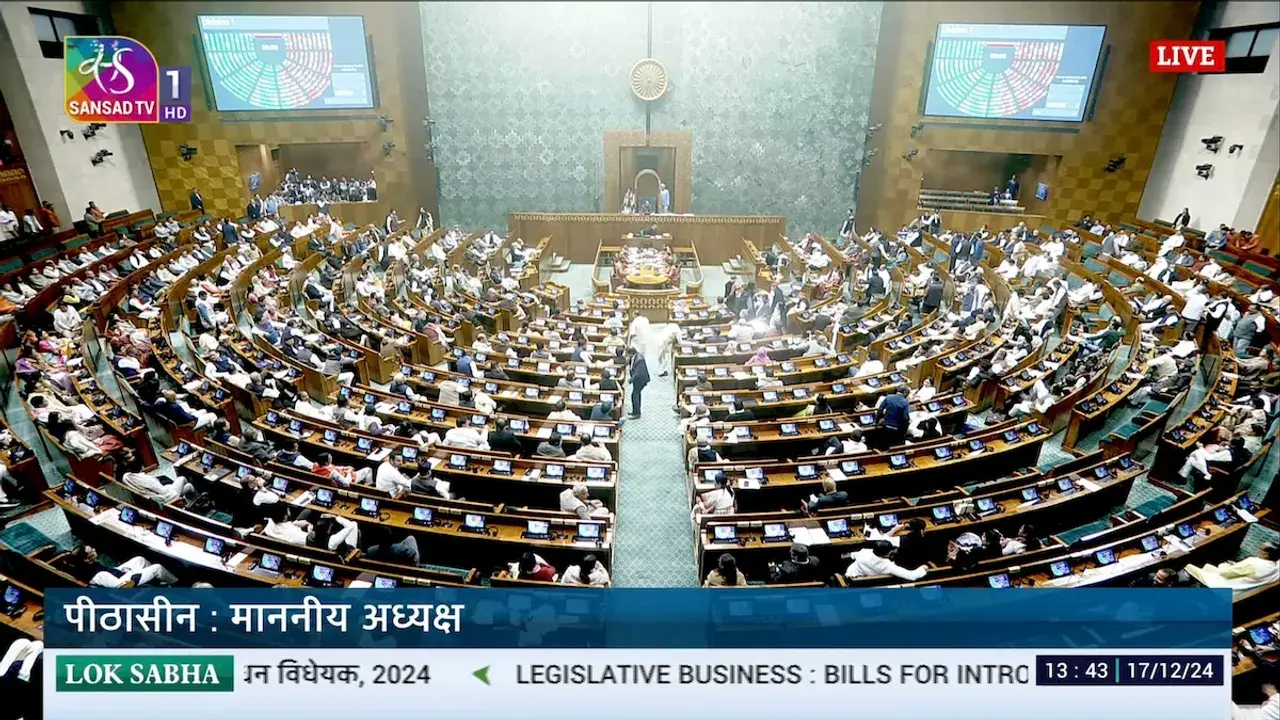
Signalling an end to the prolonged standoff between the government and the Opposition, the Lok Sabha on Tuesday resumed normal proceedings and took up discussion on the Union Budget, which had been stalled for days amid demands that Rahul Gandhi be allowed to speak on various issues.

When the House reconvened at 2 pm after two adjournments, Krishna Prasad Tenneti, who was in the Chair, invited Congress MP Shashi Tharoor to initiate the debate. The Thiruvananthapuram MP began the discussion, marking the formal start of deliberations on the Budget.

The breakthrough followed a day of rapid political developments, including Opposition parties submitting a notice seeking a resolution to remove Om Birla as Speaker of the Lok Sabha.

The House functioned from 2 pm to 8 pm, with members from across party lines participating in the debate. The Business Advisory Committee has allocated 18 hours for discussion, and Union Finance Minister Nirmala Sitharaman is expected to reply on Thursday afternoon.

Since February 2, the Lok Sabha had witnessed repeated disruptions and unruly scenes, leading to the suspension of seven Congress MPs and one CPI(M) member for the remainder of the Budget session.

Amid concerns over potential disruptions, Speaker Birla had earlier requested Prime Minister Narendra Modi not to attend the House when he was scheduled to reply to the Motion of Thanks on the President’s Address. Birla’s remarks, suggesting that Congress members might create unpleasant scenes, had further deepened the impasse.

As a result of the disruptions, the Prime Minister was unable to respond to the Motion of Thanks on the President’s Address delivered to both Houses on January 28. The motion was eventually adopted by voice vote amid sloganeering by Opposition members.

Birla had earlier expressed regret that more than 19 hours of House proceedings were lost due to repeated disruptions.

Four Stars of Destiny: A General’s Truth vs a Government’s Projection

Four Stars of Destiny, China standoff, china, military, penguin books, mm naravane, manoj mukund naravane, rahul gandhi, narendra modi
Four Stars of Destiny: A General's Truth vs a Government’s Projection 16

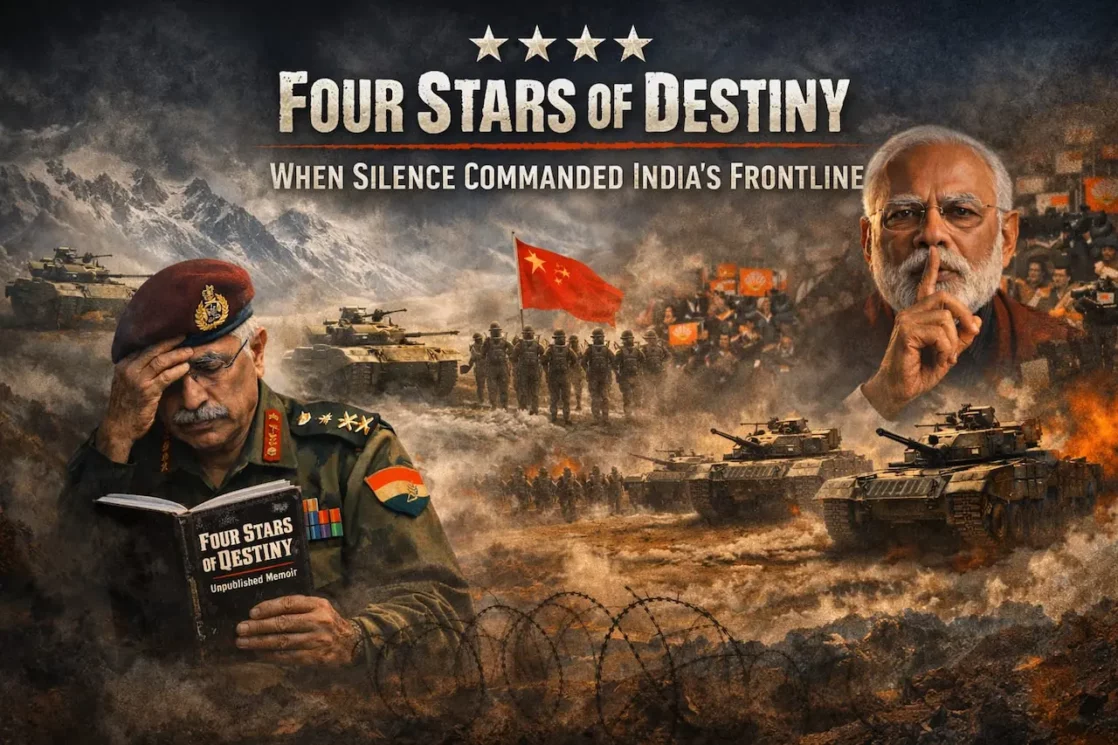
India has reached a moment where the distance between image and reality has grown so wide that it can no longer be masked by slogans, studio debates, or choreographed nationalism, and the unease surrounding the unpublished memoir Four Stars of Destiny by Manoj Mukund Naravane exposes that gap with brutal clarity. This is not a tale of leaked secrets or protocol breaches; it is the quieter, more dangerous story of hesitation at the top when decisiveness was demanded, and of a soldier left to shoulder the weight of history while political leadership chose ambiguity over ownership.

At the height of the 2020 standoff with China, when the situation along the Line of Actual Control was spiraling and Chinese armor moved into threatening positions near Kailash Ridge, what the military needed was not motivational language but unambiguous political direction, because armies fight on orders, not vibes. Yet the account that has now unsettled the establishment suggests a vacuum at the worst possible moment—calls unanswered, time slipping, and finally a message that effectively pushed the burden downward: do what you think is right. In corporate folklore, that sounds like trust; in the fog of a potential war between two nuclear-armed states, it borders on abdication.

Civilian supremacy is the bedrock of democracy, but supremacy without responsibility is just distance from consequence, and when elected authority refuses to clearly own decisions in moments of crisis, someone else ends up gambling with blood and blame. What followed was a dangerous “game of bluff,” Indian tanks moved forward, nerves stretched thin, and the People’s Liberation Army ultimately backed down, but the strategic success, such as it was, came from military resolve under uncertainty, not from political clarity.

The irony is that this same political leadership later wrapped the episode in the language of strength and decisiveness, folding it neatly into a carefully curated strongman narrative that dominates screens and speeches, where Narendra Modi is projected as an unflinching leader who never hesitates, never blinks, and never defers. Projection, however, is not performance, and strength that exists only in messaging collapses the moment an insider’s recollection introduces doubt. The reported sense of being “alone” felt by the Army Chief is not emotional excess; it reveals a deeper structural problem in which the risks of decisions are privatized downward while political credit is nationalized upward.

The same pattern surfaces in the controversy around the Agnipath Scheme, marketed loudly as bold reform but, according to accounts now in the public domain, implemented in a form that diluted the military’s own recommendations, brushed aside concerns over retention, morale, and preparedness, and rebranded institutional unease as resistance to change. Consultation occurred, but consideration did not, and that distinction defines the current governance style: listen enough to tick a box, decide elsewhere, and sell the outcome as inevitability. What makes the present moment especially revealing is not disagreement—democracies survive disagreement—but the instinctive attempt to manage the narrative by delaying approvals, questioning motives, and shifting public attention to anything but the substance of what is being said.

The book remains stuck in clearance loops, not because it endangers national security, but because it endangers a story that the government has invested enormous political capital in telling, the story of unwavering resolve, instant decision-making, and supreme control. Meanwhile, governance has increasingly become an exercise in distraction management: amplify symbols, inflate spectacles, keep the Vishvaguru imagery permanently polished, and relegate inconvenient questions about borders, preparedness, and accountability to the margins. This is the irony of the moment—while the country faces complex internal and external challenges, relevance is manufactured by focusing attention on the trivial and the theatrical, allowing unresolved failures to dissolve into noise.

India does not suffer from a lack of talent in uniform or intelligence in institutions; it suffers from a political culture that confuses visibility with leadership and branding with courage. A Prime Minister can dominate news cycles, command applause, and control narratives, but history does not archive campaigns; it records moments, especially the ones when silence replaced command. The uncomfortable truth hinted at by Naravane’s recollections is not that the army faltered, but that political leadership hesitated, and that hesitation was later papered over with muscular rhetoric.

That is why this book unsettles power—not because it reveals secrets, but because it exposes silences, and silence at the edge of conflict is never neutral. India today needs a performing prime minister, not a projected one; a leader who owns decisions when the stakes are highest, not one who delegates risk and later claims resolve. Suppressing such accounts will not strengthen the republic; it will only delay a reckoning that grows harsher the longer it is postponed. Soldiers deserve clarity, citizens deserve honesty, and democracy demands accountability—everything else is spectacle, and spectacle cannot defend a nation when reality knocks without warning.

At Ram Katha, Swami Dr. Umakantanand Saraswati Lauds Vaidehi Taman for Reviving Savarkar’s Vision

487C0A22 BD6D 4900 BBAE 47C7A6ACA479
At Ram Katha, Swami Dr. Umakantanand Saraswati Lauds Vaidehi Taman for Reviving Savarkar’s Vision 18

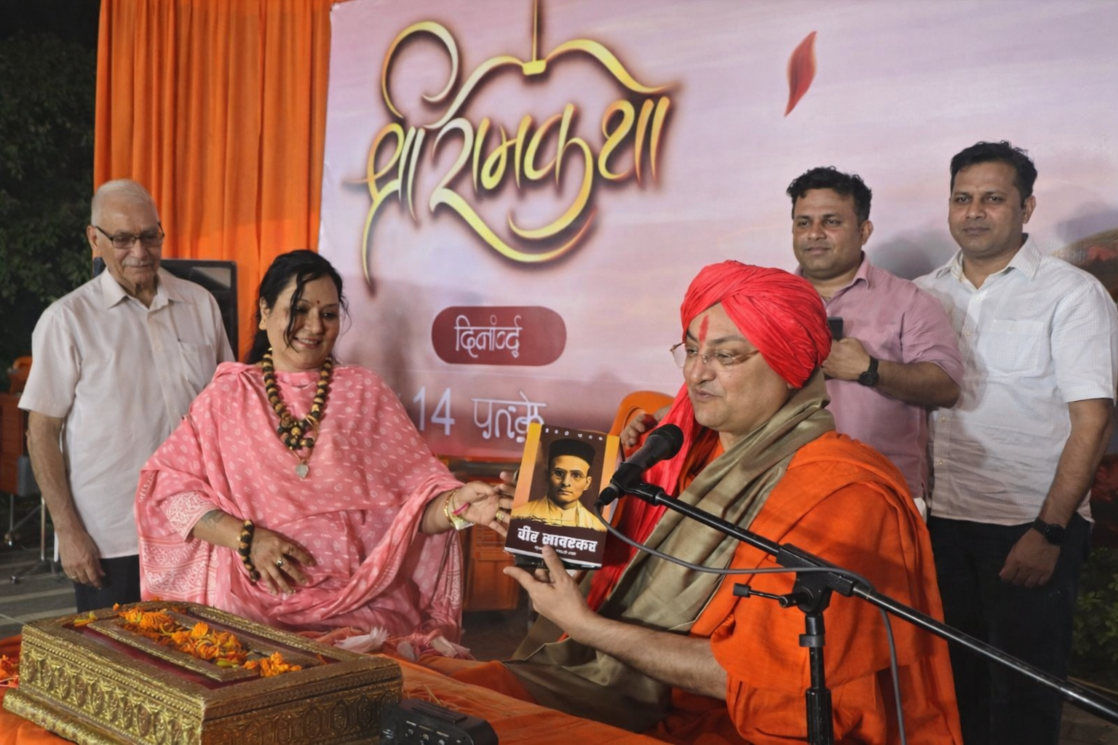
Mahamandaleshwar Swami Dr. Umakantanand Saraswati Ji Maharaj of the Juna Akhada, Haridwar, held a powerful Shri Ram Katha in Mumbai, drawing a massive gathering from all walks of life. Known internationally for preaching Vedic wisdom, the Ramayana, and the Bhagavad Gita, the revered saint once again demonstrated why his discourses resonate far beyond ritual—rooted firmly in real-life guidance and civilizational clarity.

Through the Shashvatham Foundation, Swami Ji has carried Indian spiritual and cultural education to over 80 countries, blending scriptural depth with practical life philosophy and a strong sense of Sanatan values.

At the Mumbai Ram Katha, devotees were visibly engrossed as the Swami seamlessly connected the ideals of Shri Ram with everyday challenges of modern life—from personal conduct and resilience to national character. His distinct husky voice, sharp narration, and uncompromising Vedic outlook kept the audience spellbound throughout the pravachan.

During the event, Swami Ji also spoke at length about the book Savarkar: Rashtravad Ki Krantikari Yatra, authored by Dr. Vaidehi Taman. Stressing the relevance of historical clarity, he remarked:

“We must read about all freedom fighters who brought us independence. But reading Savarkar is essential, because what he envisioned a hundred years ago remains relevant even today.”

Recalling a personal incident, Swami Ji shared how he once published a magazine that carried a detailed series on Veer Savarkar’s life.
“People warned me—Swamiji, don’t do this, some will come after you. I told them clearly—let them come after me or stand in front of me; I don’t care,” he said, drawing loud applause from the gathering.

He openly lauded Dr. Vaidehi Taman for her intellectual courage, praising her for taking up “subjects that demand spine, not convenience,” and for presenting nationalism through research and conviction rather than fear.

The Mumbai Ram Katha thus became more than a spiritual congregation—it evolved into a civilizational dialogue, where Ram, Rashtra, and responsibilitywere articulated with clarity and courage. As many attendees remarked, Swami Umakantanand Saraswati Ji’s pravachan does not merely comfort—it awakens.

App-Based Cab, Auto Drivers Stage Nationwide One-Day Strike Over Bike Taxis, Fare Issues

ola, uber, rapido, strike, app based taxi, app based cabs
App-Based Cab, Auto Drivers Stage Nationwide One-Day Strike Over Bike Taxis, Fare Issues 20

Drivers of app-based taxis and autorickshaws across the country observed a one-day nationwide strike on Saturday to press for a ban on allegedly illegal bike taxi services and to highlight multiple long-pending grievances, including concerns over fare policies and mandatory panic button installations.

The protest was called by labour unions representing gig workers, with Maharashtra Kamgar Sabha leader Dr Keshav Kshirsagar saying the strike began in the morning across Maharashtra and several other states. He claimed that a majority of taxi and autorickshaw drivers supported the agitation and kept their vehicles off the roads.

Despite the union’s claims, app-based taxi and auto services continued to remain available on platforms such as Uber, Ola and Rapido in many cities through the day.

The unions said the strike was aimed at opposing what they described as arbitrary fare structures of ride aggregators and at demanding strict enforcement against bike taxi operations, which they allege are illegal and adversely affecting the livelihoods of licensed cab and autorickshaw drivers. They also flagged the financial burden caused by mandatory panic button installations.

According to the drivers’ body, although 140 panic button device providers are approved by the Centre, nearly 70 per cent of them have been declared unauthorised by state authorities. This, they alleged, has forced drivers to remove previously installed devices and spend around Rs 12,000 to install new ones, adding to their financial stress.

Additional concerns raised included loss of income due to an increase in autorickshaws under the open permit policy and the alleged denial of insurance benefits to victims of accidents involving illegal bike taxis.

Reacting to the strike, Maharashtra Transport Minister Pratap Sarnaik warned ride-hailing companies against unfair treatment of drivers and assured government support on genuine issues. Speaking to reporters in Thane, he said the agitation should not inconvenience the public and added that the state government was in constant touch with driver unions.

“Passengers should not suffer because of the strike. Drivers should clearly communicate what support they expect from the government. We are ready to stand by them on all genuine issues,” Sarnaik said, noting that Regional Transport Office officials were coordinating with driver organisations.

He also cautioned that if aggregator companies were found acting unjustly towards drivers, the state government would not hesitate to take appropriate action.