Sharad Pawar Praises PM Modi’s Global Role, Says National Prestige Must Rise Above Politics 2
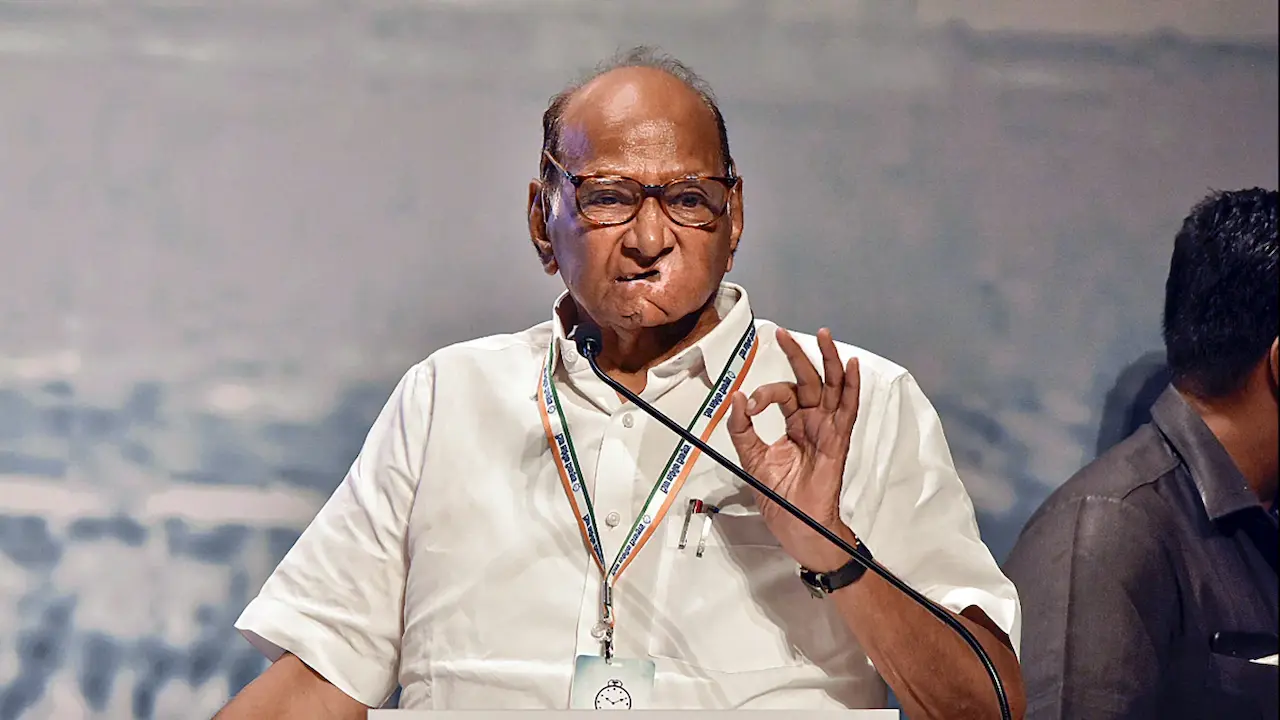
NCP (SP) chief Sharad Pawar on Tuesday said that despite political differences with Prime Minister Narendra Modi, national interest and India’s global prestige should remain above party lines.
Speaking at a gratitude and fellowship gathering organised by the Pune-based Lakshmanrao Gutte Rural Development Foundation, Pawar stressed that leaders across political ideologies should unite whenever the nation’s honour and interests are at stake.
“Prime Minister Narendra Modi is working to protect India’s prestige outside the country. We may have different political views, but when it comes to the nation’s honour, political differences should not come in the way,” Pawar said.
The veteran leader and former Union minister emphasised that national priorities should take precedence over political rivalry. He noted that whenever there is an opportunity to work collectively for the country’s welfare, leaders should join hands with a common purpose.
Pawar also highlighted the leadership of former prime ministers and leaders such as Indira Gandhi, P V Narasimha Rao and Manmohan Singh, stating that they consistently placed India’s future and international standing at the centre of governance.
Addressing former colleagues and political workers at the event, Pawar acknowledged that many individuals who once worked together had now moved to different political parties but had continued their commitment to public service.
“Some may belong to different political parties today, but all of you have remained connected with common people and preserved your commitment to society,” he said.
Recalling his own political journey, Pawar shared memories of moving from Baramati to Pune in 1958 due to the absence of a college in his hometown. He recounted how his involvement in youth movements eventually led him to leadership roles in the Youth Congress at city, state and national levels.
He also reflected on meeting India’s first Prime Minister Jawaharlal Nehru during his youth and narrated an anecdote involving former Prime Minister Indira Gandhi, highlighting her insistence on protecting India’s dignity during an official visit to the Soviet Union.
Quoting Gandhi, Pawar said, “I represent 40 crore people of India. If their prestige is not respected, I will never accept it.”
Pawar concluded by urging leaders and former colleagues to continue participating in initiatives that strengthen the country and uphold India’s prestige globally.
The Twisha Sharma Case Is Not Just A Mystery — It Is A Mirror To India's Silent Domestic Crisis 4
Bhopal is not merely witnessing another sensational headline. The death of Twisha Sharma has now become a disturbing symbol of everything Indian society refuses to confront honestly — toxic marriages, hidden domestic abuse, dowry pressure, emotional torture, social hypocrisy, and the dangerous protection of influence over truth.
What initially appeared to be a straightforward case of suicide has slowly transformed into a deeply controversial and emotionally explosive investigation. Every new forensic detail, every legal development, and every public statement emerging from this case has raised even more troubling questions.
And the most dangerous thing about this case is not only the death itself — it is the possibility that the truth may get buried beneath status, power, legal games, and carefully manufactured narratives.
Twisha Sharma was not an anonymous woman lost in statistics. She was educated, ambitious, independent, and known in public life. Before entering the corporate world, she had participated in beauty pageants, earned recognition as a former Miss Pune, and appeared in film projects including Mugguru Monagallu and Zara Sambhal Kay. She later moved away from cinema and worked as a marketing manager in the hospitality and restaurant sector.
Like countless young women in India, she stepped into marriage carrying dreams, trust, emotional hope, and the belief that she was entering a secure future.
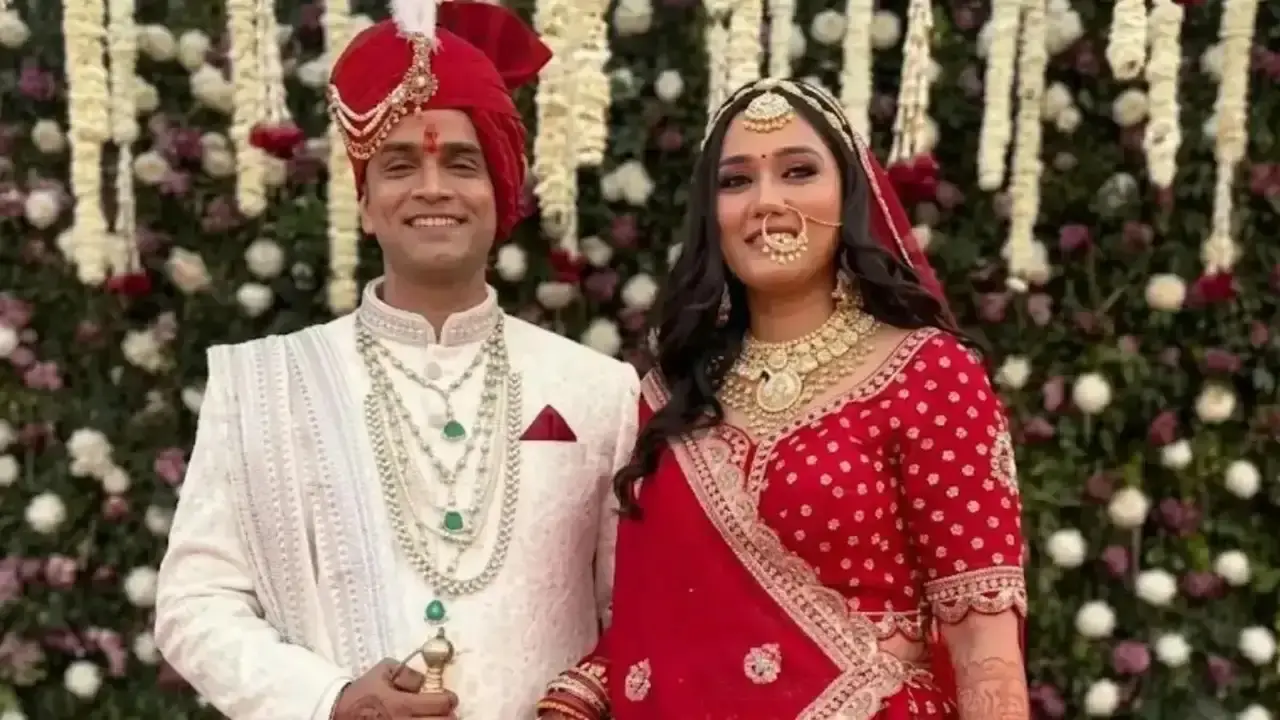
But barely five months after marrying Samarth Singh in December 2025, she was found dead inside her husband’s residence in Bhopal’s Katara Hills area.
The first version presented to the public was simple: suicide.
But the deeper the investigation goes, the weaker that simplicity appears.
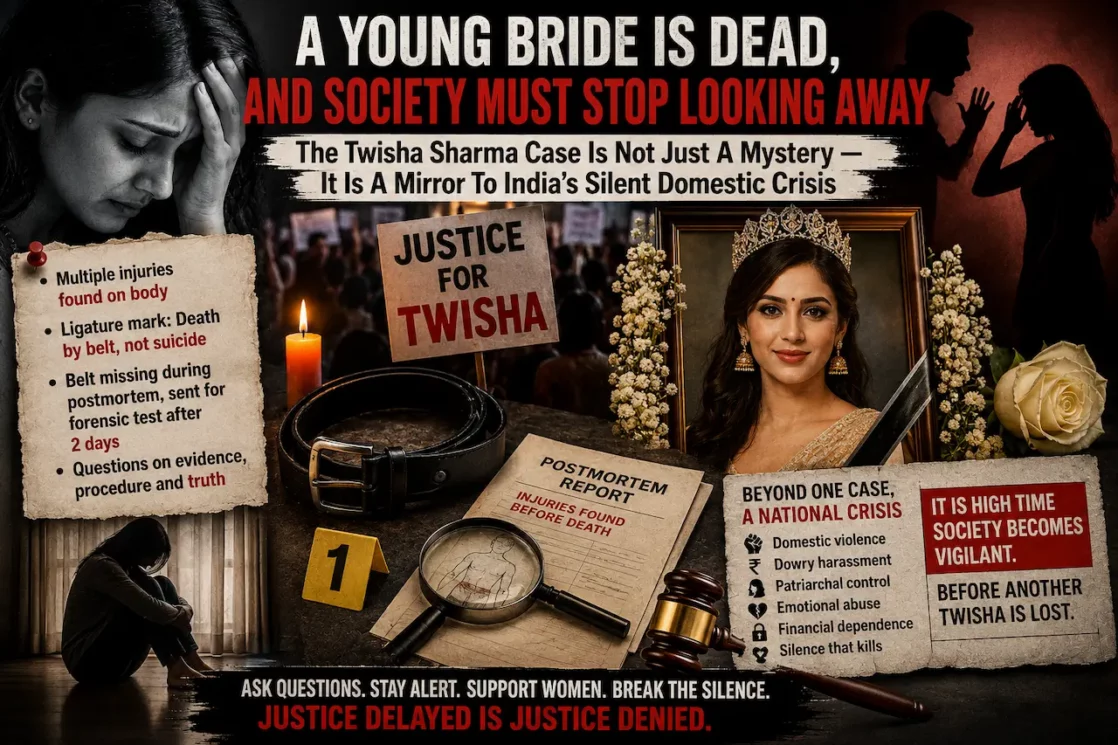
According to reports, the postmortem documented multiple ante-mortem injuries on Twisha’s body — abrasions on the neck, bruises on the arm, wrist, finger, and even injuries beneath the scalp. The report also reportedly noted classic signs associated with asphyxia, including bluish discolouration of the ears and fingernails, facial congestion, and petechial haemorrhages in the eye.
Then came the most explosive revelation — the ligature report.
Investigators reportedly concluded that Twisha died due to asphyxia caused by a belt allegedly used as the ligature material. But this revelation immediately triggered another deeply disturbing question: if the belt was such critical evidence, why was it reportedly absent during the initial postmortem examination?
How does a crucial piece of forensic evidence disappear during one of the most sensitive stages of investigation and then suddenly reappear two days later for forensic analysis?
Who handled that evidence? Where was it kept? Why was it not sealed immediately? Was protocol violated? Was there negligence? Or was someone trying to shape the narrative before forensic scrutiny complicated the official version?
These are not conspiracy theories. These are legitimate investigative concerns that any transparent system must answer clearly and fearlessly.
The situation becomes even more complicated because the accused family is not socially powerless. Twisha’s husband Samarth Singh and his mother, retired judge Giribala Singh, now stand accused amid growing allegations of mental harassment and dowry-related abuse. While Samarth is reportedly absconding and police have announced a reward linked to his arrest, anticipatory bail granted to the retired judge has already triggered public debate about how differently the justice system appears to function when influence enters the room.
This is precisely why public trust begins collapsing in high-profile cases.
Ordinary citizens start wondering whether investigations remain genuinely independent when powerful names become involved. People begin questioning whether evidence is being examined honestly or merely managed carefully.
The growing anger surrounding this case intensified further during a press conference involving the lawyer representing the former judge. When journalists questioned him regarding reports about the divorce of the family’s elder daughter-in-law, the response was not calm clarification but visible irritation. “Can’t you get divorced too?” he reportedly snapped back.
But the media’s question was not irrelevant gossip.
The question mattered because allegations are now surfacing that previous daughters-in-law in the family may also have faced distress and humiliation. Whether those allegations are eventually proven or disproven is a separate matter. But dismissing such questions with aggression instead of transparency only deepens public suspicion.
And this is where the Twisha Sharma case stops being about one family alone.
It becomes a mirror reflecting a brutal social reality that India still refuses to acknowledge openly.
Behind thousands of respectable homes, many women continue to live under suffocating emotional pressure. They are expected to tolerate humiliation silently in the name of adjustment, marriage, tradition, and family honour. They are taught that “good women” endure everything quietly.
If the husband drinks excessively, tolerate it. If he becomes violent, stay silent. If in-laws mentally torture you, compromise. If dowry pressure continues, adjust. If your mental health collapses, hide it. If you cry for help, society often sends you back to the same house with advice to “save the marriage.”
This silence is deadly.
India today faces a deeply uncomfortable reality: suicide among married women has quietly become a national crisis.
Data repeatedly shows that married women form a disturbingly high percentage of female suicides in the country. Unlike many Western societies where marriage often acts as emotional support, for countless Indian women marriage becomes the beginning of social isolation, emotional dependency, financial helplessness, and psychological imprisonment.
Domestic violence remains one of the strongest hidden triggers. Dowry harassment continues despite decades of laws and public campaigns. Patriarchal control inside households still dictates how women dress, speak, work, socialize, and live. Many women lose not only freedom after marriage — they lose identity itself.
And the tragedy is that abuse does not always leave visible wounds. Sometimes the most dangerous violence is emotional. Constant humiliation, Gaslighting, Threats, Control, Isolation, Mockery, Manipulation, Fear, Financial dependency, Subtle intimidation. These things slowly destroy a person internally long before society notices anything is wrong.What makes matters worse is the social obsession with appearances.
Parents often investigate salary packages, luxury homes, family status, political influence, property, and caste background before marriage. But they rarely ask the most important questions.
How does the man behave under stress? Does he abuse substances? Does he show violent tendencies? How does the family treat women? What is the emotional environment inside that household? What is their history with daughters-in-law? Do they believe marriage is partnership — or ownership?
These questions are not disrespectful. They are necessary.
Because expensive weddings and respectable surnames cannot protect a daughter from psychological destruction inside a toxic home.
Society must also stop glorifying silent suffering in women. Endurance is not always strength. Sometimes endurance becomes slow emotional death.
If a daughter repeatedly expresses fear, distress, humiliation, or emotional exhaustion after marriage, families must take it seriously immediately. Not after public scandal. Not after violence escalates. And certainly not after a funeral.
The Twisha Sharma case deserves neither media hysteria nor blind assumptions. No investigation should become a public lynching. But neither should uncomfortable questions be buried under influence, legal intimidation, or reputation management.
A fearless investigation is not anti-family. Transparency is not character assassination. Demanding accountability is not disrespect. And asking difficult questions is not conspiracy.
If evidence appears inconsistent, if forensic gaps exist, if timelines raise suspicion, and if crucial questions remain unanswered, then society has every right to demand clarity.
Because once people begin believing that truth itself can be negotiated by power, institutions lose moral authority.
A young woman is dead.
And somewhere between forensic reports, legal strategies, missing evidence, public statements, and emotional outrage lies the truth of what happened inside that house.
India owes Twisha Sharma more than headlines.
It owes her honesty. It owes her accountability. And above all, it owes her justice.
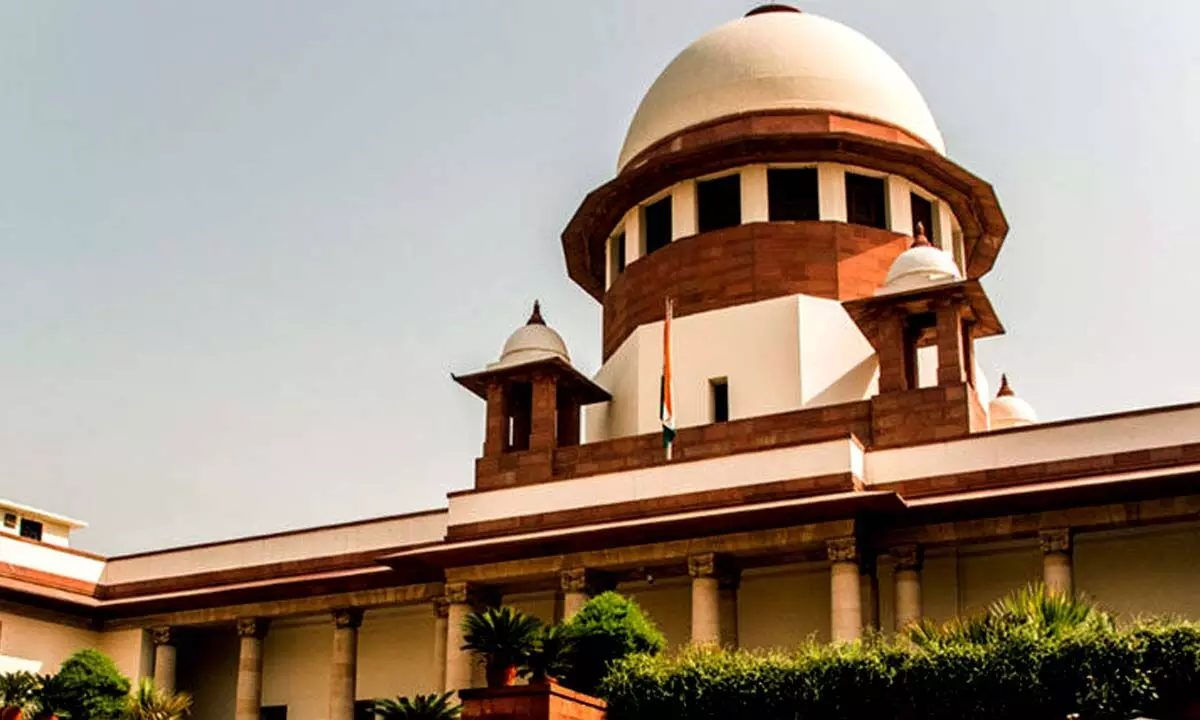
The Supreme Court on Tuesday dismissed all applications seeking modifications to its November 7, 2025 order regarding the relocation and sterilisation of stray dogs, reaffirming its stance on addressing the growing stray animal crisis.
The apex court also rejected pleas challenging the validity of the standard operating procedures issued by the Animal Welfare Board of India (AWBI) concerning stray animals. It observed that states and Union Territories had failed to make sustained efforts to develop the necessary infrastructure to deal with the increasing stray dog population.
Emphasising the broader public safety concerns, the court stated, “The right to life with dignity encompasses the right to live freely without the threat of harm from dogs.”
The Supreme Court, in its landmark judgment last year, had taken note of the “alarming rise” in dog bite incidents, particularly in public and institutional spaces such as educational institutions, hospitals, bus stands and railway stations.
In response, the court had directed authorities to relocate stray dogs from such high-footfall areas to designated shelters and ensure proper management mechanisms.
The top court had also directed agencies, including the National Highways Authority of India (NHAI), to ensure the removal of stray animals and cattle from highways and expressways in the interest of public safety.
The ruling comes amid increasing debate over balancing animal welfare concerns with public safety, with the Supreme Court underscoring the need for authorities to address the issue through practical and long-term measures.
Twisha Sharma Death Row Deepens: Family Calls Drug, Mental Illness Claims 'Character Assassination' 8
The family of model and actress Twisha Sharma, who allegedly died due to dowry harassment, on Tuesday strongly rejected claims made by her mother-in-law that she suffered from drug addiction and mental illness, calling the allegations a deliberate attempt at “character assassination.”
Twisha was found hanging at her marital home in Bhopal’s Katara Hills area on May 12, just months after marrying Samarth Singh in December 2025. The couple reportedly met through a dating application in 2024.
Rejecting allegations made by retired judge Giribala Singh, Twisha’s Noida-based family questioned attempts to tarnish the deceased actress’s image and demanded accountability regarding her death.
Speaking to PTI Videos, Twisha’s father, Navnidhi Sharma, said, “Because the girl is dead now, they think they can say anything against her and shift the blame.” He added that the accused would have to substantiate their claims in court.
His remarks came after a local court rejected the anticipatory bail plea of Twisha’s absconding husband, lawyer Samarth Singh, on Monday. Following the court order, Bhopal Police announced a reward of Rs 10,000 for information leading to his arrest.
Soon after the bail rejection, Giribala Singh addressed a press conference claiming Twisha had been undergoing psychiatric counselling and was taking medicines generally prescribed to schizophrenia patients.
Responding strongly, Navnidhi Sharma described his daughter as highly educated, ambitious and career-driven. He also criticised the allegations, stating that publicly defaming a deceased woman was deeply inappropriate, particularly from someone who had held a high judicial position.
Twisha’s mother, Rekha Sharma, also denied claims that the family was financially dependent on her daughter or that Giribala Singh had transferred large sums of money to her in recent months.
“We never faced any financial difficulties. The real issue was that her in-laws were trying to derail her career,” she alleged.
Meanwhile, the Special Investigation Team (SIT) probing the alleged dowry death is examining CCTV footage, call records and digital evidence to trace Samarth Singh, who remains absconding.
Alleging bias in the local investigation, Twisha’s family has now demanded that the case be transferred outside Madhya Pradesh for a fair and impartial probe.
Kashmiriyat Literary Fest to Bring Writers, Thinkers and Cultural Icons Together in Grand July Gathering 10
A grand Literary Fest and Book Launch themed “Kashmiriyat” is set to take place on July 12, 2026, at the iconic Tagore Hall, promising to emerge as one of the most significant cultural and intellectual gatherings of the year.
The event is expected to attract hundreds of writers, scholars, artists, academicians, thinkers, social leaders and literature enthusiasts from across the country, bringing together diverse voices on a common platform dedicated to literature, culture and ideas.
Conceived as a celebration of heritage, knowledge and creative expression, the festival aims to become a “Kumbh of Knowledge, Literature and Thought,” creating space for meaningful discussions and intellectual exchange around the essence of Kashmiriyat — its civilizational ethos, artistic traditions and inclusive cultural legacy.
The event is being organised by noted author and writer Dr. Vaidehi Taman, whose literary and cultural initiatives have consistently focused on preserving India’s civilizational values and encouraging social dialogue through literature.
Several distinguished dignitaries, public figures and literary personalities are expected to attend the event, adding to its significance and scale.
Alongside literary sessions and book launches, the festival will also showcase Kashmir’s rich cultural traditions through folk performances and artistic presentations by renowned local artists. Organisers said these performances would reflect the beauty, spirit and timeless heritage of the Valley.
Speaking about the significance of the initiative, Dr. Vaidehi Taman said such platforms are essential for strengthening literary culture, preserving civilizational identity and fostering constructive dialogue in society.
She said literature and culture continue to serve as powerful bridges connecting communities, generations and ideas, particularly at a time when preserving heritage and identity has become increasingly important.
Organisers believe the upcoming Literary Fest will go beyond being a conventional event and evolve into a larger cultural movement celebrating literature, heritage and the enduring spirit of Kashmiriyat.
'Bail Is Rule, Jail Exception': SC Grants Relief to Accused in Jammu Narco-Terror Case 12
Reinforcing the principle that personal liberty remains central even under stringent anti-terror laws, the Supreme Court on Monday observed that “bail is the rule and jail is an exception” and granted bail to an accused in a high-profile narco-terror case linked to Jammu and Kashmir.
A bench comprising Justices B V Nagarathna and Ujjal Bhuyan granted bail to Syed Iftikhar Andrabi, a resident of Handwara, who is facing trial over his alleged involvement in a cross-border network accused of drug trafficking and terror financing in Jammu and Kashmir.
The court directed Andrabi to surrender his passport and report to the local police station once every 15 days as part of the bail conditions.
The National Investigation Agency (NIA) is probing the case, which was registered in 2020 under provisions of the Unlawful Activities (Prevention) Act (UAPA) and the Indian Penal Code (IPC).
In a significant observation, the apex court held that Section 43D(5) of the UAPA, which imposes strict conditions for granting bail, cannot be used to justify prolonged or indefinite imprisonment and must operate within the constitutional framework of Articles 21 and 22.
“Bail is the rule and jail the exception is a constitutional principle flowing from Articles 21 and 22, and the presumption of innocence is the cornerstone of any civilised society governed by the rule of law,” the bench observed.
The Supreme Court also stressed that its landmark 2021 judgment in the K A Najeeb case remains binding law and cannot be diluted, bypassed or ignored by trial courts, high courts, or benches of lesser strength.
The K A Najeeb ruling had established important safeguards regarding bail under the UAPA, especially in cases involving prolonged incarceration without trial.
Andrabi had moved the Supreme Court challenging an order of the Jammu & Kashmir and Ladakh High Court, which had earlier denied him bail after citing scrutiny of cellphone records that allegedly showed his contact with terror operatives across the border.
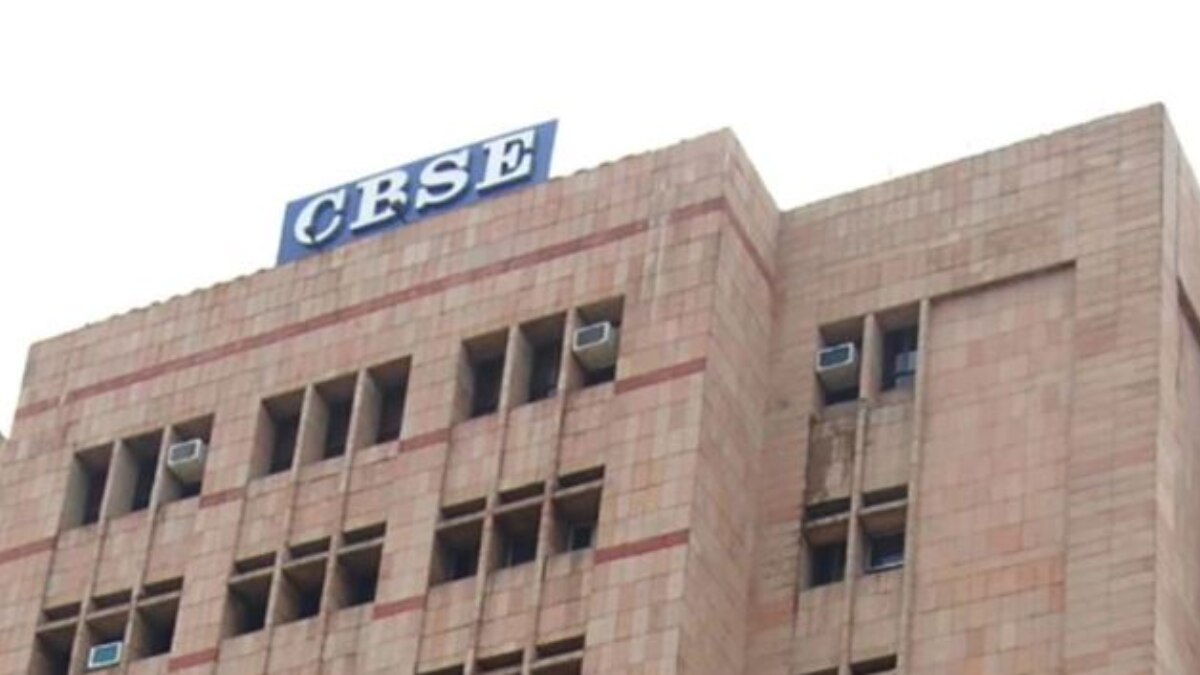
The implementation of the CBSE’s revised three-language policy for Class 9 students has sparked concern among educationists and parents, with many questioning the timing of the move and schools’ preparedness as the academic session is already underway.
The Central Board of Secondary Education (CBSE) recently made three languages compulsory for Class 9 students from July 1, requiring at least two native Indian languages under the framework. However, schools had already begun classes and conducted unit tests for the ongoing session, triggering confusion among stakeholders.
School administrators and parents have expressed concern over the abrupt rollout, saying it has created uncertainty for students who had already selected language combinations and begun coursework.
Mount Abu School Principal Jyoti Arora described the implementation as “very sudden”, stating that while the policy aligns with the National Education Policy (NEP), introducing it after the academic year had started had created a “sense of restlessness.” She also sought greater clarity regarding the role of English within the new framework.
Parents also raised objections, saying children had already appeared for assessments in selected languages and were now being forced to alter academic choices midway through the session.
The revised framework classifies English as a foreign language and permits only one foreign language within the three-language structure. This change could affect students who had opted for both English and another foreign language, such as French.
Several parents expressed concern that students with prior preparation in foreign languages may now be compelled to shift subjects, adding academic pressure at a critical stage. Others pointed to practical challenges, including limited language options offered by schools.
Educationists also flagged implementation issues related to teacher availability, timetable restructuring and introducing entirely new languages to students without prior exposure. Questions were also raised over CBSE’s suggestion that Class 9 students beginning a new language could temporarily use Class 6 textbooks to build foundational knowledge.
Experts stressed that while the broader objective of promoting multilingual education is welcome, major academic reforms should ideally be introduced at the start of an academic session rather than midway through the year.
The debate also spilled onto social media, with users questioning whether schools possess the infrastructure and teaching resources required to effectively implement the new language policy. Others voiced concerns over the additional academic burden on students already navigating the transition from Class 8 to Class 9.
V D Satheesan Takes Oath as Kerala CM as Congress Returns to Power in Grand Ceremony 16
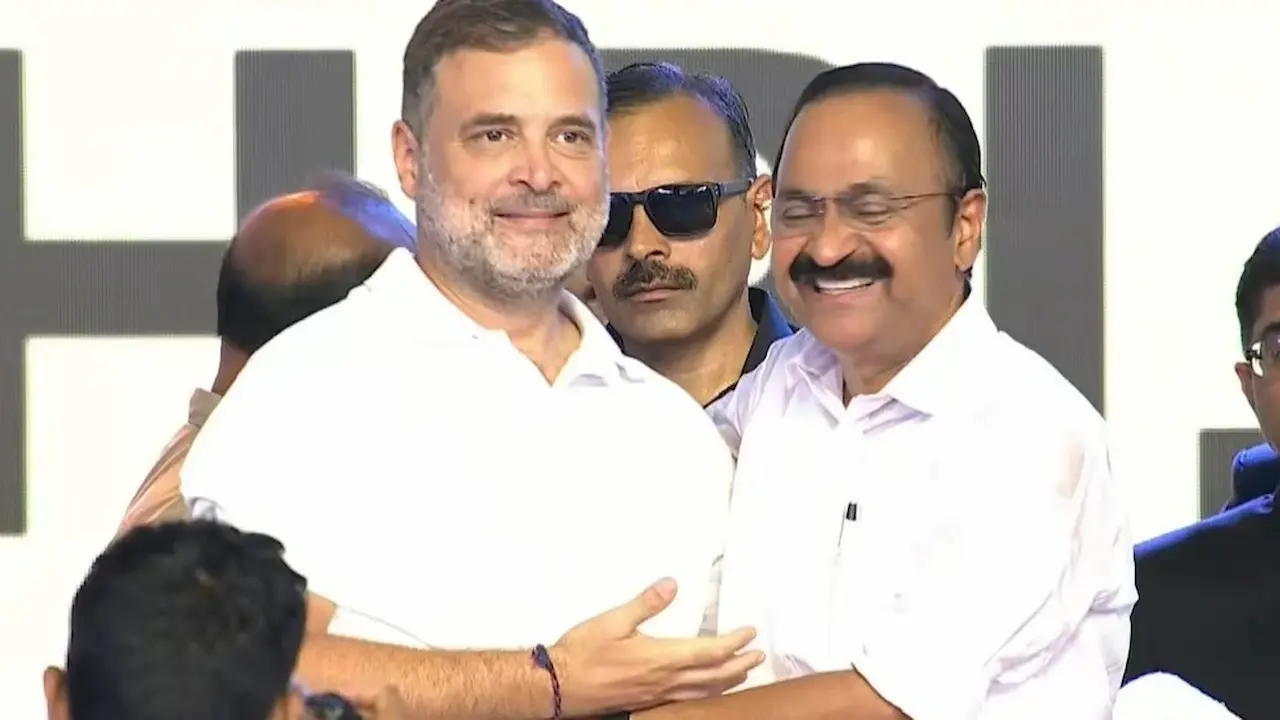
Congress leader V D Satheesan on Monday took oath as the Chief Minister of Kerala, marking the Congress-led United Democratic Front’s (UDF) return to power after a decisive victory in the state Assembly elections.
Governor Rajendra Vishwanath Arlekar administered the oath of office and secrecy to Satheesan, the Congress Legislature Party leader, at a grand swearing-in ceremony attended by top political leaders and thousands of party supporters.
Satheesan took the oath in the name of God. Alongside him, members of his 20-member Cabinet were also sworn in during the ceremony.
The event witnessed the presence of senior Congress leaders, including party president Mallikarjun Kharge, Rahul Gandhi and Priyanka Gandhi Vadra. Chief ministers of Congress-ruled states, former Kerala Chief Minister Pinarayi Vijayan, leaders from Left parties and BJP representatives also attended the event.
Thousands of Congress workers and supporters from across Kerala gathered in the state capital to witness the swearing-in ceremony, turning the occasion into a major political show of strength.
The Congress-led UDF secured a massive mandate in the recently concluded Assembly elections for the 140-member House, held on April 9. Results announced on May 4 saw the alliance win 102 seats, while the Left Democratic Front (LDF) managed 35 seats and the BJP secured three.
Satheesan’s elevation as chief minister comes as the Congress looks to consolidate its political revival in Kerala following a strong electoral performance and a clear anti-incumbency verdict against the previous government.
Trump-Xi Summit Signals New US-China Reset as Symbolism Overshadows Major Breakthroughs 18
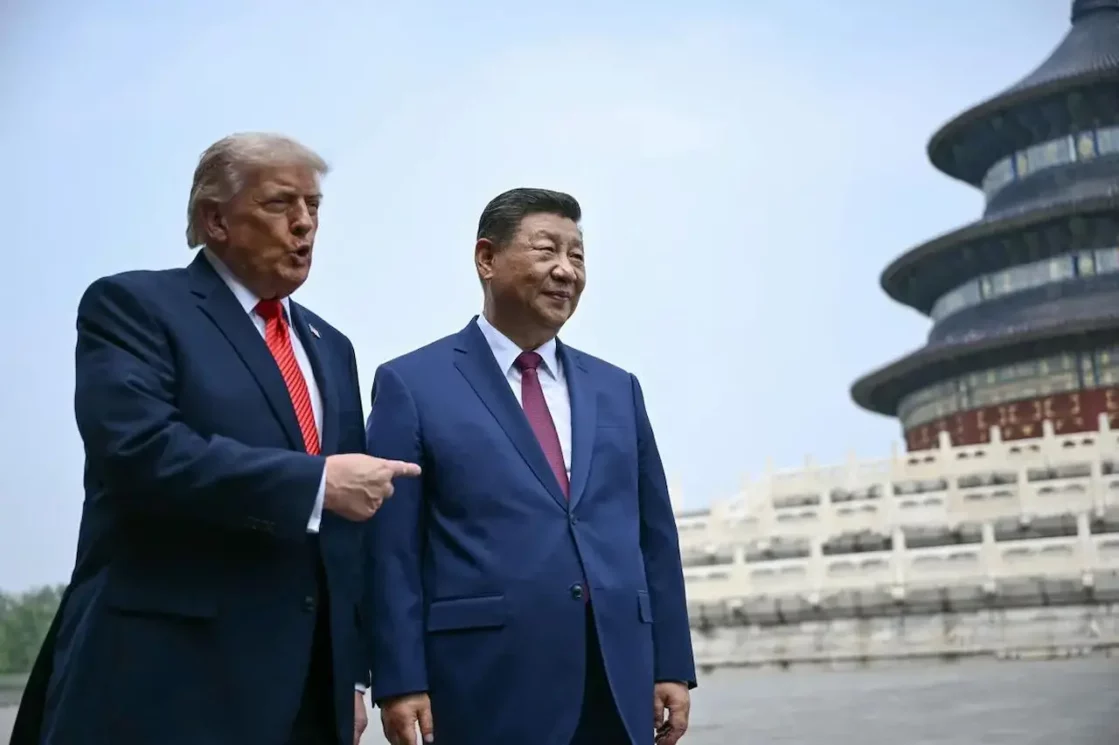
US President Donald Trump returned from his China visit describing his discussions with Chinese President Xi Jinping as a meeting between leaders of “two great countries”, with the summit emerging as a powerful display of symbolism amid efforts to reset ties between Washington and Beijing.
Trump arrived at Joint Base Andrews in Maryland on Friday evening after a brief refuelling stop in Anchorage, Alaska. He claimed that the trip resulted in significant trade agreements, including a deal involving China’s purchase of 200 Boeing aircraft with a commitment for an additional 750 in the future, alongside agreements expected to benefit the American agriculture sector.
Calling the relationship between the United States and China central to global stability, Trump described the summit as a defining moment.
“It’s the two great countries. I call it the G-2. This is the G-2. I think it’ll go down as a very important moment in history,” Trump told Fox News after meeting Xi on Thursday.
Observers noted that Trump’s remarks placed China on an equal footing with the US, a diplomatic position long pursued by Beijing. According to analyses in American media, the carefully orchestrated meetings and symbolic gestures reflected China’s effort to project itself as an equal global power alongside the United States.
Trump also spoke about Taiwan, suggesting that China was unlikely to pursue aggressive action while he remained in office.
“It’s not a takeover. They just don’t want to see this place — we’ll call it a place because nobody knows how to define it — but they don’t want to see it go independent,” Trump said.
“I don’t think they’ll do anything when I’m here. When I’m not here, they might, to be honest with you,” he added.
The US President further said he had invited Xi Jinping to visit Washington in September as both leaders appear set for multiple engagements later this year.
Foreign policy experts viewed the summit as a strategic exercise focused more on optics and relationship management than resolving longstanding disagreements between the two powers.
Former National Security Council officials and diplomatic observers noted that the summit appeared designed to stabilise relations and manage tensions rather than deliver immediate solutions on contentious issues.
Analysts believe the Trump-Xi engagement may mark the beginning of a broader diplomatic process expected to unfold through multiple meetings in the months ahead, including possible interactions during major international summits later this year.
Despite the friendly public messaging, experts remain divided over whether the summit strengthened US-China ties or simply showcased a carefully staged reset with unresolved geopolitical challenges still looming in the background.
Extreme Workouts, Steroids and Supplements Trigger Alarming Rise in Heart Risks Among Youth: Experts 20
India’s growing obsession with muscular physiques and rapid body transformations is fuelling the misuse of steroids, stimulant-heavy pre-workout powders and unregulated gym supplements, with medical experts warning of an alarming rise in heart-related complications among young fitness enthusiasts.
Cardiologists have cautioned that the combination of extreme workouts, anabolic steroids, dehydration and performance-enhancing supplements can significantly increase the risk of arrhythmias, high blood pressure, heart failure and even sudden cardiac arrest in seemingly healthy young individuals.
The trend, amplified by social media fitness culture and aggressive online supplement marketing, is pushing many gym-goers toward unsafe practices and unrealistic body-image expectations, experts said.
Dr Rahul Chandola, Cardiovascular and Thoracic Surgeon and Chairman of the Institute of Heart and Lung Diseases, said regular exercise itself is beneficial and protects heart health, but problems arise when individuals combine intense physical activity with unsupervised supplement use and steroids.
“We are increasingly seeing young individuals suffering from palpitations, abnormal heart rhythms, blood pressure spikes and even early structural heart changes associated with supplement misuse,” he said.
Doctors noted that sudden collapses and cardiac deaths among amateur bodybuilders and fitness enthusiasts are becoming a growing concern both in India and globally.
Dr Mayank Yadav, cardiothoracic and vascular surgeon at AIIMS, said many young people wrongly believe that products sold online or promoted by influencers are safe. He warned that several formulations remain poorly regulated and are often consumed in excessive quantities.
Experts also raised concerns over the absence of proper cardiovascular screening before people begin intense exercise regimens. According to Chandola, many individuals may unknowingly have underlying heart conditions that remain undetected until a major event occurs during strenuous physical activity.
He pointed out that routine annual health check-ups often fail to identify hidden cardiovascular abnormalities, creating a false sense of reassurance among individuals who may actually be at high risk.
Medical experts stressed the need for more comprehensive preventive screening, particularly for people above 40 years of age and those with conditions such as diabetes, hypertension, obesity, smoking habits or a family history of heart disease.
Doctors also advised young gym-goers to avoid shortcuts to rapid muscle gain and prioritise long-term health over appearance-driven goals and social media pressure.