Home Blog Page 9

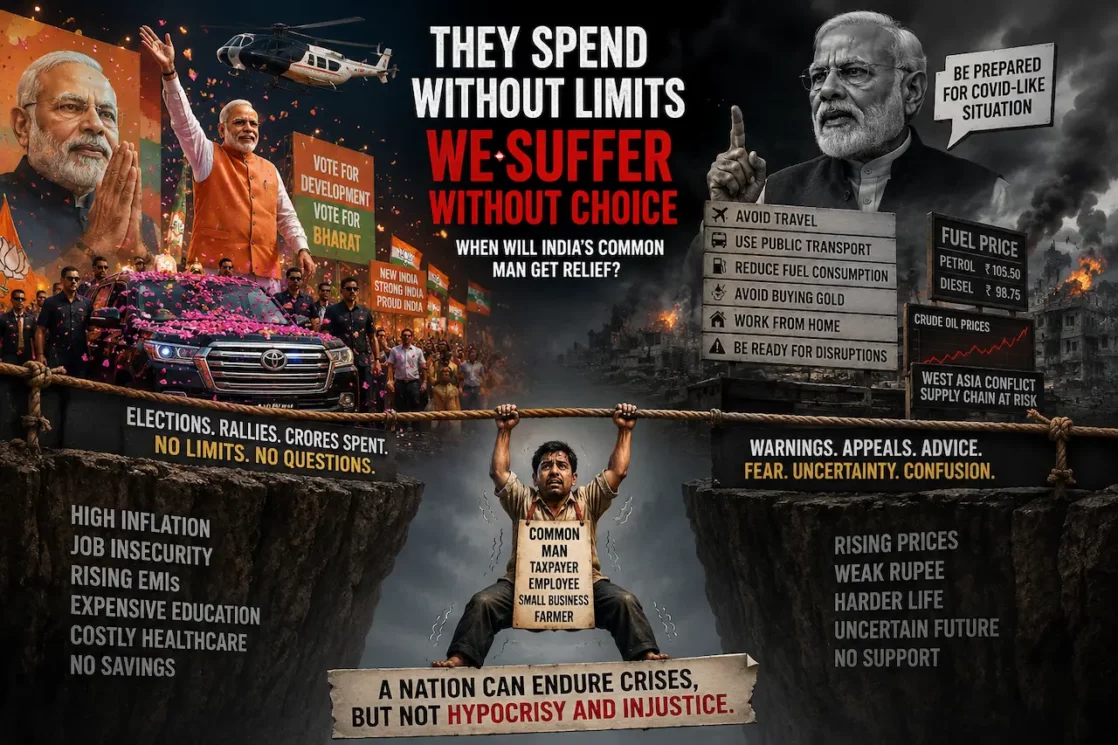
From Election Extravagance to Economic Fear: Why Is the Common Indian Always Asked to Sacrifice?

election, extravagance, economic fear, narendra modi, modi, middle east, south west, west asia conflict
From Election Extravagance to Economic Fear: Why Is the Common Indian Always Asked to Sacrifice? 2

The government’s recent messaging asking citizens to prepare for “Covid-like” economic disruptions has triggered understandable anxiety across the country, and rightly so. When the Prime Minister of India publicly advises people to reduce fuel consumption, avoid unnecessary travel, postpone gold purchases, revive work-from-home culture, and prepare for uncertainty caused by the escalating West Asia conflict, it is not treated as a casual advisory. Such statements carry enormous psychological, economic, and political consequences. Markets react instantly. Households panic. Businesses slow spending. Investors become cautious. The memory of the Covid lockdowns is still fresh in the minds of millions of Indians who suffered unemployment, isolation, migration crises, bankruptcies, and emotional trauma. Therefore, the government cannot afford ambiguity, contradiction, or selective alarmism while communicating with the nation.

What makes the situation deeply troubling is the timing and contrast in political behaviour. For months before the elections, the country witnessed one of the most expensive and aggressive political campaigns in modern Indian history. Every major state election became a spectacle of enormous financial power. Massive rallies were organized daily. Chartered aircraft moved leaders across states non-stop. High-voltage advertising campaigns dominated television, newspapers, digital platforms, and public spaces. Giant stages were erected, endless roadshows were conducted, and enormous state machinery was deployed. Political parties, especially the ruling establishment, spent money on a scale unimaginable to the average citizen struggling with inflation and rising costs of living.

At that time, there was complete silence about conserving national resources. There was no public appeal to reduce travel. No warning about fuel consumption. No concern about foreign exchange reserves. No advice to postpone luxury spending. No speeches about economic discipline or austerity. The government projected confidence, strength, and abundance during elections because political optics demanded it. But the moment the elections concluded, the narrative abruptly shifted from celebration to caution. Suddenly the public was told that difficult times could be approaching. Citizens were urged to prepare for disruptions similar to the Covid era because of geopolitical instability and energy insecurity.

This contradiction is precisely what is unsettling ordinary Indians.

People are asking a simple question: if the economic situation was serious enough to warrant nationwide caution, why was the country simultaneously witnessing massive political extravagance? Why is austerity expected only from the common citizen after elections are over? Why are ordinary taxpayers repeatedly asked to tighten their belts while political establishments continue functioning with limitless resources?

The concern becomes even more serious because the government’s warnings are not entirely baseless. The West Asia conflict indeed poses major risks for India. India imports nearly 85–90 percent of its crude oil requirements. Any instability around the Strait of Hormuz directly threatens India’s energy security. Rising crude oil prices increase transportation costs, food prices, manufacturing expenses, and inflation across sectors. Aviation turbine fuel becomes expensive, affecting airlines and travel industries. A weakening rupee increases the burden on imports and foreign debt. Supply chain disruptions can create shortages and uncertainty in essential commodities.

These are genuine economic concerns. But genuine concerns require mature governance and transparent communication, not fear-inducing public messaging without clarity.

When the Prime Minister invokes Covid-era behavioral patterns such as work-from-home arrangements, restricted travel, virtual meetings, reduced spending, and conservation habits, people naturally interpret it as a signal of an approaching crisis. The word “lockdown” may not have been explicitly used, but the psychological association is unavoidable. India remembers the catastrophic human consequences of sudden restrictions during the pandemic. Migrant workers walking hundreds of kilometres, small businesses collapsing overnight, families losing livelihoods, mental health crises, educational disruption, and millions pushed into financial insecurity are not distant memories. Therefore, any comparison to the Covid period immediately creates panic and speculation.

The government cannot escape responsibility for the confusion by later claiming that the public “misunderstood” the message. Leadership communication is not a private conversation; it shapes public behaviour. Markets move based on signals from the highest offices. Investors react to tone as much as policy. Citizens begin hoarding, postponing purchases, cancelling travel, and cutting expenses out of fear. Even rumors become economically damaging when uncertainty is amplified by vague official warnings.

The reaction in financial markets after the Prime Minister’s appeal regarding gold purchases is a perfect example. Jewellery company stocks witnessed sharp declines because investors feared that consumer demand would weaken. India’s gold market is deeply connected to cultural practices, weddings, savings behavior, and household security. Telling citizens to avoid buying gold for a year may sound economically logical from a foreign exchange perspective, but such appeals also send a message that the government expects prolonged economic stress. Markets understand this instantly.

Similarly, the suggestion to reduce unnecessary foreign travel and revive work-from-home practices signals anticipated pressure in aviation, fuel pricing, and discretionary spending sectors. Airlines already operate under thin margins, and any surge in crude oil prices creates severe financial pressure because aviation fuel constitutes a large share of operational costs. A weakening rupee further worsens the situation since aircraft leasing, maintenance, and insurance are dollar-dependent. When the government publicly advises reduced travel, the market interprets it as preparation for economic slowdown.

The deeper frustration among ordinary Indians, however, lies in the unequal distribution of sacrifice. During every major crisis, it is the common citizen who bears the heaviest burden. During prosperity, political establishments celebrate achievements and claim credit. During hardship, citizens are asked to endure pain in the name of national interest. The wealthy protect themselves through assets and influence. Large corporations receive policy cushions and financial restructuring. Political campaigns continue uninterrupted. But the middle class, small traders, salaried employees, farmers, migrant workers, and daily wage earners are repeatedly expected to “adjust.”

This pattern has become painfully visible.

The average Indian today is already financially stretched. Inflation has eroded purchasing power. Fuel prices remain high. Household savings are shrinking. Education and healthcare costs continue rising. Employment insecurity persists across sectors. Young people entering the workforce face uncertainty despite qualifications. Small businesses are still recovering from the economic shocks of the pandemic years. Under such conditions, repeated warnings about future disruptions create psychological exhaustion and public distrust.

What the nation needs right now is not panic-driven economic messaging but consistent and credible leadership. If the government genuinely believes India is heading toward severe economic stress because of global instability, then it must lead by example. The first step should be cutting wasteful political expenditure and excessive publicity campaigns funded directly or indirectly by public resources. Extravagant political rallies, oversized promotional events, and image-building exercises must give way to visible fiscal discipline. Citizens are more likely to cooperate with sacrifice when they see those in power practicing it themselves.

Secondly, the government must communicate clearly and responsibly. Vague comparisons to the Covid era without precise explanations create unnecessary fear. Citizens deserve facts, not dramatic caution signals designed to emotionally condition the public. Explain the exact risks. Present economic data transparently. Outline concrete contingency plans. Reassure vulnerable sectors. Inform businesses about preparedness measures. Provide confidence rather than uncertainty.

Thirdly, there must be protection mechanisms for ordinary people if global disruptions worsen. Fuel price shocks cannot become another excuse for uncontrolled inflation while wages remain stagnant. Small businesses and vulnerable workers cannot again become collateral damage in geopolitical crises beyond their control. Economic resilience must include social resilience, not merely macroeconomic statistics.

India is strong enough to face global challenges, but resilience cannot be built on selective austerity and political hypocrisy. A government that spends extravagantly during elections and then suddenly lectures citizens about restraint risks appearing disconnected from the realities of ordinary life. Leadership demands consistency. If sacrifice is necessary, it must begin at the top.

The nation does not need fear campaigns disguised as preparedness. It does not need symbolic appeals while structural waste continues unchecked. It does not need contradictory messaging that celebrates excess one month and warns of scarcity the next.

India needs honest governance, disciplined leadership, transparent communication, and economic planning rooted in fairness. Most importantly, the common citizen deserves respect—not repeated treatment as the emergency shock absorber for every political and economic crisis that emerges.

Gautam Adani Calls for India to Build and Own AI Infrastructure on Home Soil

cii, gautam adani, adani, Confederation of Indian Industry
Gautam Adani Calls for India to Build and Own AI Infrastructure on Home Soil 4

Billionaire industrialist Gautam Adani on Monday called on India to build sovereign capabilities across the artificial intelligence value chain, asserting that energy security and digital infrastructure would define geopolitical power in the coming decades.

Addressing the Confederation of Indian Industry’s (CII) Annual Business Summit 2026, the Adani Group chairman said the foundations of globalisation were being reshaped amid growing geopolitical tensions and technological competition.

“The world that is emerging is not flat. It is fractured and contested,” Adani said, adding that semiconductors had become instruments of statecraft, while data and cloud infrastructure were increasingly being treated as strategic national assets.

Highlighting the importance of technological sovereignty, Adani said countries that control energy and computing power would dominate the future global order.

“The country that controls its energy will power its industrial future. The country that controls its compute will power its intelligence future. And the country that controls both will shape the century ahead,” he said.

Calling artificial intelligence a strategic infrastructure challenge rather than merely a software revolution, Adani said India must develop and own its AI ecosystem domestically.

“India must not rent the infrastructure of its intelligence future. India must build it, power it and own it on its own soil,” he said.

Adani said India’s growing domestic demand in sectors such as manufacturing, logistics, mobility and digital services gives it a unique advantage in building large-scale AI and energy infrastructure.

He noted that India had already crossed 500 gigawatts of installed power capacity and projected that the country’s AI-driven data centre capacity could rise from 5 GW by 2030 to nearly 75 GW by 2047.

The Adani Group chairman stressed that AI infrastructure includes energy, cooling systems, chips, networks, data and talent, and warned that India must prepare immediately for a sharp rise in computing demand.

Rejecting concerns that artificial intelligence would primarily eliminate jobs, Adani argued that India should harness AI to boost productivity, empower entrepreneurs and create new employment opportunities.

“The real measure of AI will not be how many jobs it replaces. The real measure will be how many Indians it empowers,” he said.

Adani also reiterated the group’s previously announced USD 100 billion investment commitment towards energy transition and digital infrastructure, including the 30-GW renewable energy project at Khavda in Gujarat, which he described as the world’s largest single-site renewable energy plant.

He further announced continued expansion of the group’s data infrastructure business through partnerships with companies such as Google, Microsoft, Flipkart and Uber, including plans for a gigawatt-scale data centre campus in Visakhapatnam.

Drawing parallels with India’s digital payments revolution through UPI, Adani said artificial intelligence could unlock even greater economic transformation if supported by sovereign infrastructure and innovation.

“The future does not arrive. It is built,” he said.

WFI Bars Vinesh Phogat From Domestic Events Till June 2026, Issues Show-Cause Notice

WFI notice, vinesh phogat, wfi
WFI Bars Vinesh Phogat From Domestic Events Till June 2026, Issues Show-Cause Notice 6

The Wrestling Federation of India (WFI) has issued a detailed show-cause notice to wrestler Vinesh Phogat, accusing her of indiscipline and violations of anti-doping regulations, while declaring her ineligible to participate in domestic competitions until June 26, 2026.

The federation stated that the two-time World Championships medallist failed to comply with the mandatory six-month notice period required under United World Wrestling (UWW) Anti-Doping Rules for athletes returning from retirement. As a result, Vinesh will be unable to compete in the National Open Ranking Tournament in Gonda, which began on Sunday and was expected to mark her return to the mat.

In the 15-page notice, the WFI alleged that Vinesh’s conduct had caused “lasting damage to the reputation of Indian wrestling” during the 2024 Paris Olympics and violated provisions of the WFI Constitution, UWW International Wrestling Rules and anti-doping regulations.

The federation sought her explanation on multiple charges, including her disqualification from the Paris Olympics after failing to make weight, alleged whereabouts failures under anti-doping rules, and competing in two weight categories during the March 2024 selection trials held under the IOA-appointed ad-hoc committee.

According to the notice, the International Testing Agency (ITA), acting on behalf of UWW, informed WFI on May 4, 2026 about a “missed test” linked to an unsuccessful doping control attempt on December 18, 2025. The federation also referred to an earlier whereabouts failure notice issued by NADA in September 2024 after officials allegedly failed to locate her at her declared residence in Sonipat for an out-of-competition test.

WFI said that under Article 5.7 of the UWW Anti-Doping Rules, athletes returning from retirement must notify UWW at least six months in advance and remain available for testing during that period. The federation claimed Vinesh had not fulfilled these conditions.

The notice further highlighted the controversy surrounding her disqualification from the Paris Olympics. Vinesh had reached the women’s 50kg final after defeating Japanese wrestling star Yui Susaki, but was disqualified before the gold medal bout after being found 100 grams overweight during the second weigh-in. The WFI said the incident cost India a “certain Olympic medal” and led to widespread negative publicity.

The federation also questioned her participation in both the 50kg and 53kg categories during the March 2024 selection trials in Patiala, alleging it violated UWW rules permitting wrestlers to compete in only one weight category. Complaints received by WFI reportedly alleged that the trials were delayed after Vinesh demanded written assurance for another trial in the 53kg category before the Paris Olympics.

The WFI has asked Vinesh to explain why disciplinary action should not be initiated against her under provisions related to indiscipline, unsportsmanlike conduct and actions prejudicial to the interests of the federation and the sport. She has been given 14 days to respond to the notice.

Consensual Relationship on Promise of Marriage Not Rape: Thane Court Acquits Man

court, thane, Consensual Relationship, Marriage Not Rape
Consensual Relationship on Promise of Marriage Not Rape: Thane Court Acquits Man 8

A sessions court in Maharashtra’s Thane district has acquitted a 33-year-old man accused of rape and cheating, observing that a consensual relationship spanning over two years on the promise of marriage cannot automatically be treated as rape.

Additional Sessions Judge Ruby U. Malvankar acquitted Shahbaz Mohammad Salim Khan, a resident of Mumbra, of charges under the Indian Penal Code related to rape and cheating. A copy of the May 2 order was made available on Sunday.

According to the prosecution, the accused befriended the complainant, a divorcee with two daughters, while both were employed at a mall in Thane. It was alleged that Khan established physical relations with her between 2016 and 2018 after promising to marry her, but later backed out and allegedly threatened her.

While acquitting the accused, the court underlined the consensual nature of the relationship and noted the absence of evidence suggesting dishonest intentions from the beginning.

“A relationship spanning two years is a substantial period, and throughout this time, she never lodged a complaint nor indicated that she felt cheated. This suggests she was an equal participant in the sexual relationship,” the court observed.

The court further stated that there was nothing on record to show that the accused had any mala fide intention to deceive or exploit the complainant at the inception of the relationship.

The judge also noted that the complainant’s allegations regarding criminal intimidation and intentional insult were vague and lacked certainty and conviction.

Holding that the prosecution failed to establish the charges beyond reasonable doubt, the court ordered the discharge of the accused’s bail bonds and acquitted him of all charges.

Delhi Govt May Take Over Janakpuri School After Toddler Sexual Assault Case

sexual assault graphic
Delhi Govt May Take Over Janakpuri School After Toddler Sexual Assault Case 10

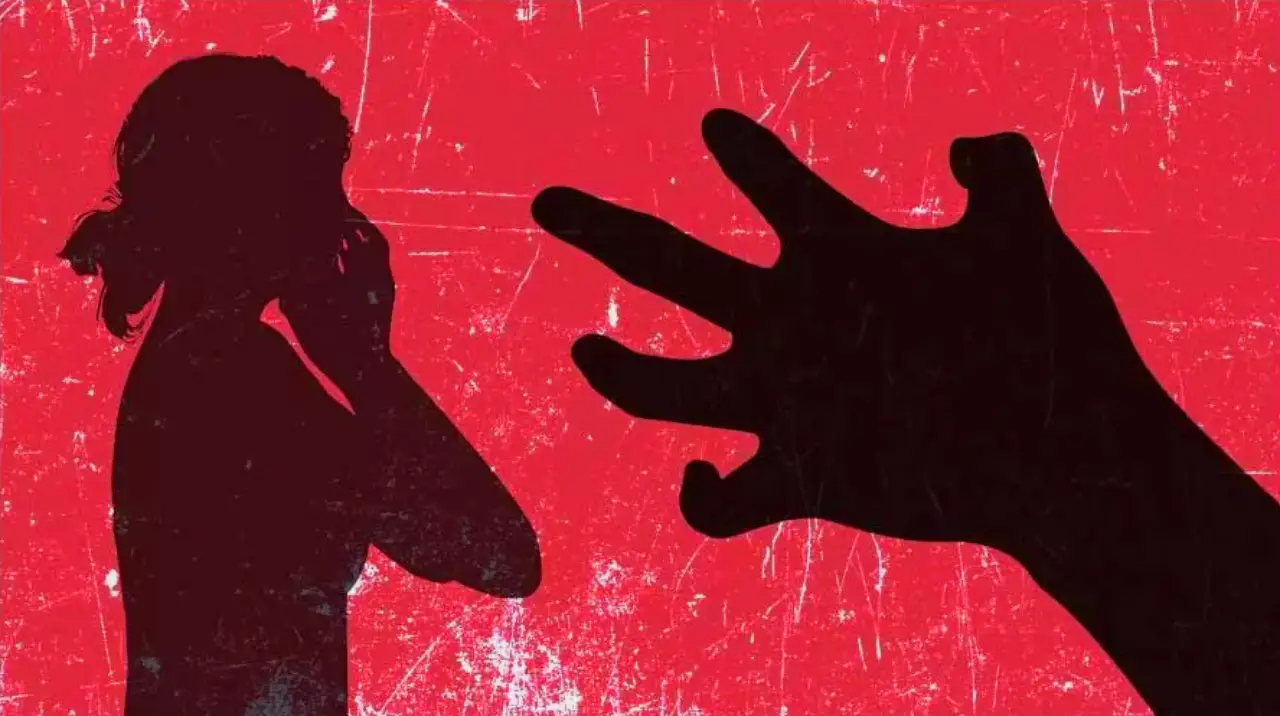
The Delhi government may take over the management of a private school in west Delhi’s Janakpuri after the institution failed to respond to a show-cause notice issued over the alleged sexual assault of a three-year-old girl on its premises, officials said on Monday.

The Directorate of Education (DoE) had issued the notice on May 8, citing serious lapses in child safety, supervision and compliance with statutory norms. The department warned that failure to submit a satisfactory reply within three days could lead to withdrawal of the school’s recognition and a possible takeover of its management under provisions of the Delhi School Education Act and Rules (DSEAR).

Officials said the school authorities have not yet submitted their response, and disciplinary action is now being considered against the institution for alleged deficiencies in child protection measures.

According to police, the child’s mother filed a complaint at Janakpuri police station on May 1, alleging that her daughter was sexually assaulted during school hours on April 30, just a day after she was admitted to the school.

Police said the girl complained of pain after returning home and later informed her mother that she had been taken to an isolated area inside the school where a staff member allegedly assaulted her.

A 57-year-old caretaker employed at the school was arrested in connection with the case. Police said the child identified the accused, who was later produced before a court and sent to judicial custody. However, he was granted bail by a Dwarka court on May 7 despite strong objections from the prosecution.

The DoE, in its preliminary inquiry, reportedly found several violations by the school administration. The department alleged that the institution failed to maintain adequate surveillance systems, including the absence of CCTV cameras in sensitive areas of the campus.

The notice also flagged lapses in the implementation of child protection safeguards and preventive mechanisms within the school premises.

Additionally, the department alleged that nursery and pre-primary classes were being operated from a separate private premises located nearly one kilometre away from the recognised main campus without prior approval from authorities.

According to the notice, shifting students to an unapproved location raised serious concerns regarding student safety, statutory compliance and possible violation of land allotment conditions.

The DoE had directed the school management to submit details related to CCTV footage, staff deployment, child safety policies, suspension procedures against the accused, building and fire safety certificates, and permissions for operating classes from the separate premises by May 11.

The notice warned that failure to provide a satisfactory response could result in withdrawal of recognition, takeover of management and a recommendation to the Delhi Development Authority for cancellation of land allotment or lease.

Police have registered a case under Section 64(1) of the Bharatiya Nyaya Sanhita related to rape of minors and Section 6 of the Protection of Children from Sexual Offences (POCSO) Act concerning aggravated penetrative sexual assault.

Investigators said CCTV footage from the school premises is also being examined as part of the probe.

Jewellery Stocks Crash Up to 12% After PM Modi Urges Indians to Delay Gold Purchases

Gold, Mumbai Airport, seized
Gold, Mumbai Airport, seized | Image : Representative

Shares of major jewellery companies witnessed sharp declines on Monday after Prime Minister Narendra Modi urged citizens to postpone gold purchases and avoid non-essential foreign travel for one year to help conserve foreign exchange amid the ongoing West Asia crisis.

The appeal triggered heavy selling across jewellery and bullion-related stocks, with investors fearing a potential slowdown in discretionary spending and gold demand.

Sky Gold And Diamonds Ltd plunged 12.24 per cent, while Senco Gold Ltd dropped 11 per cent on the BSE. Kalyan Jewellers fell 9.99 per cent, Thangamayil Jewellery declined 9.79 per cent and Titan Company slipped 8 per cent. Shares of Tribhovandas Bhimji Zaveri Ltd and PC Jeweller Ltd also dropped 6.83 per cent and 5.67 per cent, respectively.

The broader market also came under pressure, with the BSE Sensex falling 1,082.40 points to 76,243.56 in morning trade, while the Nifty 50 declined 309.45 points to 23,865.10.

Addressing a BJP rally in Hyderabad on Sunday, Modi appealed to citizens to use fuel judiciously and reduce foreign exchange outflows amid the escalating geopolitical tensions in West Asia.

The prime minister suggested measures such as reducing petrol and diesel consumption, using metro rail services, opting for carpooling, increasing the use of electric vehicles, relying more on railways for parcel movement and adopting work-from-home practices wherever possible.

He also stressed the need to postpone gold purchases and non-essential foreign travel for a year to reduce pressure on India’s import bill and conserve foreign exchange reserves.

V K Vijayakumar said the appeal was part of a broader crisis-management strategy to tackle the current account deficit caused by soaring crude oil prices.

“This austerity call may have a mildly negative impact on economic growth in FY27. Sectors linked to petroleum, fertilisers, gold, air travel and hospitality are likely to face sentiment-driven pressure,” he said.

Jateen Trivedi said the appeal should be viewed in the context of India’s macroeconomic stability and import management.

“India is one of the world’s largest gold importers, and high gold imports during periods of elevated crude prices and geopolitical uncertainty increase pressure on the trade deficit and the rupee,” he said.

He added that while gold remains deeply embedded in India’s cultural and investment landscape, the prime minister’s remarks could temporarily affect discretionary jewellery purchases and weigh on sentiment in the bullion sector.

AIADMK Faces Internal Turmoil After Poll Defeat as Rift Deepens Over Support to TVK

tvk, mla, aiadmk, tamil nadu, tamil nadu polls
AIADMK Faces Internal Turmoil After Poll Defeat as Rift Deepens Over Support to TVK 13

The All India Anna Dravida Munnetra Kazhagam appears to be facing an internal crisis following its poor performance in the Tamil Nadu Assembly elections, with divisions emerging over whether to support the ruling Tamilaga Vettri Kazhagam government led by C Joseph Vijay.

The AIADMK contested 167 of the 234 assembly constituencies but managed to win only 47 seats, triggering unrest within the party ranks.

In the aftermath of the electoral setback, a series of meetings chaired by party general secretary Edappadi K Palaniswami were held to assess the situation and discuss the party’s future course.

According to party sources, one faction strongly opposed extending support to the Vijay-led TVK government, while another section favoured offering outside support to ensure political relevance.

The poll debacle has also intensified dissatisfaction with Palaniswami’s leadership, with some MLAs reportedly demanding that he step down as party chief.

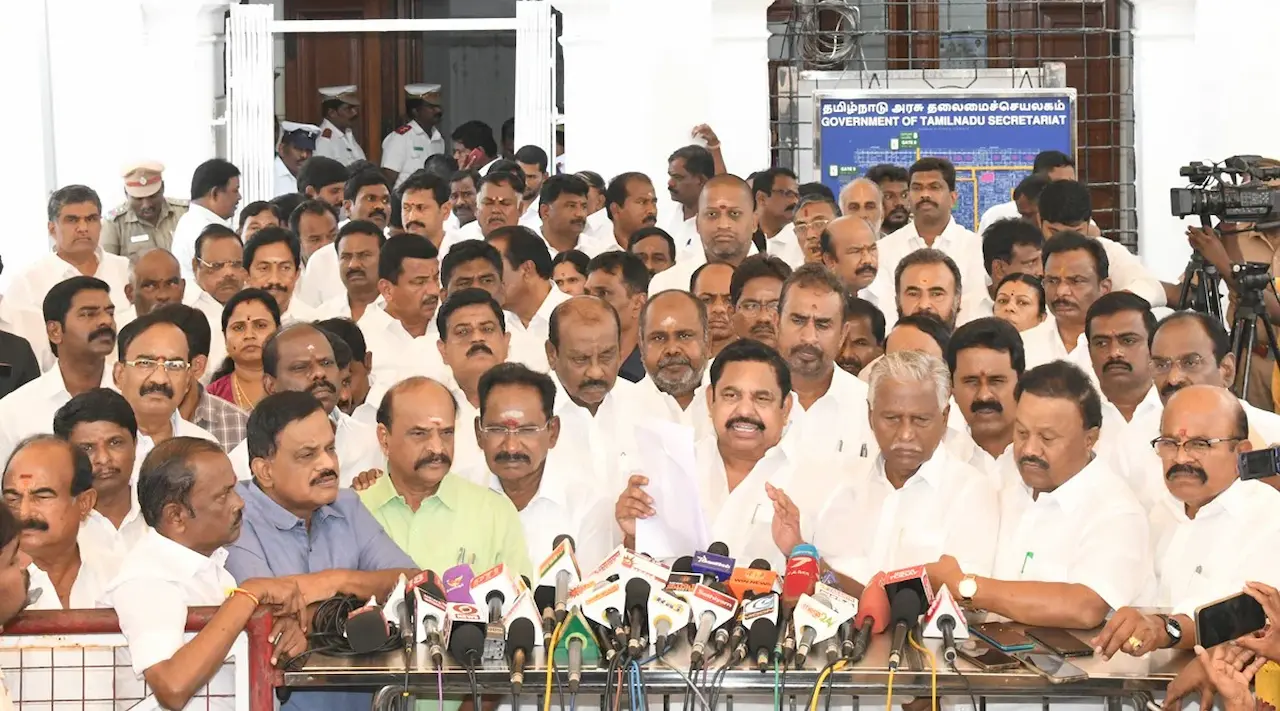
Several senior AIADMK leaders and former ministers, including C Ve Shanmugam and S P Velumani, along with MLAs aligned with them, stayed away from meetings convened by Palaniswami.

Party insiders indicated that Shanmugam, Velumani and their supporters are inclined towards backing the TVK government.

Former AIADMK leader K C Palanisamy claimed there was a clear split within the party and said many legislators were seeking a leadership change.

“If Palaniswami continues as leader, there is a possibility that some MLAs may extend support to the TVK,” he said, adding that Palaniswami should voluntarily step down to help reunite the party ahead of future elections.

Political analyst Sathyalaya Ramakrishnan said the disagreements within the AIADMK should be resolved through dialogue and unity.

“I feel the party still appears united since all AIADMK MLAs were seated together in the Assembly. Senior leaders must ensure that no split takes place within the party,” he said.

The developments come amid growing political realignments in Tamil Nadu following the rise of TVK and its strong electoral debut.

Mumbai Local Trains Get AI-Like ‘Electronic Co-Pilot’ System to Boost Safety and Reduce Errors

silas, mumbai, central railway, train, silas system
Mumbai Local Trains Get AI-Like 'Electronic Co-Pilot' System to Boost Safety and Reduce Errors 15

Central Railway has upgraded the Signal Location Announcement System (SILAS) across all Mumbai suburban local trains to assist motormen in safer and error-free train operations, officials said on Monday.

The GPS-based SILAS functions as an “electronic co-pilot” by announcing the number and position of upcoming railway signals, including whether they are located on the left, extreme left, right or extreme right side.

More than 2,300 local train services operate daily on Central Railway’s suburban network under an automatic signalling system. Since most signals are placed just 400 to 500 metres apart, motormen often work under intense operational pressure.

Central Railway Chief Public Relations Officer Swapnil Nila said Mumbai suburban motormen perform a “single-man job” under extremely demanding conditions.

“SILAS is being upgraded to act as an electronic co-pilot, reducing stress and enhancing safety by ensuring no signal is missed,” he said, adding that the move is a major step towards achieving the railway’s “Zero SPAD” goal, referring to “signal passed at danger” incidents.

According to railway officials, the upgraded SILAS provides audio alerts 350 metres and 250 metres before approaching a signal. In the case of a yellow signal, the system repeatedly warns motormen with the message: “Be careful, next signal is Red,” until a green or double-yellow signal appears.

The technology includes pre-loaded GPS coordinates, signal locations and route-specific audio recordings. Before beginning a trip, the train manager selects the relevant route, including up or down local and through lines.

Officials said SILAS is also being enhanced to announce upcoming stations 500 metres and 250 metres before arrival to improve operational efficiency and passenger convenience.

The upgraded system will additionally help analyse motormen’s driving patterns by monitoring train speeds at critical points such as yellow signals, platform entries, permanent speed restrictions and neutral sections.

Railway authorities said the technology also enables real-time train tracking and speed monitoring of EMU local trains, improving overall operational control on Mumbai’s busy suburban network.

CM Vijay Takes Oath as MLA in Tamil Nadu Assembly Along With Ministers and Newly Elected Members

vijay, c joseph vijay, tamil nadu, tamil nadu assembly, mla
CM Vijay Takes Oath as MLA in Tamil Nadu Assembly Along With Ministers and Newly Elected Members 17

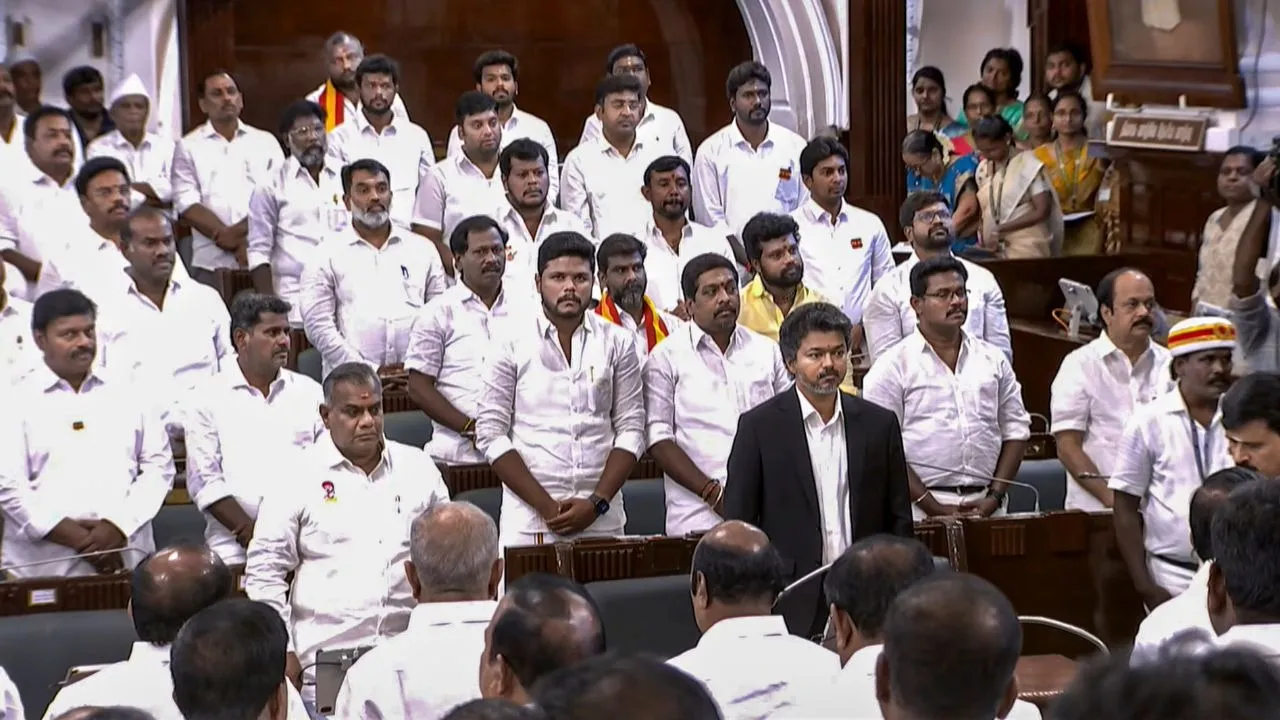
C Joseph Vijay on Monday took oath as a member of the Tamil Nadu Legislative Assembly along with nine ministers, former chief ministers and newly elected MLAs during the inaugural proceedings of the newly constituted House, officials said.

Pro-Tem Speaker M V Karuppaiah administered the oath of office to the members.

The Assembly proceedings commenced at 9.30 am with a brief introductory address by the Pro-Tem Speaker. Chief Minister Vijay was the first member to take oath as an MLA.

Nine ministers, including N Anand and Aadhav Arjuna, also took oath as legislators during the session.

Later, DMK legislature party leader and former Deputy Chief Minister Udhayanidhi Stalin, former chief minister and AIADMK leader Edappadi K Palaniswami, and former chief minister O Panneerselvam took oath as MLAs.

Several senior AIADMK leaders, including Agri Krishnamurthy and K P Anbalagan, were also among those sworn in during the proceedings.

The oath-taking ceremony marked the formal beginning of the new Assembly term following the recently concluded Tamil Nadu Assembly elections.

Democracy Or Political Circus?

political circus, tvk, vijay, congress, suvendu adhikari, west bengal, tmc, tamil nadu government, tamil nadu governor
Democracy Or Political Circus? 19

Indian politics was once ideological. Leaders fought elections on vision, sacrifice, and conviction. Today, politics resembles a never-ending reality show where morality changes every hour, enemies become allies overnight, defeated leaders refuse to leave, governors become political referees, and constitutional institutions are dragged into public street fights.

The political developments unfolding in West Bengal and Tamil Nadu in May 2026 have exposed the most hilarious — and dangerous — side of modern Indian democracy. What we are witnessing is not merely political competition. It is the transformation of governance into high-voltage entertainment where power matters more than mandate, optics matter more than ethics, and constitutional morality is interpreted according to political convenience.

The irony is breathtaking.

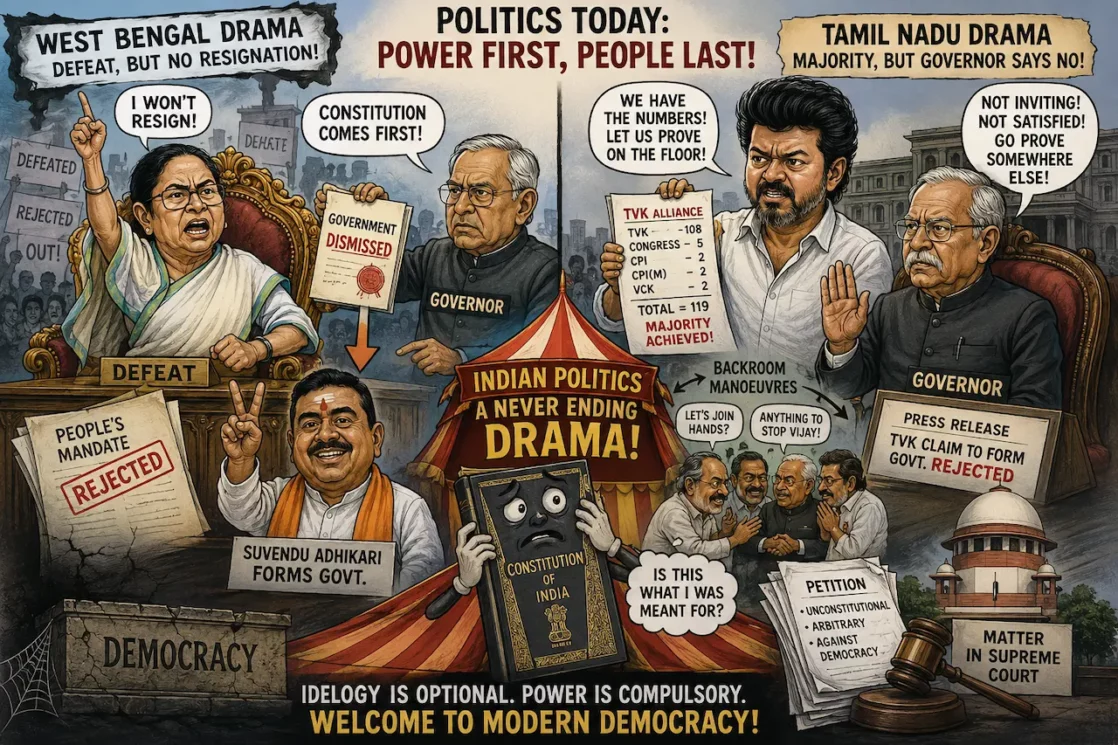
In West Bengal, after facing a humiliating electoral defeat, Mamata Banerjee reportedly refused to resign gracefully. The same leader who once projected herself as the undisputed “Didi” of Bengal suddenly appeared unwilling to accept the people’s verdict. Eventually, the Governor had to step in, dismiss the government, and pave the way for Suvendu Adhikari to form the government.

Just pause and absorb the absurdity.

For decades, Indian political leaders lectured citizens about democratic values. They spoke endlessly about respecting institutions and the people’s mandate. But when defeat arrived at their own doorstep, democracy suddenly became negotiable.

This is the new political culture of India — leaders who celebrate democracy only when they win.

The Bengal episode demonstrated something deeper than political stubbornness. It exposed the psychological transformation of modern politicians. Earlier generations of leaders treated power as temporary responsibility. Today’s politicians treat power as personal property. Losing office feels less like electoral defeat and more like an eviction notice from a kingdom.

And Bengal was only the beginning.

Tamil Nadu has now produced an even grander political drama — a blockbuster film script that would embarrass even the most exaggerated cinema plotlines.

Actor-turned-politician C. Joseph Vijay stormed into Tamil Nadu politics with remarkable momentum. His party, Tamilaga Vettri Kazhagam (TVK), emerged as the single-largest party with 108 seats in the 234-member Assembly — just 10 short of the majority mark.

Under established parliamentary convention, the leader of the single-largest party is generally invited to form the government and prove majority on the floor of the House. That is how parliamentary democracy works. Or at least, that is how it used to work.

But modern politics no longer trusts conventions. It trusts calculations, manipulation, and delay tactics.

What followed in Tamil Nadu looked less like constitutional governance and more like a political chess tournament played behind closed doors.

Even before the ink on election results had dried, intense backroom manoeuvring reportedly began. Senior AIADMK leaders allegedly explored splitting their own legislative party to support Vijay while attempting to bypass anti-defection laws. Simultaneously, another faction reportedly opened discussions with the DMK — their traditional rival — simply to prevent Vijay from becoming Chief Minister.

Imagine the level of political irony here.

Parties that spent decades calling each other corrupt, anti-Tamil, anti-people, and dangerous suddenly discovered “common democratic values” the moment a new political force threatened their survival.

This is precisely why citizens increasingly distrust politicians. Ideology today lasts only until the counting of votes is complete.

The Tamil Nadu developments have exposed a brutal reality — many political parties are no longer fighting for principles. They are fighting for political survival. And when survival becomes the priority, ideology becomes disposable.

The Governor’s role has added another dramatic layer to the unfolding crisis.

Despite TVK emerging as the single-largest party and later crossing the majority mark with support from Congress, CPI, CPI(M), and VCK, the Governor reportedly hesitated to invite Vijay to form the government. That hesitation triggered outrage, legal challenges, and accusations of constitutional impropriety.

Now the matter has reached the Supreme Court.

The petition filed against the Governor raises fundamental constitutional questions. Can a Governor deny the single-largest party an opportunity to prove majority on the floor of the Assembly? Can Raj Bhavan become an active political gatekeeper instead of a constitutional office?

These are not minor procedural questions anymore. They strike at the heart of parliamentary democracy.

Ironically, every political party changes its position on the Governor’s powers depending on whether it is in power or opposition.

When Governors help them, parties praise constitutional wisdom.

When Governors obstruct them, they scream about democracy being murdered.

This selective morality has become the trademark of modern Indian politics.

The Tamil Nadu crisis also reveals another major transformation in Indian politics — the rise of personality-driven political movements.

Earlier, political parties were built around ideological schools of thought. Today, politics revolves around charisma, celebrity culture, social media popularity, and emotional branding. Vijay’s rise is a perfect example of this shift. He did not emerge through decades of grassroots organizational struggle. He emerged through mass emotional connect, cinematic popularity, and public frustration with traditional parties.

And perhaps that is exactly why established political forces appear nervous.

The old political order understands something very clearly: celebrity-politicians with mass appeal can destroy decades of carefully constructed caste equations, alliance structures, and traditional vote banks.

That is why resistance becomes fierce.

But the larger issue goes beyond Vijay, Mamata Banerjee, or Suvendu Adhikari.

The real issue is this: modern politics has normalized instability.

Political defections are normal.

Midnight negotiations are normal.

Governors being accused of bias is normal.

Courtroom battles over government formation are normal.

Parties joining hands with sworn enemies is normal.

Defeated leaders refusing to step aside is normal.

Everything that once would have shocked the nation now barely surprises anyone.

That is perhaps the most dangerous development of all.

Citizens are slowly becoming emotionally numb to constitutional manipulation.

India’s democracy was designed with certain assumptions — dignity in defeat, restraint in power, respect for conventions, and institutional neutrality. But modern politics increasingly treats conventions as obstacles rather than guiding principles.

And social media has further accelerated this decay.

Today, politics is no longer about governance. It is about perception warfare.

Every event becomes content.

Every constitutional crisis becomes propaganda.

Every political negotiation becomes hashtag warfare.

Supporters no longer defend principles. They defend personalities.

One side calls every opponent anti-national.

The other side calls every institution fascist.

Nuance has disappeared.

The tragedy is that serious governance issues — unemployment, agriculture, inflation, infrastructure, education, healthcare — are increasingly overshadowed by political theatrics.

Television debates scream about government formation arithmetic while ordinary citizens struggle with daily survival.

Meanwhile, political leaders behave like corporate competitors fighting hostile takeovers.

What India is witnessing today is the corporatization of democracy.

Power is treated like acquisition.

MLAs are treated like assets.

Alliances are treated like mergers.

And ideology is treated like advertising material.

Yet amid this chaos, there is one silver lining.

The Indian voter is becoming unpredictable.

Regional giants are falling.

New forces are emerging.

Political arrogance is being challenged.

The message from voters is becoming increasingly clear: no leader is invincible anymore.

Not Mamata Banerjee.

Not Stalin.

Not the Congress.

Not even national parties.

That unpredictability is perhaps democracy’s last surviving strength.

The Bengal and Tamil Nadu dramas should serve as warning signs for the entire political class. Citizens are watching carefully. They may tolerate political drama for a while, but eventually they punish arrogance, manipulation, and betrayal.

History repeatedly teaches one lesson — leaders who stop respecting public sentiment eventually lose public trust.

Modern politicians would do well to remember that democracy is not merely about capturing power. It is about accepting defeat with dignity too.

Unfortunately, in today’s political climate, dignity appears to be the first casualty after election results are declared.