


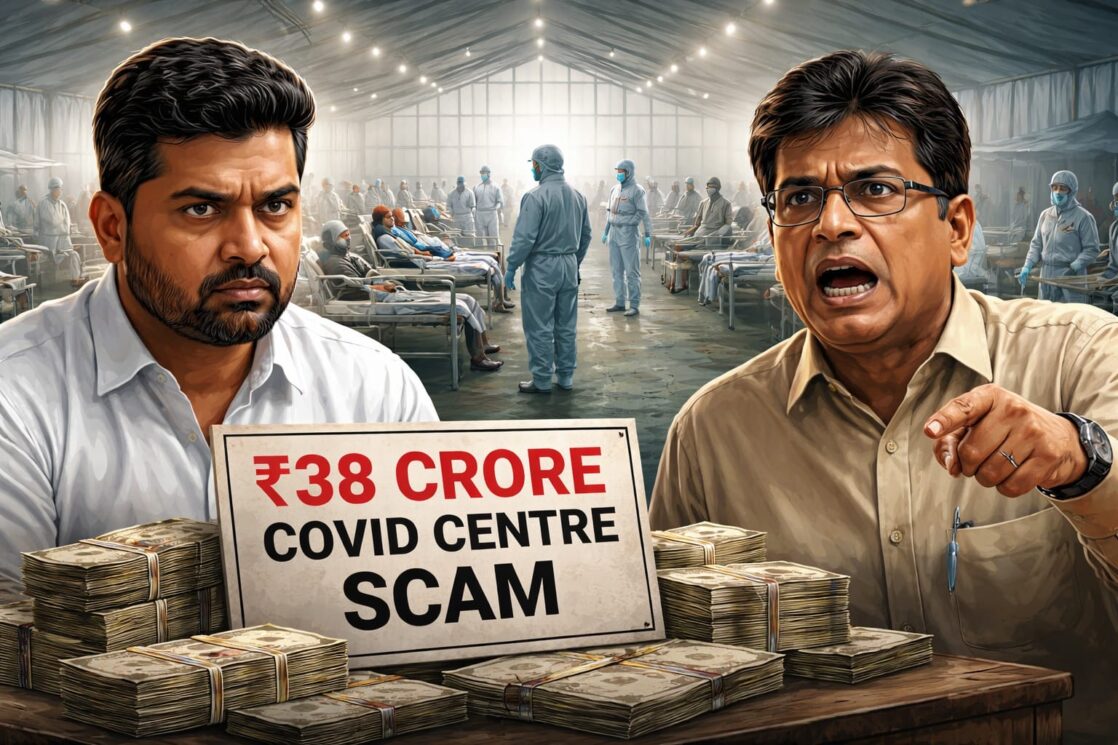
The COVID-19 pandemic was India’s darkest hour in recent memory. Hospitals collapsed, oxygen ran out, and municipal corporations scrambled to create makeshift treatment centres overnight. In Mumbai, Asia’s most expensive and densely populated city, the Brihanmumbai Municipal Corporation (BMC) rushed to set up “jumbo” COVID centres—large, centrally managed facilities meant to absorb the overflow of patients and save lives. Speed was essential.
Oversight, unfortunately, was sacrificed at the altar of urgency. It is in this chaos that the seeds of what later came to be known as the ₹38-crore Jumbo COVID Centre scam were sown, with Sujit Patkar emerging as the central figure and Kirit Somaiya as the man who lit the fuse.
The story begins not in 2022, when the scandal became public, but in early 2020, when BMC began awarding contracts to private operators to manage these jumbo centres. One such contract went to Lifeline Hospital Management Services (LHMS), a consortium that included Sujit Patkar. On paper, LHMS projected itself as an experienced medical services provider capable of handling a crisis of unprecedented scale. In reality, according to investigators, it was anything but.
The core allegation—now part of formal police and Enforcement Directorate records—is brutally simple: LHMS allegedly secured the jumbo centre contracts using forged documents, exaggerated credentials, and false claims of experience. Once the contracts were obtained, the consortium is accused of grossly under-deploying doctors, nurses, and paramedical staff, while simultaneously raising bills as if full staffing norms were met. In other words, Mumbai paid for a fully staffed emergency hospital; what it allegedly received was a skeleton operation dressed up with inflated invoices.
The Economic Offences Wing (EOW) of Mumbai Police later estimated the wrongful loss to the BMC—and the corresponding gain to the accused—at approximately ₹38 crore, though public claims ranged from ₹32 crore to over ₹100 crore depending on who was speaking and when. Numbers aside, the moral weight of the allegation was immense: profiteering during a pandemic, when citizens were dying without beds or oxygen, is not merely corruption; it is a civilisational crime.
Yet for nearly two years, this remained buried under files and fatigue. Then, in August 2022, Kirit Somaiya, a BJP leader known for his relentless, sometimes abrasive anti-corruption campaigns, filed a formal complaint at Azad Maidan police station. Somaiya accused LHMS and Sujit Patkar of forging partnership deeds, misrepresenting experience, and cheating the municipal corporation during a national emergency. His complaint was not casual activism—it named documents, pointed to discrepancies, and demanded criminal action.
That complaint changed everything. Within weeks, the case was transferred to the EOW. Scrutiny of BMC files began. Statements were recorded. Financial trails were examined. What started as a municipal fraud case soon acquired national significance when the money trail appeared complex enough to attract the attention of the Enforcement Directorate. Once ED steps in, the language of the case shifts—from cheating and forgery to proceeds of crime and money laundering.
By mid-2023, the investigation reached its most dramatic moment. In July 2023, the ED arrested Sujit Patkar under the Prevention of Money Laundering Act (PMLA). The agency alleged that funds obtained through inflated billing and fraudulent contracts were layered and concealed through various transactions. A PMLA chargesheet followed in September 2023, cementing the case’s seriousness. This was no longer a political allegation; it was a live criminal prosecution backed by documentary and financial evidence, at least according to the investigating agencies.
Parallel to the legal process ran a political narrative that made the case explosive. Sujit Patkar was widely described in the media as an associate of Sanjay Raut, a senior Shiv Sena (UBT) leader and one of the BJP’s most vocal critics in Maharashtra. This association ensured that the case was framed not merely as corruption, but as proof of moral rot within the rival camp. BJP spokespersons amplified it. Television debates thrived on it. Somaiya himself became the public face of the exposé.
And then, something changed.
As Maharashtra politics realigned—fractures within Shiv Sena, defections, new alliances—critics began asking an uncomfortable question: why had Kirit Somaiya gone quiet on some alleged corrupt figures once they were no longer politically inconvenient? Opposition leaders and commentators accused him of selective outrage—aggressive when targets belonged to rival parties, restrained when equations changed.
To be clear, there is no evidence that Somaiya withdrew his complaint, interfered with the investigation, or pressured agencies to go slow in the Sujit Patkar case. The record shows the opposite: his complaint triggered the entire chain of events that led to arrests and chargesheets. Investigations proceeded under EOW and ED independently of his later public posture. Courts examined evidence, not tweets.
However, politics is not judged only by files; it is judged by perception. And the perception that emerged was damaging: that anti-corruption crusades in Maharashtra, like elsewhere in India, often burn brightest when they serve immediate political ends and dim when alliances shift. Whether fair or not, Somaiya’s relative silence after the initial phase fed into a larger national debate about the selective application of investigative pressure.
This debate cannot be dismissed as cynical whining. Across cases and states, citizens have noticed a pattern—leaders raided aggressively when in opposition, suddenly finding relief or inertia once aligned with the ruling dispensation. The Sujit Patkar case became part of this larger mosaic, even though its legal trajectory continued.
In 2024 and 2025, the case entered a quieter but crucial phase: court proceedings. Bail applications, legal arguments on parity and procedural compliance, and judicial scrutiny replaced headline-grabbing raids. In 2025, the Bombay High Court granted bail to Sujit Patkar on legal grounds. Predictably, this was interpreted in two extremes—proof of innocence by supporters, proof of systemic failure by critics. In reality, bail is neither. It is a constitutional safeguard, not a verdict.
What remains undeniable is this: during a moment of collective national suffering, Mumbai’s emergency healthcare system was allegedly exploited for private gain. Whether the final number is ₹32 crore or ₹38 crore matters less than the principle involved. Emergency procurement without oversight is an open invitation to fraud. And fraud during a pandemic is not just financial—it is ethical bankruptcy.
The role of Kirit Somaiya, therefore, must be judged with nuance. He was the whistle-blower who forced the system to act. Without his complaint, the scam may never have surfaced. At the same time, his case illustrates the limits of personality-driven anti-corruption politics. When crusades appear selective, even genuine exposures lose moral authority.
Ultimately, the Sujit Patkar saga is not just about one businessman, one BJP leader, or one Shiv Sena MP. It is about governance under stress, institutions under pressure, and a political culture that treats corruption as a weapon rather than a disease. The courts will decide guilt or innocence. History, however, will judge something broader: whether India learned anything from the pandemic, or merely added another file to the archive of forgotten scandals.
In crises, character is revealed. For individuals. For institutions. And for politics itself.

