


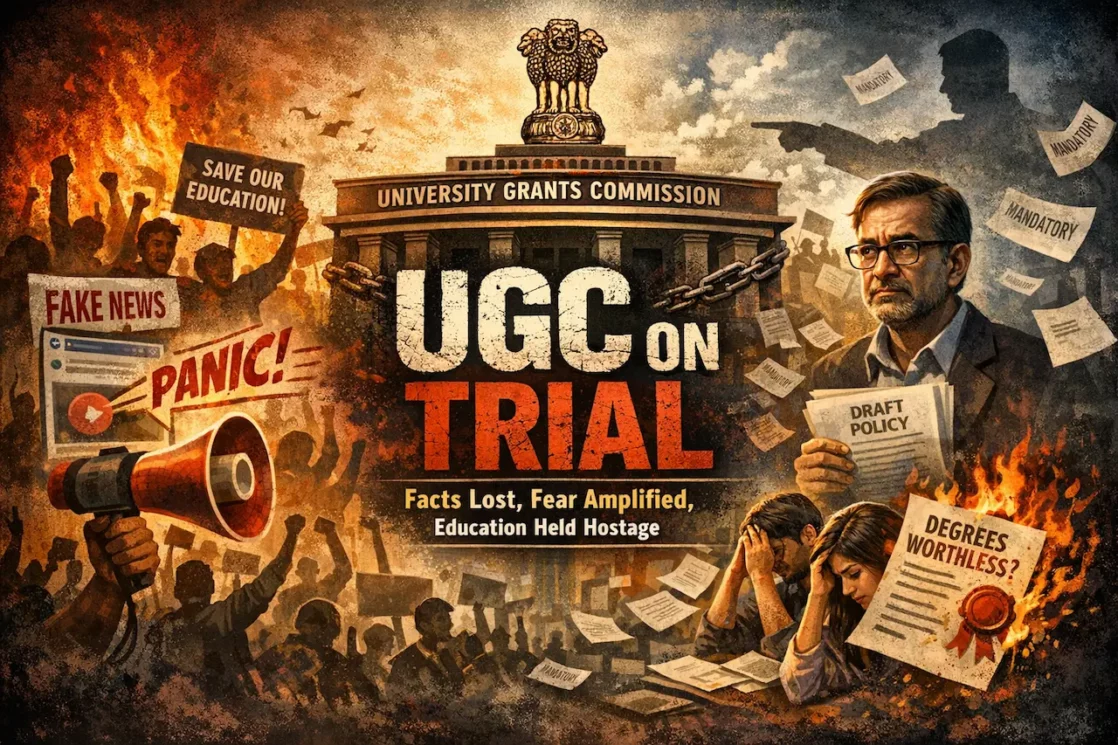
The University Grants Commission did not suddenly wake up one morning and decide to become India’s most controversial institution. It became the “big talk” because India’s higher education system is finally being dragged—kicking, screaming, and protesting—from comfortable stagnation into uneasy change. And whenever a system that has enjoyed decades of inertia is nudged toward reform, the reflex is not introspection but outrage. What we are witnessing today is not merely criticism of UGC; it is the systematic, often reckless, spreading of fear, half-truths, and deliberate misrepresentation, packaged as concern for students and sold aggressively to the public.
UGC has long been an invisible power—issuing grants, setting norms, regulating universities, operating in dusty files and dry notifications. Nobody held placards against it when salaries were secure, promotions were automatic, syllabi remained untouched for decades, and accountability was optional. The anger began the moment UGC started executing structural changes linked to the National Education Policy—changes that challenged entitlement, comfort zones, and academic complacency. Suddenly, reform was branded as destruction, regulation as dictatorship, and standardisation as ideological warfare. This narrative did not emerge organically; it was manufactured, amplified, and irresponsibly circulated.
What is striking is how swiftly misinformation replaced reading. Draft guidelines were projected as final orders. Optional frameworks were sold as mandatory diktats. Transitional chaos was painted as irreversible collapse. Social media, which thrives on immediacy and outrage, became the new campus corridor—only louder, dumber, and far less informed. A single UGC circular, stripped of context, could now spark nationwide panic within minutes. No one waited for clarification. No one bothered to read footnotes. Nuance was declared irrelevant, and complexity was treated as suspicious. In this atmosphere, truth did not stand a chance.
Students became the softest targets in this disinformation war. They were told their degrees would be worthless, their careers uncertain, their futures sabotaged. Anxiety was not just spread—it was weaponized. Instead of calm academic counselling, students received alarmist slogans. Instead of structured explanations, they were fed ideological interpretations. The tragedy is that many of the reforms being protested either allow flexibility, offer choice, or are still evolving through consultation. But fear, once planted, does not wait for facts. It metastasises.
Faculty resistance, too, deserves scrutiny beyond its moral posturing. Yes, there are genuine concerns about implementation gaps, regional disparities, and infrastructural readiness. But to pretend that all opposition is noble is dishonest. A significant part of the backlash stems from disrupted comfort—performance metrics replacing seniority rituals, digital accountability intruding into opaque systems, research output being measured instead of assumed. When scrutiny enters spaces long protected by insulation, outrage is the first defence mechanism. Tradition is invoked selectively—not to preserve pedagogical depth but to shield stagnation.
The most dangerous distortion, however, has been the politicisation of UGC. Education policy is now framed almost exclusively through ideological suspicion. Every syllabus change is portrayed as indoctrination. Every institutional reform is branded authoritarian. Every regulation is presumed to be politically motivated. This is not critical thinking; it is intellectual laziness disguised as vigilance. Universities cannot become permanent theatres of ideological anxiety, nor can regulators function while being tried daily in the court of social media hysteria. Genuine critique is drowned out by performative outrage, and serious issues are reduced to hashtags.
This is not to absolve UGC of responsibility. Its failures are real and consequential. Communication has been abysmal. Rollouts have often ignored on-ground capacity. State universities are routinely treated as afterthoughts. Uniform frameworks fail to account for India’s extraordinary institutional diversity. These are not minor lapses—they demand correction, accountability, and reform within the regulator itself. But incompetence is not conspiracy, and clumsy execution is not tyranny. To collapse every flaw into malicious intent is either intellectually dishonest or wilfully deceptive.
The real investigative question is this: who benefits from turning UGC into a public villain? It is certainly not students who need stability. Not universities, which need cooperation. Not faculty, who need structured autonomy. The beneficiaries are those who profit from chaos—attention-seekers, ideological entrepreneurs, and institutional actors unwilling to adapt. Fear is easier to sell than reform; outrage moves faster than understanding.
India aspires to global academic relevance, but it wants that future without discomfort, without transition pain, and without accountability. That is fantasy. No education system modernises without friction. No reform emerges without confusion. And no regulator survives change without being unpopular. The mature response is not to spread panic but to demand better execution, clearer timelines, transparent dialogue, and genuine consultation.
UGC has become the big talk not because it has destroyed education, but because it has disturbed entrenched habits. The problem is not debate; the problem is distortion. In a civilisation that once treated learning as sacred and teachers as guides, we have reduced educational reform to viral outrage and policy discussion to political theatre.
If India is serious about its intellectual future, it must stop mistaking noise for resistance and confusion for collapse. UGC must be held accountable, not crucified. Critiqued, not caricatured. Reformed, not relentlessly demonised. Because when education policy is reduced to propaganda—of any ideology—the ultimate casualty is not an institution, but an entire generation of students trained to react before they think.
