


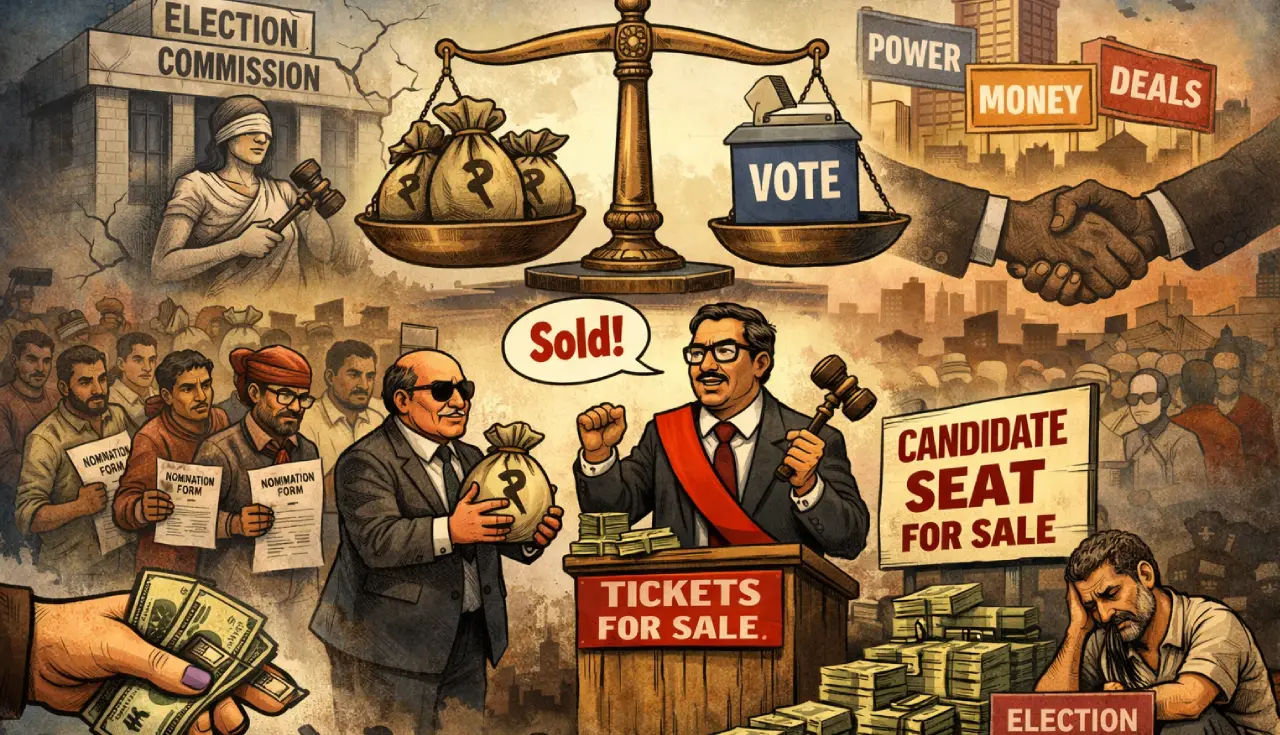
What unfolded during the Pune Mahanagar Palika election process is not a logistical footnote—it is a loud moral indictment. Thousands of nomination forms sold in a flash, queues that looked less like civic enthusiasm and more like a cattle market, and whispers—no, allegations—that “tickets” are effectively priced rather than earned. Call it what you want: procedure, enthusiasm, or coincidence. To the ordinary citizen, it smells like a democracy on discount.
Let’s stop pretending. When nomination forms are sold in bulk with such frenzy, the obvious question is why. Civic service does not suddenly become a mass obsession overnight. What has exploded is not public spirit, but political profiteering. Tickets have become commodities, wards have price tags, and ideology has been replaced by investment-return calculations. If governance were a stock market, Pune just witnessed an IPO frenzy.
And where, exactly, is the referee in this spectacle?
The credibility of the Election Commission of India stands squarely in the dock. Not accused of bias—but of blindness. When the system allows money power to bulldoze entry into the electoral arena, neutrality becomes negligence. A watchdog that merely watches while the house is looted cannot later claim it barked enough.
This is not about one party or another; that excuse is old, lazy, and dishonest. This is about structural rot. When ticket distribution becomes opaque, when the cost of entry silently eliminates the capable but poor, democracy mutates into an exclusive club for the wealthy, the connected, and the cynical. Elections then stop being a voice of the people and become background music for deal-making.
The tragedy is deeper. Pune is not some political backwater. It is an intellectual, cultural, and economic nerve centre. If this is the standard here, one shudders to imagine the silent compromises happening elsewhere. The middle class shrugs, the poor despair, and the political class laughs its way to the counting room.
The Pune Municipal Corporation elections should have been about urban planning, water, transport, housing, and collapsing infrastructure. Instead, they have turned into a masterclass on how to launder ambition through procedural loopholes. Democracy isn’t dying in loud coups; it is being suffocated in orderly queues with printed forms and unasked questions.
The Election Commission must answer—not with press notes, but with reform. Transparent caps, strict audits of party nominations, public disclosure of candidate selection criteria, and real-time financial scrutiny are not “nice ideas”; they are democratic CPR. If the Commission cannot enforce this, it must at least admit the system it oversees is compromised.
Because when citizens begin to believe that elections are for sale, they don’t just lose faith in politicians—they lose faith in the ballot itself. And once that faith is gone, no amount of ink on fingers can bring it back.
Democracy was never meant to be perfect. But it was never meant to be purchasable either.
