


In India, justice takes time, and politicians take people for granted. Corruption is another issue where many villages need urgent attention because they are deprived of basic necessities such as roads, water, electricity, job opportunities, and medical facilities. During elections, politicians beg for votes with lofty promises, but once the elections are over, those promises vanish. People suffer, but in Uttarakhand, the resilience of the people has set a strong example of determination and unwavering struggle for their rights. Their courage deserves recognition, and their fight for justice is a lesson in perseverance.
After months of protest and an indefinite strike, there is now a glimmer of hope for the road to reach Dumak, the most remote village in Chamoli district. The government has finally given financial approval to connect Dumak with the Saanji Laga-Maikot-Dumak-Kalgoth (32 km) road. On paper, this road already existed—a classic case of corruption where public money is syphoned off while development remains stagnant. Villagers took the government to court, exposing the blatant fraud. However, the legal system’s limitations meant that justice remained elusive for the voiceless. Undeterred, the villagers continued their agitation, and their persistence paid off. The defining moment came when spiritual leader Shri Kalikanand Saraswati joined the hunger strike, becoming the bridge between the authorities and the villagers. His presence reinforced the movement, and the villagers’ courage remained unstoppable.
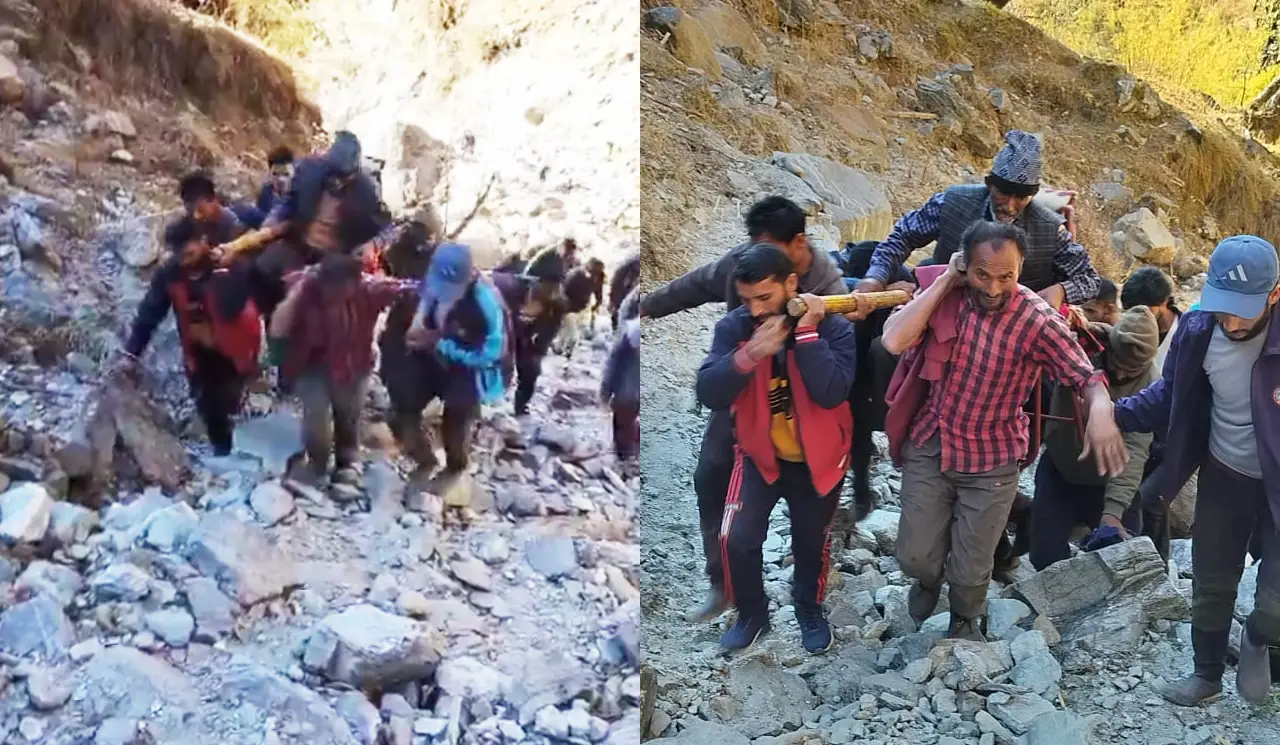
Eventually, the District Magistrate informed the villagers that during a meeting chaired by the Chief Secretary, financial approval for road construction had been granted, with a formal government order soon to follow. This road is not a luxury but a necessity—without it, villagers are forced to carry pregnant women, senior citizens, and critically ill patients on their shoulders for miles to reach a hospital.
The struggle for this road dates back to 2007-08, when the government first approved the Saanji Laga-Maikot-Dumak-Kalgoth road, yet nothing materialised. Road connectivity in Uttarakhand, especially in the higher hills, remains a serious issue. Some remote areas in border districts have been neglected for decades, with repeated demands falling on deaf ears. For this project, Rs. 15.85 crore was sanctioned under the Pradhan Mantri Gram Sadak Yojana (PMGSY) Pokhari scheme. In 2018, the department cleared about 19 km of road till Syun village, but the remaining 12 km was abandoned. PMGSY later proposed an alternative route directly to Kalgoth, citing landslide risks between Syun and Dumak—an excuse rejected outright by the villagers. They demanded road construction along the original alignment, leading to eight geological surveys since 2010. Now, after years of bureaucratic delays, the government has finally agreed to construct the road along the 2010 alignment. However, the so-called high-level meetings that were postponed twice earlier do not inspire much confidence.
A recent meeting chaired by the Chief Secretary led to verbal financial approval for the project. The District Magistrate, Sandeep Tiwari, played a key role in pushing the demand forward. Until now, PMGSY officials merely made empty promises, but it was the villagers’ relentless struggle and the DM’s proactive stance that pushed the government into action. The villagers’ phased agitation stretched over six years, intensifying in 2024 with prolonged protests throughout the year. A 115-day gradual fast took place, even reaching the Collectorate premises. This victory is the result of people’s relentless fight and the guiding influence of the monk who stood with them.
Earlier, the agitation reached the district headquarters, where angry villagers burnt the effigy of Chief Minister Pushkar Dhami. The government had been lying to them for years, offering false assurances while doing nothing. Despite government officials visiting occasionally to pacify them, their demands remained unmet. More than 75 years since independence, they still lack basic road access. Frustrated by years of deception, villagers finally burnt the effigy of the Rural Development Secretary in the Panchayat Bhawan courtyard, raising slogans against the administration. The movement gained support from several think tanks and spiritual leaders, adding pressure on the authorities.
One of the most striking moments of the protest came when a 100-year-old resident of Dumak, Bachhi Devi, began a fast unto death, demanding road construction. The villagers had already been participating in a relay fast for 40 days, and her involvement drew national attention. Despite her age, Bachhi Devi remained firm, declaring that she would not break her fast until the administration met their demands. Dumak, a remote village in Jyotirmath tehsil, is situated 52 km from the sub-district headquarters and 119 km from the district headquarters in Gopeshwar. With only 68 households and a population of around 311, Dumak has been left in isolation for far too long.
Villagers in hilly states like Uttarakhand endure immense hardships due to a lack of roads, particularly in remote areas where even basic amenities remain out of reach. The villagers of Dumak, having suffered for years, are demanding that the administration restart the long-pending construction of the Saanji-Maikot-Dumak-Kalgoth road on the previously approved route. Their frustrations have escalated to the point where they have threatened to boycott the Lok Sabha polls, a bold move signalling their desperation.
Historically, politicians have manipulated these villagers during election seasons. Before elections, construction agencies rush machinery to the village, raising false hopes, only to withdraw them once polling concludes. Dumak, one of the most remote polling stations in Chamoli district, has been consistently used as a pawn in this game. The residents of Dasholi and Pankhanda have twice boycotted elections since the 1990s to demand road construction, yet their appeals remained ignored.
In 2019, Dumak residents announced an election boycott, prompting the authorities to hastily send machines a week before polling day, tricking them into withdrawing their protest. However, as soon as voting ended, the machines disappeared. Five years later, the road remains incomplete. The agitation intensified again in January 2024, with villagers launching a full-scale protest. Despite Chief Minister Pushkar Singh Dhami’s intervention and assurances, construction has yet to begin, pushing villagers to renew their election boycott.
The demand for the Sainji-Lagga-Maikot-Bemru-Dumak-Kalgoth motor road has been pending for decades. Dumak, one of the highest-altitude villages in Chamoli, hosts the second-highest polling booth in the state at an elevation of around 10,000 feet. The village falls within the Badrinath Assembly segment, part of the Garhwal (Pauri) Lok Sabha constituency. BJP’s national media in-charge, Anil Baluni, contested and won the elections, playing a role in addressing the villagers’ grievances. Finally, there is hope that this road will soon become a reality, offering some relief to the high-altitude residents who have been deprived of basic infrastructure for far too long.
This is not just about a road; it is about justice, dignity, and holding the government accountable. The villagers of Dumak have fought long and hard, proving that persistence and solidarity can challenge even the most negligent authorities. The question remains: how many more years will it take for the government to honor its promises?
