


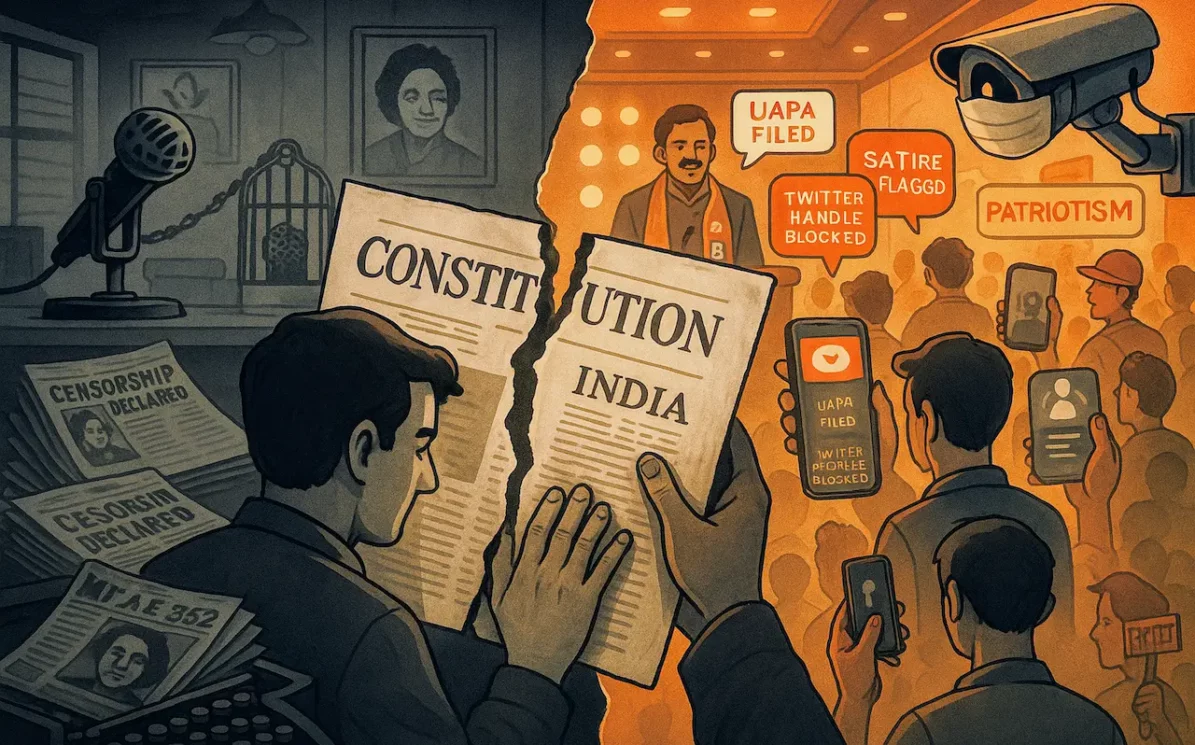
It’s that time again—June 25. The annual constitutional weep-fest. The government is out with its banners, hashtags, and pious speeches about “dark times,” the Congress is squirming in selective amnesia, and Twitter is ablaze with black-and-white photos of Atal Bihari Vajpayee behind bars. We’re told to “Never Forget.” Fair enough. But while we’re lighting digital candles for democracy’s past, maybe—just maybe—we should take a long, hard look at democracy present.
Let’s rewind to 1975.
Indira Gandhi, cornered by a court verdict that declared her election invalid, chose not to step down, not to appeal for calm—but to shut the nation down. Using Article 352, she declared a national Emergency citing “internal disturbance”—which conveniently translated to “I might lose my job.” Press freedom? Suspended. Civil liberties? Erased. Opposition leaders? Jailed by the thousands. Sanjay Gandhi became the unelected czar, sterilizing the poor and bulldozing slums like an overzealous architect of dystopia. Parliament became a rubber stamp. Judiciary bowed. Police saluted. The “voice of India” was reduced to a whisper—often behind prison bars.
Now fast-forward to 2025.
We haven’t declared an Emergency. No, no—we’re better at this now. Why use Article 352 when you can just weaponize every institution? You don’t need to jail all opposition leaders—just enough to send a message. You don’t need to censor the press—just buy it. Why ban civil liberties outright when you can strangle them with a thousand little rules, a barrage of FIRs, UAPA cases, IT raids, and patriotic gaslighting?
And the masterstroke? Call yourself the guardian of democracy while operating in an “undeclared emergency” mode.
Let’s be brutally honest—India went wrong in 1975 because it allowed one person’s insecurity to hijack the entire system. We let fear override freedom, loyalty override law, and propaganda override principles. The Parliament sang chorus, the President signed like a stenographer, and the courts—barring a few brave exceptions—folded like paper.
India is going wrong again—but this time, it’s worse because the erosion is slow, silent, sugarcoated. No formal declaration, just a daily diet of fear, manipulation, and mass distraction.
Back then, newspapers had their power supply cut. Today, they cut their own credibility voluntarily. Then, journalists like Kuldip Nayar and Arun Shourie resisted. Now, anchors compete to out-yell each other in lapdog nationalism. Then, the opposition was jailed; now, they’re sued, silenced, defamed, or conveniently investigated by every acronym-laced agency from CBI to ED.
Back then, there was at least shock. Today, there is normalization. The public shrugs. The youth scrolls. Parliament gets bulldozed—literally and metaphorically—and we call it “efficiency.”
We criticize Indira Gandhi for centralizing power. Yet today, decisions are taken by one man and one machine. Cabinet ministers tweet after the PM tweets. Governors behave like party secretaries. Even the Election Commission reads like a WhatsApp forward factory.
Indira Gandhi’s Emergency was blatant, ugly, and brutal. Modi’s undeclared version is slick, digital, and drenched in nationalism. Both function the same way: consolidate power, control institutions, cripple the opposition, manipulate the media, and rule through fear disguised as pride.
Let’s not forget—Indira Gandhi at least paid a political price. She withdrew the Emergency. She held elections. She lost. Today, the government thrives on elections. In fact, it wins more when it silences more. Why fear elections when you have money, media, muscle, and myths all working in sync?
The real tragedy is this: while we spend hours arguing about 1975, most Indians don’t even realize they are already in a different kind of emergency—one without sirens, but with a deep, systemic rot. An emergency where surveillance is celebrated, dissent is sedition, satire is a threat, and questions are acts of betrayal.
So yes, commemorate June 25. Mourn what was lost. But do so with the courage to confront what we are losing now.
Because what’s the point of remembering a dictatorship from the past if you can’t even recognize the one staring you in the face—armed with slogans, electoral data, a billion-dollar IT cell, and a national anthem playing in the background?
Democracy didn’t die in 1975.
It was just a trailer. The full film is now streaming—across all channels, with commercial breaks brought to you by your friendly neighborhood government.
And we? We’re watching it in HD… with popcorn in hand.
