


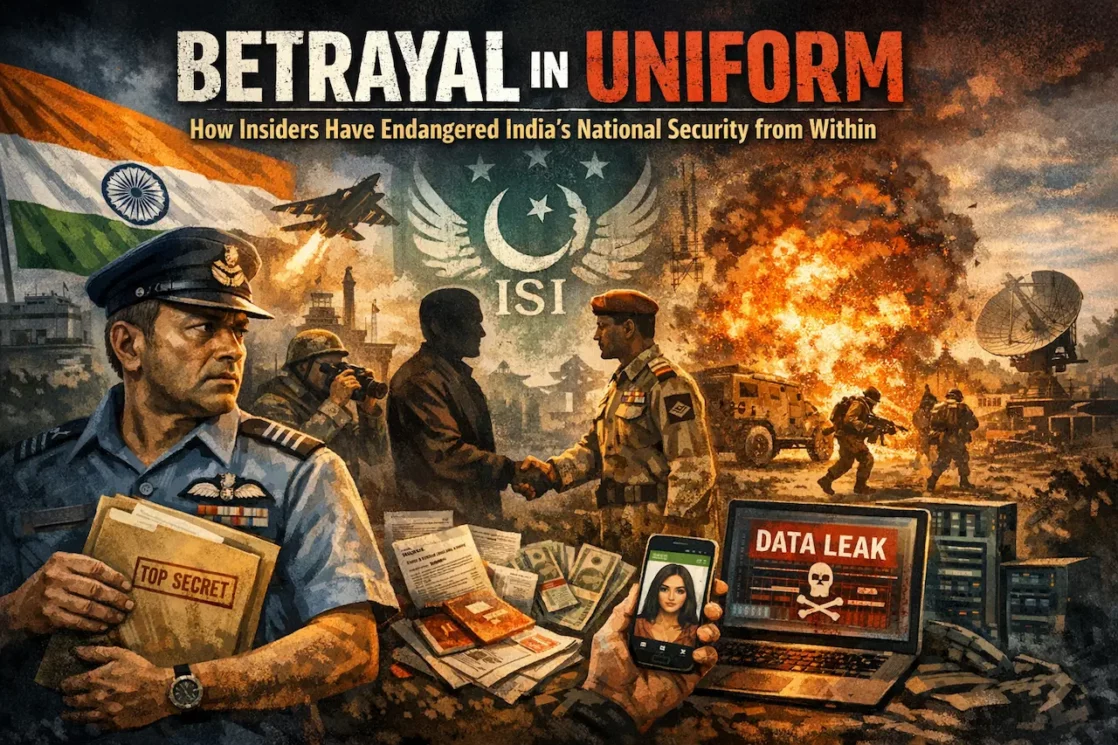
Nationalism in India is often reduced to speeches, flags, and slogans, but real betrayal happens quietly—between files, inside encrypted chats, and across secret meetings. The arrest of retired Air Force officer Kulendra Sharma from Tezpur, Assam, is not an isolated incident. It is another link in a long and disturbing chain where individuals in uniform, or once in uniform, loudly project themselves as patriots while silently punching holes in India’s national security. History is clear on one uncomfortable truth: India has suffered more damage from “insiders” than from enemies standing across the border.
It is a harsh reality that many individuals who have served in India’s defence establishments continue to carry sensitive institutional knowledge long after retirement. Their memory, networks, and experience do not retire with them. Enemy intelligence agencies understand this well and exploit it ruthlessly. Greed, ego, resentment, financial stress, or ideological confusion—each becomes a lever. When such people break, the loss is not limited to leaked documents; it costs soldiers’ lives, strategic advantage, and national confidence.
A look back shows how old and recurring this pattern is. As early as the 1970s, India learned that rank and uniform are not guarantees of loyalty. In 1975, a senior Indian Navy commander was arrested for spying for a foreign intelligence agency. A man entrusted with maritime security was feeding sensitive information to hostile powers. At the time, the issue was quietly buried to protect “institutional image”—placing optics above accountability, a mistake India continues to repeat.
In the 1990s, as Kashmir burned and Pakistan intensified its proxy war, multiple cases emerged where information was leaking from within India’s own security apparatus. Some officers were found in direct contact with ISI handlers; others claimed they had shared details “unknowingly.” This excuse deserves no sympathy—espionage is rarely accidental. Information that enables terror attacks does not travel by mistake.
One of the most alarming episodes surfaced in the early 2000s involving espionage networks linked to DRDO and the Ministry of Defence. Scientists, clerks, and officers were caught leaking classified data on missile programs, radar systems, and defence procurement. These were not fringe elements; they were trained professionals who often wrapped themselves in nationalist rhetoric. Their loyalty became clear not through speeches but through bank transactions and call records.
After 2010, espionage evolved into an even more dangerous form. Intelligence agencies no longer needed trench coats or embassies. Facebook friend requests, fake female profiles, LinkedIn connections, and conversations disguised as “academic research” became the new tools. Several serving and retired officers fell into these traps. Many believed they were merely offering “analysis,” not realizing—or pretending not to realize—that strategic analysis itself is a weapon.
Cases from Rajasthan and Haryana exposed how Indian Army personnel were honey-trapped using fake Pakistani profiles. Some exchanged information for money, others for attention and validation. All lofty claims of nationalism collapsed the moment a video call or a few dollars entered the picture.
In 2018, leaks related to the BrahMos missile system—one of India’s most critical strategic assets—sent shockwaves through the security establishment. Those involved were not outsiders but insiders with legitimate access. The real question was not whether arrests were made, but how such individuals gained prolonged access and why detection took so long.
The role of retired officers is particularly worrying. After retirement, many struggle with a loss of status and relevance. Enemy agencies exploit this psychological vacuum expertly. A simple line—“We value your experience”—is often enough to start the slide. Conversations turn into disclosures, disclosures into documents, and documents into outright betrayal.
The greatest deceit occurs when such individuals publicly posture as nationalists while privately undermining national security. They appear on television debates praising the armed forces, wave the tricolour on social media, and simultaneously feed adversaries with insights into vulnerabilities. This dual character is far more dangerous than open hostility because it corrodes trust from within.
The consequences are not abstract. When adversaries gain accurate intelligence on troop deployment, preparedness, or weaknesses, attacks become more precise and deadlier. After incidents like Uri and Pulwama, questions were raised about how terrorists obtained such detailed information. The blame was conveniently pushed outward, while serious introspection about internal leaks remained limited.
India also suffers from a chronic lack of institutional transparency in espionage cases. Matters are labeled “sensitive,” names are withheld, facts are diluted, and the public is kept in the dark. As a result, society never fully understands the nature of the threat. Without visible consequences, deterrence remains weak.
It must be stated clearly: the vast majority of retired defence personnel live with honour and dignity, continuing to serve the nation in various capacities. But in matters of national security, even a handful of compromised individuals can endanger the entire system.
India must now move beyond emotional nationalism to practical national security. Clear post-retirement conduct rules, regular counter-intelligence briefings, lifetime restrictions on sensitive access, and strict monitoring of suspicious activity are not signs of mistrust—they are necessities.
The Kulendra Sharma case is a reminder that threats do not always stand across borders. Sometimes they sit in living rooms, hide in call logs, and lie buried in old files. When those who claim to be the loudest nationalists begin to weaken the nation from within, it is not just a crime—it is a failure of collective vigilance. And India has paid the price of that failure too many times already.
