


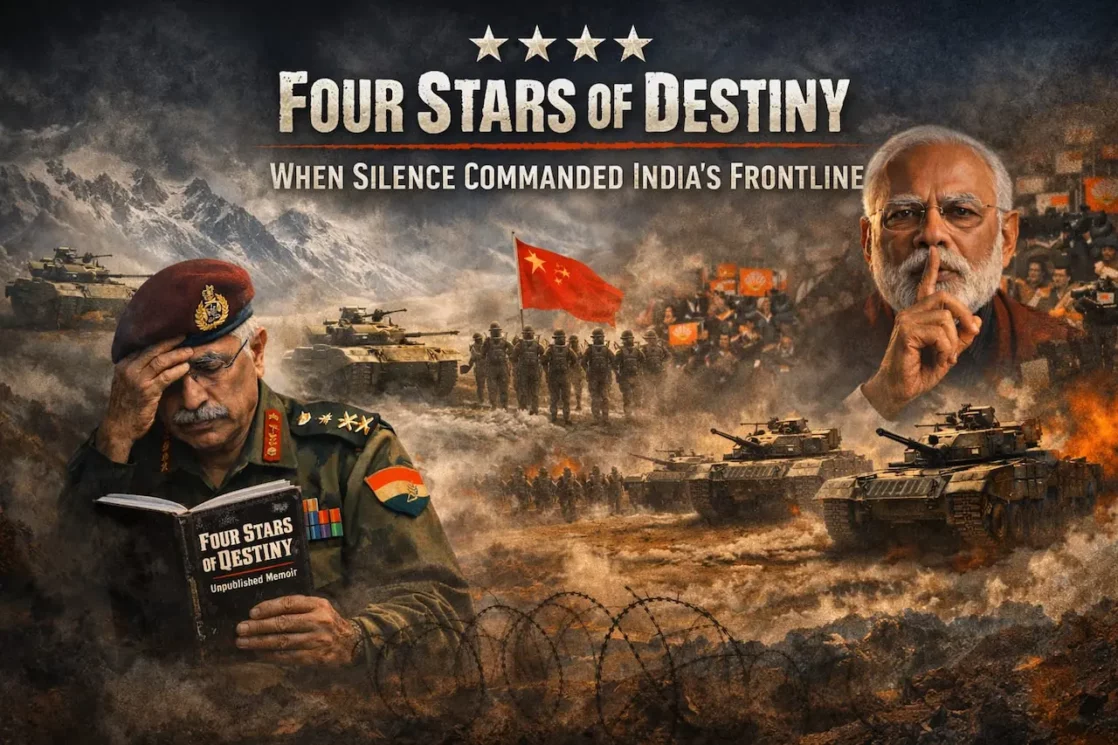
India has reached a moment where the distance between image and reality has grown so wide that it can no longer be masked by slogans, studio debates, or choreographed nationalism, and the unease surrounding the unpublished memoir Four Stars of Destiny by Manoj Mukund Naravane exposes that gap with brutal clarity. This is not a tale of leaked secrets or protocol breaches; it is the quieter, more dangerous story of hesitation at the top when decisiveness was demanded, and of a soldier left to shoulder the weight of history while political leadership chose ambiguity over ownership.
At the height of the 2020 standoff with China, when the situation along the Line of Actual Control was spiraling and Chinese armor moved into threatening positions near Kailash Ridge, what the military needed was not motivational language but unambiguous political direction, because armies fight on orders, not vibes. Yet the account that has now unsettled the establishment suggests a vacuum at the worst possible moment—calls unanswered, time slipping, and finally a message that effectively pushed the burden downward: do what you think is right. In corporate folklore, that sounds like trust; in the fog of a potential war between two nuclear-armed states, it borders on abdication.
Civilian supremacy is the bedrock of democracy, but supremacy without responsibility is just distance from consequence, and when elected authority refuses to clearly own decisions in moments of crisis, someone else ends up gambling with blood and blame. What followed was a dangerous “game of bluff,” Indian tanks moved forward, nerves stretched thin, and the People’s Liberation Army ultimately backed down, but the strategic success, such as it was, came from military resolve under uncertainty, not from political clarity.
The irony is that this same political leadership later wrapped the episode in the language of strength and decisiveness, folding it neatly into a carefully curated strongman narrative that dominates screens and speeches, where Narendra Modi is projected as an unflinching leader who never hesitates, never blinks, and never defers. Projection, however, is not performance, and strength that exists only in messaging collapses the moment an insider’s recollection introduces doubt. The reported sense of being “alone” felt by the Army Chief is not emotional excess; it reveals a deeper structural problem in which the risks of decisions are privatized downward while political credit is nationalized upward.
The same pattern surfaces in the controversy around the Agnipath Scheme, marketed loudly as bold reform but, according to accounts now in the public domain, implemented in a form that diluted the military’s own recommendations, brushed aside concerns over retention, morale, and preparedness, and rebranded institutional unease as resistance to change. Consultation occurred, but consideration did not, and that distinction defines the current governance style: listen enough to tick a box, decide elsewhere, and sell the outcome as inevitability. What makes the present moment especially revealing is not disagreement—democracies survive disagreement—but the instinctive attempt to manage the narrative by delaying approvals, questioning motives, and shifting public attention to anything but the substance of what is being said.
The book remains stuck in clearance loops, not because it endangers national security, but because it endangers a story that the government has invested enormous political capital in telling, the story of unwavering resolve, instant decision-making, and supreme control. Meanwhile, governance has increasingly become an exercise in distraction management: amplify symbols, inflate spectacles, keep the Vishvaguru imagery permanently polished, and relegate inconvenient questions about borders, preparedness, and accountability to the margins. This is the irony of the moment—while the country faces complex internal and external challenges, relevance is manufactured by focusing attention on the trivial and the theatrical, allowing unresolved failures to dissolve into noise.
India does not suffer from a lack of talent in uniform or intelligence in institutions; it suffers from a political culture that confuses visibility with leadership and branding with courage. A Prime Minister can dominate news cycles, command applause, and control narratives, but history does not archive campaigns; it records moments, especially the ones when silence replaced command. The uncomfortable truth hinted at by Naravane’s recollections is not that the army faltered, but that political leadership hesitated, and that hesitation was later papered over with muscular rhetoric.
That is why this book unsettles power—not because it reveals secrets, but because it exposes silences, and silence at the edge of conflict is never neutral. India today needs a performing prime minister, not a projected one; a leader who owns decisions when the stakes are highest, not one who delegates risk and later claims resolve. Suppressing such accounts will not strengthen the republic; it will only delay a reckoning that grows harsher the longer it is postponed. Soldiers deserve clarity, citizens deserve honesty, and democracy demands accountability—everything else is spectacle, and spectacle cannot defend a nation when reality knocks without warning.
