


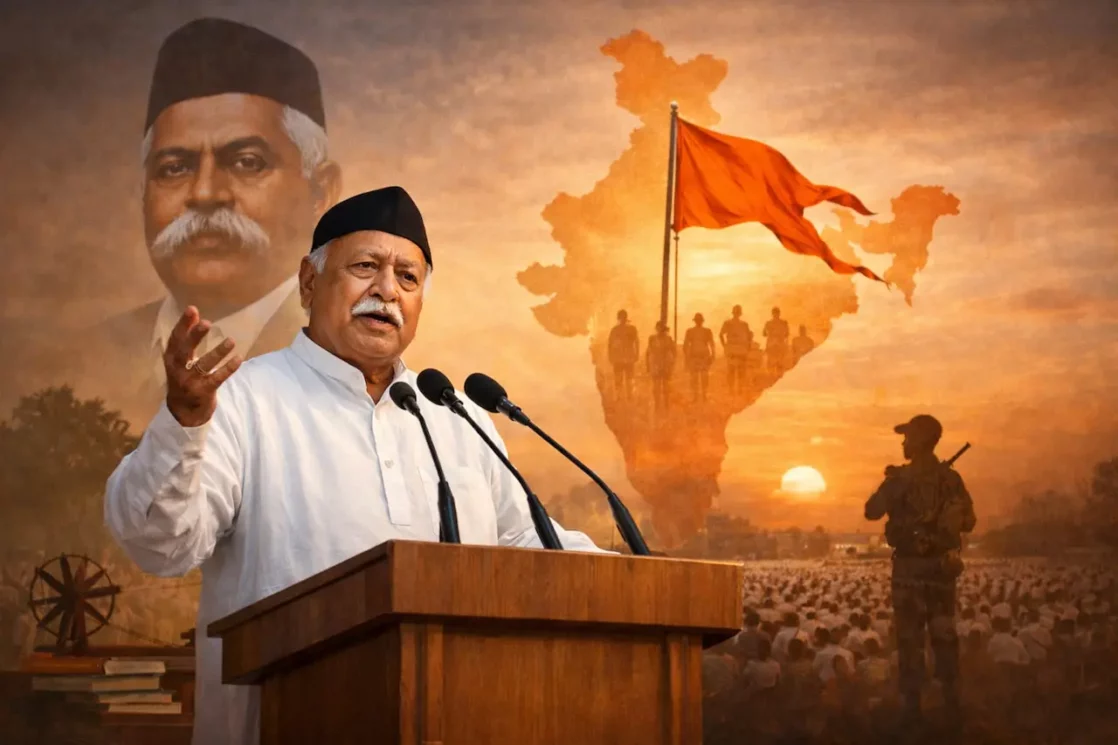
Mohan Bhagwat’s address at the RSS Centenary Ceremony was not merely a celebration of a hundred years of organizational existence; it was a deep introspection on India’s social character, cultural consciousness, and national direction. This was not a speech crafted for applause, but a carefully weighted articulation where every word carried a long-term vision, a demand for discipline, and an expectation of accountability from society. When he positioned the Sangh not as a substitute for political power but as a lifelong practice of social nation-building, it was not just a formal distancing from politics; it was a reassertion of the core idea that organizations must act as moral catalysts within society rather than aspire to become centers of authority. This also served as a rebuttal to those who see the Sangh only through the prism of political power, while simultaneously acting as a caution to internal tendencies that might confuse social influence with the lure of power.
By separating nationalism from sloganeering and placing it on the anvil of conduct, Bhagwat directly challenges the culture of crowd politics. His subtext is unmistakable: it is easy to inflame emotions in the name of the nation, but difficult to cultivate character for the nation. In an age where social media often converts patriotism into noise and spectacle, his words relocate nationalism from performative outrage to everyday ethical choices. Paying taxes honestly, respecting civic rules, and standing up for justice become as much acts of nation-building as standing at the border with a rifle. This reframing strips nationalism of its sentimental excess and grounds it in civic responsibility.
His insistence on social harmony is not a poetic celebration of diversity but a practical warning against deepening polarization. When he says that India’s civilizational soul cannot be imprisoned within a single identity, he confronts the political convenience that turns diversity into division. He implicitly acknowledges that inequality and mistrust are not merely the results of external conspiracies but also of internal prejudices and rigidities. Therefore, the call is not only to change others but to change oneself, an uncomfortable demand for self-critique that any society serious about reform must accept.
The emphasis on discipline and restraint for the youth is not moral sermonizing but a blueprint for future stability. In a time driven by instant gratification and viral validation, character-building appears outdated, yet it is precisely this slow, demanding process that forms the bedrock of lasting national strength. Bhagwat’s message suggests that demanding opportunities without cultivating the discipline to deserve them is a hollow politics of entitlement. Rights gain moral legitimacy only when accompanied by an equally strong acceptance of duties.
His recurring invocation of “service” moves beyond charitable sentiment into the realm of social contract. Service here is not about patronizing benevolence but about rebalancing power relations through genuine sensitivity to the vulnerable. When service becomes self-congratulatory charity, it preserves inequality; when it becomes structural empathy, it nudges society toward justice. This reframes the Sangh’s tradition of service under a sharper ethical lens, insisting that service must translate into dignity, not dependency.
By asserting that India must become a reliable partner to the world before proclaiming itself a world teacher, Bhagwat checks the self-congratulatory nationalism that confuses rhetoric with reality. Global influence is built through conduct, consistency, and credibility, not through grand declarations. A nation fractured within cannot convincingly claim moral leadership abroad. Power, in his framing, is not merely military or economic capacity but moral authority rooted in social cohesion and ethical governance. This redirects national pride toward self-improvement rather than self-adulation.
His stress on dialogue and restraint confronts the dominant political culture of instant outrage and rhetorical aggression. In an environment where disagreement quickly turns into enmity, calling for restraint seems unfashionable, yet history shows that societies endure not by silencing dissent but by converting conflict into conversation. This appeal is not only for political actors but for citizens who habitually turn disagreement into hostility. Social peace, in this vision, is not an emotional appeal but a strategic necessity.
Describing the centenary as an occasion for introspection rather than self-glorification is itself a statement. Organizations often turn milestones into platforms for self-praise; here, the emphasis on future responsibility suggests an admission of incompleteness and a commitment to continuous reform. This public posture of self-examination signals a willingness to engage with criticism rather than evade it.
At its core, the address relocates nationalism from the language of entitlement to the language of responsibility. Nation-building is presented not as the monopoly of any institution or ideology but as a collective civic discipline practiced through everyday choices. The discomfort produced by this message is its greatest strength. The speech does not soothe with easy pride; it unsettles with hard questions. It asks whether we are merely loud in the name of the nation or truly becoming citizens worthy of it. In celebrating a century, the address burdens the present with the moral weight of the next century, and that demanding horizon is what gives the speech its lasting power.
