


Artificial intelligence is no longer a passing wave in technology; it is becoming the structural framework of the next global economy. With projections placing its economic contribution near $15 trillion by 2030, the real question for nations is not whether AI will matter—but whether they will shape it or simply consume it. In agriculture, that question becomes even more urgent. Climate unpredictability, rising input costs, fragmented landholdings, and volatile markets have exposed the limits of traditional farming systems. Experience and instinct remain invaluable, but in an era of data abundance and weather disruption, they must be reinforced by precision, prediction, and platform-driven intelligence. Maharashtra has recognized this inflection point and chosen to act decisively.
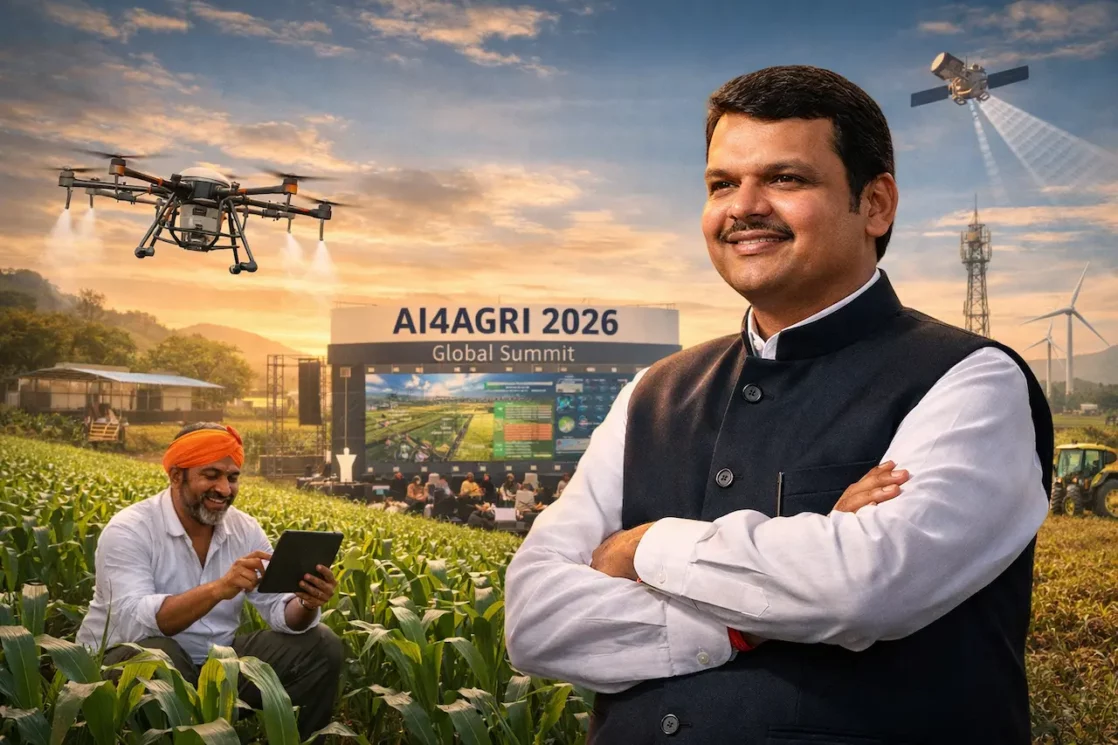
The AI4AGRI 2026 Global Conference, organised at the Jio World Convention Centre in Bandra Kurla Complex, Mumbai, was not staged as a ceremonial gathering but as a strategic declaration. Conceived as a global knowledge-exchange platform, it brought together policymakers, state governments, international scientists, climate experts, investors, multilateral institutions, and AgriTech innovators to engage in evidence-based dialogue on deploying AI and digital public infrastructure for agricultural transformation. The ambition was clear: to move beyond incremental reform and design an ecosystem where frontier AI, advanced analytics, generative AI, remote sensing, and affordable computing converge to strengthen productivity, resilience, and farmer incomes.
Agriculture has always been India’s civilizational spine. But modern pressures demand intelligent systems capable of operating at scale. AI-powered advisory tools can integrate soil data, satellite imagery, weather forecasts, crop histories, and market signals to generate hyper-local recommendations. Instead of generic guidance, farmers receive region-specific insights—optimal sowing windows, irrigation adjustments, early pest detection alerts, nutrient management suggestions, and yield forecasting. Drone surveillance and remote sensing help detect crop stress before it becomes irreversible. Predictive climate modelling reduces uncertainty. Data-backed market intelligence narrows the information gap between producer and buyer. When farming decisions become data-informed rather than purely reactive, risk declines and margins improve.
The strength of this transformation lies not only in algorithms but in infrastructure. India has already demonstrated that digital public platforms can operate at population scale with reliability and trust. Extending that framework into agriculture creates the foundation for secure data flows, transparent traceability, and scalable innovation. AI systems require trust as much as intelligence; farmers must believe that data will not be exploited and that recommendations are practical, not theoretical. This is where responsible AI governance, digital identity, platform design, and policy coherence intersect.
AI4Agri has therefore been structured not as a one-time event but as a multi-year global platform aimed at mobilising international collaboration and investment into Agri-AI solutions. Its agenda reflects strategic depth: inclusive AI models for women farmers and emerging rural leaders; digital public infrastructure that ensures data integrity and traceability; capital alignment to scale innovations; scientific collaboration through global research networks; and policy frameworks that embed accountability in AI deployment. This approach acknowledges a basic truth—technology without governance destabilises, but technology with foresight transforms.
Leadership becomes decisive at such moments of transition. Agricultural reform has often oscillated between subsidies and short-term relief. What Maharashtra is attempting signals a shift toward systems thinking—toward building institutional architecture that can endure technological change rather than chase it. A Green Revolution powered by AI will not resemble the chemical-intensive transformation of the past; it will be driven by intelligence, precision, sustainability, and inclusion. The aim is not merely higher output but resilient food systems capable of withstanding climate shocks while preserving soil health and water resources.
When governments, industry, academia, and global institutions converge around a shared framework, ecosystems begin to form. Standards evolve. Research aligns with field realities. Investment scales solutions beyond pilots. Maharashtra’s positioning as a convening hub for Agri-AI dialogue indicates strategic intent: not to imitate global leaders blindly, but to contribute meaningfully to shaping the future of intelligent agriculture. In a world where technology defines competitiveness, the ability to integrate tradition with data-driven modernization becomes a formidable strength.
The coming decades will test whether agriculture remains vulnerable to uncertainty or becomes empowered by insight. The choice is not between tradition and technology; it is between stagnation and evolution. By embedding AI within its agricultural vision, Maharashtra signals that the next revolution in farming will not arrive through accident or rhetoric—it will be engineered through foresight, collaboration, and disciplined execution. And in an age defined by disruption, foresight is the most valuable crop a nation can cultivate.
