


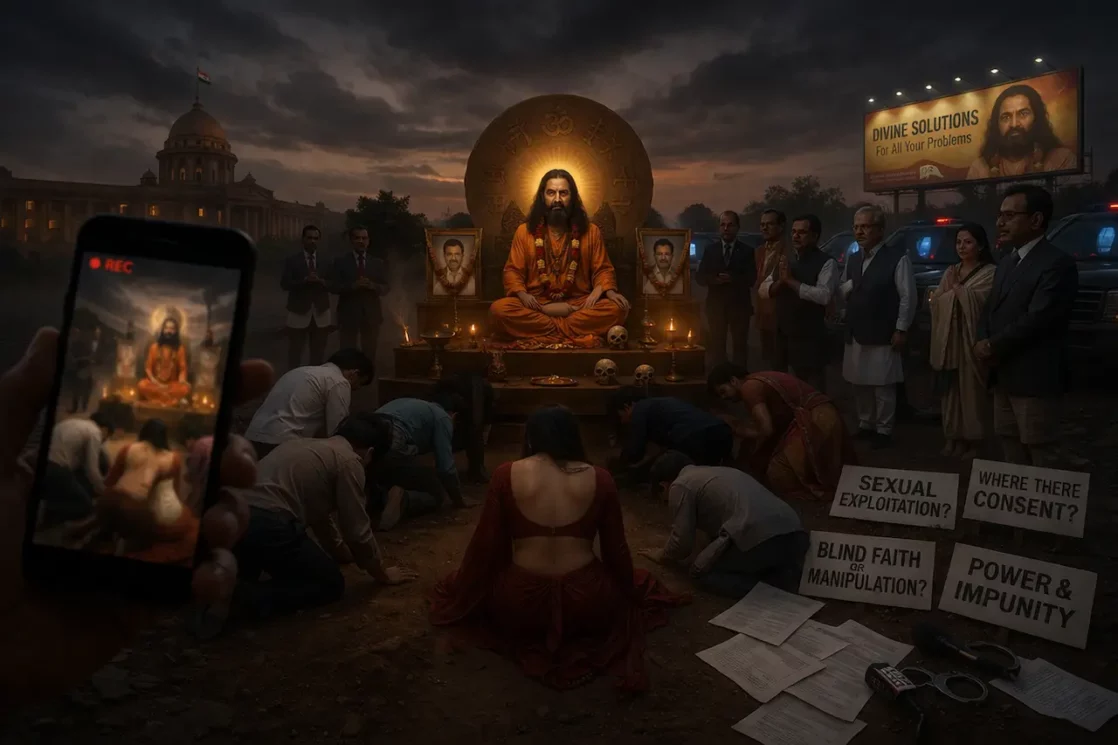
The Ashok Kharat episode is not merely about one controversial figure or a set of disturbing viral videos. It is a brutal mirror held up to society—reflecting uncomfortable truths about blind faith, moral ambiguity, selective outrage, and, most importantly, the unsettling role of willing participants in their own exploitation.
For days now, public discourse has been hijacked by two extreme narratives. One paints Kharat as a monstrous predator who manipulated and violated women. The other attempts to dismiss the entire episode as a conspiracy, a media trial fueled by selective leaks and moral panic. But both sides are conveniently avoiding the most disturbing question of all: what happens when people willingly walk into the trap?
The viral videos—disturbing as they are—do not present a straightforward story of visible force or resistance. What emerges instead is a deeply uncomfortable gray zone. The individuals involved appear conscious, aware, and, at least on the surface, compliant. The acts themselves are framed not as coercion, but as part of some ritualistic, quasi-religious process.
This is where the debate must shift. Because if this was not overt force, then what exactly are we looking at? Consent? Manipulation? Psychological conditioning? Or a dangerous cocktail of all three?
Let us be clear: consent under the influence of blind belief is not the same as free, informed choice. When individuals surrender agency to a self-proclaimed spiritual authority—believing that submission will bring divine reward, healing, or personal gain—the very idea of consent becomes distorted. It is no longer a decision made freely; it is one shaped by indoctrination, fear, and hope.
But here lies the uncomfortable counterpoint—one that society is reluctant to confront. At what stage does personal responsibility enter the equation?
Why do educated, socially aware individuals—many from influential backgrounds—fall at the feet of such figures? Why do they suspend logic, ignore red flags, and participate in acts that, in any other context, would be immediately recognized as exploitative or absurd?
This is not victim-blaming. It is a necessary examination of societal psychology.
Because the truth is, figures like Kharat do not operate in isolation. They thrive because there is demand. There is a market for miracles, shortcuts, and mystical solutions to real-world problems. People do not just stumble into these traps—they are often seeking them out.
In this ecosystem, the so-called “godman” is not just an individual. He is a product—manufactured by belief, validated by influence, and protected by power.
And that power is not abstract. It is very real.
When political leaders, bureaucrats, and celebrities openly associate with such individuals—calling them “family gurus” or seeking their blessings—they legitimize them. They create an aura of untouchability. A silent message is sent: this person is above scrutiny.
In such an environment, questioning becomes rebellion. Doubt becomes disrespect. And skepticism becomes a social risk.
It is within this carefully constructed bubble that exploitation flourishes.
Now consider the timeline of events. For years, there were no public complaints of sexual exploitation against Kharat. His influence grew. His following expanded. His access to powerful circles deepened. Then suddenly, videos surface—reportedly leaked by an insider—and the narrative explodes overnight.
Only after the exposure do complaints begin to emerge.
This sequence raises difficult questions. Were people silent out of fear? Or were they complicit until exposure made silence impossible? Were the relationships perceived as consensual until public shame reframed them as violations?
Again, the answers are not simple. But they cannot be ignored.
Equally troubling is the role of institutions. Authorities have claimed that women were drugged or hypnotized. Yet, the visual evidence—at least what is publicly available—does not clearly support such assertions. If these claims are exaggerated or unverified, then we are looking at a dangerous attempt to simplify a complex reality for public consumption.
Why? Because the truth is far more uncomfortable.
It is easier to say “they were drugged” than to confront the possibility that individuals willingly submitted under the influence of belief.
It is easier to construct a villain than to question the system that creates and sustains him.
It is easier to shout for punishment than to demand introspection.
And yet, introspection is exactly what this moment demands.
Because Kharat is not an anomaly. He is part of a larger pattern. Across regions, religions, and communities, similar figures continue to emerge—each exploiting faith, each building empires on belief, and each eventually exposed, only to be replaced by another.
This cycle persists because the underlying conditions remain unchanged.
Blind faith is not just tolerated—it is celebrated. Questioning is discouraged. Rationality is often dismissed as arrogance. And in this environment, superstition does not merely survive—it thrives.
Another dimension that cannot be ignored is the gendered aftermath of such scandals. While the central figure becomes a subject of debate—guilty or innocent—the women involved bear the brunt of social judgment.
Their identities are exposed. Their dignity is compromised. Their lives are permanently altered.
Society, in its hypocrisy, is quick to consume their images, circulate their videos, and pass judgment—while conveniently ignoring its own role in creating the conditions that led to their vulnerability.
If there is outrage, it must be directed not just at the individual, but at the ecosystem.
At the normalization of blind surrender to authority.
At the political patronage that shields questionable figures.
At the media sensationalism that prioritizes spectacle over substance.
And yes, at the societal tendency to seek miracles instead of solutions.
This is where the conversation must evolve.
Punishing one individual—if found guilty—will not dismantle the system. It will merely provide temporary satisfaction. The deeper problem will remain intact, waiting for the next figure to occupy the same space.
Real change requires something far more difficult: a shift in mindset.
It requires questioning authority, even when it is wrapped in religious legitimacy.
It requires educating individuals—not just academically, but psychologically—to recognize manipulation.
It requires dismantling the culture of unquestioned reverence.
And perhaps most importantly, it requires acknowledging that exploitation is not always imposed. Sometimes, it is enabled—through belief, through silence, and through the human tendency to seek certainty in uncertain times.
The Ashok Kharat episode, uncomfortable as it is, presents an opportunity.
An opportunity to ask hard questions.
An opportunity to confront inconvenient truths.
An opportunity to move beyond outrage and towards understanding.
Because unless we address the root cause—the willingness to believe without question—we will continue to produce both the exploiters and the exploited.
And the cycle will continue.
Not because we were unaware.
But because we chose not to see.
