


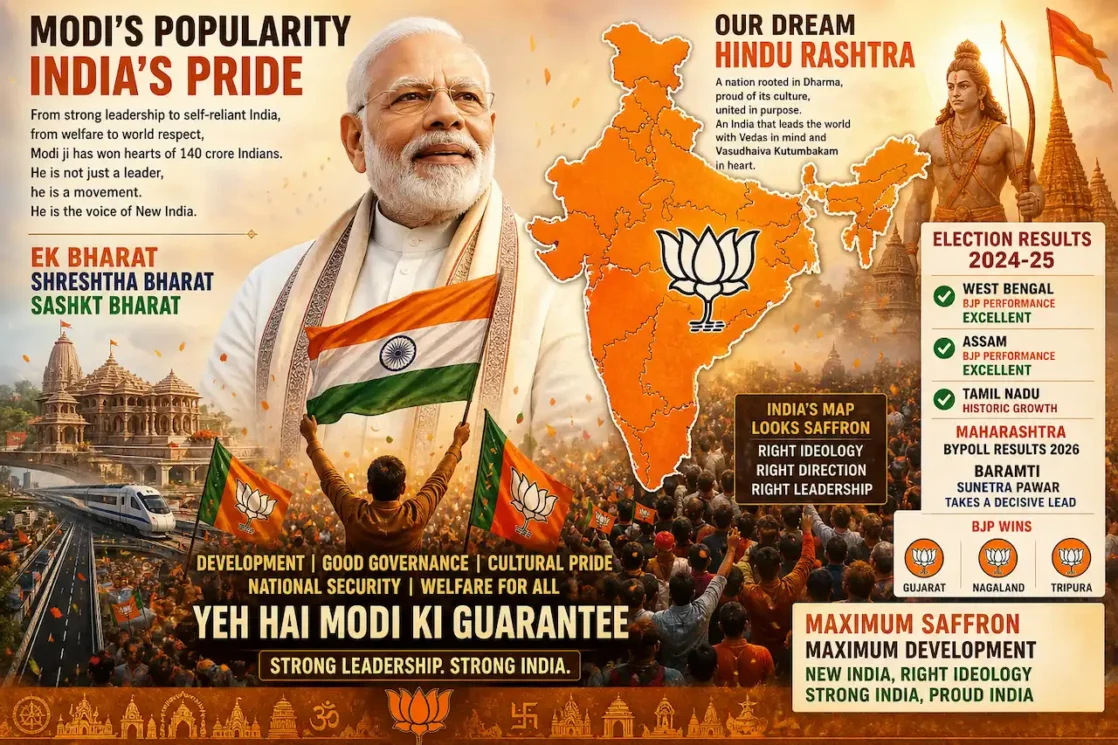
The current political climate in India reflects not just a series of electoral victories but a deeper, more structural transformation led by the Bharatiya Janata Party under the leadership of Narendra Modi, whose influence continues to shape voter behavior across regions, classes, and generations. What sets this phase apart from earlier political waves is the BJP’s refusal to remain confined to traditional strongholds; instead, it has adopted an aggressive, calculated approach to expand into territories that were once considered politically inaccessible, and this shift is not accidental but the result of meticulous planning, ideological clarity, and organizational discipline. Modi’s popularity remains the central pillar of this expansion, functioning almost as a unifying force in a country otherwise defined by diversity and fragmentation, because for a large section of voters he represents decisiveness, national pride, and a sense of cultural reclamation that resonates beyond routine governance, and unlike many leaders who fade with time, Modi has managed to retain both relevance and emotional connection with the electorate, which is no small feat in a democracy as complex as India.
The BJP’s strategy has been to combine strong grassroots organization with a powerful national narrative, ensuring that even in regions where it lacked historical presence, it steadily built a cadre, absorbed local leadership, and created an alternative political imagination for voters seeking change, and this is particularly evident in states like West Bengal, where the party has made remarkable inroads despite decades of dominance by regional forces led by Mamata Banerjee, because what changed in Bengal was not overnight sentiment but a gradual accumulation of factors, including fatigue with prolonged rule; rising aspirations among youth; concerns around identity and governance; and the BJP’s ability to position itself as a credible challenger that could break the status quo. The narrative around border security, illegal immigration, and cultural identity found resonance among sections of the population, while the central government’s welfare schemes created a direct connection between beneficiaries and Modi, often bypassing local political structures, and this combination of emotional, ideological, and practical appeal allowed the BJP to carve out space in a state that once seemed impenetrable.
At the same time, the party’s success in Assam and its expanding footprint in Tamil Nadu reflect a broader pattern where regional complexities are not ignored but strategically engaged with, as the BJP aligns local aspirations with a national vision, carefully balancing cultural sensitivity with ideological messaging, and while Tamil Nadu remains a challenging terrain due to its entrenched Dravidian political culture, the incremental gains indicate a long-term strategy rather than immediate electoral impatience, which again highlights the party’s willingness to invest time and resources in reshaping political narratives rather than relying on short-term calculations. Across the Northeast, the BJP has demonstrated an ability to integrate regional identities into a larger developmental framework, emphasizing connectivity, infrastructure, and inclusion, thereby turning what was once a peripheral political zone into a significant contributor to its national strength.
What makes the current moment particularly striking is the visual and symbolic reality of India’s political map increasingly reflecting saffron dominance, which is not merely about electoral wins but about the consolidation of a right-leaning ideological space that emphasizes cultural pride, national security, and centralized leadership, and while critics may debate the implications of this shift, there is no denying that it has found acceptance among a substantial section of the electorate, especially younger voters who are engaging with questions of identity and nationhood with renewed intensity. The idea of India moving toward a more culturally assertive framework, often articulated in discussions around a Hindu Rashtra, has moved from the margins to the mainstream, not necessarily as a policy blueprint but as a sentiment that influences political choices, and this reflects a broader rethinking of what Indian secularism and identity should look like in the 21st century.
However, it would be simplistic to attribute the BJP’s rise solely to ideology, because governance delivery, welfare outreach, and electoral machinery play an equally critical role, and the party has excelled in combining data-driven campaigning with emotional storytelling, ensuring that its message reaches voters consistently and effectively, while the opposition continues to struggle with coherence, leadership, and narrative clarity, often appearing reactive rather than visionary, which further strengthens the BJP’s position as the dominant political force. Yet, Indian politics has always been dynamic, and while the current momentum clearly favors Modi and the BJP, the real test will lie in sustaining this expansion while addressing the diverse expectations of a vast and complex electorate, because winning elections is one challenge, but governing varied regions with distinct identities and aspirations requires a different level of adaptability and foresight.
For now, though, the picture is unmistakable: the BJP is not just contesting elections but actively reshaping India’s political and ideological landscape, and as long as Modi’s leadership continues to inspire confidence and connect with the masses, this saffron surge is likely to persist, redefining the contours of Indian democracy in ways that will be studied and debated for years to come.
