


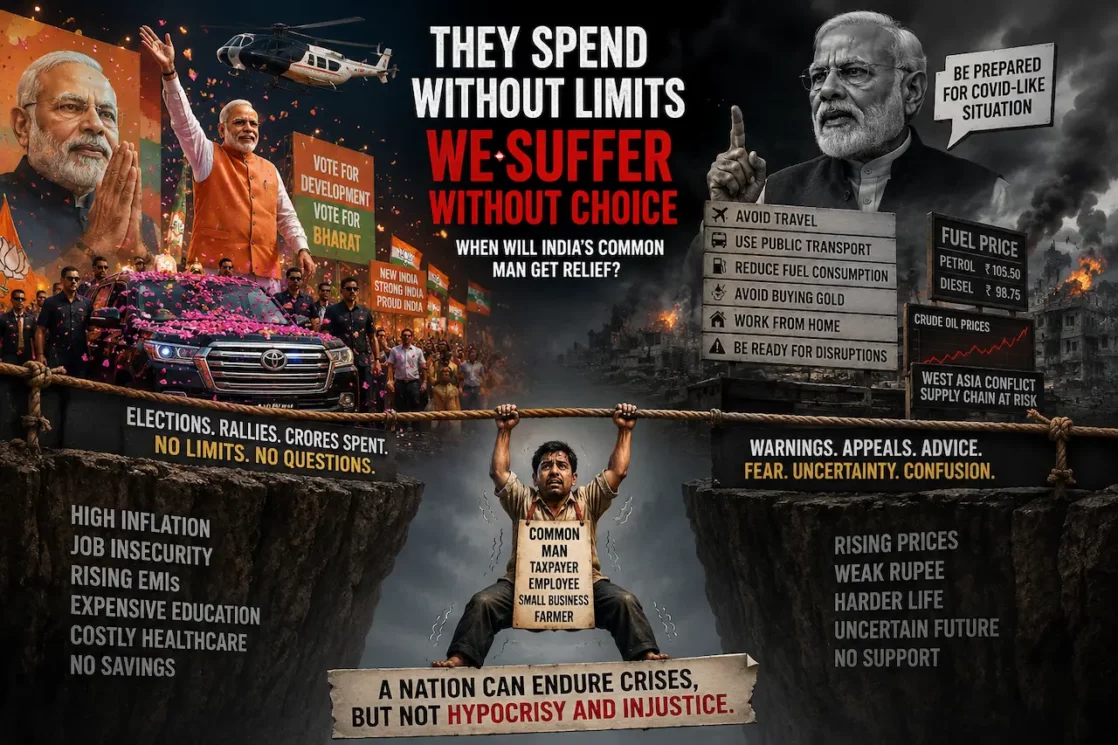
The government’s recent messaging asking citizens to prepare for “Covid-like” economic disruptions has triggered understandable anxiety across the country, and rightly so. When the Prime Minister of India publicly advises people to reduce fuel consumption, avoid unnecessary travel, postpone gold purchases, revive work-from-home culture, and prepare for uncertainty caused by the escalating West Asia conflict, it is not treated as a casual advisory. Such statements carry enormous psychological, economic, and political consequences. Markets react instantly. Households panic. Businesses slow spending. Investors become cautious. The memory of the Covid lockdowns is still fresh in the minds of millions of Indians who suffered unemployment, isolation, migration crises, bankruptcies, and emotional trauma. Therefore, the government cannot afford ambiguity, contradiction, or selective alarmism while communicating with the nation.
What makes the situation deeply troubling is the timing and contrast in political behaviour. For months before the elections, the country witnessed one of the most expensive and aggressive political campaigns in modern Indian history. Every major state election became a spectacle of enormous financial power. Massive rallies were organized daily. Chartered aircraft moved leaders across states non-stop. High-voltage advertising campaigns dominated television, newspapers, digital platforms, and public spaces. Giant stages were erected, endless roadshows were conducted, and enormous state machinery was deployed. Political parties, especially the ruling establishment, spent money on a scale unimaginable to the average citizen struggling with inflation and rising costs of living.
At that time, there was complete silence about conserving national resources. There was no public appeal to reduce travel. No warning about fuel consumption. No concern about foreign exchange reserves. No advice to postpone luxury spending. No speeches about economic discipline or austerity. The government projected confidence, strength, and abundance during elections because political optics demanded it. But the moment the elections concluded, the narrative abruptly shifted from celebration to caution. Suddenly the public was told that difficult times could be approaching. Citizens were urged to prepare for disruptions similar to the Covid era because of geopolitical instability and energy insecurity.
This contradiction is precisely what is unsettling ordinary Indians.
People are asking a simple question: if the economic situation was serious enough to warrant nationwide caution, why was the country simultaneously witnessing massive political extravagance? Why is austerity expected only from the common citizen after elections are over? Why are ordinary taxpayers repeatedly asked to tighten their belts while political establishments continue functioning with limitless resources?
The concern becomes even more serious because the government’s warnings are not entirely baseless. The West Asia conflict indeed poses major risks for India. India imports nearly 85–90 percent of its crude oil requirements. Any instability around the Strait of Hormuz directly threatens India’s energy security. Rising crude oil prices increase transportation costs, food prices, manufacturing expenses, and inflation across sectors. Aviation turbine fuel becomes expensive, affecting airlines and travel industries. A weakening rupee increases the burden on imports and foreign debt. Supply chain disruptions can create shortages and uncertainty in essential commodities.
These are genuine economic concerns. But genuine concerns require mature governance and transparent communication, not fear-inducing public messaging without clarity.
When the Prime Minister invokes Covid-era behavioral patterns such as work-from-home arrangements, restricted travel, virtual meetings, reduced spending, and conservation habits, people naturally interpret it as a signal of an approaching crisis. The word “lockdown” may not have been explicitly used, but the psychological association is unavoidable. India remembers the catastrophic human consequences of sudden restrictions during the pandemic. Migrant workers walking hundreds of kilometres, small businesses collapsing overnight, families losing livelihoods, mental health crises, educational disruption, and millions pushed into financial insecurity are not distant memories. Therefore, any comparison to the Covid period immediately creates panic and speculation.
The government cannot escape responsibility for the confusion by later claiming that the public “misunderstood” the message. Leadership communication is not a private conversation; it shapes public behaviour. Markets move based on signals from the highest offices. Investors react to tone as much as policy. Citizens begin hoarding, postponing purchases, cancelling travel, and cutting expenses out of fear. Even rumors become economically damaging when uncertainty is amplified by vague official warnings.
The reaction in financial markets after the Prime Minister’s appeal regarding gold purchases is a perfect example. Jewellery company stocks witnessed sharp declines because investors feared that consumer demand would weaken. India’s gold market is deeply connected to cultural practices, weddings, savings behavior, and household security. Telling citizens to avoid buying gold for a year may sound economically logical from a foreign exchange perspective, but such appeals also send a message that the government expects prolonged economic stress. Markets understand this instantly.
Similarly, the suggestion to reduce unnecessary foreign travel and revive work-from-home practices signals anticipated pressure in aviation, fuel pricing, and discretionary spending sectors. Airlines already operate under thin margins, and any surge in crude oil prices creates severe financial pressure because aviation fuel constitutes a large share of operational costs. A weakening rupee further worsens the situation since aircraft leasing, maintenance, and insurance are dollar-dependent. When the government publicly advises reduced travel, the market interprets it as preparation for economic slowdown.
The deeper frustration among ordinary Indians, however, lies in the unequal distribution of sacrifice. During every major crisis, it is the common citizen who bears the heaviest burden. During prosperity, political establishments celebrate achievements and claim credit. During hardship, citizens are asked to endure pain in the name of national interest. The wealthy protect themselves through assets and influence. Large corporations receive policy cushions and financial restructuring. Political campaigns continue uninterrupted. But the middle class, small traders, salaried employees, farmers, migrant workers, and daily wage earners are repeatedly expected to “adjust.”
This pattern has become painfully visible.
The average Indian today is already financially stretched. Inflation has eroded purchasing power. Fuel prices remain high. Household savings are shrinking. Education and healthcare costs continue rising. Employment insecurity persists across sectors. Young people entering the workforce face uncertainty despite qualifications. Small businesses are still recovering from the economic shocks of the pandemic years. Under such conditions, repeated warnings about future disruptions create psychological exhaustion and public distrust.
What the nation needs right now is not panic-driven economic messaging but consistent and credible leadership. If the government genuinely believes India is heading toward severe economic stress because of global instability, then it must lead by example. The first step should be cutting wasteful political expenditure and excessive publicity campaigns funded directly or indirectly by public resources. Extravagant political rallies, oversized promotional events, and image-building exercises must give way to visible fiscal discipline. Citizens are more likely to cooperate with sacrifice when they see those in power practicing it themselves.
Secondly, the government must communicate clearly and responsibly. Vague comparisons to the Covid era without precise explanations create unnecessary fear. Citizens deserve facts, not dramatic caution signals designed to emotionally condition the public. Explain the exact risks. Present economic data transparently. Outline concrete contingency plans. Reassure vulnerable sectors. Inform businesses about preparedness measures. Provide confidence rather than uncertainty.
Thirdly, there must be protection mechanisms for ordinary people if global disruptions worsen. Fuel price shocks cannot become another excuse for uncontrolled inflation while wages remain stagnant. Small businesses and vulnerable workers cannot again become collateral damage in geopolitical crises beyond their control. Economic resilience must include social resilience, not merely macroeconomic statistics.
India is strong enough to face global challenges, but resilience cannot be built on selective austerity and political hypocrisy. A government that spends extravagantly during elections and then suddenly lectures citizens about restraint risks appearing disconnected from the realities of ordinary life. Leadership demands consistency. If sacrifice is necessary, it must begin at the top.
The nation does not need fear campaigns disguised as preparedness. It does not need symbolic appeals while structural waste continues unchecked. It does not need contradictory messaging that celebrates excess one month and warns of scarcity the next.
India needs honest governance, disciplined leadership, transparent communication, and economic planning rooted in fairness. Most importantly, the common citizen deserves respect—not repeated treatment as the emergency shock absorber for every political and economic crisis that emerges.
