Indore Water Crisis Worsens: 142 Hospitalised as Fresh Diarrhoea Cases Surface, Political Heat Rises 2
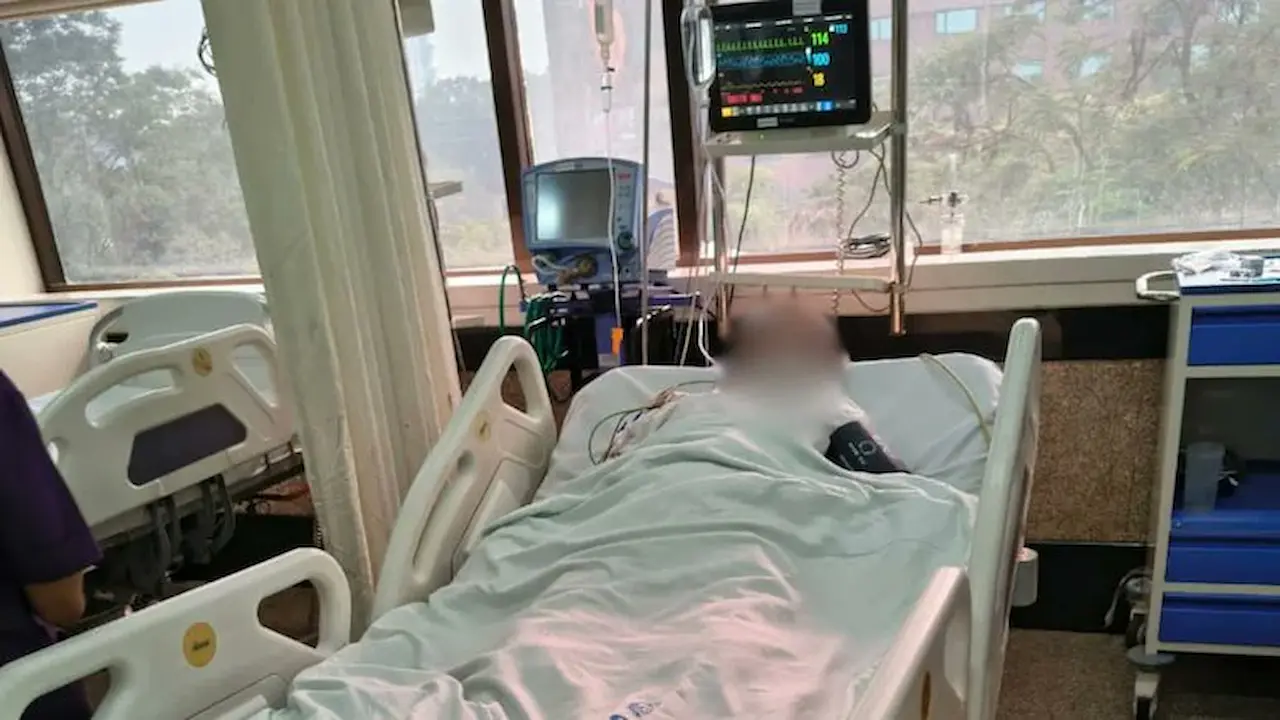
The water contamination crisis in Indore deepened on Sunday with 142 people currently hospitalised, including 11 in intensive care units, even as fresh diarrhoea cases emerged during large-scale health screenings in Bhagirathpura, the epicentre of the outbreak.
Health officials said 20 new patients were detected after medical teams screened 9,416 people across 2,354 households in Bhagirathpura, where six deaths have been officially confirmed due to consumption of contaminated drinking water. In total, 398 people have been admitted to hospitals since the outbreak began, of whom 256 have been discharged following recovery.
Authorities maintained that the situation is now under control, though hospitalisations continue. Chief Medical and Health Officer Dr Madhav Prasad Haasani said a team from the Kolkata-based National Institute for Research in Bacterial Infections has reached Indore to investigate the outbreak and provide technical support to contain it.
While the district administration has confirmed six deaths, the toll remains disputed. Mayor Pushyamitra Bhargava has claimed 10 fatalities, while local residents allege that at least 16 people, including a six-month-old child, have died.
The crisis has triggered sharp political reactions. The Congress held bell-ringing protests across Madhya Pradesh, demanding the resignation of senior minister Kailash Vijayvargiya after he sparked controversy by using the word “ghanta” while responding to reporters’ questions on the crisis on December 31. The Congress termed the remark insensitive and demanded a judicial inquiry, along with Vijayvargiya’s removal from office. Bhagirathpura falls under his Indore-1 assembly constituency.
State Congress president Jitu Patwari warned of a statewide agitation from January 11 if corrective measures were not taken. He demanded the registration of a culpable homicide case against the Indore mayor and concerned civic officials, alleging that residents had been complaining about contaminated tap water for the past eight months without action. He further claimed that even water supplied through municipal tankers remained unsafe.
Amid the escalating controversy, a sub-divisional magistrate in neighbouring Dewas was suspended on Sunday for allegedly reproducing portions of a Congress memorandum verbatim in an official order related to law and order arrangements during protests. Ujjain division revenue commissioner Ashish Singh said the action was taken for serious negligence and irregularities in official conduct.
Renowned water conservationist Rajendra Singh, a Magsaysay Award winner popularly known as the “Waterman of India,” described the deaths as a “system-created disaster” and blamed deep-rooted corruption. Expressing concern that such a crisis could unfold in India’s cleanest city, he warned that the condition of drinking water systems elsewhere could be far worse.
Government officials have acknowledged that sewage overflow entered drinking water pipelines, triggering severe cases of vomiting and diarrhoea. Singh alleged that cost-cutting practices, including laying water pipelines close to drainage lines, and falling groundwater levels have made cities like Indore increasingly vulnerable to such crises.
Delhi Riots Case: Supreme Court Denies Bail to Umar Khalid, Sharjeel Imam, Grants Relief to Five Others 4
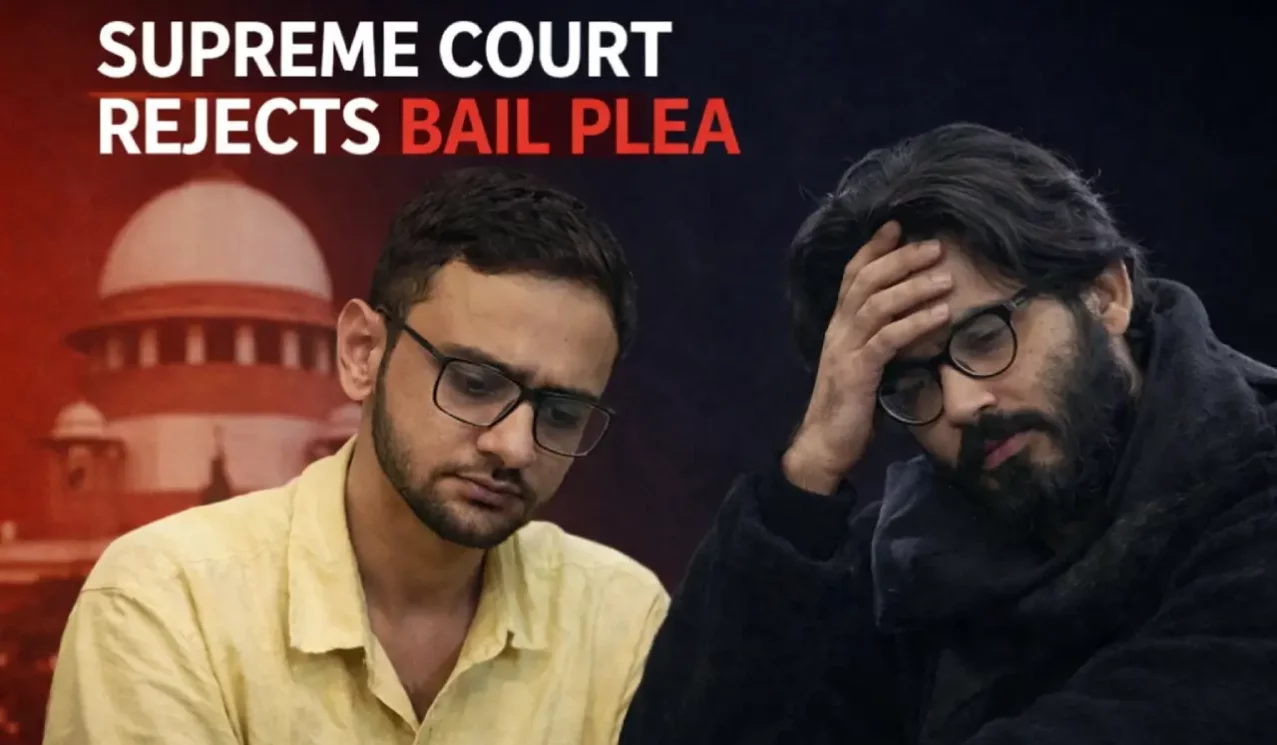
The Supreme Court of India on Monday rejected the bail pleas of activists Umar Khalid and Sharjeel Imam in the “larger conspiracy” case linked to the February 2020 Delhi riots, holding that the two stand on a “qualitatively different footing” from the other accused.
In the same verdict, a bench comprising Justices Aravind Kumar and N. V. Anjaria granted bail to five other accused—Gulfisha Fatima, Meeran Haider, Shifa Ur Rehman, Mohd. Saleem Khan and Shadab Ahmad—who are also facing charges in the case.
Khalid, Imam and the other accused were booked under the Unlawful Activities (Prevention) Act and provisions of the Indian Penal Code in a case in which the Delhi Police has alleged a larger conspiracy behind the communal violence in northeast Delhi in 2020. The riots claimed 53 lives and left over 700 people injured, erupting amid protests against the Citizenship (Amendment) Act and the proposed National Register of Citizens.
The bail pleas before the apex court had challenged a September 2, 2025 order of the Delhi High Court, which had declined bail to the accused in the conspiracy case. The Supreme Court had reserved its verdict in December 2025 after hearing detailed arguments from both the prosecution and the defence.
Details of the operative conditions attached to the bail granted to the five accused were not immediately available at the time of filing.
IMD Issues Orange Alert as Dense Fog, Cold Wave Grip North and East India 6
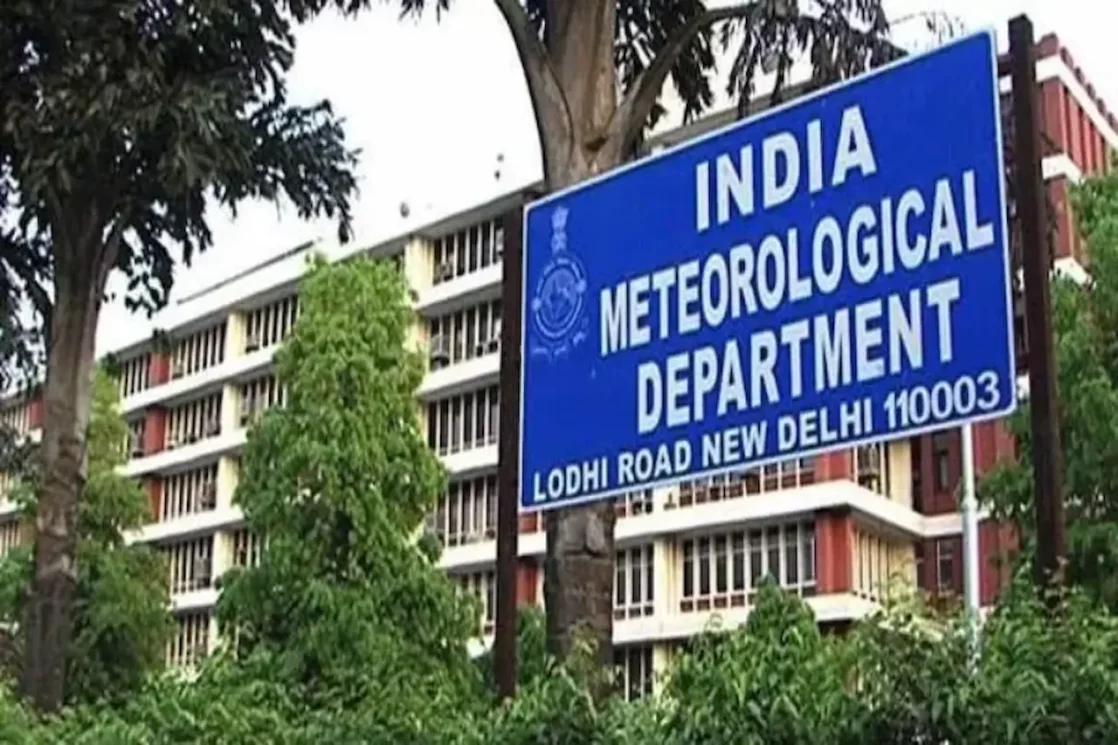
The India Meteorological Department has issued an orange alert for dense to very dense fog across several parts of the country, including Delhi, Chandigarh, East Uttar Pradesh, Haryana, Madhya Pradesh, Odisha and Punjab, warning that conditions are likely to persist till Tuesday.
According to the IMD, dense fog is also expected over parts of Gangetic West Bengal, sub-Himalayan West Bengal, Jharkhand and the northeastern states over the next two days. Similar foggy conditions are likely to continue in Himachal Pradesh and Uttarakhand until January 9.
The weather agency has further predicted cold wave conditions over Delhi, Punjab, Haryana, Chandigarh, Jharkhand and Rajasthan during the next three days, while cold day conditions have been forecast for Bihar and Uttarakhand on Monday.
Meanwhile, air quality in the national capital region remains a concern. Data from the Central Pollution Control Board showed that Delhi’s average Air Quality Index stood at 266 at 7 am on Monday, placing it in the ‘poor’ category.
Authorities have advised people to exercise caution while commuting in foggy conditions and to take necessary precautions against cold-related health issues as winter weather continues to intensify across large parts of the country.
Tension in Bengaluru's JJR Nagar After Stones Thrown at Om Shakti Devotees' Procession 8
The situation remained tense but under control in Jagjeevan Ram Nagar on Monday following a stone-pelting incident targeting a procession of Om Shakti devotees, police said.
Two women were injured when miscreants allegedly hurled stones at the religious procession on Sunday night. The incident triggered protests by local residents, who gathered outside the JJ Nagar police station demanding swift and strict action against those responsible.
In view of the tension and the possibility of retaliatory incidents, police deployed additional forces in the area. Senior police officers camped in the locality and initiated an investigation to identify and trace the accused.
A First Information Report was registered late Sunday night based on a complaint filed by Shashikumar N, a resident of VS Garden. According to the complaint, the incident took place between 8.15 pm and 9.00 pm while devotees were taking out a religious procession through the area.
Shashikumar stated that he has been participating in Om Shakti and Ayyappa Swamy worship for the past 23 years, observing the rituals by wearing the Om Shakti garland and carrying the Irumudi. He alleged that three to four youths pelted stones at the procession, during which a woman devotee suffered a serious head injury and bleeding wounds. She was later admitted to a local hospital for treatment.
The complaint also alleged that similar incidents had occurred in the past, claiming that on two or three earlier occasions miscreants had set fires during religious observances in the locality. It further stated that the area has a significant Dalit population and that incidents of atrocities against Dalits have previously been reported.
Calling the attack an assault on religious sentiments and an act of intimidation, Om Shakti and Ayyappa Swamy devotees jointly demanded stringent legal action against those involved. Police said investigations are ongoing and security arrangements will remain in place to maintain peace.
'Don't Rob Gen Z of Votes': Uddhav Thackeray Seeks Cancellation of 68 Unopposed Civic Wins 10
Shiv Sena (UBT) chief Uddhav Thackeray on Sunday urged the State Election Commission to cancel results in 68 civic wards where candidates of the ruling Mahayuti were declared elected unopposed, arguing that such outcomes effectively deny first-time voters and Gen Z citizens their right to vote.
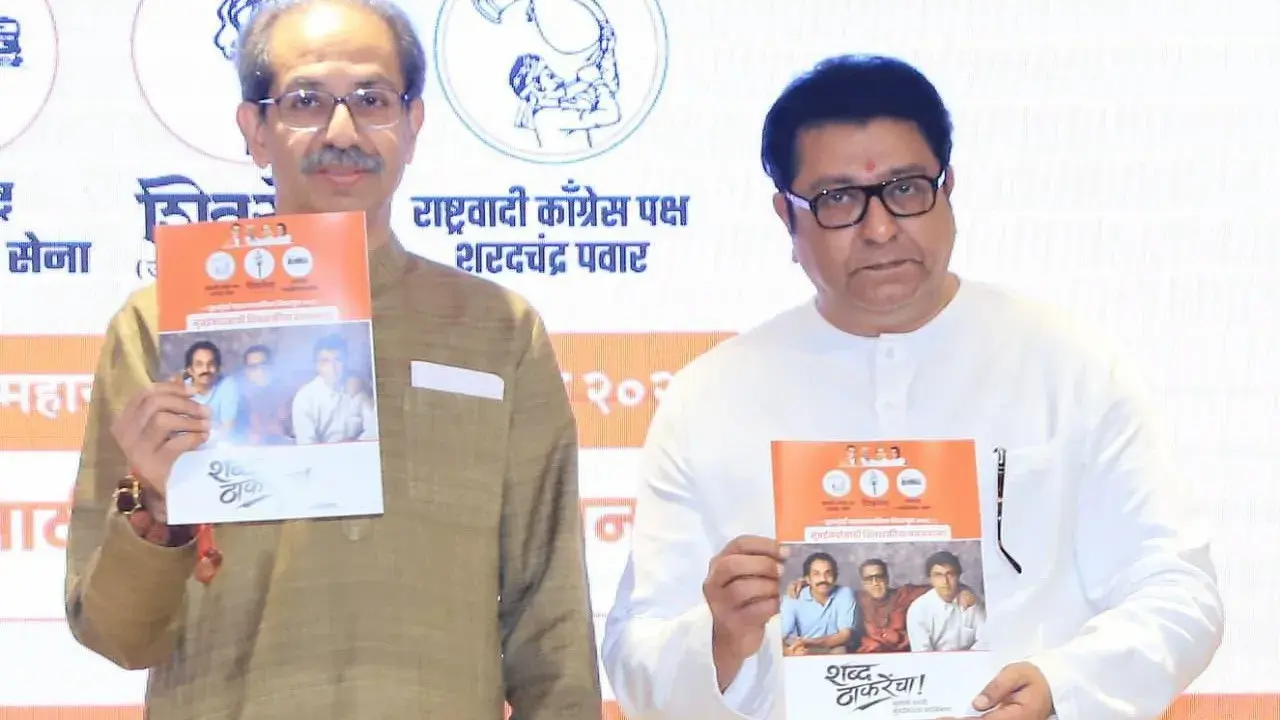
Sharing the stage with Raj Thackeray while unveiling their joint manifesto for the upcoming Mumbai civic polls, Uddhav warned against democracy slipping into “mobocracy”. Launching a sharp attack on the Mahayuti government, he alleged that since his government was ousted in June 2022 and Eknath Shinde assumed office, the Brihanmumbai Municipal Corporation’s finances were being squandered on contractors. He claimed that after “stealing votes”, the ruling alliance was now “stealing candidates”.
Raj Thackeray accused the BJP of double standards, recalling that the party had approached the Supreme Court of India in similar cases in West Bengal where ruling party candidates were elected unopposed. He asked the BJP to clarify its stand now that 68 Mahayuti candidates—44 of them from the BJP—have won without contest in Maharashtra, largely due to withdrawals by rivals or rebels.
Responding to the criticism, Chief Minister Devendra Fadnavis said the people’s mandate would prevail even if the Opposition moved the courts. Speaking at a roadshow in Chandrapur, he said, “They can certainly go to court, but the people’s court has elected us.” He also questioned the Opposition’s silence on unopposed victories of independents and Muslim candidates, alleging that the protests stemmed from a fear of defeat.
Referring to the uncontested results ahead of the January 15 elections to 29 civic bodies, Uddhav said the State Election Commission should have the courage to cancel polls in wards where candidates were elected unopposed and restart the process. Such outcomes, he said, amounted to denying voters—especially the Gen Z electorate—the opportunity to exercise their franchise.
Uddhav also alleged large-scale financial irregularities at the BMC, claiming that if its expenditure budget stood at ₹15,000 crore, advance mobilisation payments to contractors had ballooned to ₹3 lakh crore, which he termed a “scam”. He further alleged that kickbacks were being used to fund civic election campaigns.
The Sena (UBT) chief demanded the suspension of Maharashtra Assembly Speaker Rahul Narwekar, accusing him of interfering in the nomination process and tampering with CCTV footage. Narwekar, a BJP MLA from Colaba, has rejected the allegations as baseless and politically motivated.
Both Thackeray cousins indicated that the “sons-of-the-soil” plank would be a central theme of their campaign, particularly in Mumbai. Raj Thackeray asserted that Mumbai and other cities would have Marathi mayors and stressed the need to respect the local language, warning the ruling alliance that power is not permanent.
A total of 15,931 candidates are contesting 2,869 seats across 893 wards in 29 municipal corporations. Except for Mumbai, which has 227 seats, the remaining corporations have multi-member wards. Votes will be counted on January 16.
Sena (UBT)-MNS Manifesto Targets Mumbai Voters with Free Power, Rs 1,500 Allowance for Women 12
The Shiv Sena (UBT)–MNS alliance on Sunday unveiled a joint manifesto promising free electricity, a ₹1,500 monthly allowance for women domestic helps and fish vendors, and a waiver of property tax for homes up to 700 sq ft, as it sharpened its pitch to Mumbai voters ahead of the Brihanmumbai Municipal Corporation (BMC) elections.
The manifesto, titled “Vachan Nama, Shabd Thackerencha”, was released at Shiv Sena Bhawan during a joint press conference attended by Uddhav Thackeray and Raj Thackeray, marking Raj Thackeray’s return to the venue after nearly two decades. The cover prominently features the two cousins alongside Shiv Sena founder Balasaheb Thackeray.
Although the alliance also includes the NCP (SP), no senior leader from the Sharad Pawar-led party was present on the dais at the launch.
A major focus of the manifesto is on women voters. Under the proposed “Swabhiman Nidhi”, the alliance has promised ₹1,500 per month for women domestic workers and women from the Koli fishing community who sell fish, mirroring the Mahayuti government’s Ladki Bahin Yojana. The document also promises clean and well-maintained public toilets for women on major roads across the city.
Among other welfare measures, the alliance has announced a subsidised meal scheme similar to the Shiv Bhojan Thali, under which breakfast and lunch would be provided for ₹10. It has also asserted that Mumbai’s land will be used primarily for Mumbaikars, promising affordable housing for BMC, government and BEST employees, as well as mill workers.
The manifesto proposes setting up a dedicated housing authority under the BMC and constructing one lakh affordable homes over the next five years. It also promises 100 units of free electricity for residential consumers through the Brihanmumbai Electricity Supply and Transport (BEST) Undertaking, with efforts to extend the benefit to the eastern and western suburbs. However, it remains unclear whether the free power units would apply only to areas currently serviced by BEST or across the entire city.
Youth and gig workers have also been targeted, with the alliance promising financial assistance ranging from ₹25,000 to ₹1 lakh for self-employment, along with an interest-free loan of ₹25,000 for gig economy workers.
Other civic promises include waiving property tax on homes up to 700 sq ft, changing redevelopment rules to ensure at least one parking slot per flat, reducing the minimum bus fare from ₹10 to ₹5, and introducing new buses and routes.
To strengthen public healthcare, the alliance has pledged to establish five new medical colleges in civic-run hospitals, oppose any move towards privatisation of these facilities, set up a super-speciality cancer hospital, and launch rapid bike-based medical assistance services.
In the education sector, BMC-run “Mumbai Public Schools” would offer classes from junior kindergarten to Class 12, while creches would be set up in every assembly segment to support working parents. The manifesto also lists pet parks, veterinary clinics, pet ambulances and crematoriums as proposed civic initiatives.
Voting for the Brihanmumbai Municipal Corporation will be held on January 15, along with elections to 28 other civic bodies across Maharashtra.
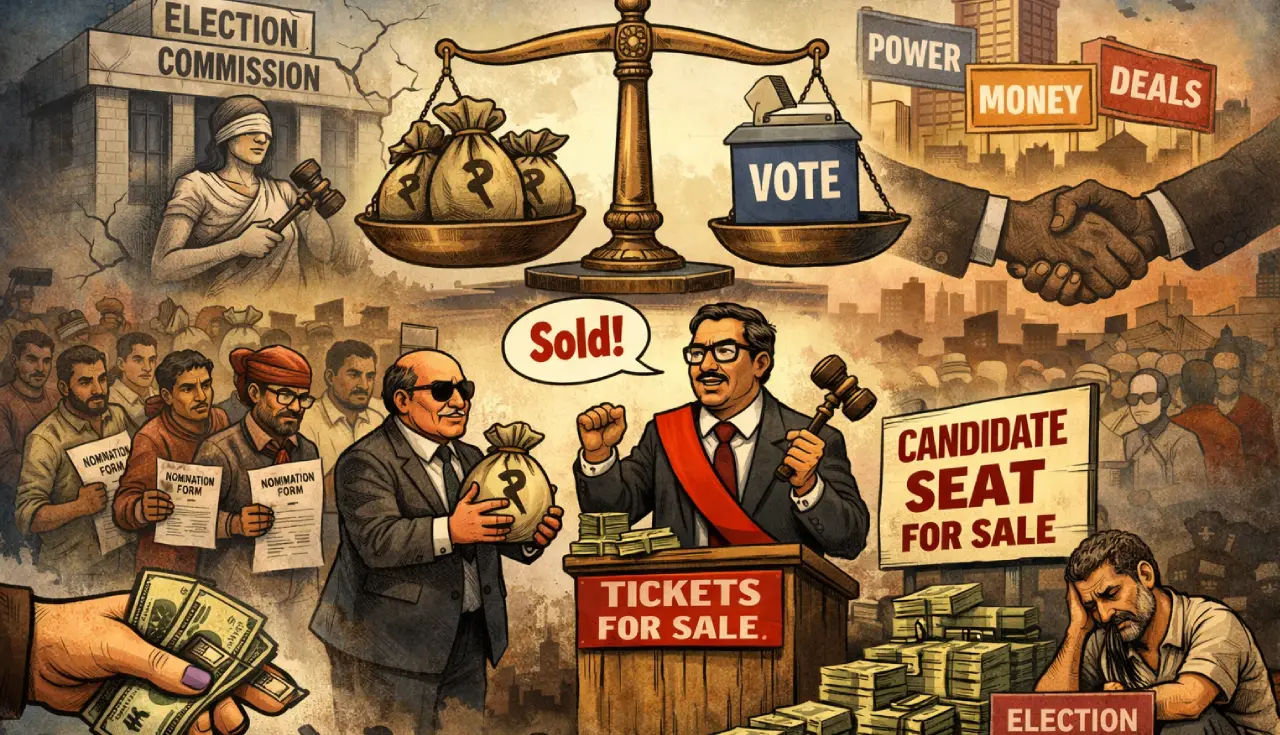
When Democracy Is Auctioned: A Question the Election Commission Cannot Dodge 14
What unfolded during the Pune Mahanagar Palika election process is not a logistical footnote—it is a loud moral indictment. Thousands of nomination forms sold in a flash, queues that looked less like civic enthusiasm and more like a cattle market, and whispers—no, allegations—that “tickets” are effectively priced rather than earned. Call it what you want: procedure, enthusiasm, or coincidence. To the ordinary citizen, it smells like a democracy on discount.
Let’s stop pretending. When nomination forms are sold in bulk with such frenzy, the obvious question is why. Civic service does not suddenly become a mass obsession overnight. What has exploded is not public spirit, but political profiteering. Tickets have become commodities, wards have price tags, and ideology has been replaced by investment-return calculations. If governance were a stock market, Pune just witnessed an IPO frenzy.
And where, exactly, is the referee in this spectacle?
The credibility of the Election Commission of India stands squarely in the dock. Not accused of bias—but of blindness. When the system allows money power to bulldoze entry into the electoral arena, neutrality becomes negligence. A watchdog that merely watches while the house is looted cannot later claim it barked enough.
This is not about one party or another; that excuse is old, lazy, and dishonest. This is about structural rot. When ticket distribution becomes opaque, when the cost of entry silently eliminates the capable but poor, democracy mutates into an exclusive club for the wealthy, the connected, and the cynical. Elections then stop being a voice of the people and become background music for deal-making.
The tragedy is deeper. Pune is not some political backwater. It is an intellectual, cultural, and economic nerve centre. If this is the standard here, one shudders to imagine the silent compromises happening elsewhere. The middle class shrugs, the poor despair, and the political class laughs its way to the counting room.
The Pune Municipal Corporation elections should have been about urban planning, water, transport, housing, and collapsing infrastructure. Instead, they have turned into a masterclass on how to launder ambition through procedural loopholes. Democracy isn’t dying in loud coups; it is being suffocated in orderly queues with printed forms and unasked questions.
The Election Commission must answer—not with press notes, but with reform. Transparent caps, strict audits of party nominations, public disclosure of candidate selection criteria, and real-time financial scrutiny are not “nice ideas”; they are democratic CPR. If the Commission cannot enforce this, it must at least admit the system it oversees is compromised.
Because when citizens begin to believe that elections are for sale, they don’t just lose faith in politicians—they lose faith in the ballot itself. And once that faith is gone, no amount of ink on fingers can bring it back.
Democracy was never meant to be perfect. But it was never meant to be purchasable either.
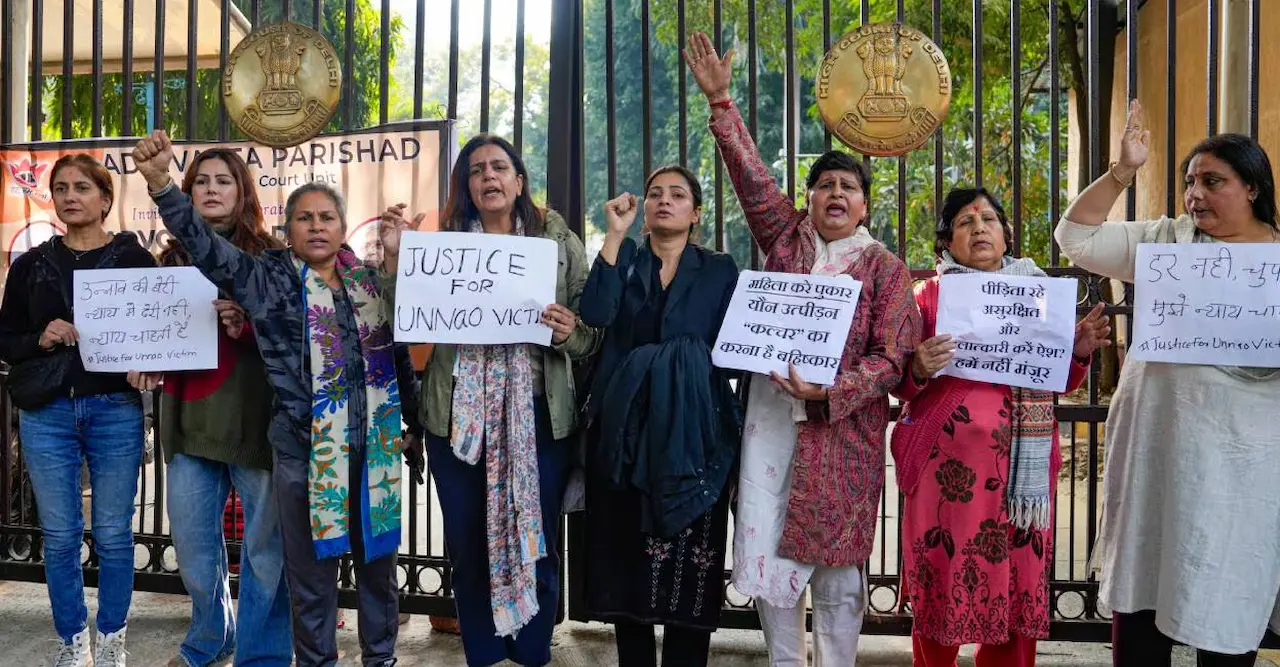
Unnao Rape Case: Protesters Gather Outside Delhi High Court Over Suspension of Kuldeep Sengar’s Sentence 16
A protest was held outside the Delhi High Court on Friday against the suspension of the jail sentence of Kuldeep Sengar, who was convicted in the Unnao rape case.
Holding placards and raising slogans such as “Balatkariyo ko sanrakshan dena band kro” (stop protecting rapists), the protesters expressed solidarity with the Unnao rape survivor. Women activists from the All India Democratic Women’s Association joined the demonstration, along with activist Yogita Bhayana and the survivor’s mother.
Speaking to reporters, the survivor’s mother said she had come to protest the court’s decision, stating that her daughter had already suffered immensely. “I am not blaming the entire court, but only the two judges whose decision has shattered our trust,” she said.
She added that earlier judicial orders had delivered justice to the family, but the recent suspension of the sentence had caused deep distress. “This is an injustice to our family. We will approach the Supreme Court of India, as I have full faith in it,” she said.
On Tuesday, the Delhi High Court ordered the release of Sengar on bail pending the disposal of his appeal against his conviction and life sentence awarded by a trial court in December 2019. The court imposed strict conditions, directing that the former Bharatiya Janata Party MLA must not enter within a five-kilometre radius of the survivor’s residence or threaten the survivor or her mother, warning that any violation would result in automatic cancellation of bail.
Despite the bail order in the rape case, Sengar will continue to remain in prison as he is also serving a 10-year sentence in connection with the custodial death of the survivor’s father and has not been granted bail in that matter.
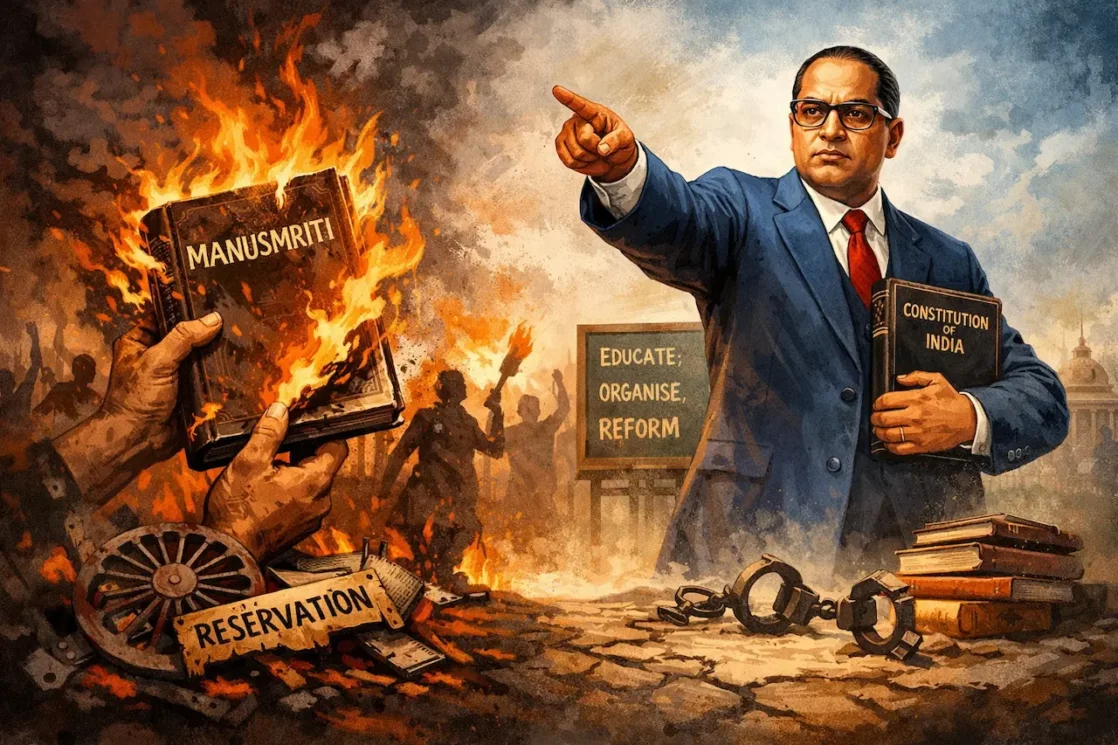
Ambedkar Wanted Minds Awakened, Not Books Burned 18
What happened recently in Madhya Pradesh, where members of the Bhim Army publicly burned the Manusmriti, is not just a political act. It is a scream—raw, angry, wounded. And it deserves to be listened to with understanding. But understanding pain does not mean endorsing every expression of it. Some acts don’t heal wounds; they deepen them.
There is a deep sadness in book-burning. Not because books are sacred objects, but because burning a book is the moment when dialogue dies and theatre begins. Fire makes noise, smoke gets attention, but neither produces wisdom. Burning Manusmriti may give a few minutes of emotional release, a sense of symbolic revenge against centuries of humiliation—but after the ash settles, nothing real changes. The caste structure does not collapse, discrimination does not vanish, dignity does not magically arrive. Only anger gets recycled.
The Manusmriti controversy is not new. It did not begin yesterday, nor did it start with today’s politics. Even before independence, Manusmriti had become a symbol—less a text and more a metaphor. A metaphor for oppression, hierarchy, and social cruelty inflicted in the name of religion. For many Dalits, Manusmriti is not a philosophical document; it is remembered as a social weapon used against their ancestors. That memory is real. That pain is real. Pretending otherwise is dishonest.
But history also demands honesty in the other direction.
Manusmriti is not a single unified, state-sponsored law book that ruled India the way modern constitutions do. It is one among many Smritis, written, interpolated, edited, misused, and reinterpreted over centuries. Different versions exist. Different regions followed different customs. Even within Hindu traditions, Manusmriti was never universally applied. Kings ruled by rajdharma, village customs mattered more than texts, and lived practice often contradicted written codes.
More importantly, post-independence India consciously rejected Manusmriti as a governing authority. Modern India does not run on Manusmriti. It runs on the Constitution drafted under the leadership of B. R. Ambedkar—a Constitution that guarantees equality, dignity, liberty, and justice. Hindus, conservatives included, accepted that Constitution. They did not revolt demanding Manusmriti be reinstated. That fact matters.
This is where the pain sharpens into concern.
Dr. Ambedkar criticised Manusmriti fiercely—and rightly so. He symbolically burned it in 1927 to awaken a sleeping society, not to permanently replace social reform with ritual outrage. Ambedkar’s legacy was not book-burning as an end, but social transformation as a goal. He believed in annihilating caste—not by permanent confrontation theatre, but by legal safeguards, education, economic empowerment, and rational thought.
Reducing Ambedkar’s vision to repetitive acts of symbolic fire is, frankly, a betrayal of his intellect.
Burning Manusmriti today does not make one an intellectual. If intellect could be acquired by lighting a matchstick, universities would be redundant. And if symbolic rebellion alone could uplift communities, reservations would have ended long ago. The uncomfortable question must be asked: are such acts about justice—or about preserving permanent victimhood politics, where anger is more useful than empowerment?
This is not said lightly. It is said with pain.
Because communities do not progress by fighting symbols endlessly. They progress by building institutions, focusing on education, health, employment, social discipline, and ethical reform. Ask honestly: how much time is spent on addiction reform, school dropout prevention, skill development, women’s safety, mental health, entrepreneurship? Burning a book does none of this work. It only gives the illusion of resistance.
There is another hard truth. Manusmriti is not merely a book that can be destroyed and erased. It has seeped into social habits—good and bad—over centuries. Some parts promote order, duty, self-control, ethical conduct: “do not lie,” “avoid intoxication,” “seek knowledge,” “respect teachers,” “practice restraint.” Other parts reflect the worst of historical patriarchy and hierarchy. Civilisations mature by discrimination—by accepting what elevates human life and rejecting what degrades it. Hindu society, slowly and imperfectly, has been doing exactly that.
No Hindu today defends untouchability openly. No law allows it. Social crimes still exist—yes—but they exist not because Manusmriti survives, but because moral reform lags behind legal reform. Burning a text does nothing to reform daily behaviour. Changing social norms does.
Manusmriti today functions less as a ruling book and more as a social memory—contested, criticised, partially inherited. Burning it does not erase caste any more than burning a history book erases history. Caste is a lived social structure. It will fall only when communities invest in self-correction, internal reform, mutual respect, and collective upliftment.
Here is the most painful irony: acts like these give ammunition to those who genuinely oppose reform. They convert a moral struggle into a spectacle. They replace conversation with confrontation. They turn social justice into a predictable annual ritual, safely ignored by those in power because it changes nothing on the ground.
And let us say this clearly and without cruelty: publicly burning a book, in a democracy, is not courage. It is an act born from helplessness. True courage is harder—it requires patience, sustained engagement, institution-building, and the willingness to evolve even when evolution is uncomfortable.
Dr. Ambedkar urged people to educate, agitate, organise. Not just agitate.
India has changed. The era has changed. Mentalities must change too. Communities that want prosperity, progress, and perfection must shift focus from symbolic enemies to structural solutions. Social traditions do not disappear by fire; they disappear by reform. Discrimination does not die by slogans; it dies by sustained ethical and economic transformation.
Burning Manusmriti neither humiliates Hinduism nor emancipates Dalits. It only freezes both in a permanent war of symbols, where real issues remain untouched.
If Ambedkar were alive today, he would not ask for more ashes. He would ask harder questions: What have you built? What have you reformed? How many minds have you sharpened instead of inflamed?
Pain deserves respect. Anger deserves empathy. But the future demands wisdom.
And wisdom, unlike books, cannot be burned into existence.
Mohandas Gandhi's Brahmacharya Experiments: Power, Silence, and a Moral Failure History Must Confront 20
Any serious discussion on Mahatma Gandhi must begin by discarding the dishonest habit of treating him as a moral deity instead of a historical actor. Gandhi was a towering figure of the freedom movement, and his philosophy of non-violence reshaped political resistance worldwide. That truth stands. But it does not give him a free pass for conduct that, when examined honestly, was deeply disturbing, irresponsible, and morally indefensible. One such conduct was his so-called brahmacharya experiment in old age—an episode repeatedly minimised, rationalised, or outright buried by admirers who seem more interested in protecting an icon than confronting history.
Gandhi was married. He had a wife, Kasturba, who endured decades of emotional deprivation as Gandhi transformed marriage into a moral laboratory. His decision to practise celibacy is not the issue; many spiritual traditions respect that choice. The issue is what Gandhi chose to do decades later and why. In his seventies, at the height of his political authority and moral influence, Gandhi deliberately chose to sleep naked in the same bed with adolescent girls—some around fifteen or sixteen years old—claiming it was necessary to test whether he had conquered sexual desire. He did not do this secretly. He documented it. He defended it. He expected the world to accept it.
This was not spiritual asceticism. This was moral recklessness camouflaged as self-discipline.The first question that demands a straight answer is one Gandhi’s defenders avoid: why young girls? If the experiment was about testing celibacy, there was no logical, ethical, or spiritual necessity to involve minors. Gandhi had adult followers. He had peers. He had a wife. He had solitude. Instead, he consciously selected teenage girls because, by his own reasoning, they represented the strongest “temptation.” That admission alone destroys the claim of moral innocence. One cannot simultaneously claim purity and design an experiment around presumed sexual provocation. That contradiction cannot be dressed up as spirituality.
The second question is even more damning: what about the girls themselves? History records Gandhi’s thoughts in great detail, yet remains largely silent on what this experience meant for the girls involved. That silence is not accidental; it reflects power. These were not equals participating freely in a philosophical exercise. These were minors placed in an intimate situation with the most powerful and revered man in the country. Consent in such a context is meaningless. Reverence neutralises choice. Obedience replaces agency. When authority is absolute, silence is not approval—it is submission.
The argument that Gandhi had no sexual intent is beside the point. Modern ethics and modern law rightly recognise that harm does not begin with physical intercourse. Intimacy imposed by power, age, and influence is itself a violation. Even if no physical abuse occurred, the act normalised the idea that spiritual authority could override bodily boundaries, particularly those of young girls. That precedent is dangerous, because when the most revered man in the nation does it, lesser men feel legitimised to cross lines with far uglier intentions. The central question that refuses to go away is simple and brutal: why young girls? Gandhi had peers, followers, adult associates, and a wife. If the purpose was self-testing, why were adolescent bodies made instruments of that test? Gandhi’s own explanation—that youth represented the highest challenge—reveals precisely why this episode cannot be brushed aside as harmless. It acknowledges that the presence of young girls was considered sexually significant, which collapses any claim that the experiment was abstract or purely spiritual. Intent may not have been sexual gratification, but the framing itself exposes how power, desire, and control were being negotiated in dangerously unequal conditions.
Equally troubling is the near-total absence of concern for the inner lives of the girls involved. History remembers Gandhi’s thoughts, Gandhi’s reasoning, Gandhi’s moral dilemmas. It rarely pauses to ask what it meant for a teenage girl, raised in a culture of deference, reverence, and obedience, to share a bed with the most powerful man in the freedom movement. Consent in such circumstances is not a meaningful category. Reverence distorts choice. Silence cannot be read as agreement. The lives of those girls did not become footnotes because they were unimportant; they became footnotes because power decides which voices matter.
The timing of these experiments makes them even harder to defend. India in the 1940s was not a peaceful laboratory for philosophical inquiry. The British colonial state was still cruel, suppressive, and violent. Communal tensions were escalating toward Partition. Women and girls across India were profoundly unsafe—subjected to early marriage, sexual violence, social erasure, and exploitation under the weight of tradition and poverty. In such a context, the moral responsibility of a national leader was to protect, stabilise, and reassure, not to normalise physical intimacy with minors under the language of spiritual testing. Whatever Gandhi’s internal motivations, the social message transmitted by his actions mattered far more than his self-assessment of purity.
One must also ask why this experiment mattered at all. Gandhi was over seventy. Whether he experienced sexual desire or not at that age had no bearing on India’s freedom struggle, no impact on dismantling colonial rule, no relevance to protecting women, peasants, or workers. Political ethics does not require sexual negation. Moral leadership does not demand public certification of desire lessness. By making his private bodily discipline a public moral project, Gandhi blurred lines that should never have been crossed, especially by someone whose actions shaped societal norms.
If evaluated under contemporary legal standards, there is little doubt that such conduct would fall within the scope of child protection laws like the POCSO Act, which does not require proof of sexual intent and recognises power imbalance as central to harm. Indian criminal law rightly does not operate retrospectively, but moral judgment is not bound by technical legality. Law evolves precisely because societies recognise that acts once tolerated or rationalised inflicted harm that was not visible, recorded, or permitted to be spoken.
None of this erases Gandhi’s achievements. It does not negate his philosophy of nonviolence or the transformative impact of his leadership on colonial politics. But neither do those achievements erase his errors. Reverence does not grant moral immunity. History loses its integrity the moment certain figures are declared exempt from scrutiny.
Two failures in Gandhi’s legacy stand out not because they cancel his greatness, but because they remind us that greatness without accountability is dangerous. One was his deeply misguided brahmacharya experiment, which should be recognised today as a profound lapse of judgment rooted in moral absolutism and unchecked authority. The other was his role in acquiescing to the division of Akhand Bharat, a political tragedy whose human costs continue to haunt the subcontinent. Both were avoidable. Both were framed at the time as moral necessities. Neither escaped the long shadow of consequence.
To respect Gandhi is not to defend everything he did. It is to engage with him honestly, without fear and without worship. History is not a temple; it is a mirror. And mirrors do not flatter—they reveal.