Left Unity Sweeps JNU Polls, Defeats RSS-Backed ABVP in Major Comeback Victory 2
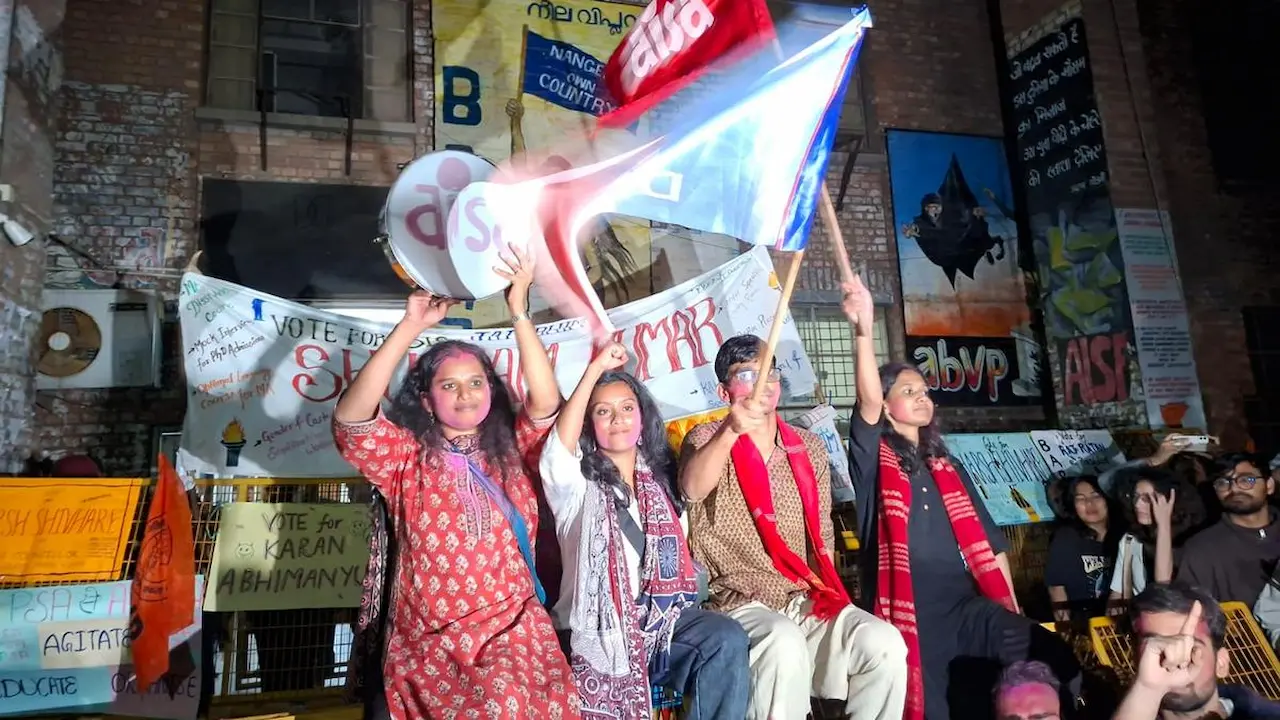
The Left Unity alliance has once again stamped its dominance over Jawaharlal Nehru University (JNU), sweeping all four central panel posts in the 2025 JNUSU elections, the university’s election committee announced on Thursday (November 6).
The joint front of the All India Students’ Association (AISA), Students’ Federation of India (SFI), and Democratic Students’ Federation (DSF) secured a resounding victory, reaffirming the Left’s long-standing hold on the politically charged JNU campus.
Aditi Mishra was elected President, defeating RSS-backed ABVP candidate Vikas Patel by 449 votes, while Kizhakoot Gopika Babu clinched the Vice-President’s post, defeating Tanya Kumari. Sunil Yadav and Danish Ali won the General Secretary and Joint Secretary positions, respectively, trouncing their ABVP rivals Rajeshwar Kant Dubey and Anuj.
This year, 9,043 students were eligible to vote, with a 67% turnout, slightly lower than the previous year’s record. The atmosphere on campus remained charged throughout the polling day, as students queued outside hostels and departments amid slogans, drumbeats, and campaign songs.
The results mark a major setback for the Akhil Bharatiya Vidyarthi Parishad (ABVP), which had managed to return to the JNUSU central panel last year after a decade-long drought when Vaibhav Meena won the joint secretary’s seat. Before that, the ABVP’s only presidential win came in 2000–01, when Sandeep Mahapatra broke the Left’s dominance, followed by Saurabh Sharma’s victory in 2015 after 14 years.
With this sweeping win, the Left Unity alliance has reaffirmed its influence in JNU’s vibrant political landscape, continuing its long tradition of debate, dissent, and activism that has shaped generations of student leaders.
Bihar Deputy CM Vijay Kumar Sinha’s Convoy Attacked with Stones, Shoes, and Cow Dung; ‘Murdabad’ Slogans Raised 4
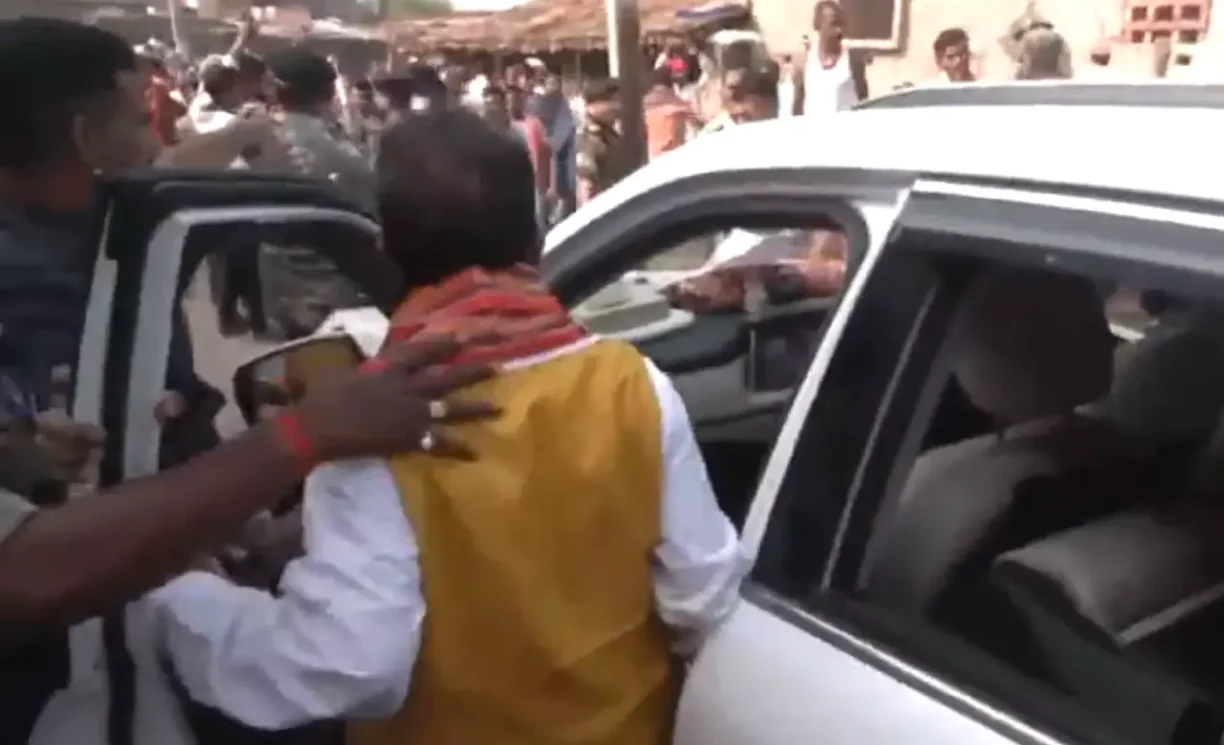
Tension flared in Bihar’s Lakhisarai district on Thursday after the convoy of Deputy Chief Minister Vijay Kumar Sinha, the BJP candidate from the constituency, came under attack allegedly by RJD supporters during the first phase of polling.
According to eyewitnesses, Sinha’s convoy was ambushed in Khoriari village, where a mob reportedly pelted stones, hurled slippers, and flung cow dung at his vehicle while chanting “Vijay Sinha Murdabad” slogans. The attackers surrounded the Deputy CM’s vehicle, attempting to block his passage.
In a tense phone call to the district’s Superintendent of Police (SP), Sinha demanded immediate action and reinforcements. “I am here at the village. The crowd is getting closer. Send Special Forces now. The SP is weak and cowardly. They are not letting the Deputy CM move. They have hurled stones and cow dung,” Sinha said.
The Deputy CM squarely blamed the Rashtriya Janata Dal (RJD) for the violence. “These are RJD goons. Look at their hooliganism, and they’re doing this even without being in power. They threatened my polling agent early this morning and stopped voters from coming out,” he alleged.
The confrontation occurred as voting was underway across 121 constituencies in Bihar. Following the incident, additional police forces were deployed to restore order in the area.
Speaking to reporters later, Sinha said the attack was evidence of the RJD’s intent to return the state to ‘jungle raj’ if it comes to power. “They threw slippers, cow dung, and stones at my convoy. The administration remained silent despite my complaints. Their workers tried to capture a polling booth. We will be filing a complaint with the Election Commission,” he said.
The incident has heightened tensions in Lakhisarai, with BJP leaders condemning the attack and demanding strict action against those involved.
CJI Gavai: “New Bombay HC Building Must Be a Temple of Justice, Not a Seven-Star Hotel” 6
Chief Justice of India Bhushan Gavai on Wednesday said that the upcoming new Bombay High Court complex in Bandra (East) must reflect simplicity and democratic values, not extravagance. He urged that the new facility should be a “temple of justice, not a seven-star hotel.”
Speaking after laying the foundation stone of the project, CJI Gavai emphasised that court buildings must represent the spirit of the Constitution and the service of common citizens, rather than grandeur or elitism. “Judges are no longer feudal lords. Whether it is the High Court, trial court, or Supreme Court — all institutions of governance exist to serve the last citizen,” he said.
Responding to reports describing the project as lavish, Gavai clarified that only one lift will be shared by two judges, dismissing claims of luxury. “We must maintain the iconic identity of the Bombay High Court, but this structure must embody justice, not opulence,” he stated.
The CJI stressed that while designing court buildings, planners often focus on judges’ needs but must remember that litigants and citizens are at the centre of the justice system. “The judiciary, legislature, and executive all function under the Constitution to provide justice to society,” he noted.
Gavai, who will retire on November 24, said this was his last visit to Maharashtra as Chief Justice, expressing gratitude that his tenure was concluding with the foundation-laying of what he called “the best court building in the country.”
Chief Minister Devendra Fadnavis, present at the event, said the new complex will complement the historic Bombay High Court building at Fort, which has stood since 1862. He shared that the old building was completed with an expenditure of just ₹16,000, and ₹300 was even saved from the allocated funds.
Fadnavis also revealed that noted architect Hafeez Contractor has been instructed to ensure that the new structure remains grand yet democratic. He said the government will ensure sufficient space for legal officers within the new premises, noting, “The government is the biggest litigant; our legal officers should have adequate facilities.”
Deputy Chief Ministers Ajit Pawar and Eknath Shinde described the event as a historic milestone in the Bombay High Court’s 150-year journey. Pawar said that 15 acres of land have already been transferred for the project, with the remaining to be handed over by March 2026. The new complex will spread across 50 lakh square feet and cost over ₹4,000 crore.
Assuring full financial support, Shinde said the project will be AI-enabled and completed on schedule, adding that the new structure will stand as a symbolic extension of the legacy of justice in Maharashtra.
Fadnavis Asserts Mahayuti's Unity: "Together Before or After Polls, We’ll Win Maharashtra" 8
With Maharashtra heading for crucial local body elections on December 2, Chief Minister Devendra Fadnavis on Wednesday reiterated that the Mahayuti alliance remains united and ready for the polls. Speaking to reporters in Kolhapur, Fadnavis said that while the BJP, Eknath Shinde-led Shiv Sena, and Ajit Pawar’s NCP may or may not contest together before the elections, they are certain to unite after the results.
“The elections have been announced, and we are ready to face the polls. Our Mahayuti leaders will decide on alliances at local levels, but in any circumstance, we are together. Even if there is no pre-poll alliance, a post-poll alliance is certain,” Fadnavis said, expressing confidence that the people of Maharashtra would “back the ruling coalition in a big way.”
The State Election Commission has announced that elections for 246 municipal councils and 42 nagar panchayats will take place on December 2, with counting on December 3. However, the schedule for 29 municipal corporations, 32 zilla parishads, and 336 panchayat samitis is yet to be announced.
Reacting to Shiv Sena (UBT) chief Uddhav Thackeray’s ongoing Marathwada tour—a region that recently suffered severe crop losses—Fadnavis said it was a welcome move. “It’s good that Uddhavji is touring the state. For the first time, he has come out, and I am happy. But he cannot go beyond taunting,” the CM remarked, adding, “I’ve said it before—show me one speech of his on development, and I’ll give Rs 1,000.”
When asked about MNS chief Raj Thackeray’s demand to postpone the polls citing voter list discrepancies, Fadnavis dismissed the possibility, saying, “As per the Supreme Court’s order, elections cannot be postponed. So he will not get the answer he’s looking for from the Election Commission.”
Fadnavis’s remarks come at a crucial juncture, as the Mahayuti coalition prepares to test its strength at the grassroots level for the first time since the Assembly elections, where it recorded a sweeping victory. His statement was widely seen as a bid to project unity amid speculation over differences among the ruling partners.
Rahul Gandhi Drops 'Hydrogen Bomb': Claims 25 Lakh Fake Voters in Haryana, Says Polls Were "Stolen" 10
In a fiery press conference at Indira Bhawan on Wednesday, Congress leader Rahul Gandhi made explosive allegations, claiming that the 2024 Haryana Assembly elections were “stolen” through massive voter list manipulation. Citing electoral data, Gandhi alleged that over 25 lakh fake entries existed in Haryana’s voter rolls, accusing the Election Commission of colluding with the BJP to ensure its victory.
“This is not a small issue — it’s a hydrogen bomb for democracy,” Gandhi said, asserting that he was raising questions against the Election Commission and the democratic process “with 100 per cent proof.”
Gandhi alleged that Chief Election Commissioner Gyanesh Kumar and two other commissioners were “in partnership” with Prime Minister Narendra Modi and the BJP to orchestrate the fraud under what he termed “Operation Sarkar Chori”, claiming it converted a clear Congress majority into defeat.
Displaying voter list data, Gandhi said 25,41,144 entries were fake, with numerous examples of duplicate names, invalid addresses, and bulk voter registrations. “Why is the Election Commission not removing duplicates? Because fair elections would expose the BJP’s manipulation,” he asserted.
The Congress leader also alleged that in several cases, the same individuals voted in both Haryana and Uttar Pradesh, showing signs of a “centralised operation.” Holding up a photograph from the Rai constituency, Gandhi claimed that a woman’s image was repeated 22 times across 10 booths, and the photo itself was allegedly taken from a Brazilian database.
“One in every eight voters in Haryana is fake,” Gandhi said, adding that despite this, Congress lost eight key seats by margins as low as 22,779 votes. “I was in shock when I saw the data. I made my team cross-check multiple times. I want India’s youth to know — your future is being stolen.”
Gandhi also played a video of Haryana Chief Minister Nayab Singh Saini, recorded two days before the counting, where Saini claimed the BJP “already had a system in place.” The remark, Gandhi said, confirmed their suspicion that the operation was being carried out at both state and national levels.
He further recalled similar instances he had highlighted earlier from Karnataka’s Mahadevapura and Aland constituencies, where he alleged that votes of Congress supporters were deleted systematically before elections.
The Election Commission, however, dismissed Gandhi’s allegations as “baseless and incorrect,” maintaining that no voter deletion can occur without due notice to the affected individual.
In the 2024 Haryana Assembly elections, the BJP secured 48 seats, while the Congress, which most exit polls predicted to win, managed 37 seats. The INLD won two, and independent candidates claimed three in the 90-member Assembly.
US Pledges $24 Million in Aid for Caribbean Nations Devastated by Hurricane Melissa 12
The United States has announced $24 million in emergency aid for Jamaica, Haiti, the Bahamas, and Cuba after Hurricane Melissa, a Category 5 storm, wreaked havoc across the Caribbean last week. The hurricane left a trail of destruction, cutting off communities and claiming over 50 lives, according to the U.S. State Department.
The State Department said teams have been deployed across the region to assist with relief efforts and assess humanitarian needs. Of the total package, $12 million has been allocated to Jamaica, $8.5 million to Haiti, and $500,000 to the Bahamas.
A senior State Department official confirmed that more assistance will be announced soon, particularly for Jamaica and Haiti, as on-ground teams evaluate the extent of the devastation.
In a separate move, $3 million has been approved for Cuba, to be distributed through the Catholic Church. The aid follows a humanitarian declaration issued by Secretary of State Marco Rubio, emphasizing Washington’s commitment to deliver assistance directly to the Cuban people despite strained diplomatic relations.
“Regardless of what the Cuban regime says, we care about the Cuban people, and we are heartened that so far the Cuban government has not interfered with the provision of assistance,” said a U.S. official, noting that Havana has not formally requested aid.
The aid announcement comes as President Donald Trump’s administration faces scrutiny for having dismantled the U.S. Agency for International Development (USAID) earlier this year. Disaster management responsibilities now rest with the State Department, which has mobilized Disaster Assistance Response Teams and Urban Search and Rescue units in the affected nations.
Hurricane Melissa has been described as the most destructive natural disaster to hit the Caribbean in recent years, leaving widespread damage to infrastructure, homes, and communication networks. The relief effort aims to provide immediate assistance, restore essential services, and help rebuild the affected communities.
Maharashtra Cabinet Clears Ordinance to Abolish NA Tax, Ends Decades-Old Permission System 14
Exactly a year after announcing the plan, the Mahayuti government has fulfilled a key election promise by approving a draft ordinance to abolish the Non-Agricultural (NA) tax and permission system in Maharashtra. The landmark decision, cleared by the state cabinet on Tuesday, marks a major step toward streamlining land development and reducing bureaucratic hurdles.
Once ratified by the state legislature and approved by the Governor, the ordinance will become law, officially putting an end to the long-standing system that required landowners to seek NA permissions from revenue authorities.
The reform allows citizens and developers to submit their land development proposals directly to local planning authorities instead of approaching the district collector — a move aimed at eliminating delays and red tape that have plagued the process for decades.
In addition to scrapping the NA permission requirement, the cabinet has abolished the Sanad system, which previously required references to the Revenue Department even in cases where such permission wasn’t mandatory. The duplication under Sections 42(a), (b), (c), and 44-A of the Maharashtra Land Revenue Code (1966) often led to the same delays as obtaining NA permission itself.
Under the new system, the government has replaced the annual NA tax with a one-time premium based on Ready Reckoner (RR) valuation:
0.10% for plots up to 1,000 sq. m
0.25% for plots between 1,001 and 4,000 sq. m
0.50% for plots above 4,001 sq. m
The Revenue Department clarified that the premium will be collected once, replacing the yearly NA tax burden on landowners. For properties with NA permission granted on or before December 31, 2001, the premium will be based on the RR valuation of 2001. For permissions granted on or after January 1, 2002, it will be calculated based on the valuation applicable at the time of building permission.
Importantly, the department has also stated that no recovery of NA tax arrears will take place until all legislative amendments come into effect — providing much-needed relief to landowners and developers.
The reform is being hailed as a landmark policy shift that simplifies land development in Maharashtra and aligns with the government’s broader push toward ease of doing business in the state.
Mystery in Purnea: JD(U) Leader's Brother, Wife, and Daughter Found Dead at Home 16
A shocking incident has emerged from Bihar’s Purnea district, where the elder brother of a JD(U) leader, his wife, and daughter were found dead at their home on Tuesday night, police said on Wednesday.
The bodies of Naveen Kushwaha, his wife Mala Devi, and their daughter Tanu Priya were recovered from their residence in the European Colony under the Kehat Police Station limits, confirmed Purnea Sadar SDPO Jyoti Shankar.
According to locals, Naveen was the elder brother of JD(U) leader Neeranjan Kushwaha and was himself a well-known figure in the area, having contested both Lok Sabha and Assembly elections in the past.
“Soon after receiving information about the incident, a police team reached the spot and sent the bodies for post-mortem to ascertain the cause of death,” said SDPO Shankar. Forensic experts have also been called to collect evidence as the investigation continues.
Preliminary accounts from family members suggest a tragic sequence of events — that Tanu Priya may have fallen from the staircase, and her father died while trying to save her. Reportedly, Mala Devi suffered a fatal cardiac arrest upon learning of their deaths.
However, the police have not ruled out any angle. “We are investigating the case from all possible directions,” said an officer on condition of anonymity.
The shocking deaths have sent waves of grief across the locality, with hundreds of residents gathering outside the Kushwaha home. State Minister Lesi Singh and Independent MP Pappu Yadav also visited the family late Tuesday night to offer condolences.
The police are awaiting the post-mortem report and forensic findings to determine whether the deaths were accidental, sequential, or involved any foul play.
Maharashtra to Hold Local Body Polls on December 2 After Five-Year Gap 18
After a gap of five years, Maharashtra will conduct local body elections on December 2, marking the first major statewide electoral exercise since the Mahayuti alliance’s sweep in last year’s Assembly polls. The elections will cover 246 municipal councils and 42 nagar parishads across the state.
The Model Code of Conduct has come into force in all areas where elections are to be held, restricting the government from taking any new policy decisions affecting these regions until the results are declared.
The announcement comes against the backdrop of strong Opposition protests alleging irregularities in the July 1 voter list being used for the polls. Opposition parties have demanded that the elections be postponed until the voter list is revised.
“There will be no injustice towards any voter or political party. We have to complete the polls by January 31, 2026, as per the Supreme Court’s directive,” said State Election Commissioner Vijay Waghmare. He clarified that the State Election Commission (SEC) has no authority to add or delete names from the voter list, a responsibility that lies with the Chief Electoral Office of the Election Commission of India (ECI).
Waghmare added that the SEC had used specialized software to identify duplicate names, which were marked with double asterisks on the voter rolls. Local authorities will now verify these entries to confirm whether they belong to the same person. In cases where duplication is confirmed, voters must submit an undertaking specifying from which ward they wish to vote, after which they will be barred from voting in any other ward.
Earlier, the SEC had sought permission from the ECI to use a supplementary voter list allowing updates until October 15, but no response was received. When asked whether the SEC might use the updated list for later phases, Waghmare said, “If we receive the October 15 list, we can consider it.”
He also clarified that VVPAT machines will not be used in the local body elections, as they are designed for single-member wards, whereas these polls involve multi-member and multi-post wards.
Candidates contesting from reserved seats must submit their caste validity certificates within six months of winning, failing which their seats will be forfeited.
To aid voters, the SEC has launched a mobile app and a dedicated website — http://mahasecvoterlist.in — where citizens can check their names on the voter list. Mobile phones will be permitted outside polling stations but must be deposited before entering the booth, subject to the presiding officer’s discretion.
Maharashtra's Digital Leap: Fadnavis Builds a Future of Innovation and Jobs 20
Maharashtra has once again proved why it stands at the forefront of India’s economic and technological transformation. The recent announcement of two forward-looking policies — one for Global Capability Centres (GCCs) and another for the Animation, Visual Effects, Gaming, Comics and Extended Reality (AVGC-XR) sector — marks a decisive step in redefining the state’s industrial identity. Together, these initiatives aim to attract an investment of around ₹15,000 crore and generate nearly nine lakh jobs across the state in the coming years. But beyond the impressive figures lies a deeper vision — a vision shaped by Deputy Chief Minister Devendra Fadnavis, who has consistently believed that Maharashtra must evolve from being just India’s economic engine to becoming its global knowledge and innovation hub.
For decades, Maharashtra’s story has been that of industry and finance. Mumbai became India’s financial heartbeat, Pune emerged as a manufacturing and IT powerhouse, and Nagpur grew as a logistics and education hub. Yet, as the world transitions toward knowledge economies driven by artificial intelligence, creativity, and digital innovation, Maharashtra’s new policies reflect a bold shift — from traditional growth to intellectual leadership. The Global Capability Centres policy is an effort to make Maharashtra the preferred destination for global corporations to set up their high-value operations. These GCCs, once known as mere back offices, have now transformed into strategic innovation hubs powering the world’s biggest companies in data analytics, design, research, finance, and product development. India already hosts over 1,600 such centres, employing over 1.6 million professionals, and Maharashtra wants to capture a significant share of this rapidly expanding ecosystem.
The policy lays strong emphasis on creating the right environment — ease of doing business, plug-and-play infrastructure, integrated IT zones, and collaboration between industry and academia. Pune, Mumbai, and Navi Mumbai are being developed as global nodes with specialized facilities and top-tier connectivity. Skill development programs will ensure that the youth of Maharashtra are not just employable but industry-ready, bridging the gap between education and evolving global demands. Devendra Fadnavis, who has long championed technology-led governance and smart urban planning, understands that human talent is the state’s most valuable resource. His vision is not only to bring investment but to create ecosystems that nurture innovation, attract global minds, and retain homegrown talent.
Parallel to the GCC policy, the AVGC-XR policy opens a new frontier for creativity and technology. The animation, gaming, and visual effects sector is one of the fastest-growing industries worldwide, blending art and science in ways that define the modern economy. The global market for AVGC and immersive media is estimated to touch $500 billion, and India’s creative potential positions it as a natural contender. Maharashtra, with Mumbai’s legacy in entertainment and Pune’s strength in technology, is uniquely placed to lead this revolution. The policy envisions the state as a global content hub, offering incentives for production studios, start-ups, and training centres. It also proposes the establishment of Centres of Excellence equipped with cutting-edge tools, mentoring networks, and collaborative workspaces where artists, coders, and storytellers can create world-class digital experiences.
This integration of creativity and technology is at the core of Maharashtra’s economic evolution. It’s not just about jobs; it’s about building industries of the future that thrive on imagination, skill, and intellectual capital. Fadnavis’s governance model has always been rooted in systematic execution rather than rhetoric. During his tenure, he has focused on policy continuity, administrative transparency, and infrastructure expansion — principles that make Maharashtra a trusted destination for investors. His leadership style reflects both pragmatism and vision: building today for the world that will exist tomorrow. He views these new policies as architectural blueprints for long-term prosperity — frameworks designed not for immediate applause, but for sustainable transformation.
The economic impact of these initiatives will extend far beyond the sectors themselves. Every job in a GCC or AVGC-XR firm creates two or three indirect jobs — in logistics, housing, education, and services. The ripple effect will spread across the state, energizing tier-2 cities like Nashik, Nagpur, and Aurangabad. This will lead to balanced regional development, reducing the dependency on Mumbai and Pune while creating new centres of growth. More importantly, it will reshape Maharashtra’s talent narrative. The youth, equipped with global skills and creative exposure, will no longer have to migrate out of the state in search of opportunities; instead, the world will come to them.
This development strategy aligns closely with India’s national vision of Viksit Bharat 2047 — a future-ready India that is self-reliant, technologically empowered, and globally competitive. Maharashtra’s proactive policies ensure that it not only contributes to that dream but leads it. The projected ₹15,000 crore investment is not merely financial capital; it represents the beginning of a deeper shift toward intellectual capital — the foundation of all sustainable progress. The challenge, however, lies in execution. Implementation speed, skill alignment, and infrastructure readiness will determine the ultimate success of these policies. The government will need to maintain administrative agility, continuously update training programs, and ensure that bureaucracy never becomes a bottleneck to innovation.
Yet, if Maharashtra sustains this pace, it can truly become India’s digital and creative capital — where finance, technology, and art merge to define the future economy. The GCC and AVGC-XR policies are not isolated announcements; they are strategic statements of intent — declarations that Maharashtra is not content with leading the past but determined to own the future. Devendra Fadnavis’s approach combines the precision of an administrator with the imagination of a visionary. His focus has always been clear: governance should not merely manage the present but prepare the next generation for what’s coming.
These policies do exactly that. They open the doors for young Maharashtrians to dream beyond boundaries, to create, innovate, and lead in fields that were once considered foreign or futuristic. They reflect a larger belief that in a rapidly digitizing world, power belongs to those who can think, design, and transform — not just produce. Maharashtra, under Fadnavis’s leadership, is aligning itself with that global shift, crafting a narrative of growth that is both modern and deeply rooted in the state’s entrepreneurial spirit.
In the final analysis, the move to promote GCCs and the AVGC-XR sector is not just an economic reform — it’s a cultural and intellectual leap. It represents a Maharashtra ready to transition from a manufacturing powerhouse to a global knowledge society, from a financial capital to a creative capital. It is about giving shape to a vision where technology and talent merge seamlessly, where the state becomes a magnet for both global investors and young dreamers. Devendra Fadnavis’s leadership has always been marked by clarity, discipline, and foresight. With these policies, he has once again shown that progress is not achieved by chance, but by design. Maharashtra is not waiting for the future — it is building it, step by step, with confidence, conviction, and a clear sense of purpose.