


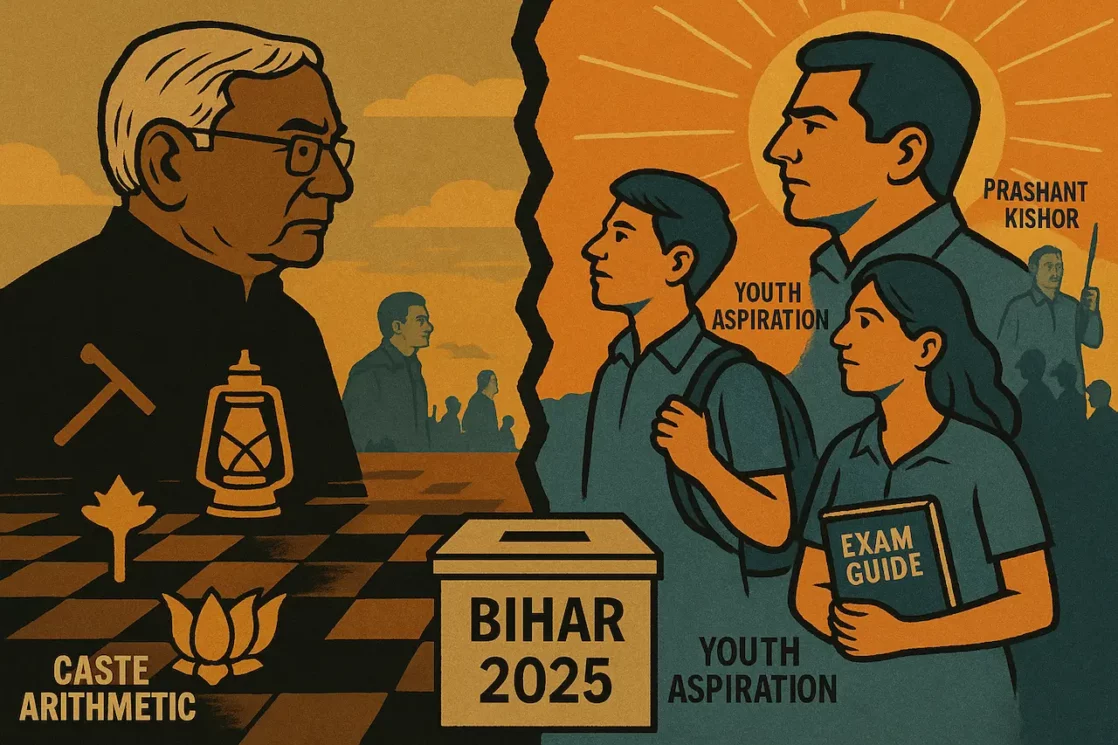
Bihar, once again, stands at the cusp of an election that will determine not only the balance of power in Patna but also the trajectory of its society, where the twin forces of caste arithmetic and youth aspiration are clashing in unpredictable ways. The 2025 assembly election is not a routine contest; it is a referendum on nearly two decades of Nitish Kumar’s rule, a test of Tejashwi Yadav’s credibility as a leader beyond the shadow of his father, and an experiment with Prashant Kishor’s attempt to script a new grammar of politics.
The National Democratic Alliance (NDA), comprising the Bharatiya Janata Party (BJP), Janata Dal (United) [JD(U)], and smaller partners like HAM and VIP, enters the contest with an apparent advantage. Opinion polls have placed the NDA at nearly 49% support compared to the Mahagathbandhan’s 36%. On paper, this looks like a comfortable margin. Yet, beneath these numbers lies a deep undercurrent of anti-incumbency against Nitish Kumar, who has been at the helm in one form or another since 2005. Voters, particularly the younger generation, express frustration with unemployment, lack of industrial growth, and the stagnation of governance. But dissatisfaction with Nitish does not automatically translate into a groundswell for Tejashwi Yadav, for the shadow of the “jungle raj” era continues to haunt the Rashtriya Janata Dal (RJD).
To understand Bihar’s present, one must return to its past. The state’s political story since the early 1990s has been shaped by two broad waves: the Mandal wave, which empowered backward classes under Lalu Prasad Yadav, and the counter-wave of governance politics, which propelled Nitish Kumar. Lalu’s rise in 1990 symbolized the triumph of social justice; he broke the monopoly of upper castes, particularly Rajputs and Bhumihars, who had dominated Bihar’s politics since independence. His politics of MY (Muslim-Yadav) consolidation ensured electoral success for nearly fifteen years, but it also bred resentment among non-Yadav OBCs, Dalits, and upper castes who felt excluded. The RJD era was marked by frequent law-and-order breakdowns, especially crimes against women and extortion, which earned it the pejorative tag of “jungle raj.”
Nitish Kumar, once Lalu’s colleague in the Janata Dal, crafted his politics in direct response to this excess. Aligning with the BJP, he projected himself as the face of “sushasan” (good governance). Roads, electricity, schools, and law enforcement improved under his leadership, restoring some measure of state capacity. His deft social engineering—wooing Mahadalits, Extremely Backward Classes (EBCs), and Kurmis/Koeris—helped him build a durable base. Nitish’s survival instinct was legendary: he aligned with BJP, broke away to ally with RJD and Congress, and then returned to the BJP fold. Each time, he managed to justify the move as pragmatic, if not entirely principled.
But by 2025, Nitish Kumar is no longer the “sushasan babu” of the mid-2000s. The sheen has worn off, and he is seen as a weary survivor rather than a transformative leader. Anti-incumbency is visible in conversations across Bihar’s towns and villages. Young voters, who form a large share of the electorate, complain about unemployment and mass migration. Yet when asked if they will vote for RJD, the hesitation is palpable. “Nitish se thak gaye hain, lekin jungle raj phir se laayenge kya?” (We are tired of Nitish, but do we want a return to jungle raj?) is a refrain heard repeatedly.
This ambivalence defines the 2025 election. The Mahagathbandhan, led by Tejashwi Yadav, has energy but not enough credibility. Tejashwi, undeniably more charismatic than Nitish, has positioned himself as the voice of the youth, promising 10 lakh government jobs in past elections and now amplifying that agenda with promises of social justice. He has matured as a politician, focusing less on fiery rhetoric and more on pragmatic issues. Among young voters, particularly first-time voters, Tejashwi enjoys strong popularity. But the RJD’s structural weakness lies in its caste base. It remains, above all, a party of Yadavs and Muslims. This MY axis, while significant, is insufficient for a majority in a state as fragmented as Bihar. Non-Yadav OBCs, scarred by memories of RJD’s dominance in the 1990s, continue to distrust the party. Dalits, particularly those mobilized as Mahadalits by Nitish, remain wary. And Muslims, though sympathetic, have shown signs of drifting—choosing AIMIM in Seemanchal or even tactically voting elsewhere when RJD denied them adequate representation.
Tejashwi’s challenge is to break out of the MY ghetto. Unless he can persuade non-Yadav OBCs and Dalits that the RJD today is different from Lalu’s RJD, his appeal will remain capped. This is easier said than done, for within the RJD organization, Yadav leaders dominate ticket distribution and decision-making. The caste supremacy instinct is strong, and it alienates others.
Meanwhile, the Congress, once a formidable force in Bihar, is now a pale shadow of itself. Its presence in the Mahagathbandhan is largely ornamental, aimed at keeping the national opposition alliance (INDI) intact. In truth, the Congress has neither organization nor cadre strength in Bihar. It contests out of habit and nostalgia rather than genuine capacity. For Tejashwi, accommodating Congress is more a compulsion than a strategy.
The wild card is Prashant Kishor. A master strategist for others, Kishor is now testing his own electoral appeal through the Jan Suraaj Party. Contesting all 243 seats, he positions himself as an alternative to the entrenched political class. His message—clean politics, development, people’s participation—resonates with Bihar’s aspirational class, particularly urban youth and sections of the middle class. Yet Bihar is not an easy state for outsiders. Politics here is not merely about ideas but about caste anchors. Kishor, despite his outreach yatras, lacks a fixed caste base. His strength lies in his credibility and ability to disrupt. Even if Jan Suraaj wins only 5–10 seats, the party’s performance could alter margins in dozens of constituencies, especially in areas where contests between NDA and RJD are tight. Kishor’s entry is therefore less about forming government and more about reshaping the conversation.
Caste arithmetic remains the central determinant. The upper castes, about 10% of the electorate, are firmly aligned with BJP-JD(U), largely because they fear a return of Yadav dominance. Yadavs, nearly 14% of the population, are solidly with RJD. Muslims, 16–17%, remain RJD’s allies but with growing doubts. Non-Yadav OBCs—Kurmis, Koeris, and EBCs—make up a massive 30–35%, and they hold the key. These groups, feeling marginalized during Lalu’s time, migrated to Nitish, who offered them recognition and representation. Dalits, around 16%, are divided, with Paswans gravitating towards LJP splinters but often swinging with alliances.
It is this fragmentation that has allowed Nitish Kumar to remain relevant. He is not as popular as Tejashwi, nor as organizationally strong as BJP. But when Nitish allies with BJP, their combined arithmetic covers most bases: upper castes, non-Yadav OBCs, Dalits, and a share of EBCs. The RJD, by contrast, is too dependent on Yadav-Muslim support, which caps its ceiling.
In terms of likely outcomes, the NDA appears set to secure around 130–150 seats, the Mahagathbandhan 90–100, and Jan Suraaj perhaps 5–10. The BJP is likely to outshine JD(U) within the NDA, shifting the power balance. This could create future friction, as BJP would seek to assert itself as the dominant partner, reducing Nitish to a junior ally. But in the immediate term, the NDA’s combination remains more formidable than the opposition.
For Tejashwi Yadav, the election will be a test of reinvention. If he can expand RJD beyond the MY axis and present himself as a leader of all backward and marginalized communities, he could position himself as Bihar’s long-term future. If not, he risks being remembered as a popular but limited challenger. For Prashant Kishor, the election is less about seats and more about establishing credibility. If he emerges with even a modest presence, he could become a serious force in future cycles.
The Congress, meanwhile, drifts further into irrelevance. Its decline in Bihar mirrors its national decline—once central, now peripheral. Even threats of going alone no longer unsettle allies.
Ultimately, the 2025 Bihar election reflects the paradox of the state. Caste remains the grammar of politics, but aspiration is the growing prose. Nitish Kumar’s survival shows the resilience of arithmetic, while Tejashwi’s popularity shows the hunger for change. Kishor’s entry reflects the desire for a politics beyond caste, though it is unclear if Bihar is ready for it. The likely outcome is continuity—an NDA victory, BJP stronger, JD(U) weaker, RJD frustrated, Congress irrelevant, and Jan Suraaj disruptive but embryonic. Yet beneath that continuity lies churn, for Bihar’s young voters are restless. The day they decisively break caste barriers, Bihar’s politics will truly change. Until then, the state will remain locked in its unfinished battle between arithmetic and aspiration.
