Uttarakhand Becomes First Indian State to Enforce Uniform Civil Code 2
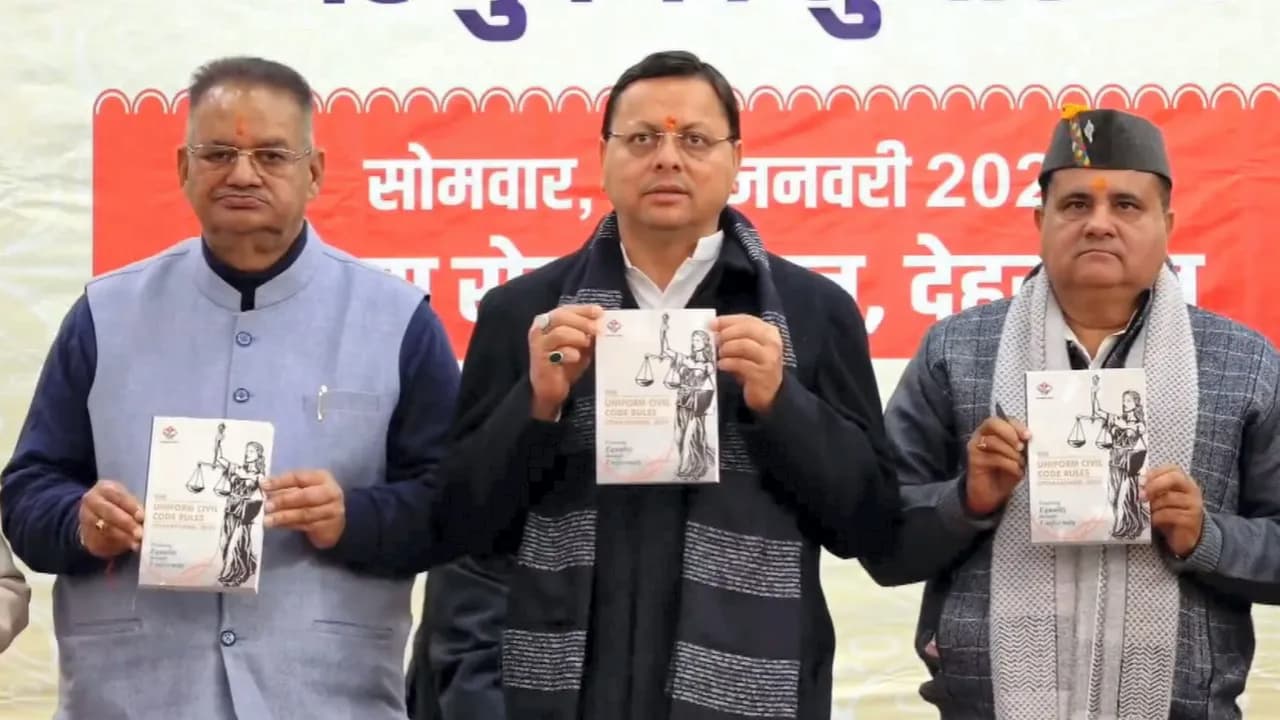
In a historic move, Uttarakhand on Monday became the first state in India to implement the Uniform Civil Code (UCC), fulfilling a key promise made by the ruling BJP during the 2022 Assembly elections. The landmark step aims to establish a single set of laws for all citizens, irrespective of religion, as envisioned in Article 44 of the Constitution.
Chief Minister Pushkar Singh Dhami unveiled the UCC notification, released the rules for its implementation, and launched a dedicated portal for mandatory online registration of marriages, divorces, and live-in relationships. The event, held at the “Mukhya Sevak Sadan,” the CM’s official residence, was attended by ministers and senior officials.
Speaking at the occasion, CM Dhami hailed the UCC as a tool to end discriminatory practices against women across all religions. “The implementation of the UCC is a historic moment for Uttarakhand and the entire nation. It stands as a testament to the people’s mandate and their faith in the vision of equality,” Dhami stated.
The UCC, modeled on the constitutional principle of equal laws for all, was a central promise in the BJP’s campaign leading to the 2022 polls. The BJP’s re-election marked the first time a party retained power consecutively in the state since its formation in 2000. Dhami credited the resounding mandate to the party’s commitment to implementing the UCC.
Immediately after taking office in March 2022, Dhami’s government approved the formation of an expert committee to draft the UCC. Chaired by retired Supreme Court Judge Ranjana Prakash Desai, the committee conducted extensive consultations with various stakeholders before submitting a comprehensive draft on February 2, 2024. The state legislature passed the legislation on February 7, 2024, and it received presidential assent in March, paving the way for its enforcement.
Another committee, led by former chief secretary Shatrughan Singh, was tasked with framing the rules and regulations for implementation. After receiving the committee’s report late last year, the state cabinet recently approved it, authorizing the chief minister to decide the date of enforcement.
With the UCC now officially in force, Uttarakhand has set a precedent that could reignite the national debate on its adoption across the country.
Uttarakhand: Gun-Waving Chaos: MLA and Ex-MLA Clash in Roorkee Over Rivalry 4
A long-standing feud between former BJP MLA Kunwar Pranav Singh Champion from Laksar and Independent MLA Umesh Kumar from Khanpur spiralled into chaos on Sunday as both leaders, accompanied by their supporters, allegedly attacked each other’s offices in Roorkee. The incident saw them waving pistols and hurling abuses, escalating tensions to a dangerous level.
Haridwar SSP Pramendra Singh Doval confirmed that both politicians were taken into custody after complaints were filed by each side. Champion was detained at the Ranipur police station, while Kumar was held at the Roorkee police station. Doval also announced plans to recommend the cancellation of their firearm licenses and a review of the security provided to them, emphasising, “No one can be allowed to take the law into their own hands.”
Champion was picked up from his residence in Dehradun after the incident and transported to Haridwar. A viral video captured him speaking to reporters from a police van, claiming that his actions were a response to Kumar’s alleged attack on his Landhaura mansion the previous night. “This is injustice. I will fight against it,” he asserted.
Champion’s wife, Devyani Singh, backed his claims, stating that they had reported Kumar’s alleged attack to the police on Saturday night but received no action. She defended her husband’s response as necessary to “protect their honour.”
The violence escalated on Sunday evening when Champion, along with his supporters, stormed Kumar’s Roorkee office and fired multiple rounds into the air. Upon learning of the incident, Kumar retaliated by marching to Champion’s office with his own group of supporters, allegedly brandishing a pistol and shouting threats.
Kumar accused Champion of using offensive language about his parents on social media, which he claimed provoked him to confront Champion at his Landhaura residence on Saturday night. Videos of both incidents have gone viral, further fuelling the controversy.
The police are investigating the matter as the shocking public showdown between the two political rivals continues to make headlines, raising questions about the conduct and accountability of public representatives.
The Waqf (Amendment) Bill, 2024, has ignited intense debate, with members of a parliamentary panel suggesting a staggering 572 amendments to the proposed legislation. The Joint Committee on the Waqf Amendment Bill, chaired by BJP leader Jagdambika Pal, circulated the consolidated list of amendments late Sunday as discussions reached a critical stage.
The committee is set to review the clause-by-clause amendments during its Monday meeting. Notably, the amendments have been submitted by members of both the BJP and the opposition, while BJP allies are absent from the list of contributors.
Introduced in the Lok Sabha on August 8 by Union Minority Affairs Minister Kiren Rijiju, the bill seeks to amend the Waqf Act of 1995 to address challenges in the regulation and management of Waqf properties. However, the proposed changes have created a rift between the government and the opposition, intensifying the legislative tussle.
As the panel enters the final phase of its deliberations, the high number of amendments underscores the contentious nature of the bill, which remains a flashpoint in Parliament.
BJP Sweeps Urban Local Body Polls in Uttarakhand, Wins 10 of 11 Mayoral Seats 8
The BJP on Sunday swept the urban local body elections in Uttarakhand, winning 10 out of 11 mayoral seats to emerge as the dominant party in the municipal councils and nagar panchayats.
While the BJP won 10 mayoral seats, an Independent candidate bagged the remaining seat, State Election Commissioner Sushil Kumar told the news agency.
However, the counting which began on Saturday is still underway and the results of all the 100 urban local bodies which went to the polls on January 23 are likely to be out by late afternoon, Kumar said.
Polling to 11 municipal corporations, 43 municipal councils, and 46 nagar panchayats was held by ballot on Thursday with 65.4 per cent of voters exercising their franchise.
A total of 5,405 candidates, including 72 running for 11 mayoral posts, 445 for municipal council chairperson and 4,888 for municipal councillors and members, were in the fray.
The mayoral seats won by the BJP included Dehradun (Saurabh Thapliyal), Rishikesh (Shambhu Paswan), Kashipur (Dipak Bali), Haridwar (Kiran Jaisdal), Roorkee (Anita Devi), Kotdwar (Shailendra Rawat), Rudrapur (Vikas Sharma), Almora (Ajay Verma), Pithoragarh (Kalpana Devlal), and Haldwani (Gajraj Bisht).
Arti Bhandari , an Independent nominee, won the Srinagar mayoral seat in Pauri district, Kumar said.
Congress, which won two mayoral seats in the last urban local body polls held in 2018, drew a blank this time.
In municipal councils too, it finished third behind the BJP and independents.
In the run-up to the urban local body polls, the BJP had sought votes in the name of a triple-engine government to keep the pace of development “uninterrupted” in the state.
As the results showed a BJP sweep, Chief Minister Pushkar Singh Dhami congratulated the winning party candidates and asked them to speed up development works in their respective areas.
“Heartiest congratulations to all the winning candidates of BJP. People have elected capable public representatives. Now it is the job of all the elected representatives to speed up development in their respective areas and strengthen the system.
“Our aim is to implement the concept of clean and green city on the ground through municipal bodies so that tourists coming to the state from across the country and abroad return with positive and inspiring experiences,” Dhami said after unfurling the Tricolour at the state BJP office here to mark the 76th Republic Day.
He also thanked the state election commission for holding the polls peacefully.
Uttarakhand BJP chief Mahendra Bhatt termed the poll verdict another stamp of approval by the people on the policies and programmes of the BJP governments in the state and at the Centre.
“The verdict is a trailer of BJP’s third consecutive victory in the assembly polls due in 2027,” he said.
India's Military Prowess Takes Centre Stage at 76th Republic Day Parade 10
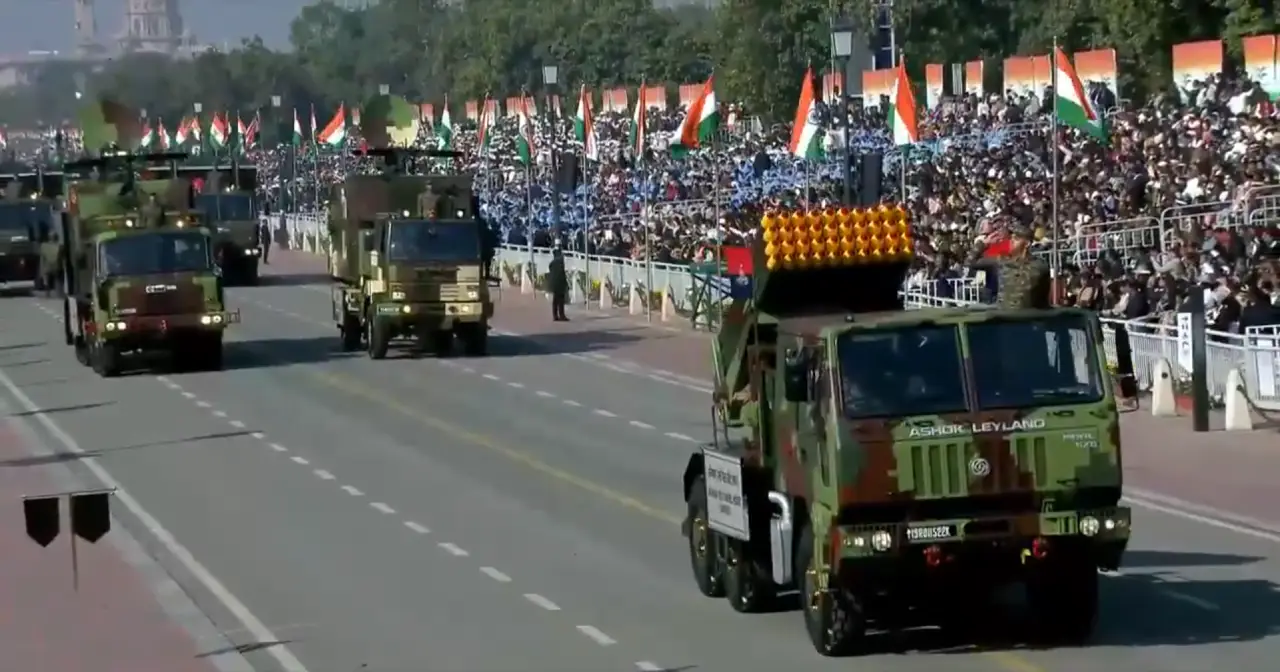
India celebrated its 76th Republic Day on Sunday with a grand display of its military might that included elite marching contingents, missiles and various indigenous weapon systems, with Indonesian President Prabowo Subianto gracing the occasion as the chief guest.
In a first, a tri-services tableau, depicting the broader spirit of “jointness” among the armed forces, rolled down Kartavya Path, the centrepiece boulevard of the national capital.
It displayed a battlefield scenario, demonstrating a synchronised operation in land, water and air with the indigenous Arjun battle tank, Tejas fighter aircraft and advanced light helicopter.
The theme of the tri-services tableau was “Shashakt aur Surakshit Bharat” (strong and secure India).
The parade commenced with President Droupadi Murmu taking the salute shortly after she and Subianto, flanked by the Indian president’s bodyguards, arrived at Kartavya Path in a “traditional buggy”.
Prime Minister Narendra Modi, Defence Minister Rajnath Singh, several other Union ministers, the country’s top military brass, foreign diplomats and senior officials were among the spectators on both sides of Kartavya Path.
The first Army contingent leading the mounted column was 61 Cavalry, led by Lieutenant Ahaan Kumar.
Raised in 1953, 61 Cavalry is the only serving active horsed cavalry regiment in the world. It was followed by nine mechanised columns and nine marching contingents.
Tank T-90 Bhishma, the NAG missile systems, the BrahMos supersonic cruise missile, the Pinaka multi-launcher rocket system, the Agnibaan multi-barrel rocket launcher, the Akash weapon system, the integrated battlefield surveillance system and all-terrain vehicle (Chetak) were among the key displays by the mechanised columns.
Light specialist vehicle Bajrang, vehicle-mounted infantry mortar system Airawat, quick reaction force vehicles Nandighosh and Tripurantak and the short-span bridging system were also on display.
The Army’s marching contingents included the Brigade of the Guards, the Jat Regiment, the Garhwal Rifles, the Mahar Regiment, the Jammu and Kashmir Rifles Regiment and the Corps of Signals.
The Indian Navy’s contingent consisted of 144 personnel led by Lieutenant Commander Sahil Ahluwalia as the contingent commander and Lt Commander Indresh Choudhary, Lt Commander Kajal Anil Bharani and Lt Devender as platoon commanders.
It was followed by the Naval tableau, depicting a strong “Aatmanirbhar” (self-reliant) Navy capable of protecting India’s maritime interests.
The tableau showcased the newly-commissioned indigenous frontline state-of-the-art combatants, including destroyer INS Surat, frigate INS Nilgiri and submarine INS Vaghsheer, highlighting India’s rapid progress in indigenous warship design and construction.
The tableau showcased the Indian Navy’s commitment to build a robust and self-sufficient defence ecosystem.
The Indian Air Force’s (IAF) contingent comprised four officers and 144 personnel, led by Squadron Leader Mahender Singh Garati. It was followed by a fly-past by three MiG-29 aircraft in “Baaz formation”.
Another highlight of the parade was the veterans’ tableau on the theme “Viksit Bharat ki Ore Sadaiv Agrasar”, a heartfelt tribute to the unwavering spirit of the ex-servicemen towards the nation.
Several veterans who brought glory to India in sports were also part of the parade.
In its tableau, the Defence Research and Development Organisation (DRDO) displayed many home-grown critical systems and technologies developed by it.
The DRDO tableau, with the theme “Raksha Kavach – Multi-layer Protection against Multi-domain Threats”, featured quick reaction surface-to-air missile, airborne early warning and control system, 155 mm/52-calibre advanced towed artillery gun system and drone detect, deter and destroy system.
It also showcased a satellite-based surveillance system, medium-power radar Arudhra, advanced lightweight torpedo, electronic warfare system Dharashakti, laser-based directed energy weapon, very-short-range air defence system and unmanned aerial system.
It was for the first time that the indigenously-developed Pralay missile system was showcased.
A 352-member marching and band contingent from Indonesia also participated in the Republic-Day parade. This was the first time that an Indonesian marching and band contingent participated in a national-day parade abroad.
Among the contingents marching down Kartavya Path were a 148-member all-women marching contingent of the Central Reserve Police Force (CRPF), led by Assistant Commandant Aishwarya Joy M.
The Assam Rifles contingent was led by Captain Karanveer Singh Kumbhavat of 29 Assam Rifles. It comprised soldiers recruited from all over the country.
The Camel contingent of the Border Security Force (BSF) was under the command of Deputy Commandant Manohar Singh Kheechee.
The all-girls marching contingent of the National Cadet Corps (NCC) was led by Senior Under Officer Ekta Kumari of the Jammu Kashmir and Ladakh Directorate.
The all-boys marching contingent was led by Senior Under Officer Prasad Prakash Waikul of the Maharashtra Directorate.
The National Service Scheme’s (NSS) marching contingent of 148 volunteers was led by Deepak from Punjab.
Five Bangladeshi Nationals Arrested in Thane for Illegal Stay Amid Immigration Crackdown 12
In a crackdown on illegal immigrants, Maharashtra police arrested five Bangladeshi nationals for residing in the country without proper documentation in Thane district, officials confirmed on Saturday.
Raids conducted on Thursday in Kalyan and Dombivli towns led to the arrests of four women and one man, who were engaged in petty jobs in the area, Deputy Commissioner of Police (Zone III) Atul Zende said.
The accused were found living in a slum colony in Gandhi Nagar and near the Kalyan railway station. When questioned, they failed to produce any valid documents justifying their entry or stay in India.
The individuals have been booked under the Foreign Nationals Act, Indian Passport Act, and Passport (Entry into India) Act. Authorities are now investigating how the accused managed to enter and remain in the country undetected.
The arrests come amidst heightened scrutiny over illegal immigration in Maharashtra, following recent allegations of fraudulent documentation and an increase in delayed birth certificate registrations linked to illegal migrants.
Maharashtra Govt Launches SIT Probe into Delayed Birth, Death Certificates Amid Illegal Immigration Concerns 14
In a bid to curb illegal immigration, the Maharashtra government has established a Special Investigation Team (SIT) to investigate the issuance of birth and death certificates based on delayed applications, an official from the Chief Minister’s Office (CMO) said on Saturday.
The SIT, led by Inspector General Datta Karale, will scrutinise applications filed at least a year after the birth or death of an individual. This move comes amid growing concerns over the infiltration of Bangladeshi immigrants into Maharashtra.
The urgency for such an investigation intensified after the arrest of Shariful Islam Shehzad Mohammad Rohilla Amin Fakir, a 30-year-old Bangladeshi national, in connection with a knife attack on actor Saif Ali Khan in Mumbai.
Revenue Minister Chandrashekhar Bawankule confirmed the probe, stating that it will cover both previously issued certificates and pending applications. The investigation follows allegations of a widespread birth certificate scam raised by BJP leader Kirit Somaiya.
Somaiya claimed that 269 delayed birth registration orders were issued by the magistrate court in Akola City between January 2021 and December 2023, but the tehsildar approved 4,849 delayed birth registrations. He further alleged that 11,864 delayed applications were filed in Yavatmal, 15,845 in Akola, and 4,350 in Nagpur districts during the same period.
According to Somaiya, nearly two lakh Bangladeshi Rohingyas have applied for birth certificates in Maharashtra. He also highlighted the suspension of a tehsildar in Malegaon linked to these irregularities.
The SIT’s findings are expected to shed light on the scale of the issue and determine whether these delayed registrations are being exploited to aid illegal immigrants in obtaining official documentation.
Federal Judge Blocks Trump's Order Redefining Birthright Citizenship, Calls It 'Blatantly Unconstitutional' 16
A federal judge temporarily blocked former President Donald Trump’s controversial executive order seeking to deny U.S. citizenship to children born to undocumented immigrants, calling the measure “blatantly unconstitutional.” The ruling came during the first hearing in a multi-state legal challenge to the order.
The executive order, issued shortly after Trump’s second-term inauguration, aimed to deny citizenship to children born after February 19 whose parents are in the country illegally. It also prohibited federal agencies from issuing or accepting documents recognising citizenship for these children.
Citing the 14th Amendment, which guarantees citizenship to all individuals born on U.S. soil, U.S. District Judge John Coughenour issued a temporary 14-day restraining order, halting the administration’s plans. “This is as clear-cut a constitutional violation as I’ve seen in over four decades on the bench,” said Coughenour, an appointee of President Ronald Reagan.
The case, filed by 22 states and immigrant rights groups, was spearheaded by Washington, Oregon, Arizona, and Illinois. The states argued that Trump’s order was an affront to constitutional protections and would cause immediate and irreparable harm to families and state systems.
Assistant Attorney General Lane Polozola, representing the states, lambasted the order as “absurd,” highlighting that undocumented immigrants are still subject to U.S. laws and jurisdiction. Polozola argued that the executive order would force states to spend millions restructuring healthcare and benefits systems to accommodate its demands, impacting hundreds of thousands of individuals.
The Department of Justice, defending Trump’s order, claimed it “correctly interprets the 14th Amendment” and vowed to vigorously defend the policy. DOJ attorney Brett Shumate asserted that the arguments supporting the order were unprecedented but valid, despite the judge’s skepticism.
Trump’s executive order also reignited debate over the legal interpretation of the Citizenship Clause of the 14th Amendment. Historically, the clause was ratified in 1868 to ensure citizenship for former slaves and their descendants. However, Trump’s order contended that children of undocumented immigrants are not “subject to the jurisdiction” of the United States, a claim opponents deemed baseless.
Washington Attorney General Nick Brown criticized the order as an attack on fundamental constitutional principles, likening it to the dark legacy of the Dred Scott decision, which denied citizenship to African Americans. “The law is clear—if you are born on American soil, you are an American citizen. This principle has stood for generations, and no executive order can erase it,” Brown said.
Legal experts also pointed to the landmark 1898 Supreme Court case United States v. Wong Kim Ark, which affirmed the citizenship of a man born in San Francisco to Chinese immigrants under the 14th Amendment, despite restrictive immigration laws of the time.
Trump’s latest move sparked outrage among immigrant rights advocates and personal reflections from attorneys general like Connecticut’s William Tong, who emphasized the deeply personal impact of birthright citizenship on immigrant families. “There is no legitimate legal debate here. Trump is wrong, and his order threatens American families like my own,” Tong said.
The next hearing on the case is scheduled for February 6, where the court will decide whether to extend the restraining order as the case proceeds. Meanwhile, the political and legal battle over birthright citizenship continues to divide the nation.
MP Government Shuts Liquor Shops in 17 Holy Towns: CM Mohan Yadav Announces 18
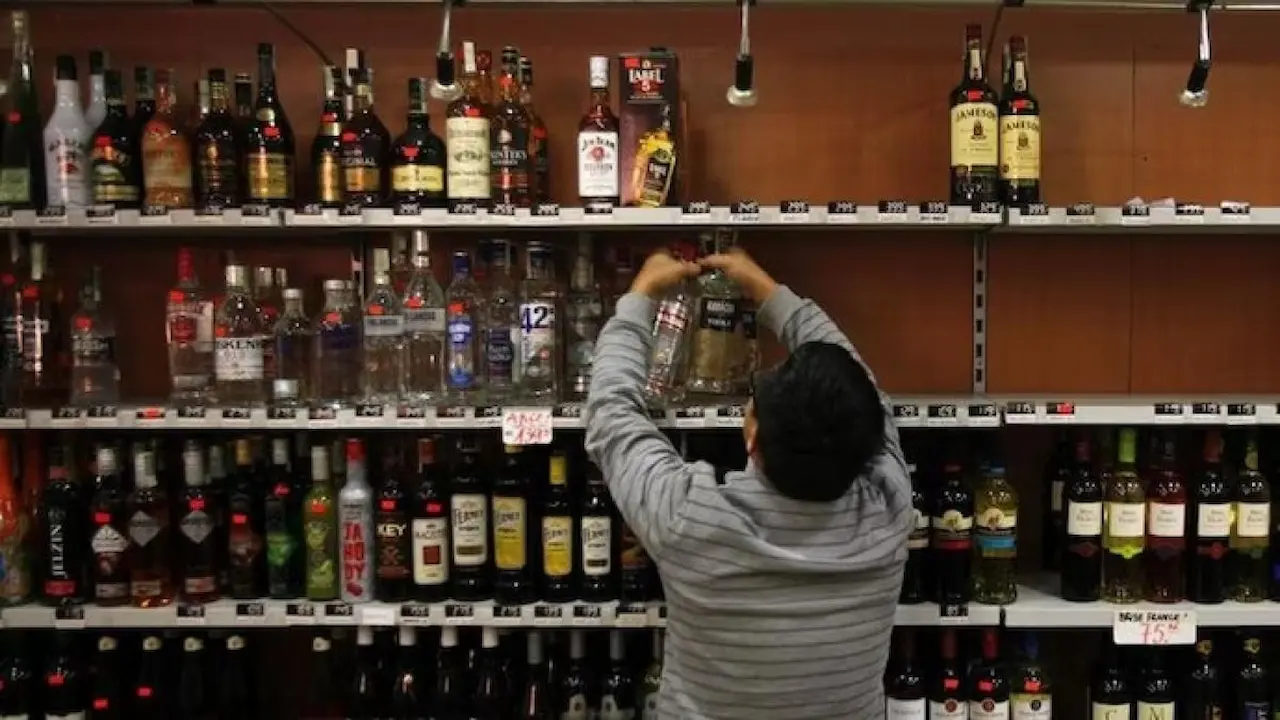
In a significant move, the Madhya Pradesh government has decided to shut down liquor shops in 17 holy towns across the state. Chief Minister Mohan Yadav announced the decision following a cabinet meeting held on Friday in Khargone.
The initiative is being touted as the first step toward eradicating alcohol consumption in the state. “Liquor shops in these towns will not be relocated—they will be permanently shut. This includes a complete ban on liquor vends within Ujjain Municipal Corporation limits,” Yadav told reporters.
The 17 designated areas include one municipal corporation, six municipalities (nagar palikas), six urban councils (nagar parishads), and six village panchayats. Among the affected towns are Datia, Panna, Mandla, Multai, Mandsaur, Maihar, Omkareshwar, Maheshwar, Mandleshwar, Orchha, Chitrakoot, and Amarkantak. The village panchayats impacted include Salkanpur, Barman Kala, Linga, Kundalpur, Bandakpur, and Barmankhurd.
Yadav also confirmed that the existing liquor ban within a 5-kilometer radius of the Narmada River will remain in force. The move aligns with the state’s broader efforts to curb alcohol consumption and promote a healthier social environment.
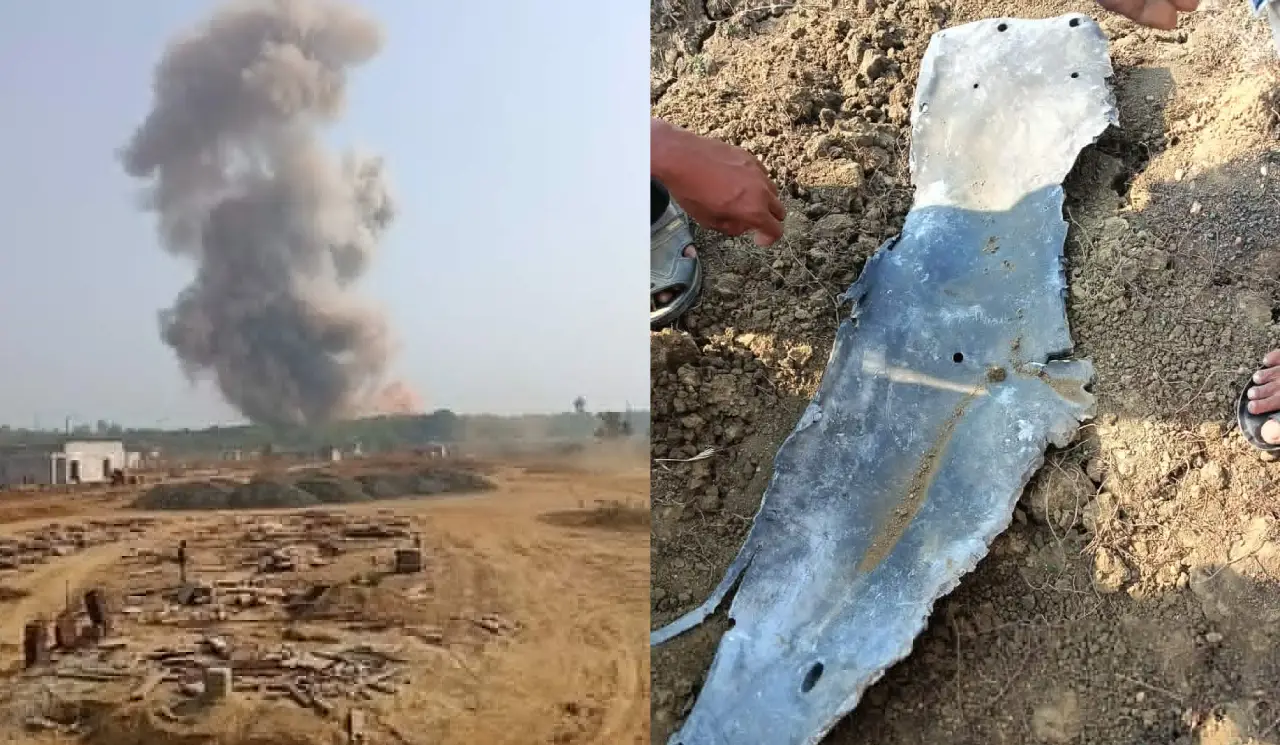
A tragic explosion at the ordnance factory in Maharashtra’s Bhandara district claimed the lives of eight people on Friday, Union Minister Nitin Gadkari confirmed. Preliminary reports also indicate that seven individuals sustained injuries in the blast.
The explosion occurred in the LTP section of the factory located in the Jawahar Nagar area around 10:30 am, causing the roof of the unit to collapse. Search and rescue operations are ongoing at the site, according to officials.
District Collector Sanjay Kolte reported that 13 to 14 workers were inside the unit at the time of the incident. Six individuals were rescued, one of whom succumbed to injuries, while the others are receiving medical treatment.
Earlier, Chief Minister Devendra Fadnavis had stated that efforts were underway to save the trapped workers. The incident has raised serious concerns about safety measures in such high-risk facilities.