


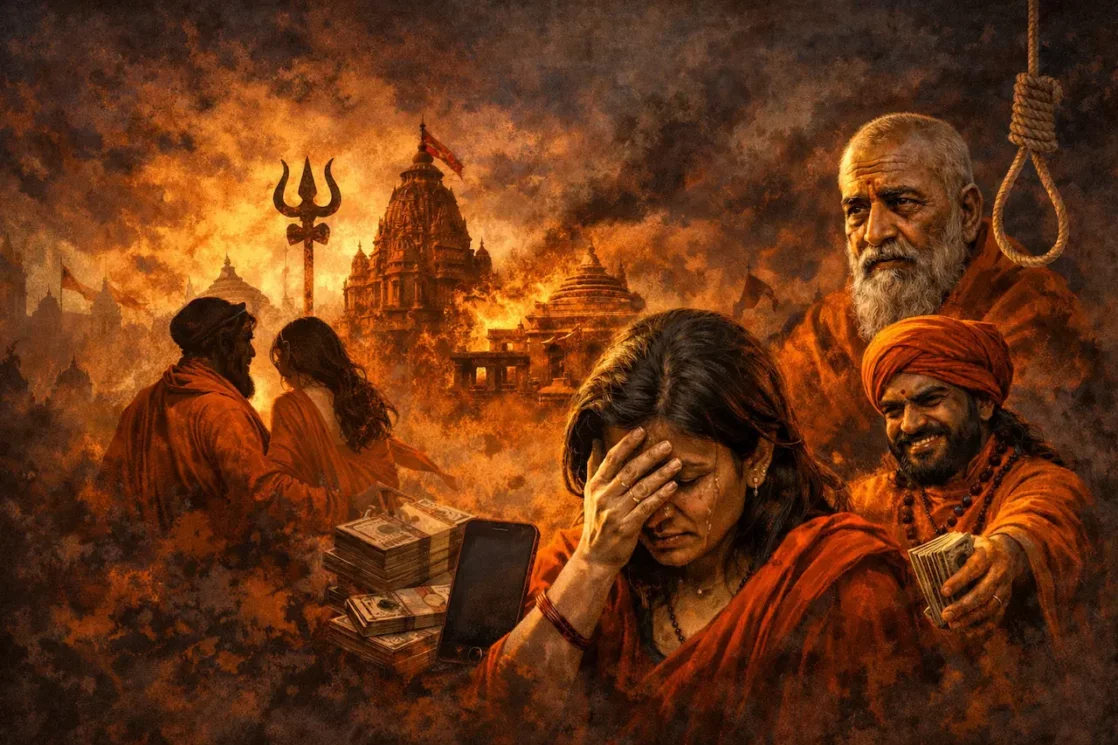
This is not merely an isolated incident; it is a stark reflection of a moral decay we have long chosen to ignore under the comforting label of “faith.” When wrongdoing thrives under the cover of religion and society chooses silence despite recognizing it, the problem ceases to belong to individuals—it becomes systemic. The case of Mamta Joshi, alias Mandakini, is not just disturbing; it is a brutal exposure of a rotting structure that has gone unquestioned for far too long.
There was a time when renunciation was not a title but a lifelong discipline. To be accepted into the fold of saints required years of surrender, rigorous training under a Guru, and a complete conquest over ego, desire, and greed. Today, that sacred pathway appears dangerously diluted. A woman who began by cooking at religious gatherings gradually entered the inner circles of ascetics through manipulation, false claims, and calculated proximity. Eventually, during the Ujjain Simhastha, she rose to the rank of Mahamandaleshwar—an elevation that once demanded spiritual merit, now seemingly granted without adequate scrutiny. This is not merely an individual’s cunning; it is a collapse of institutional vigilance.
But the real horror lies deeper. Allegations suggest that a woman was lured under the pretext of spiritual guidance, secretly filmed in compromising conditions, and then blackmailed using those recordings. She was allegedly coerced into falsely accusing a saint of rape. This is not just immorality—it is a calculated criminal enterprise masquerading as religion. Here, devotion has been replaced by intimidation, and spirituality by manipulation. Faith has become a currency, traded in fear, greed, and control.
And let us not pretend this is unprecedented. Over the past decade, numerous controversies have surfaced—cases of sexual exploitation within ashrams, financial fraud under the guise of donations, and power struggles disguised as spiritual hierarchy. The pattern is painfully consistent: build trust, exploit it, and when exposed, dismiss it all as a conspiracy against religion. But how long can this defense hold? Is every accusation a conspiracy? Is every victim lying? If so, where does truth reside?
The most tragic consequence of such scandals is borne by women. They are first drawn in through faith and trust, then exploited, and finally discarded—often with their dignity shattered beyond repair. When they dare to resist or speak out, society frequently turns against them, questioning their character rather than the actions of the accused. It is a double injustice—first the violation, then the vilification.
Is this the ethos Sanatan Dharma claims to uphold? A civilization that reveres women as embodiments of Shakti—how does it reconcile such repeated indignities within its own spiritual institutions? If a woman cannot feel safe within the very spaces that preach purity and protection, then what moral authority remains?
An even more uncomfortable question arises—does the saintly order still possess any mechanism of self-purification? Who ensures that those donning saffron truly embody renunciation and not ambition? When positions can allegedly be influenced by money, when ashrams become battlegrounds for control, and when words like blackmail and honeytrap find their way into religious discourse, we are no longer dealing with isolated lapses—we are witnessing systemic erosion.
So how can such individuals claim to safeguard the dignity of Sanatan Dharma? How can those who lack personal integrity guide a society seeking moral direction? If saffron robes become tools for power rather than symbols of sacrifice, then the very identity of spiritual leadership stands compromised.
Have we, as a society, paused to examine how easily our faith is being manipulated? Or have we chosen convenient silence out of fear that questioning might “damage religion”? But does suppressing truth preserve dignity—or does it accelerate decay? History is clear: institutions are not destroyed by criticism, but by unchecked corruption.
Consider this—when a doctor commits malpractice, we demand accountability from the entire medical system. When a police officer is corrupt, we question the integrity of law enforcement. But when a self-proclaimed saint is accused of grave misconduct, we hesitate even to ask questions. Why? Is religion so fragile that it cannot withstand scrutiny? Or have we become too complacent to defend it honestly?
Sanatan Dharma, by its very nature, is eternal and resilient. Its strength lies in its ability to evolve, to introspect, and to cleanse itself. But that process of self-correction requires courage—the courage to confront uncomfortable truths. If we abandon that courage, we risk allowing decay to masquerade as tradition.
What is needed today is not blind defense, but fearless introspection. The saintly community must take responsibility for cleansing its own ranks. Empty statements and claims of conspiracy will not suffice. Transparency, accountability, and strict adherence to ethical conduct are no longer optional—they are imperative.
Society, too, must awaken. Blind devotion is not faith; it is surrender of intellect. True faith is rooted in awareness, in the ability to question without losing reverence. If followers cannot question their spiritual leaders, then the relationship ceases to be spiritual—it becomes subservient.
Ultimately, this is not just about one scandal or one individual. It is about the direction in which a civilization is heading. Are we moving toward a society where religion becomes a façade behind which anything can be justified? Or will we uphold the core principles that have sustained Sanatan Dharma for millennia—truth, discipline, and righteousness?
Because the truth is simple and unyielding—Sanatan Dharma does not need protection from external forces; it needs protection from those who exploit it from within. And until we recognize this distinction, such scandals will not remain exceptions—they will become the norm.
So the final, uncomfortable question remains: how long will we continue to look away? And if not now, then when will we choose to stand up for the true dignity of Sanatan Dharma?
